South Korea, Taiwan top Japan in exports for first time on AI boom

Beijingwalker

VIP Member
Joined
Nov 4, 2011
Messages
92,820
Reaction score
113,356
Reputation
2,127.4
Country of Origin
Country of Residence

South Korea, Taiwan top Japan in exports for first time on AI boom​

Both economies benefit more from surging demand for semiconductors in 2026 first half

20260807 chip file photo

South Korea's SK Hynix is among the few companies that produce advanced semiconductors. (SK Hynix)

Nikkei staff writers
August 7, 2026 18:01 JST

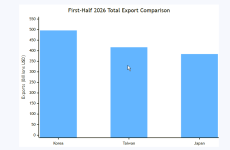
For the first time ever, South Korea and Taiwan both surpassed Japan in exports during the first half of this year, fueled by an artificial intelligence semiconductor boom. South Korea's exports reached $496.3 billion and Taiwan's hit $416.6 billion, exceeding Japan's $384.4 billion. Companies producing finished advanced semiconductors, such as Samsung Electronics, SK Hynix, and TSMC, drove the export surge, while Japan, which holds strengths in equipment and materials, relatively missed out on the explosive demand growth. Analysts suggest this gap is not a temporary phenomenon but reflects a shift in leadership within growth industries in the digital era.

In the first half of this year, South Korea and Taiwan simultaneously surpassed Japan in exports for the first time in history, propelled by a boom in artificial intelligence (AI) semiconductors. The analysis indicates that while South Korea and Taiwan, which produce finished semiconductor products, have emerged as core supply chains in the AI era, Japan, with its strengths in materials and equipment, has relatively missed out on the benefits of explosive demand growth.

An analysis commissioned by the Nikkei from Mitsubishi UFJ Research and Consulting, using trade statistics from South Korea, Japan, and Taiwan, along with databases from the Japan External Trade Organization (JETRO) and the United Nations, showed that South Korea's exports from January to June totaled $496.3 billion (approximately 702.8 trillion won). Taiwan recorded $416.6 billion (approximately 590 trillion won), and Japan posted $384.4 billion (approximately 544 trillion won). Year-on-year growth rates for South Korea and Taiwan each approached 50%, while Japan's increase was limited to about 10%.

搜狗截图20260811111245.png
 
Japs should be ashamed. Looks like their country is doomed.
 
Japan recorded a trade deficit of ¥135.2 billion on a balance of payments basis in June 2026, driven by surging import costs from a weak yen and rising energy prices, even as robust global demand for AI-related semiconductors boosted overall exports.
 
Japan vehicle industry is getting devastated by China globally same as germany
 
Japan vehicle industry is getting devastated by China globally same as germany
They still excel in the AV industry, no one is likely going to touch that, maybe Americans second.
 
They still excel in the AV industry, no one is likely going to touch that, maybe Americans second.
They are just too slow to adapt and adopt which is a cultural weakness. Chinas growth in electronics and vehicles is going to make Japan irrelevant and they know that too.

They can make some anime where luffy and zoro bangs nami but that's about it lol
 
  • Like
Reactions: ety
They are just too slow to adapt and adopt which is a cultural weakness. Chinas growth in electronics and vehicles is going to make Japan irrelevant and they know that too.

They can make some anime where luffy and zoro bangs nami but that's about it lol
I am surprised the Japs are so stubborn clinging to their old habits and practices, so different from their fast to learn and decisive to adopt advanced western tech and systems in the Meiji Restoration that quickly made Jap an industrialized nation while at the same time Qing China pretty much refused to reform. Now, seems like the roles of Jap and China have been reversed. Jap is doomed to become a second or even a third rate country.
 
Last edited:
Jap is doomed to become a second or even a third rate country.
And In population, Vietnam is going to overtake Japan's in no time. Japan will soon fade into oblivion in East Asia's history as it alway did in most part of this region's history.

Vietnam's population in 2026 is approximately 102.2 million people, ranking 16th globally.

Japan's citizen population falls below 120M as annual decline hits record

 
  • Like
Reactions: ety

How Japan Lost Its Economic Dominance in Asia​

June 12, 2026

Japans-Economic-Position-Over-Time_WEB.webp

Key Takeaways​

  • In 1995, Japan’s economy was larger than the rest of Asia, Africa, and Eastern Europe combined.
  • By 2025, the combined economies of four Chinese provincial regions exceeded Japan’s entire GDP.
  • The comparison highlights one of the biggest shifts in global economic power over the last 30 years.
The story of modern Asia can be told through a single economic handoff.

For decades, Japan was the region’s dominant economic power and one of the world’s most influential economies. But while Japan’s growth slowed after the collapse of its asset bubble, China embarked on an expansion that reshaped global trade, manufacturing, and investment.

This graphic compares Japan’s nominal GDP in 1995 and 2025, using two striking snapshots to show how the balance of economic power in Asia has changed. National GDP figures come from the International Monetary Fund’s World Economic Outlook (April 2026), while Chinese provincial data comes from official statistical bulletins.

In 1995, the Soviet Union had just collapsed, and Japan was comfortably the world’s second-largest economy by nominal GDP after the United States.

As the first non-Western country to industrialize, Japan had long been the dominant economic power in its region, aided by postwar rebuilding and high-quality, high-value exports coveted around the world. By 1995, Japan’s economy was larger than the rest of Asia, Africa, and Eastern Europe combined.

This data table lists 1995 nominal GDP for Japan and selected global regions.

搜狗截图20260613110106.png


Japan’s rise was so dramatic that many observers in the 1980s believed it could eventually challenge U.S. economic leadership. Japanese firms dominated industries ranging from consumer electronics to automobiles, while Tokyo became synonymous with corporate and technological excellence.

Washington responded with restrictions on Japanese car and semiconductor exports, as well as the Plaza Accord, which led to a sharp appreciation of the Japanese yen against the U.S. dollar and other currencies. Japan’s policy responses to the Plaza Accord have been cited in part for contributing to the country’s massive asset price bubble of the late 1980s.

Japan’s economy began to sputter after the collapse of the asset price bubble in 1990, and the following decades have often been referred to as the Lost Decades. During this period, Japan’s nominal GDP fell in part because of a weaker yen, real GDP growth slowed to a crawl, and national debt surged.

Meanwhile, across the East China Sea, another Asian giant emerged. Through its reform and opening-up era, China’s economy grew rapidly throughout the early 21st century, averaging at least 7% growth annually and reshaping global supply chains.

Despite having been an impoverished and underdeveloped country for much of the 20th century, China surpassed Japan in nominal GDP in 2010 and became the world’s second-largest economy.

搜狗截图20260613110216.png


Just as Japan once towered over the rest of Asia, China now stands as the region’s dominant economic power.


Users who are viewing this thread

Pakistan Defence Latest

Back
Top