Beijingwalker
VIP Member

South Korea, Taiwan top Japan in exports for first time on AI boom
Both economies benefit more from surging demand for semiconductors in 2026 first half
South Korea's SK Hynix is among the few companies that produce advanced semiconductors. (SK Hynix)
Nikkei staff writers
August 7, 2026 18:01 JST
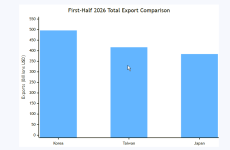
For the first time ever, South Korea and Taiwan both surpassed Japan in exports during the first half of this year, fueled by an artificial intelligence semiconductor boom. South Korea's exports reached $496.3 billion and Taiwan's hit $416.6 billion, exceeding Japan's $384.4 billion. Companies producing finished advanced semiconductors, such as Samsung Electronics, SK Hynix, and TSMC, drove the export surge, while Japan, which holds strengths in equipment and materials, relatively missed out on the explosive demand growth. Analysts suggest this gap is not a temporary phenomenon but reflects a shift in leadership within growth industries in the digital era.
In the first half of this year, South Korea and Taiwan simultaneously surpassed Japan in exports for the first time in history, propelled by a boom in artificial intelligence (AI) semiconductors. The analysis indicates that while South Korea and Taiwan, which produce finished semiconductor products, have emerged as core supply chains in the AI era, Japan, with its strengths in materials and equipment, has relatively missed out on the benefits of explosive demand growth.
An analysis commissioned by the Nikkei from Mitsubishi UFJ Research and Consulting, using trade statistics from South Korea, Japan, and Taiwan, along with databases from the Japan External Trade Organization (JETRO) and the United Nations, showed that South Korea's exports from January to June totaled $496.3 billion (approximately 702.8 trillion won). Taiwan recorded $416.6 billion (approximately 590 trillion won), and Japan posted $384.4 billion (approximately 544 trillion won). Year-on-year growth rates for South Korea and Taiwan each approached 50%, while Japan's increase was limited to about 10%.