China loading more missile punch into its frigate fleet
Type 054B frigate turned into a heavier-hitting workhorse at exactly the moment US is struggling to field a credible counterpart
By
GABRIEL HONRADA
AUGUST 20, 2026
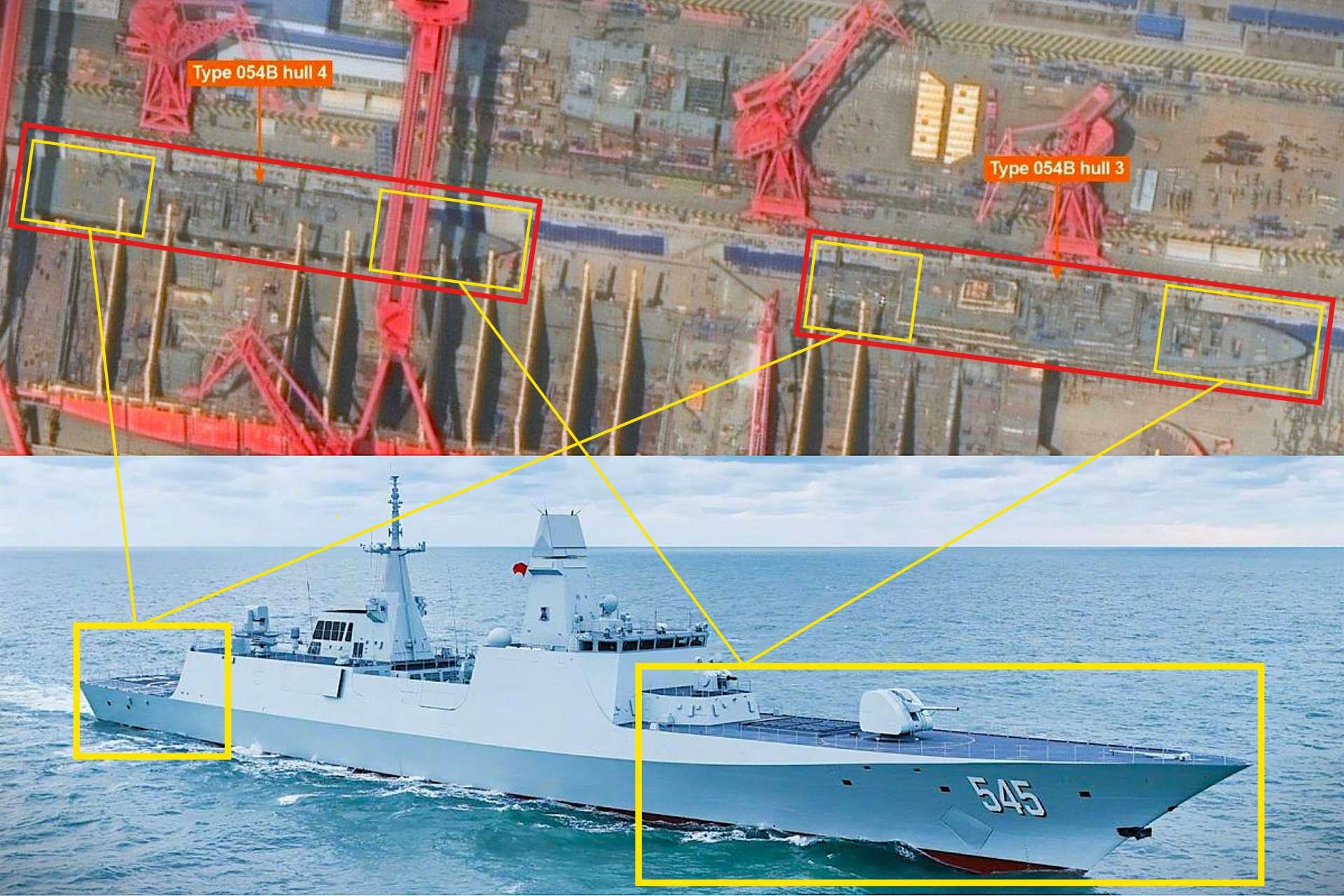
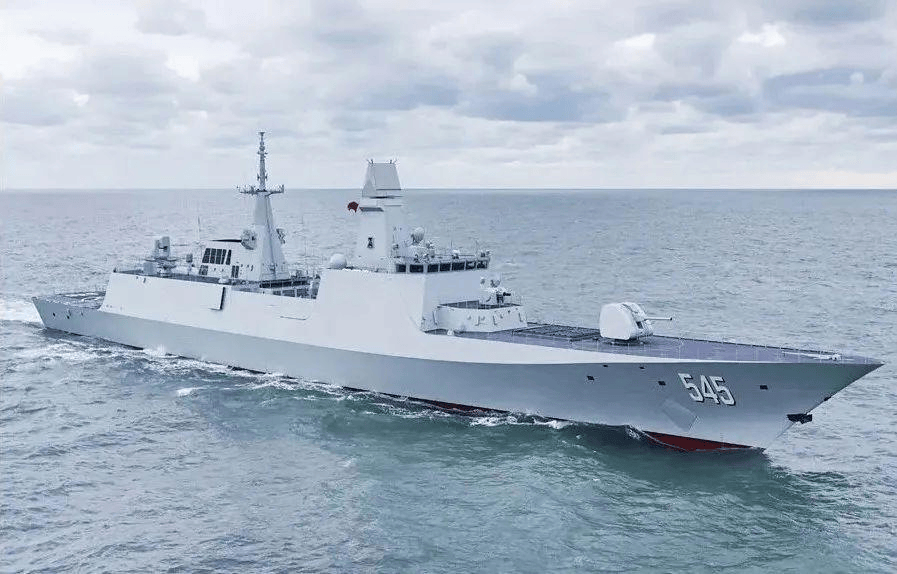
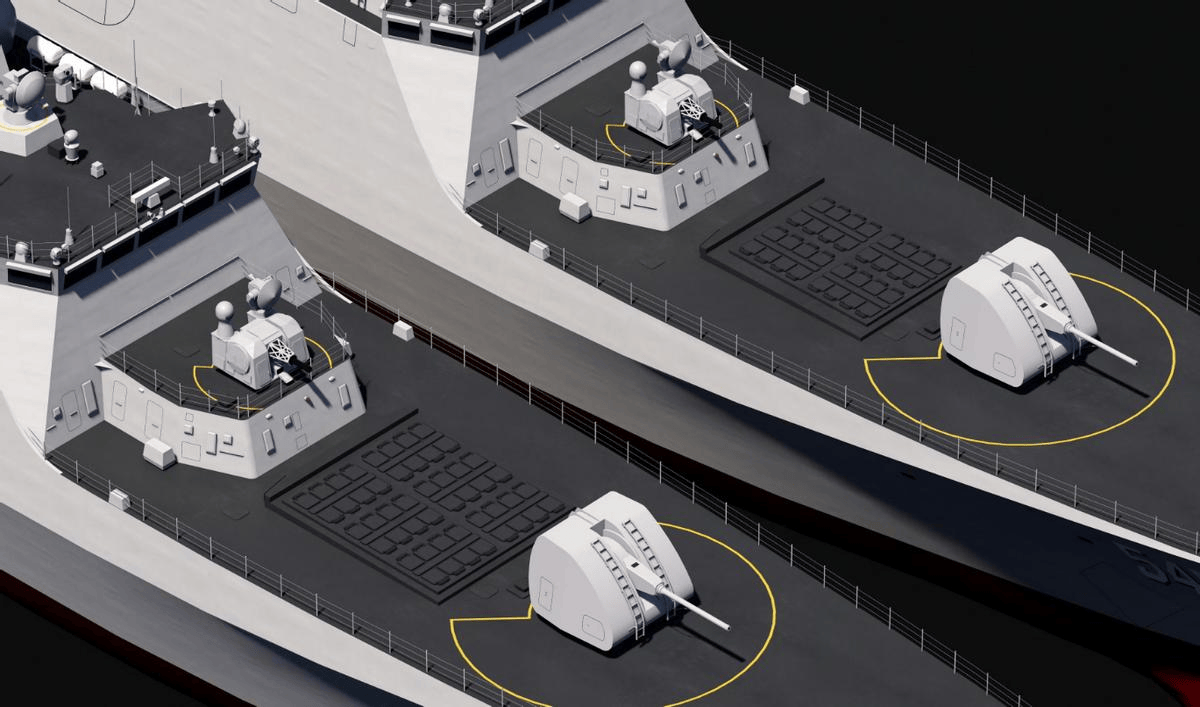
China's Type 054B frigate is getting an upgrade. Image: Global Times
China’s Type 054B frigate upgrade is more than a bigger missile load—it is a warning that the next naval arms race may be won by the fleet that can combine firepower with mass.
This month, the South China Morning Post (SCMP)
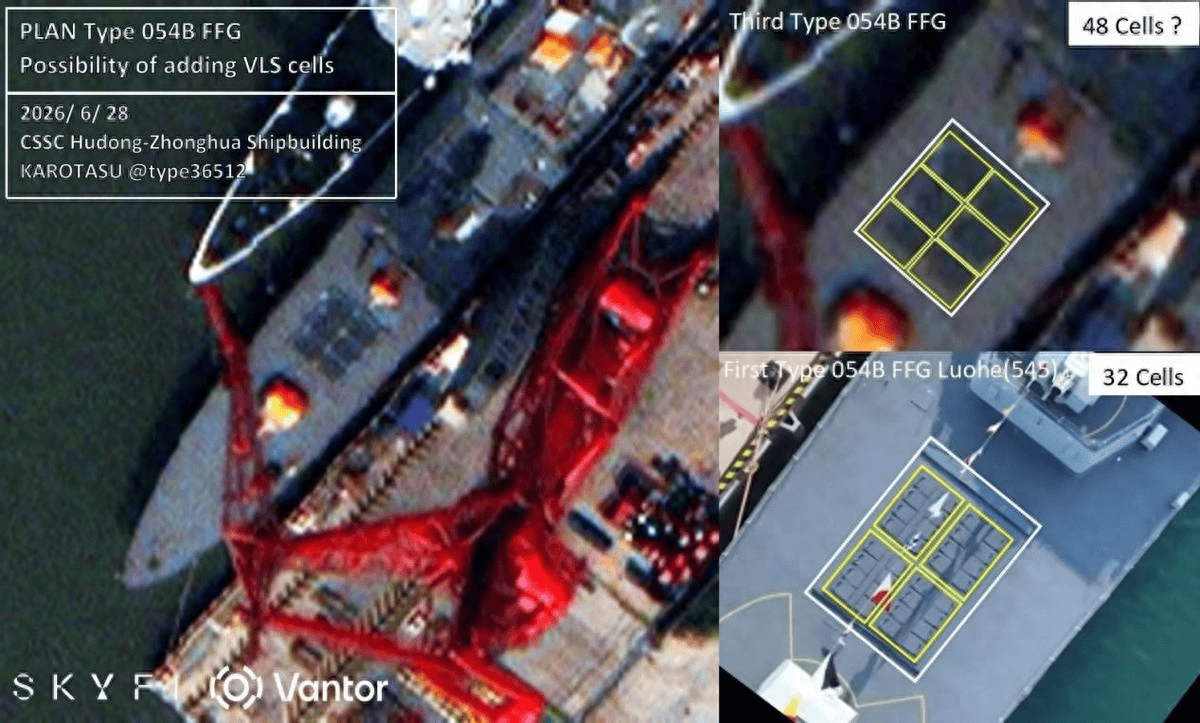
reported that China appears to be expanding the missile capacity of its next-generation Type 054B guided-missile frigate by 50%, outfitting a new hull under construction in Shanghai with a 48-cell vertical launch system (VLS), according to satellite imagery captured by US intelligence firm Vantor in June.
The imagery reveals a six-unit VLS layout at the vessel’s bow at the Hudong Zhonghua shipyard, marking an upgrade from the four eight-cell modules (32 cells) installed on the first two commissioned Type 054B frigates, the Luohe and Qinzhou.
The additional cells — which launch HHQ-16 surface-to-air missiles and Yu-8 rocket-assisted anti-submarine torpedoes — are engineered to significantly boost the 5,000-ton warship’s anti-saturation defenses and regional air-defense envelope.
Designed with radar-reducing stealth features and AI-assisted combat systems, the Type 054B serves as an escort for aircraft carrier strike groups and conducts long-range patrols.
A larger munitions payload directly enhances the vessel’s standalone combat effectiveness and survivability during independent single-ship missions in distant waters such as the Western Pacific and the South China Sea.
The Type 054B broadly occupies the same frigate category as the
US Constellation class and its planned FF(X) successor, though the three designs reflect different capability tradeoffs. The roughly 5,000-ton Type 054B sits below the nearly 8,000-ton Constellation but close to the planned 4,750-ton FF(X).
The clearest distinction is missile magazine depth. The Constellation-class carries 32 Mk 41 VLS cells, compared with the upgraded Type 054B’s apparent 48-cell VLS. The initial FF(X), meanwhile, is planned without an integrated VLS and instead emphasizes modular weapons, unmanned systems and provision for up to 16 Naval Strike Missiles (NSM).
The Type 054B and Constellation nevertheless occupy broadly comparable multi-mission roles, particularly in anti-submarine, anti-surface and air-defense warfare as part of larger naval formations. In contrast, the FF(X) places greater emphasis on surface warfare, modular payloads and teaming with unmanned systems.
Explaining the advantages afforded by that increased VLS count, Dmitry Filipoff explains in an April 2023
article for the Center for International Maritime Security (CIMSEC) that larger magazine depth enables a platform to maintain force distribution longer by supporting multiple small salvos while staying on station.
Filipoff points out that an isolated or stressed platform benefits from a high magazine depth, allowing it to fire significant volleys, whether independently or as a final effort.
In contrast to a large magazine depth, Filipoff points out that a shallow magazine depth necessitates more frequent reloading during conflicts, which can disrupt force deployment. He also adds that a shallow magazine depth leads to last-ditch, independent salvos with limited firepower, decreasing the chances of overwhelming the enemy.
Situating the role of Type 054B in carrier operations, Daniel Rice mentions in a July 2024
report for the China Maritime Studies Institute (CMSI) that the Type 054A frigate – and possibly the up-armed Type 054B – is deployed as a dedicated escort within their carrier’s “Middle Defense Zone,” spanning 45 to 185 kilometers.
Rice notes that these ships serve as the carrier’s “constant bodyguard,” functioning as a secondary defensive barrier alongside the Type 052D destroyer. He says they are tasked with neutralizing any adversary subsurface, surface, or aerial threats that slip past the outer defensive perimeter consisting of carrier-based fighter aircraft and submarines.
These frigates could also reinforce China’s quantitative naval advantages. An April 2025 US Congressional Research Service (CRS)
report notes that the People’s Liberation Army Navy (PLAN) is the world’s largest navy, with 370 platforms, including major surface combatants, at the time of its writing.
According to the report, China’s overall battle fleet is expected to grow to 435 ships by 2030, with much of that growth in major surface combatants. In contrast, the report says the US Navy had 296 battle force ships as of September 2024 and that this number is projected to shrink to 294 by 2030.
Numerical mass enhances scouting capabilities, facilitates saturation attacks via massed fires, and enables forces to absorb enemy first salvos while maintaining dominant striking power.
Furthermore, superior numbers deplete enemy precision-guided weapon inventories, create complex targeting dilemmas, and provide a vital reserve to replace combat losses in protracted attrition warfare.
However, simply having numerical mass doesn’t ensure naval superiority, since factors such as training, sensors, networking, logistics, weapons quality, and command effectiveness affect how effectively those ships are utilized.
The US still holds major qualitative advantages in high-end warships, submarines, carrier aviation and networked warfare, but quality cannot fully compensate for a shortage of affordable combat mass.
Kevin Eyer points out in an April 2026 Proceedings
article that the US has so far failed to produce affordable surface combatants due to relentless requirements creep and gold-plating, which led to the
cancellation of the Constellation-class frigate program in November 2025, leaving only the first two of six procured ships under construction.
Eyer says that by overloading small hulls with unproven technologies, excessive speed mandates, and complex multi-mission requirements like area air defense, costs spiraled while construction stalled.
He adds that former US Secretary of the Navy John Phelan noted that the Constellation-class cost 80% of an Arleigh Burke destroyer yet had only 60% of its capability, making it more sensible to buy more of the latter ships.
In the aftermath of the Constellation-class program, the US initiated the FF(X) program, a new frigate design based on the US Coast Guard’s National Security Cutter (NSC), with a planned procurement of 50-65 units.
However, a January 2026 Navy Lookout
article notes that the FF(X) design may involve significant compromises. The article notes that the FF(X) would be substantially smaller than the Constellation-class and slightly smaller than China’s Type 054B – that smaller displacement could impose significant limits on magazine depth, power generation, and future upgrades.
Beyond that, the article says that the FF(X) may have survivability issues. It notes that while the baseline NSC design meets US Coast Guard protection standards, it falls short of the required level for purpose-built warships.
Navy Lookout says that modifying the NSC to the FF(X) may entail several modifications to the design – threatening to repeat the same gold-plating mistakes that ended the Constellation-class frigate program.
To expedite the FF(X)’s entry into service, the article notes that the US Navy may have to treat the class as expendable and accept a higher risk to its crews.
Unless the US learns to trade exquisite specifications for rapid, repeatable production, the decisive naval contest of the 2030s may hinge less on which fleet fields the best ships than on which can keep enough credible hulls fighting after the opening salvos.
China's Type 054B frigate upgrade is more than a bigger missile load—it is a warning that the next naval arms race may be won by the fleet that can

asiatimes.com