Tang dynasty battles with the caliphate

East Turkistan was never a traditional territory of the Han ethnic group

Even the name of the Altay Mountains is Turkish

The True Homeland of Turkic Peoples
For thousands of years, East Turkestan was the cradle of ancient nomadic and sedentary Turkic civilizations. It was ruled by empires like the Xiongnu (Huns), the Göktürks, the Uyghur Khaganate, the Kara-Khanid Khanate, and the Chagatai Khanate

When Ale Mount Taishan was in the Han Dynasty, its name was "金山(Jinshan)". This is a standard Chinese name. The Book of Later Han, published in 432 AD, recorded its name and historical records of the Han people living here.
 
Turkic Peoples did not want to rule China

The Turkic Peoples defeated Chinese armies numerous times and conquered vast parts of their territory. However, they made a highly conscious and strategic decision not to settle in China or directly govern its massive population to avoid assimilation.

The Warnings of the Orkhon Inscriptions
The clearest written proof of this policy comes from the Orkhon Inscriptions from the 8th century. The great statesman Bilge Tonyukuk and Emperor Bilge Khagan explicitly warned the Turkic people

-- Do not be deceived by China’s soft silk, sweet words and princesses.

-- If you move into Chinese lands and settle there, you will be outnumbered, absorbed, and lose your Turkic identity.

-- The correct strategy is to stay in the steppes (OTUKEN), maintain military readiness, defeat China from the outside, and make them pay tribute.

Nomads did briefly occupy regions such as North China in China. But those are the Xianbei, Khitan, and Jurchen ethnic groups, not the Turks. The Turks have never controlled the territory south of the Great Wall.

Of course, the ultimate result was that the Xianbei Emperor voluntarily abandoned Xianbei culture and was completely assimilated into the Han ethnic group, becoming a part of it. The Khitan people were annihilated by the Han Chinese alliance with the Jurchen ethnic group. The Jurchen people were annihilated by the Han and Mongol tribes. The ultimate winner is the Mongolians.

The leaders of Turkic, Rouran and other nomadic tribes have told their people not to go south of the Great Wall to avoid assimilation by the Han ethnic group. This is not a new thing, after all, the lessons of the Xianbei people are too shocking.


btw: The Turks never had the ability to rule China from beginning to end; on the contrary, their empire was destroyed and ruled by the Chinese Tang Dynasty.
 
Last edited:
India never fought USA , they never entered USA and They never occupied even part of USA

But Turkic Peoples fought China , entered China and occupied part of China

The Northern Dynasties Era (386–581 CE)
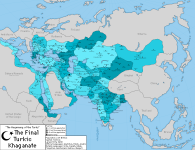
During the "Sixteen Kingdoms" and "Northern and Southern Dynasties" periods, northern China was completely conquered by nomadic coalitions heavily comprising Turkic-Mongolic peoples

Also GOKTURK Empire
View attachment 211683

During the Northern and Southern Dynasties, the rulers of northern China were the Xianbei people, not the Turks. Moreover, these Xianbei people eventually voluntarily gave up the written language and name culture of the Xianbei ethnic group and collectively joined the Han ethnic group. These Xianbei people were once the masters of the Turks, not a part of them.


I'll say it again, the Turks have never occupied the land south of the Great Wall.
 
Turkic people: My ancestors include the Xiongnu, Mongolians, Xianbei, Uyghurs... No one has more ancestors than me.
 
During the Northern and Southern Dynasties, the rulers of northern China were the Xianbei people, not the Turks

Xianbei People a multilingual, multi ethnic confederation consisting of mainly Mongol and Turkic


When Ale Mount Taishan was in the Han Dynasty, its name was "金山(Jinshan)". This is a standard Chinese name. The Book of Later Han, published in 432 AD, recorded its name and historical records of the Han people living here.

Nobody cares about Chinese name

The original name of these mountains is Turkish: ALTAY


also , Ural-Altaic is a linguistic convergence zone and abandoned language-family ( Turkic , Uralic , Mongolic , Tungusic , Yukaghir )


------------------------------------------------------------------------

As can be understood from this, this region is the homeland of the Turkic Peoples
 
btw: The Turks never had the ability to rule China from beginning to end; on the contrary, their empire was destroyed and ruled by the Chinese Tang Dynasty.

Chinese never had ability to rule Worldwide .... never
Chinese tried once, and in 751 the Karluk Turks stopped the Chinese


-- Turkic Dynasties ruled India and Iran for 800-900 years
-- Turkic Dynasties ruled Russians until 1570s
-- Turkic Dynasties ruled Egypt , North Africa , Greece , all Balkans and Middle East for centuries

-- Turkic People would be able to rule China
but a highly conscious and strategic decision not to settle in China or directly govern its massive population to avoid assimilation


Turkic Empires always were destroyed by another Turkic Empires

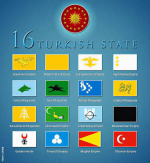
16 great Turkic Empires
1787378838366.png
1787378818437.png
 
  • Haha
Reactions: ety
Turkic people: My ancestors include the Xiongnu, Mongolians, Xianbei, Uyghurs... No one has more ancestors than me.
People often throw every steppe group into one basket — Huns, Mongols, Xiongnu, Xianbei, Uyghurs, Oghuz — as if they were all one unified “Turkic super‑tribe.” But historically, these groups were very different from each other, even if some of them interacted, mixed, or shared cultural elements over long periods.

The Huns are a good example. They were a multi‑ethnic confederation that included early Turkic‑speaking tribes, but they weren’t identical to later Turks. Their empire stretched from Central Asia to Europe, and they influenced both the steppe world and the Roman frontier. They’re part of the broader Turkic story, but not in the same way as the Oghuz or the Göktürks.

Anatolian Oghuz Turks — the ancestors of modern Turks in Türkiye — followed a completely different historical path from groups like Uyghurs or Mongolians. Once the Oghuz moved west, they mixed with Persians, Arabs, Greeks, Armenians, and other Near Eastern peoples. Their culture, religion, and political systems evolved in the Persian‑Byzantine world, not the Chinese‑Mongolian one. That’s why Anatolian Turks today differ so much from Central Asian Turks in language accents, appearance, and cultural habits.

Uyghurs, on the other hand, developed inside the eastern steppe and Chinese frontier zone. Their history is tied to the old Uyghur Khaganate, the Tarim Basin, Buddhist and later Islamic influences, and long interaction with Chinese dynasties. They’re Turkic, but their cultural evolution is completely different from the Oghuz.

Mongolians are even more distinct. They’re not Turkic, but they share a long history of cultural exchange with Turkic tribes — horse nomadism, Tengri beliefs, steppe warfare, clan structures. The closeness is mostly cultural and political, not genetic. Mongols absorbed many Turkic tribes during the empire, and Turkic groups absorbed Mongolic elements in return, but they remain separate peoples.

As for the Xianbei, they were an ancient nomadic group from northern China and Mongolia, usually classified as proto‑Mongolic. They interacted with early Turkic tribes, and some Xianbei clans later merged into Turkic or Mongolic confederations. They’re part of the steppe mosaic, but not a Turkic people themselves.

So yes — Turkic history is broad and interconnected, but it’s not a single straight line. Huns, Oghuz, Uyghurs, Mongols, Xianbei — all played roles in the wider steppe world, yet each followed its own path. That’s why modern Turkic peoples can share linguistic roots while still looking, living, and thinking very differently today.

Hope this helps.
 
The Huns are a good example. They were a multi‑ethnic confederation that included early Turkic‑speaking tribes, but they weren’t identical to later Turks. Their empire stretched from Central Asia to Europe, and they influenced both the steppe world and the Roman frontier. They’re part of the broader Turkic story, but not in the same way as the Oghuz or the Göktürks.

METE Khan was a Hunnic Turk
He is widely accepted as the historical figure behind Oguz Kagan (Oguz Khan), the legendary ancestor of the Oguz Turks.
 
Historical Identity (Hunnic Turk): Mete Khan ruled the Great Hun Empire from 209 BC to 174 BC. He is celebrated for uniting all nomadic Turkic tribes under a single banner for the first time in history

and METE KHAN founded the first regular Turkish Army in 209 BC

Even the Turkish Army has this official view
 
Historical Identity (Hunnic Turk): Mete Khan ruled the Great Hun Empire from 209 BC to 174 BC. He is celebrated for uniting all nomadic Turkic tribes under a single banner for the first time in history

and METE KHAN founded the first regular Turkish Army in 209 BC

Even the Turkish Army has this official view
Its just tiring people keep trying to lump every Turkic‑related group into one single identity ... Huns, Uyghurs, Oghuz, Mongols, Xiongnu, Xianbei — as if they were all the same people living in the same era. But historically, these groups lived in completely different regions, under different empires, and followed totally different cultural paths. It makes no sense to mix the Huns who were fighting Rome with the Turkic tribes living under the Tang Dynasty a thousand years later.

The Oghuz Turks .. the ancestors of modern Turks in Anatolia — developed in a very different world from Uyghurs and other Central Asian Turks. Once the Oghuz moved west, they entered the Persian‑Arab‑Byzantine sphere. They mixed with Greeks, Balkan, Slav peoples, and the descendants of Roman Anatolia. Their culture shifted toward Islam , and Mediterranean influences. That’s why Anatolian Turks today look, speak, and live differently from Uyghurs or Kazakhs, even though they still share Turkic linguistic roots and some deep ancestry.

Uyghurs and other eastern Turkic groups evolved inside the Chinese‑Mongolian frontier zone. Their history is tied to the old Uyghur Khaganate, the Tarim Basin, Buddhist traditions, and later Islamic influences. They interacted heavily with Chinese dynasties and Mongolic tribes. Their cultural development is eastern, not western. They’re Turkic, but their path diverged from the Oghuz long before the Seljuks ever set foot in Iran or Anatolia.

Meanwhile, the Huns represent an even earlier chapter. They were a multi‑ethnic confederation that included early Turkic tribes(A lot of Germans), but they were not identical to later Turks and yet I still feel closer to Oghuz Turks and Anatolians. What matters is where they were: in Europe. Hunnic forces were on the Danube, in Gaul, and at the gates of Rome around 500 years before the Oghuz Turks migrated into Anatolia. The Hunnic Turkic presence in Europe belongs to Late Antiquity, not the medieval Turkic migrations. Mixing those two timelines together is historically inaccurate.

And then there are groups like the Xianbei, who were proto‑Mongolic nomads in northern China and Mongolia. They interacted with early Turkic tribes, and some clans later merged into Turkic or Mongolic confederations, but they were not Turks themselves. They’re part of the wider steppe mosaic, not part of the Oghuz lineage.

So yes — Turkic peoples share linguistic roots and some ancient blood ties, but they were never one uniform nation. The Oghuz Turks who shaped Anatolia are not the same as the Uyghurs of the Tarim Basin, and neither are the same as the Huns who fought Rome. Different eras, different regions, different histories — connected, but not interchangeable.
 
The only distinguishing feature of the Chinese was their large population; otherwise, they weren't a warrior race

Warriors : Turk and Mongol


During the Korean War, 5,000 Turkish soldiers, including my uncle, defended against 100,000 Chinese soldiers to buy time for the cowardly American soldiers to retreat.
 
The Oghuz Turks .. the ancestors of modern Turks in Anatolia — developed in a very different world from Uyghurs and other Central Asian Turks.

Ne anlatıyorsun kardeşim sen
We Turks did not came to Anatolia from MARS ... Our ancestors were Turkic Leaders including METE KHAN widely accepted as the historical figure behind Oguz Kagan (Oghuz Khan), the legendary ancestor of the Oguz Turks

I gave you a official source from Turkish Army official website
 
Ne anlatıyorsun kardeşim sen
We Turks did not came to Anatolia from MARS ... Our ancestors were Turkic Leaders including METE KHAN widely accepted as the historical figure behind Oguz Kagan (Oghuz Khan), the legendary ancestor of the Oguz Turks

I gave you a official source from Turkish Army official website
Kardeşim, ben zaten “Türk değildik” gibi bir şey söylemedim. Konu o değil. Benim anlattığım şey şu: Avrupa’daki Hun Türkleri ile Orta Asya’daki Türkler tamamen farklı dönemlerde ve farklı coğrafyalarda yaşadı. Aynı çağda, aynı siyasi ortamda değillerdi.
 
The only distinguishing feature of the Chinese was their large population; otherwise, they weren't a warrior race

Warriors : Turk and Mongol


During the Korean War, 5,000 Turkish soldiers, including my uncle, defended against 100,000 Chinese soldiers to buy time for the cowardly American soldiers to retreat.
Another good Bollywood movie against Chinese army.
 

Users who are viewing this thread

Pakistan Defence Latest

Latest Posts

Back
Top