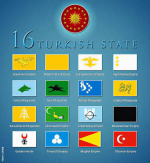
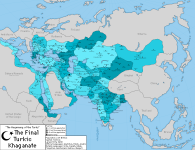
Turkic people: My ancestors include the Xiongnu, Mongolians, Xianbei, Uyghurs... No one has more ancestors than me.
People often throw every steppe group into one basket — Huns, Mongols, Xiongnu, Xianbei, Uyghurs, Oghuz — as if they were all one unified “Turkic super‑tribe.” But historically, these groups were very different from each other, even if some of them interacted, mixed, or shared cultural elements over long periods.
The Huns are a good example. They were a multi‑ethnic confederation that included early Turkic‑speaking tribes, but they weren’t identical to later Turks. Their empire stretched from Central Asia to Europe, and they influenced both the steppe world and the Roman frontier. They’re part of the broader Turkic story, but not in the same way as the Oghuz or the Göktürks.
Anatolian Oghuz Turks — the ancestors of modern Turks in Türkiye — followed a completely different historical path from groups like Uyghurs or Mongolians. Once the Oghuz moved west, they mixed with Persians, Arabs, Greeks, Armenians, and other Near Eastern peoples. Their culture, religion, and political systems evolved in the Persian‑Byzantine world, not the Chinese‑Mongolian one. That’s why Anatolian Turks today differ so much from Central Asian Turks in language accents, appearance, and cultural habits.
Uyghurs, on the other hand, developed inside the eastern steppe and Chinese frontier zone. Their history is tied to the old Uyghur Khaganate, the Tarim Basin, Buddhist and later Islamic influences, and long interaction with Chinese dynasties. They’re Turkic, but their cultural evolution is completely different from the Oghuz.
Mongolians are even more distinct. They’re not Turkic, but they share a long history of cultural exchange with Turkic tribes — horse nomadism, Tengri beliefs, steppe warfare, clan structures. The closeness is mostly cultural and political, not genetic. Mongols absorbed many Turkic tribes during the empire, and Turkic groups absorbed Mongolic elements in return, but they remain separate peoples.
As for the
Xianbei, they were an ancient nomadic group from northern China and Mongolia, usually classified as proto‑Mongolic. They interacted with early Turkic tribes, and some Xianbei clans later merged into Turkic or Mongolic confederations. They’re part of the steppe mosaic, but not a Turkic people themselves.
So yes — Turkic history is broad and interconnected, but it’s not a single straight line. Huns, Oghuz, Uyghurs, Mongols, Xianbei — all played roles in the wider steppe world, yet each followed its own path. That’s why modern Turkic peoples can share linguistic roots while still looking, living, and thinking very differently today.
Hope this helps.