India’s Potential Is Running Dry

Actually the GAP has widened. How many sectors of technology do you dominate? 0 while China leads in 69. This sounds like when China won 40 gold medals and India 0 at last olympics.

According to the Australian Strategic Policy Institute (ASPI) 2026 data, China demonstrates outstanding rankings in key technology sectors, while also ranking among the top in Asia in terms of comprehensive national power. However, please note that different reports use different evaluation dimensions and focus areas.

🔬 ASPI Critical Technology Tracker (2026 Data)

This report measures the global leadership position of countries in terms of high-level research output across 74 critical and emerging technology fields.

  • Overall Ranking: China leads globally in 69 technology fields, accounting for 93% of the total.
  • Historical Comparison: This reflects a massive structural shift. In comparison, during the 2003–2007 period, the United States dominated 60 of the 64 technologies tracked at that time.
  • Key Areas: China's leading edge covers multiple fields including artificial intelligence, advanced materials, semiconductors, and biotechnology. Particularly in frontier areas such as AI hardware and biomanufacturing, its leading position is considered to pose a "high monopoly risk."
Nowadays, many Hindus find themselves in a state of anxiety. Ten years ago, they believed that the goodwill of the world was a blessing from the gods, so they prayed to the gods more devoutly. But the more devout they became, the more the world showed them hostility. So they became even more devout and more extreme—and a negative feedback loop began.

I am not saying that Hindu nationalism is necessarily bad—it is a choice made out of desperation. But in constructing the narrative of Hindu nationalism, Modi has left out one truly great and essential component: science. What incredibly stupid short-sightedness. Once the seed of ignorance is sown, the tree that grows from it will take a thousand or a hundred times more effort to prune.

Over these 12 years, vast amounts of government money have flowed to temples, religious organizations, religious activities, and sacrificial rituals. The Kumbh Mela grows larger every time, each time setting a new world record. They make chips out of cow dung, beverages out of cow urine, and install air conditioners in cow sheds—while public schools and public hospitals are left without. Across the Indian subcontinent, a competition of piety is being played out at every moment. Modi himself has become the 11th avatar of Vishnu, and his party members have likewise taken on the roles of various saints and sages. Countless events and propaganda that contradict science are unfolding wildly.

Modi is the most powerful ruler and architect India has seen since Nehru. But lacking vision, he has squandered India's golden decade, causing the gap with China to grow ever wider. Yet from within his religious intoxication, he is always able to spot the beautiful flowers blooming in the neighboring garden: for example, the great electric vehicle industry. In what seemed like the blink of an eye, the Chinese established an industry that provides employment for tens of millions of people and generates trillions of dollars in exports. In just three short years, China overtook Japan to become the world's largest automobile exporter, and its products are flooding global markets. Just as with the photovoltaic industry, the Chinese started from the extraction of raw elements and mastered the entire technological chain. Modi realized that without investing unimaginable amounts of money and time, Indians will forever remain downstream of Chinese industry, forever students of the Chinese—learning technologies that quickly become obsolete. By the time Indians painstakingly learn a little technology, new industries have already emerged—drone industries, robotics industries—always learning, always following, but never catching up. The Vishwa Guru has become the Vishwa Student—and a rather slow one at that.

Ten years ago, Modi brought the mobile phone industry from China—this was one of his greatest achievements. But to this day, India has not produced a single globally recognized mobile phone brand.
 
Nowadays, many Hindus find themselves in a state of anxiety. Ten years ago, they believed that the goodwill of the world was a blessing from the gods, so they prayed to the gods more devoutly. But the more devout they became, the more the world showed them hostility. So they became even more devout and more extreme—and a negative feedback loop began.

I am not saying that Hindu nationalism is necessarily bad—it is a choice made out of desperation. But in constructing the narrative of Hindu nationalism, Modi has left out one truly great and essential component: science. What incredibly stupid short-sightedness. Once the seed of ignorance is sown, the tree that grows from it will take a thousand or a hundred times more effort to prune.

Over these 12 years, vast amounts of government money have flowed to temples, religious organizations, religious activities, and sacrificial rituals. The Kumbh Mela grows larger every time, each time setting a new world record. They make chips out of cow dung, beverages out of cow urine, and install air conditioners in cow sheds—while public schools and public hospitals are left without. Across the Indian subcontinent, a competition of piety is being played out at every moment. Modi himself has become the 11th avatar of Vishnu, and his party members have likewise taken on the roles of various saints and sages. Countless events and propaganda that contradict science are unfolding wildly.

Modi is the most powerful ruler and architect India has seen since Nehru. But lacking vision, he has squandered India's golden decade, causing the gap with China to grow ever wider. Yet from within his religious intoxication, he is always able to spot the beautiful flowers blooming in the neighboring garden: for example, the great electric vehicle industry. In what seemed like the blink of an eye, the Chinese established an industry that provides employment for tens of millions of people and generates trillions of dollars in exports. In just three short years, China overtook Japan to become the world's largest automobile exporter, and its products are flooding global markets. Just as with the photovoltaic industry, the Chinese started from the extraction of raw elements and mastered the entire technological chain. Modi realized that without investing unimaginable amounts of money and time, Indians will forever remain downstream of Chinese industry, forever students of the Chinese—learning technologies that quickly become obsolete. By the time Indians painstakingly learn a little technology, new industries have already emerged—drone industries, robotics industries—always learning, always following, but never catching up. The Vishwa Guru has become the Vishwa Student—and a rather slow one at that.

Ten years ago, Modi brought the mobile phone industry from China—this was one of his greatest achievements. But to this day, India has not produced a single globally recognized mobile phone brand.
India is in a state of anti-logic similar to what china went through during cultural revolution. When your anti-logic and anti-science, you can never develop.
 
印度处于一种反逻辑状态,类似于中国在文化大革命期间所经历的。当你反逻辑、反科学时,你永远无法发展。
不,你完全错了。你看到的不过是宣传。看看印度的“黄金十年”与中国在那段时期的科学技术成就相比,能带来什么:

贝尔奖级别的成就
1966年——世界上首个结晶牛胰岛素的全合成在中国完成。
1971年——屠呦呦的团队发现了青蒿素,这种药物挽救了全球数百万生命。
1973年——袁龙平成功研发出杂交稻,自此拯救了数亿人免于饥饿,成为人类历史上最伟大的农业突破之一。
遗憾的是,合成胰岛素没有获得诺贝尔奖,而青蒿素却获得了。同样遗憾的是,袁龙平的杂交稻米未能获得诺贝尔奖——尽管他被授予美国国家科学院院士资格。

国防与尖端技术
1967年——氢弹爆炸。
1970年——首艘核潜艇。印度直到五十多年后才实现这一目标。这是当时最先进、最机密的科学技术——与印度租赁俄罗斯核潜艇数十年不同。
1972年——第一台光刻机(半导体制造用)。
名单还在继续——多得数不清。
 
Last edited:
不,你完全错了。你看到的不过是宣传。看看印度的“黄金十年”与中国在那段时期的科学技术成就相比,能带来什么:

贝尔奖级别的成就
1966年——世界上首个结晶牛胰岛素的全合成在中国完成。
1971年——屠呦呦的团队发现了青蒿素,这种药物挽救了全球数百万生命。
1973年——袁龙平成功研发出杂交稻,自此拯救了数亿人免于饥饿,成为人类历史上最伟大的农业突破之一。
遗憾的是,合成胰岛素没有获得诺贝尔奖,而青蒿素却获得了。同样遗憾的是,袁龙平的杂交稻米未能获得诺贝尔奖——尽管他被授予美国国家科学院院士资格。

国防与尖端技术
1967年——氢弹爆炸。
1970年——首艘核潜艇。印度直到五十多年后才实现这一目标。这是当时最先进、最机密的科学技术——与印度租赁俄罗斯核潜艇数十年不同。
1972年——第一台光刻机(半导体制造用)。
名单还在继续——多得数不清。
Cultural revolution is not a time of progress. China was miserable, poor and laughed at and smart educated people were persecuted. If those small achievements across two decades are incomparable to what China has achieved since then.
 
Cultural revolution is not a time of progress. China was miserable, poor and laughed at and smart educated people were persecuted. If those small achievements across two decades are incomparable to what China has achieved since then.
Misery and progress are not correlated. Misery does not mean progress cannot happen. Throughout history, achievements in China—and indeed across the world—have usually been accompanied by blood and tears. Egyptians today can take pride in the pyramids; Westerners can take pride in the glory of Rome. But both the pyramids and Rome were built on the blood and tears of slaves. The fact that some educated and intelligent people suffered persecution is true. But the great advances are also true. You may say that era was entirely wrong—but you cannot say that era produced no great advances.
 
The fact that Q1 of this year saw the ratio of China and India 4-wheeler automobile production drop to ~3.5x instead of usual ~5x in previous years does indicate the potential is drying.

Steel production ratio at the start of decade was ~9x, today it is down to ~5.5x.

Yes, china still remains far ahead and India will likely not reach where china is today, but then India doesn't have as much resources as china has and is a democracy with its own flaws.
 
Misery and progress are not correlated. Misery does not mean progress cannot happen. Throughout history, achievements in China—and indeed across the world—have usually been accompanied by blood and tears. Egyptians today can take pride in the pyramids; Westerners can take pride in the glory of Rome. But both the pyramids and Rome were built on the blood and tears of slaves. The fact that some educated and intelligent people suffered persecution is true. But the great advances are also true. You may say that era was entirely wrong—but you cannot say that era produced no great advances.
If we had those 2 decades of development of current era instead of spending that time in cultural revolution, Our GDP would be twice the size of the US and we would be clearly the world leader and tone setter. We will still reach that but now it just takes longer.
 
The fact that Q1 of this year saw the ratio of China and India 4-wheeler automobile production drop to ~3.5x instead of usual ~5x in previous years does indicate the potential is drying.

Steel production ratio at the start of decade was ~9x, today it is down to ~5.5x.

Yes, china still remains far ahead and India will likely not reach where china is today, but then India doesn't have as much resources as china has and is a democracy with its own flaws.
India’s average annual GDP growth rate is 7.6%, compared with 3.6% for China. India’s GDP is now growing at more than twice China’s rate, meaning the gap is indeed closing at a very rapid pace.

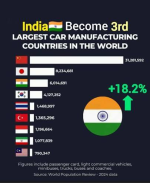
The same trend can be seen in exports and manufacturing. Take car exports, for example: India is now the world’s third-largest automobile exporter and is close to overtaking Japan to become the second-largest. At the current rate of growth, India will eventually overtake China as well and become the world’s largest car exporter. India’s car exports are currently growing at more than 18% annually.
1787995702021.png
 
If we had those 2 decades of development of current era instead of spending that time in cultural revolution, Our GDP would be twice the size of the US and we would be clearly the world leader and tone setter. We will still reach that but now it just takes longer.
China’s annual GDP grew by 5.0% in 2025, while its GDP growth in the first half of 2026 reached 4.7% year-on-year. In comparison, India’s real GDP growth for the 2025–26 financial year was estimated at 7.7%, according to data from India’s Ministry of Statistics and Programme Implementation, as reported by IBEF.

The data suggests that India is closing the economic gap with China at a very rapid pace. At the current trajectory, India should overtake China economically before China manages to overtake United States.

It is also worth noting that China’s headline GDP growth figures have faced criticism over the years, particularly because a significant portion of its growth has been driven by property and infrastructure construction. Much of this investment has generated relatively low returns, raising questions about how sustainable that model of growth is.
 

Users who are viewing this thread

Back
Top