jr_pdf
Registered Member


- Thread starter
- #16
Nowadays, many Hindus find themselves in a state of anxiety. Ten years ago, they believed that the goodwill of the world was a blessing from the gods, so they prayed to the gods more devoutly. But the more devout they became, the more the world showed them hostility. So they became even more devout and more extreme—and a negative feedback loop began.Actually the GAP has widened. How many sectors of technology do you dominate? 0 while China leads in 69. This sounds like when China won 40 gold medals and India 0 at last olympics.
According to the Australian Strategic Policy Institute (ASPI) 2026 data, China demonstrates outstanding rankings in key technology sectors, while also ranking among the top in Asia in terms of comprehensive national power. However, please note that different reports use different evaluation dimensions and focus areas.
ASPI Critical Technology Tracker (2026 Data)
This report measures the global leadership position of countries in terms of high-level research output across 74 critical and emerging technology fields.
- Overall Ranking: China leads globally in 69 technology fields, accounting for 93% of the total.
- Historical Comparison: This reflects a massive structural shift. In comparison, during the 2003–2007 period, the United States dominated 60 of the 64 technologies tracked at that time.
- Key Areas: China's leading edge covers multiple fields including artificial intelligence, advanced materials, semiconductors, and biotechnology. Particularly in frontier areas such as AI hardware and biomanufacturing, its leading position is considered to pose a "high monopoly risk."
I am not saying that Hindu nationalism is necessarily bad—it is a choice made out of desperation. But in constructing the narrative of Hindu nationalism, Modi has left out one truly great and essential component: science. What incredibly stupid short-sightedness. Once the seed of ignorance is sown, the tree that grows from it will take a thousand or a hundred times more effort to prune.
Over these 12 years, vast amounts of government money have flowed to temples, religious organizations, religious activities, and sacrificial rituals. The Kumbh Mela grows larger every time, each time setting a new world record. They make chips out of cow dung, beverages out of cow urine, and install air conditioners in cow sheds—while public schools and public hospitals are left without. Across the Indian subcontinent, a competition of piety is being played out at every moment. Modi himself has become the 11th avatar of Vishnu, and his party members have likewise taken on the roles of various saints and sages. Countless events and propaganda that contradict science are unfolding wildly.
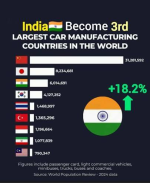
Modi is the most powerful ruler and architect India has seen since Nehru. But lacking vision, he has squandered India's golden decade, causing the gap with China to grow ever wider. Yet from within his religious intoxication, he is always able to spot the beautiful flowers blooming in the neighboring garden: for example, the great electric vehicle industry. In what seemed like the blink of an eye, the Chinese established an industry that provides employment for tens of millions of people and generates trillions of dollars in exports. In just three short years, China overtook Japan to become the world's largest automobile exporter, and its products are flooding global markets. Just as with the photovoltaic industry, the Chinese started from the extraction of raw elements and mastered the entire technological chain. Modi realized that without investing unimaginable amounts of money and time, Indians will forever remain downstream of Chinese industry, forever students of the Chinese—learning technologies that quickly become obsolete. By the time Indians painstakingly learn a little technology, new industries have already emerged—drone industries, robotics industries—always learning, always following, but never catching up. The Vishwa Guru has become the Vishwa Student—and a rather slow one at that.
Ten years ago, Modi brought the mobile phone industry from China—this was one of his greatest achievements. But to this day, India has not produced a single globally recognized mobile phone brand.