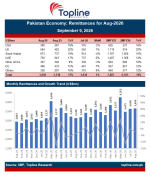
Both can happen. Remittance help with industrial growth at home.
With all due respect, I’m getting the distinct impression that you’re smoking something very strong, because if you weren’t, your response would probably be a little more coherent.
Have you actually looked at Pakistan’s industrialization policies, development, manufacturing capacity, and investment environment over the last 30 years?
That is where the real conversation needs to begin.
For decades, Pakistan has talked about attracting foreign investment, becoming an industrial powerhouse, expanding exports, developing technology, and creating jobs. We have heard the same promises from one government after another. There have been countless investment conferences, economic packages, special incentives, industrial zones, investment summits, and political speeches promising that “this time” Pakistan is finally going to take off.
But the results speak much louder than the speeches.
The uncomfortable reality is that a significant number of investors who once considered Pakistan are either leaving, reducing their exposure, or choosing countries such as Bangladesh, Vietnam, the Philippines, Malaysia, Indonesia, and others for their manufacturing and investment operations.
And we need to ask ourselves a very simple question..
Why?
Is it because Pakistan lacks talented people? No.
Is it because Pakistan lacks entrepreneurs? No.
Is it because Pakistan lacks natural resources, a large domestic market, or a strategically important geographic location? Again, no.
The problem is much deeper.
Investors need predictability. They need consistent policies, reliable electricity and infrastructure, functioning institutions, reasonable taxation, access to foreign currency, protection of contracts and property rights, efficient courts, political stability, and
perhaps most importantly
the confidence that the rules of the game will not suddenly change because a new government, military policy, bureaucracy, or political faction decides to rewrite them.
That confidence has been badly damaged in Pakistan.
You cannot build a globally competitive industrial economy when businesses spend as much time trying to understand government policy, taxation, regulations, political developments, currency restrictions, and bureaucratic requirements as they do developing their actual products.
And this is where the endless political “topi drama” becomes relevant.
Changing political faces, holding investment conferences, announcing billion-dollar memorandums, taking photographs with foreign dignitaries, or unveiling another grand economic initiative does not automatically create factories.
A country doesn’t become an investment destination because its leaders stand behind a podium and announce that billions of dollars are coming.
Investment follows confidence.
Confidence follows institutions.
Institutions follow governance.
And governance is precisely where Pakistan continues to struggle.
The defense establishment cannot simply be substituted for an economic strategy. Nor can political theatrics replace industrial policy. Security matters, of course, but security alone does not create a competitive manufacturing ecosystem.
Vietnam didn’t become a manufacturing destination because it held investment conferences.
Bangladesh didn’t dramatically expand its export manufacturing sector because politicians gave speeches about national greatness.
Malaysia, Indonesia, and the Philippines built their investment ecosystems through years of developing infrastructure, human capital, export industries, supply chains, regulatory frameworks, and relationships with global companies.
That process takes decades.
Pakistan has repeatedly tried to find shortcuts.
And there is another uncomfortable reality that many Pakistanis don’t want to acknowledge: our political class has consistently prioritized political survival and personal power over long-term national economic planning.
Our politicians behave like they are fighting over a family inheritance rather than trying to build a country that will still be competitive 30 years from now.
One government starts a project. The next government attacks it.
One administration introduces an economic policy. The next administration reverses it.
One political faction controls the government today. Tomorrow another faction comes in and treats everything the previous government did as something that must be dismantled.
Meanwhile, businesses are expected to invest billions of dollars and somehow pretend that this uncertainty doesn’t matter.
It matters enormously.
And let’s also stop pretending that foreign governments and wealthy investors are naïve.
The Gulf states are not the same countries they were in the 1980s and 1990s.
Their leadership has become far more sophisticated commercially. They have sovereign wealth funds, international investment portfolios, global corporations, technology partnerships, real estate holdings, logistics networks, and investments spread across the world.
They are not investing simply because someone gives an emotional speech about Muslim brotherhood or historical friendship.
They look at returns.
They look at risk.
They look at governance.
They look at political stability.
They look at whether they can get their money out.
They look at whether contracts will be honored.
They look at whether a project can actually make money.
And they compare Pakistan against dozens of other countries competing for exactly the same capital.
That is the part of the discussion many people conveniently ignore.
Pakistan isn’t competing only with India.
Pakistan is competing with Vietnam, Indonesia, Bangladesh, Malaysia, the Philippines, the UAE, Saudi Arabia, Türkiye, Thailand, and increasingly African economies that are actively trying to attract manufacturing and foreign capital.
Capital has options.
Investors don’t owe Pakistan their money.
Pakistan has to convince investors that putting their money there is safer, smarter, and more profitable than putting it somewhere else.
And that requires something much more difficult than political slogans.
It requires institutional reform.
It requires stable economic policies that survive changes in government.
It requires serious investment in education, technical training, energy, transportation, digital infrastructure, ports, logistics, research, and domestic manufacturing.
It requires reducing bureaucratic corruption and making it possible for a legitimate business to operate without constantly navigating political connections.
It requires an independent and predictable legal system.
It requires a tax system that businesses can actually understand.
It requires export-oriented industrial policy rather than an economy that repeatedly survives on imports, borrowing, remittances, and emergency bailouts.
And above all, it requires political maturity.
Pakistan has enormous potential. That is not the question.
The question is whether Pakistan has the political and institutional maturity to actually convert that potential into sustainable economic power.
We cannot keep blaming foreign conspiracies every time investors walk away.
Sometimes we need to look in the mirror.
If investors are leaving, ask why.
If factories are closing, ask why.
If talented young Pakistanis are leaving the country, ask why.
If multinational companies are choosing Vietnam, Bangladesh, Malaysia, or Indonesia instead of Pakistan, ask what those countries are doing differently.
And if the answer makes us uncomfortable, then perhaps the answer is exactly what we need to confront.
Pakistan doesn’t need another grand speech.
It doesn’t need another photograph.
It doesn’t need another political slogan.
It needs competent governance, predictable institutions, serious industrial policy, economic continuity, and leaders willing to think beyond the next election or the next political crisis.
Until that happens, no amount of “topi drama” is going to convince serious international investors to put their money on the line.
If Pakistan wants to economically survive in next 50 years, 34 economic zones as the second tier of government is the only viable option. Each EZ run by SMEs and technocrats, remove politicians. Using blockchain, ai and automation to reduce 60% of government overhead. One window operation for each EZ. Unified investment policy across all EZ.