Remittances from Overseas Pakistanis - Updates

Deportation data shows a mixed picture

The data presented in the National Assembly recently and seen by The Express Tribune showed that 21,951 Pakistanis were deported from Gulf countries between March 1 and July 13, 2026. Saudi Arabia accounted for the largest share at 15,495, followed by the UAE with 3,803 and Oman with 1,606.

Among the main reasons were “Other” cases (6,662), absconding (4,628), overstay/illegal entry or stay (2,811), jail cases (1,294), lost passports (1,155), blacklist cases (968), drugs (728) and visa violations (689).

The government has also rejected the impression that Pakistanis are being subjected to a blanket, country-specific deportation campaign, maintaining that deportations are linked to violations of host-country laws and immigration regulations.

The highest reported category of “Other,” though not specified, could be the cases of bounced rental cheques – a serious offence which can trigger legal cases, travel bans and visa problems, potentially leaving Pakistanis unable to return, facing detention or, separately, deportation.
 
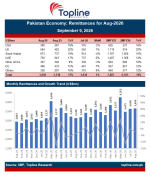
Pakistan's remittances stood at US$3.7bn in Aug 2026, up 17% YoY. This takes 2MFY27 remittances to US$7.3bn, up 15% YoY.

Looks like Pakistan remittance will cross $47bn in FY 2026-27. Well above exports which are looking around $45bn.

1788938414524.png
 
Pakistan's remittances stood at US$3.7bn in Aug 2026, up 17% YoY. This takes 2MFY27 remittances to US$7.3bn, up 15% YoY.

Looks like Pakistan remittance will cross $47bn in FY 2026-27. Well above exports which are looking around $45bn.

View attachment 214638

This is a great accomplishment by our politicians. Create an economic situation in the country that forces its people to seek employment in a foreign country. If this trend continues, we will lose cream of the crop.
 
This is a great accomplishment by our politicians. Create an economic situation in the country that forces its people to seek employment in a foreign country. If this trend continues, we will lose cream of the crop.

Its ok, more needs to go. Especially from south punjab/interior sindh.

India worker remittance 2025-26 $110bn and Modi is still continuously negotiating with countries to send more Indians.

Pakistan target should be to beat India in remittances as we can't beat them in GDP.
 
This is a great accomplishment by our politicians. Create an economic situation in the country that forces its people to seek employment in a foreign country. If this trend continues, we will lose cream of the crop.

It is short sighted strategic thinking in Pakistan unfortunately..
 
Its ok, more needs to go. Especially from south punjab/interior sindh.

India worker remittance 2025-26 $110bn and Modi is still continuously negotiating with countries to send more Indians.

Pakistan target should be to beat India in remittances as we can't beat them in GDP.

How about Pakistan tries to build industry at home?

What is the quality of life for these people, away from their wives, children, parents and families, sometimes for years in a stretch ?
 
How about Pakistan tries to build industry at home?

What is the quality of life for these people, away from their wives, children, parents and families, sometimes for years in a stretch ?

Both can happen. Remittance help with industrial growth at home.
 
Both can happen. Remittance help with industrial growth at home.


With all due respect, I’m getting the distinct impression that you’re smoking something very strong, because if you weren’t, your response would probably be a little more coherent.

Have you actually looked at Pakistan’s industrialization policies, development, manufacturing capacity, and investment environment over the last 30 years?

That is where the real conversation needs to begin.

For decades, Pakistan has talked about attracting foreign investment, becoming an industrial powerhouse, expanding exports, developing technology, and creating jobs. We have heard the same promises from one government after another. There have been countless investment conferences, economic packages, special incentives, industrial zones, investment summits, and political speeches promising that “this time” Pakistan is finally going to take off.

But the results speak much louder than the speeches.

The uncomfortable reality is that a significant number of investors who once considered Pakistan are either leaving, reducing their exposure, or choosing countries such as Bangladesh, Vietnam, the Philippines, Malaysia, Indonesia, and others for their manufacturing and investment operations.

And we need to ask ourselves a very simple question..

Why?

Is it because Pakistan lacks talented people? No.

Is it because Pakistan lacks entrepreneurs? No.

Is it because Pakistan lacks natural resources, a large domestic market, or a strategically important geographic location? Again, no.

The problem is much deeper.

Investors need predictability. They need consistent policies, reliable electricity and infrastructure, functioning institutions, reasonable taxation, access to foreign currency, protection of contracts and property rights, efficient courts, political stability, and
perhaps most importantly
the confidence that the rules of the game will not suddenly change because a new government, military policy, bureaucracy, or political faction decides to rewrite them.

That confidence has been badly damaged in Pakistan.

You cannot build a globally competitive industrial economy when businesses spend as much time trying to understand government policy, taxation, regulations, political developments, currency restrictions, and bureaucratic requirements as they do developing their actual products.

And this is where the endless political “topi drama” becomes relevant.

Changing political faces, holding investment conferences, announcing billion-dollar memorandums, taking photographs with foreign dignitaries, or unveiling another grand economic initiative does not automatically create factories.

A country doesn’t become an investment destination because its leaders stand behind a podium and announce that billions of dollars are coming.

Investment follows confidence.
Confidence follows institutions.
Institutions follow governance.

And governance is precisely where Pakistan continues to struggle.

The defense establishment cannot simply be substituted for an economic strategy. Nor can political theatrics replace industrial policy. Security matters, of course, but security alone does not create a competitive manufacturing ecosystem.

Vietnam didn’t become a manufacturing destination because it held investment conferences.

Bangladesh didn’t dramatically expand its export manufacturing sector because politicians gave speeches about national greatness.

Malaysia, Indonesia, and the Philippines built their investment ecosystems through years of developing infrastructure, human capital, export industries, supply chains, regulatory frameworks, and relationships with global companies.

That process takes decades.

Pakistan has repeatedly tried to find shortcuts.

And there is another uncomfortable reality that many Pakistanis don’t want to acknowledge: our political class has consistently prioritized political survival and personal power over long-term national economic planning.

Our politicians behave like they are fighting over a family inheritance rather than trying to build a country that will still be competitive 30 years from now.
One government starts a project. The next government attacks it.
One administration introduces an economic policy. The next administration reverses it.

One political faction controls the government today. Tomorrow another faction comes in and treats everything the previous government did as something that must be dismantled.

Meanwhile, businesses are expected to invest billions of dollars and somehow pretend that this uncertainty doesn’t matter.

It matters enormously.

And let’s also stop pretending that foreign governments and wealthy investors are naïve.

The Gulf states are not the same countries they were in the 1980s and 1990s.

Their leadership has become far more sophisticated commercially. They have sovereign wealth funds, international investment portfolios, global corporations, technology partnerships, real estate holdings, logistics networks, and investments spread across the world.

They are not investing simply because someone gives an emotional speech about Muslim brotherhood or historical friendship.

They look at returns.
They look at risk.
They look at governance.
They look at political stability.

They look at whether they can get their money out.

They look at whether contracts will be honored.

They look at whether a project can actually make money.

And they compare Pakistan against dozens of other countries competing for exactly the same capital.

That is the part of the discussion many people conveniently ignore.

Pakistan isn’t competing only with India.

Pakistan is competing with Vietnam, Indonesia, Bangladesh, Malaysia, the Philippines, the UAE, Saudi Arabia, Türkiye, Thailand, and increasingly African economies that are actively trying to attract manufacturing and foreign capital.

Capital has options.

Investors don’t owe Pakistan their money.

Pakistan has to convince investors that putting their money there is safer, smarter, and more profitable than putting it somewhere else.

And that requires something much more difficult than political slogans.

It requires institutional reform.

It requires stable economic policies that survive changes in government.

It requires serious investment in education, technical training, energy, transportation, digital infrastructure, ports, logistics, research, and domestic manufacturing.

It requires reducing bureaucratic corruption and making it possible for a legitimate business to operate without constantly navigating political connections.

It requires an independent and predictable legal system.

It requires a tax system that businesses can actually understand.

It requires export-oriented industrial policy rather than an economy that repeatedly survives on imports, borrowing, remittances, and emergency bailouts.

And above all, it requires political maturity.

Pakistan has enormous potential. That is not the question.

The question is whether Pakistan has the political and institutional maturity to actually convert that potential into sustainable economic power.

We cannot keep blaming foreign conspiracies every time investors walk away.

Sometimes we need to look in the mirror.

If investors are leaving, ask why.
If factories are closing, ask why.

If talented young Pakistanis are leaving the country, ask why.

If multinational companies are choosing Vietnam, Bangladesh, Malaysia, or Indonesia instead of Pakistan, ask what those countries are doing differently.

And if the answer makes us uncomfortable, then perhaps the answer is exactly what we need to confront.

Pakistan doesn’t need another grand speech.
It doesn’t need another photograph.
It doesn’t need another political slogan.

It needs competent governance, predictable institutions, serious industrial policy, economic continuity, and leaders willing to think beyond the next election or the next political crisis.

Until that happens, no amount of “topi drama” is going to convince serious international investors to put their money on the line.


If Pakistan wants to economically survive in next 50 years, 34 economic zones as the second tier of government is the only viable option. Each EZ run by SMEs and technocrats, remove politicians. Using blockchain, ai and automation to reduce 60% of government overhead. One window operation for each EZ. Unified investment policy across all EZ.
 
This is a great accomplishment by our politicians. Create an economic situation in the country that forces its people to seek employment in a foreign country. If this trend continues, we will lose cream of the crop.
It is major problem now for employers in Pakistan. Even if they pay their employees great salary and benefits, as soon as the employee gets a chance abroad they immediately jump ship. Entire Pakistani nation is now conditioned to see greener pastures abroad. This has great negative effect on anyone trying to complete a project in Pakistan.
 
It is major problem now for employers in Pakistan. Even if they pay their employees great salary and benefits, as soon as the employee gets a chance abroad they immediately jump ship. Entire Pakistani nation is now conditioned to see greener pastures abroad. This has great negative effect on anyone trying to complete a project in Pakistan.

It's my projection that 5 to 6 million people will migrate from Pakistan in next 5 years. Most likely 20% to 30% will go to GCC states (majority jobs will be lost due to technology and Ai) but my suggestion is for them to try eastern European states.

My TOP 5 will be....

1. Poland is currently the strongest option for Pakistanis because it offers:​

  • High demand for workers (manufacturing, logistics, construction, agriculture)
  • Relatively easy work permits
  • Pathways to long‑term residency
  • EU mobility after settlement
  • Large South Asian communities already present
Poland is becoming the “new Gulf” but with European rights and stability.

2. Romania is rapidly hiring foreign workers due to:​

  • Severe labor shortages
  • Fast work permit processing
  • Lower competition than Western Europe
  • Affordable living costs
  • Growing Pakistani community
Romania is ideal for both low‑skill and semi‑skilled workers.

3. Serbia is one of the best Balkan options because:
  • It has a booming construction and manufacturing sector
  • Work permits are accessible
  • Employers actively recruit Pakistanis
  • It’s an EU candidate state (future mobility potential)
Serbia is a realistic entry point for Pakistanis who want Europe but cannot qualify for Western Europe.

4. Bosnia is quietly becoming a migration corridor due to: (This is my top retirement destination)

  • Labor shortages in agriculture, forestry, hospitality, and manufacturing
  • Lower cost of living
  • Easier employer sponsorship
  • Existing Pakistani diaspora
Bosnia is a stable Balkan option with long‑term potential.

5. Albania is emerging as a new destination because:​

  • It needs foreign workers
  • Work permits are easier than EU states
  • Living costs are low
  • It’s aligning with EU standards as a candidate country
Albania is ideal for entry‑level workers seeking a legal European pathway.

If I could, I would save Sindhi People from PPP and shift half of them to Bosnia and half to Romania. To save people of Southern Punjab from PMLN, I would shift them to Serbia, Romania and Albania. People of Karachi to Bosnia, Albania, Estonia, Romania and Poland. KPK and Baluchistan to Albania, Poland and Serbia.
 
Last edited:
With all due respect, I’m getting the distinct impression that you’re smoking something very strong, because if you weren’t, your response would probably be a little more coherent.

Have you actually looked at Pakistan’s industrialization policies, development, manufacturing capacity, and investment environment over the last 30 years?

That is where the real conversation needs to begin.

For decades, Pakistan has talked about attracting foreign investment, becoming an industrial powerhouse, expanding exports, developing technology, and creating jobs. We have heard the same promises from one government after another. There have been countless investment conferences, economic packages, special incentives, industrial zones, investment summits, and political speeches promising that “this time” Pakistan is finally going to take off.

But the results speak much louder than the speeches.

The uncomfortable reality is that a significant number of investors who once considered Pakistan are either leaving, reducing their exposure, or choosing countries such as Bangladesh, Vietnam, the Philippines, Malaysia, Indonesia, and others for their manufacturing and investment operations.

And we need to ask ourselves a very simple question..

Why?

Is it because Pakistan lacks talented people? No.

Is it because Pakistan lacks entrepreneurs? No.

Is it because Pakistan lacks natural resources, a large domestic market, or a strategically important geographic location? Again, no.

The problem is much deeper.

Investors need predictability. They need consistent policies, reliable electricity and infrastructure, functioning institutions, reasonable taxation, access to foreign currency, protection of contracts and property rights, efficient courts, political stability, and
perhaps most importantly
the confidence that the rules of the game will not suddenly change because a new government, military policy, bureaucracy, or political faction decides to rewrite them.

That confidence has been badly damaged in Pakistan.

You cannot build a globally competitive industrial economy when businesses spend as much time trying to understand government policy, taxation, regulations, political developments, currency restrictions, and bureaucratic requirements as they do developing their actual products.

And this is where the endless political “topi drama” becomes relevant.

Changing political faces, holding investment conferences, announcing billion-dollar memorandums, taking photographs with foreign dignitaries, or unveiling another grand economic initiative does not automatically create factories.

A country doesn’t become an investment destination because its leaders stand behind a podium and announce that billions of dollars are coming.

Investment follows confidence.
Confidence follows institutions.
Institutions follow governance.

And governance is precisely where Pakistan continues to struggle.

The defense establishment cannot simply be substituted for an economic strategy. Nor can political theatrics replace industrial policy. Security matters, of course, but security alone does not create a competitive manufacturing ecosystem.

Vietnam didn’t become a manufacturing destination because it held investment conferences.

Bangladesh didn’t dramatically expand its export manufacturing sector because politicians gave speeches about national greatness.

Malaysia, Indonesia, and the Philippines built their investment ecosystems through years of developing infrastructure, human capital, export industries, supply chains, regulatory frameworks, and relationships with global companies.

That process takes decades.

Pakistan has repeatedly tried to find shortcuts.

And there is another uncomfortable reality that many Pakistanis don’t want to acknowledge: our political class has consistently prioritized political survival and personal power over long-term national economic planning.

Our politicians behave like they are fighting over a family inheritance rather than trying to build a country that will still be competitive 30 years from now.
One government starts a project. The next government attacks it.
One administration introduces an economic policy. The next administration reverses it.

One political faction controls the government today. Tomorrow another faction comes in and treats everything the previous government did as something that must be dismantled.

Meanwhile, businesses are expected to invest billions of dollars and somehow pretend that this uncertainty doesn’t matter.

It matters enormously.

And let’s also stop pretending that foreign governments and wealthy investors are naïve.

The Gulf states are not the same countries they were in the 1980s and 1990s.

Their leadership has become far more sophisticated commercially. They have sovereign wealth funds, international investment portfolios, global corporations, technology partnerships, real estate holdings, logistics networks, and investments spread across the world.

They are not investing simply because someone gives an emotional speech about Muslim brotherhood or historical friendship.

They look at returns.
They look at risk.
They look at governance.
They look at political stability.

They look at whether they can get their money out.

They look at whether contracts will be honored.

They look at whether a project can actually make money.

And they compare Pakistan against dozens of other countries competing for exactly the same capital.

That is the part of the discussion many people conveniently ignore.

Pakistan isn’t competing only with India.

Pakistan is competing with Vietnam, Indonesia, Bangladesh, Malaysia, the Philippines, the UAE, Saudi Arabia, Türkiye, Thailand, and increasingly African economies that are actively trying to attract manufacturing and foreign capital.

Capital has options.

Investors don’t owe Pakistan their money.

Pakistan has to convince investors that putting their money there is safer, smarter, and more profitable than putting it somewhere else.

And that requires something much more difficult than political slogans.

It requires institutional reform.

It requires stable economic policies that survive changes in government.

It requires serious investment in education, technical training, energy, transportation, digital infrastructure, ports, logistics, research, and domestic manufacturing.

It requires reducing bureaucratic corruption and making it possible for a legitimate business to operate without constantly navigating political connections.

It requires an independent and predictable legal system.

It requires a tax system that businesses can actually understand.

It requires export-oriented industrial policy rather than an economy that repeatedly survives on imports, borrowing, remittances, and emergency bailouts.

And above all, it requires political maturity.

Pakistan has enormous potential. That is not the question.

The question is whether Pakistan has the political and institutional maturity to actually convert that potential into sustainable economic power.

We cannot keep blaming foreign conspiracies every time investors walk away.

Sometimes we need to look in the mirror.

If investors are leaving, ask why.
If factories are closing, ask why.

If talented young Pakistanis are leaving the country, ask why.

If multinational companies are choosing Vietnam, Bangladesh, Malaysia, or Indonesia instead of Pakistan, ask what those countries are doing differently.

And if the answer makes us uncomfortable, then perhaps the answer is exactly what we need to confront.

Pakistan doesn’t need another grand speech.
It doesn’t need another photograph.
It doesn’t need another political slogan.

It needs competent governance, predictable institutions, serious industrial policy, economic continuity, and leaders willing to think beyond the next election or the next political crisis.

Until that happens, no amount of “topi drama” is going to convince serious international investors to put their money on the line.


If Pakistan wants to economically survive in next 50 years, 34 economic zones as the second tier of government is the only viable option. Each EZ run by SMEs and technocrats, remove politicians. Using blockchain, ai and automation to reduce 60% of government overhead. One window operation for each EZ. Unified investment policy across all EZ.


The reasons for deindustrialization are obvious. Expensive gas/electricity and stupid high taxes.

For exemple today govt removed super tax on exporter's. Imagine imposing super tax on exporters!

Industry pay bills on time, govt impose higher tariff on them to subsidize gas/electricity for home users. The good news? Last year govt finally reduced industry electricity tariff by removing cross subsidy. And its working on uniform gas prices which will reduce gas prices for industry.

Better late then never but it will take some time to see some effects on ground.

Consumer CategoryCurrent Tariff (USD/MMBtu)Proposed Tariff (USD/MMBtu)Per-Unit Savings (USD)Cost Reduction (%)
Cement Manufacturers$15.83$6.14$9.6861.2%
Commercial Consumers$14.03$6.14$7.8856.2%
CNG Stations$13.49$6.14$7.3554.5%
Captive Power Plants$12.59$6.14$6.4551.2%
General Industry$8.27$6.14$2.1325.7%

meanwhile home users for political reason get ridiculously low price

Consumption SlabCurrent Tariff (Rs/MMBtu)Current Tariff (USD/MMBtu)Proposed Single TariffImpact / Change (Rs)
Up to 0.25 hm³Rs 200$0.72Rs 1,708 ($6.14)+Rs 1,508 (+754%)
Up to 0.50 hm³Rs 250$0.90Rs 1,708 ($6.14)+Rs 1,458 (+583%)
Up to 0.60 hm³Rs 300$1.08Rs 1,708 ($6.14)+Rs 1,408 (+469%)
Up to 0.90 hm³Rs 350$1.26Rs 1,708 ($6.14)+Rs 1,358 (+388%)
 
The reasons for deindustrialization are obvious. Expensive gas/electricity and stupid high taxes.

For exemple today govt removed super tax on exporter's. Imagine imposing super tax on exporters!

Industry pay bills on time, govt impose higher tariff on them to subsidize gas/electricity for home users. The good news? Last year govt finally reduced industry electricity tariff by removing cross subsidy. And its working on uniform gas prices which will reduce gas prices for industry.

Better late then never but it will take some time to see some effects on ground.

Consumer CategoryCurrent Tariff (USD/MMBtu)Proposed Tariff (USD/MMBtu)Per-Unit Savings (USD)Cost Reduction (%)
Cement Manufacturers$15.83$6.14$9.6861.2%
Commercial Consumers$14.03$6.14$7.8856.2%
CNG Stations$13.49$6.14$7.3554.5%
Captive Power Plants$12.59$6.14$6.4551.2%
General Industry$8.27$6.14$2.1325.7%

meanwhile home users for political reason get ridiculously low price

Consumption SlabCurrent Tariff (Rs/MMBtu)Current Tariff (USD/MMBtu)Proposed Single TariffImpact / Change (Rs)
Up to 0.25 hm³Rs 200$0.72Rs 1,708 ($6.14)+Rs 1,508 (+754%)
Up to 0.50 hm³Rs 250$0.90Rs 1,708 ($6.14)+Rs 1,458 (+583%)
Up to 0.60 hm³Rs 300$1.08Rs 1,708 ($6.14)+Rs 1,408 (+469%)
Up to 0.90 hm³Rs 350$1.26Rs 1,708 ($6.14)+Rs 1,358 (+388%)

Pakistan has cycle of problems, not just one. It's supper cluster F* by establishment.
 
It's my projection that 5 to 6 million people will migrate from Pakistan in next 5 years. Most likely 20% to 30% will go to GCC states (majority jobs will be lost due to technology and Ai) but my suggestion is for them to try eastern European states.

My TOP 5 will be....

1. Poland is currently the strongest option for Pakistanis because it offers:​

  • High demand for workers (manufacturing, logistics, construction, agriculture)
  • Relatively easy work permits
  • Pathways to long‑term residency
  • EU mobility after settlement
  • Large South Asian communities already present
Poland is becoming the “new Gulf” but with European rights and stability.

2. Romania is rapidly hiring foreign workers due to:​

  • Severe labor shortages
  • Fast work permit processing
  • Lower competition than Western Europe
  • Affordable living costs
  • Growing Pakistani community
Romania is ideal for both low‑skill and semi‑skilled workers.

3. Serbia is one of the best Balkan options because:
  • It has a booming construction and manufacturing sector
  • Work permits are accessible
  • Employers actively recruit Pakistanis
  • It’s an EU candidate state (future mobility potential)
Serbia is a realistic entry point for Pakistanis who want Europe but cannot qualify for Western Europe.

4. Bosnia is quietly becoming a migration corridor due to: (This is my top retirement destination)

  • Labor shortages in agriculture, forestry, hospitality, and manufacturing
  • Lower cost of living
  • Easier employer sponsorship
  • Existing Pakistani diaspora
Bosnia is a stable Balkan option with long‑term potential.

5. Albania is emerging as a new destination because:​

  • It needs foreign workers
  • Work permits are easier than EU states
  • Living costs are low
  • It’s aligning with EU standards as a candidate country
Albania is ideal for entry‑level workers seeking a legal European pathway.

If I could, I would save Sindhi People from PPP and shift half of them to Bosnia and half to Romania. To save people of Southern Punjab from PMLN, I would shift them to Serbia, Romania and Albania. People of Karachi to Bosnia, Albania, Estonia, Romania and Poland. KPK and Baluchistan to Albania, Poland and Serbia.
Not sure about this. Eastern europe does not like immigrants and especially brown Muslims from poor countries. I don't know if Pakistani migrants will be welcomed in Bosnia even.
 

Users who are viewing this thread

Back
Top