Insurrection Barbie
Read distraction-free on Substack
Follow the Money: How a Shanghai Fortune Bought a U.S. Protest Infrastructure
An investigative brief on the Singham network's four-layer laundering architecture and its convergence with the Cuban revolutionary apparatus
Insurrection Barbie
Jul 21, 2026
89
27
Something worth doing this month: read the
International Peoples’ Assembly brief alongside the State Department’s
Cuba: The Capital of 21st-Century Communism, published July 20. The first is a granular accounting of the roughly $65 million that Neville Roy Singham — an American software millionaire who now lives in Shanghai — has moved into left-wing organizing since 2017. The second is the first official U.S. government document to name the American nonprofits, media outlets, and political formations that Havana runs as its stateside instruments.
Neither report cites the other. They describe the same infrastructure from opposite ends.
This Substack is reader-supported. To receive new posts and support my work, consider becoming a free or paid subscriber.
Subscribe
For a decade the question of what it looks like when a hostile foreign power actually buys American protest capacity — the buildings, the payroll, the streaming studios, the translators, the campus organizers — has been treated as either paranoid or unanswerable. It is neither. The Singham network is what it looks like. Rubio’s report, without ever using Singham’s name, describes the American terminus of the same pipeline.
What follows traces the money hop by hop and prices each transfer that has surfaced in public reporting. The legal question underneath all of it is narrow. The
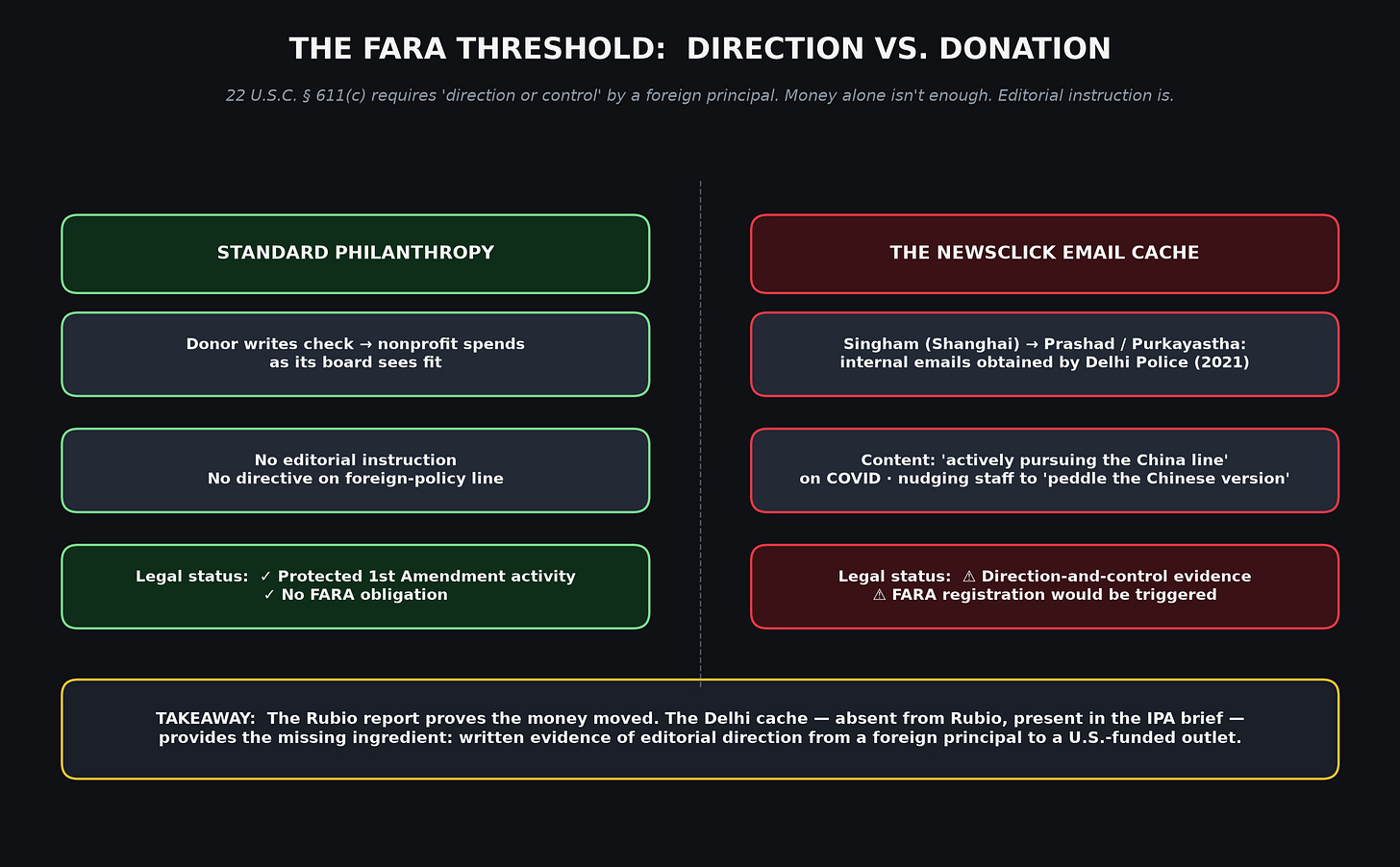
Foreign Agents Registration Act does not care how much foreign money crosses the border; it cares whether a foreign principal is directing what the American recipient says and does. The evidence that Singham crossed that line is not missing. It sits in an email cache the Delhi Police pulled off NewsClick’s servers in 2021 — and it is exactly what the Rubio report leaves out.
Layer 1: The source
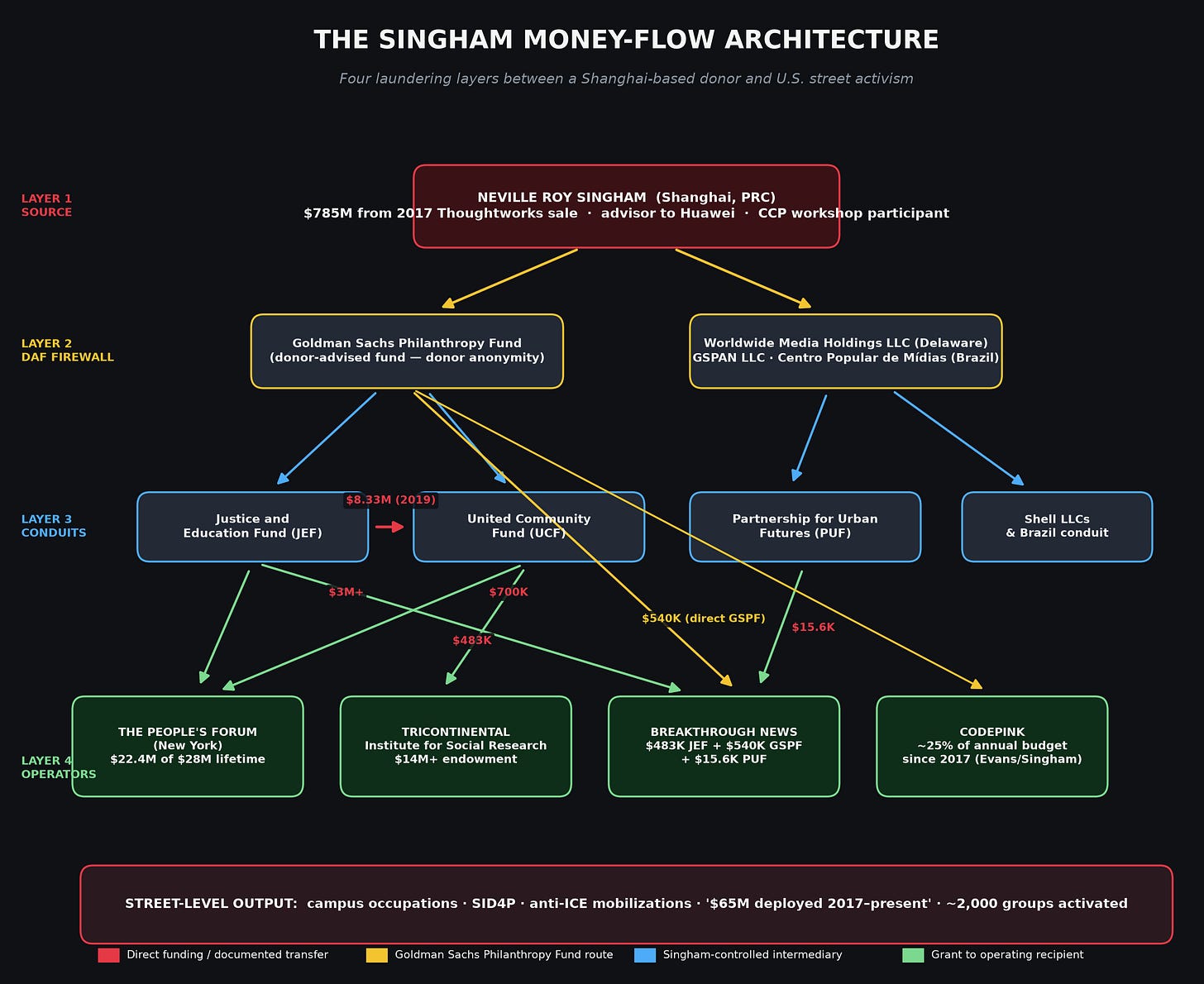
Singham sold his software consultancy, Thoughtworks, to the private equity firm Apax Partners in August 2017 for a reported $785 million (
The New York Times). Within months he had married Jodie Evans, the co-founder of CODEPINK, and moved to Shanghai. He now advises Huawei’s overseas messaging arm, sits in on ideological workshops run by Communist Party organs, and works out of an office that, according to the
Times, shares a floor with a CCP propaganda outfit.
Start there, because nothing downstream makes sense otherwise. The money that funds the network originates with one American citizen who lives in the People’s Republic of China, does business with a company on the U.S. Entity List, and makes no secret of sharing the CCP’s strategic worldview. If that person cut personal checks to American socialist nonprofits, the paperwork would land on a FARA desk at Justice and an exam file at the IRS inside a quarter. So he doesn’t.
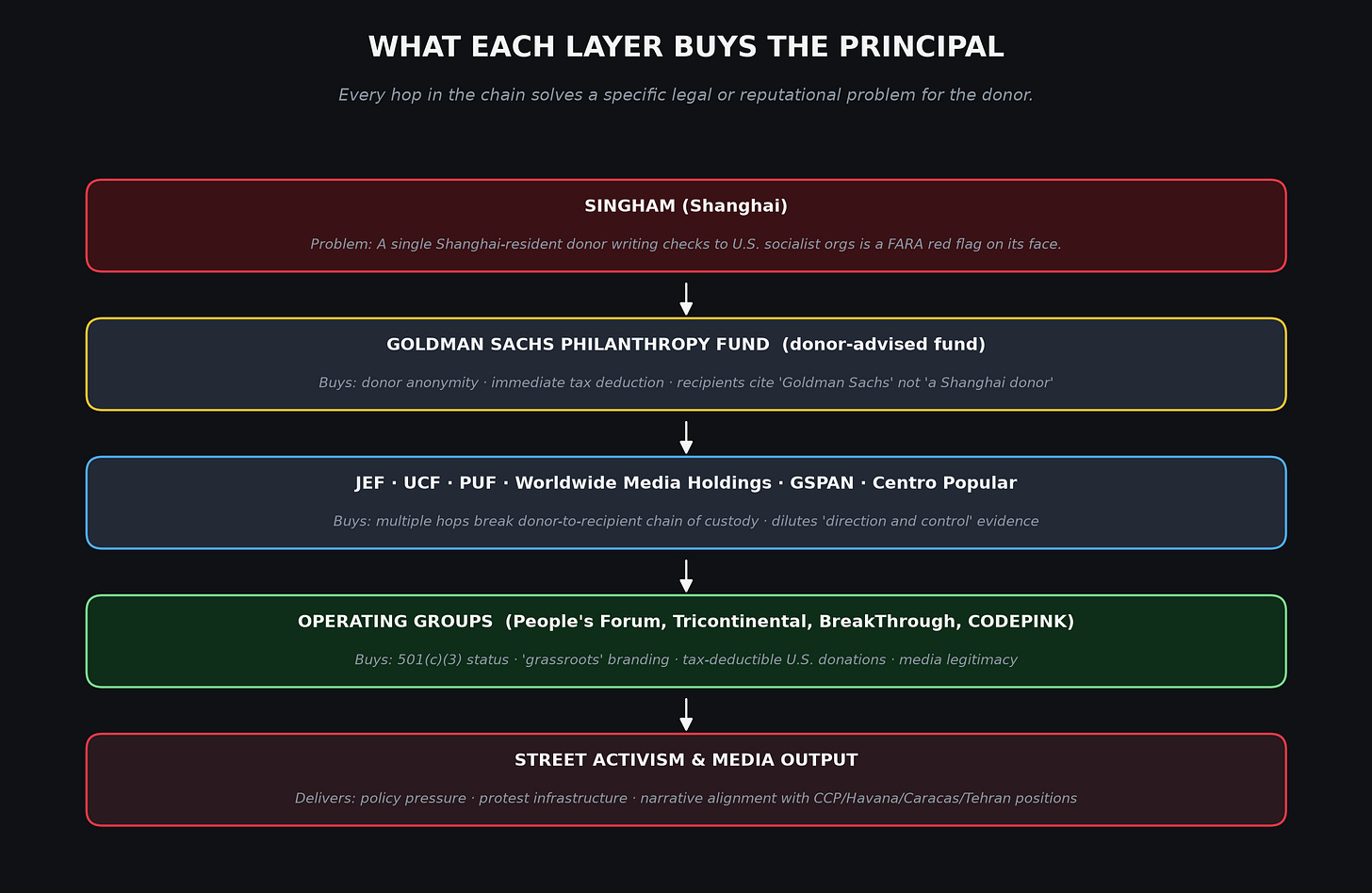
Layer 2: The donor-advised fund firewall
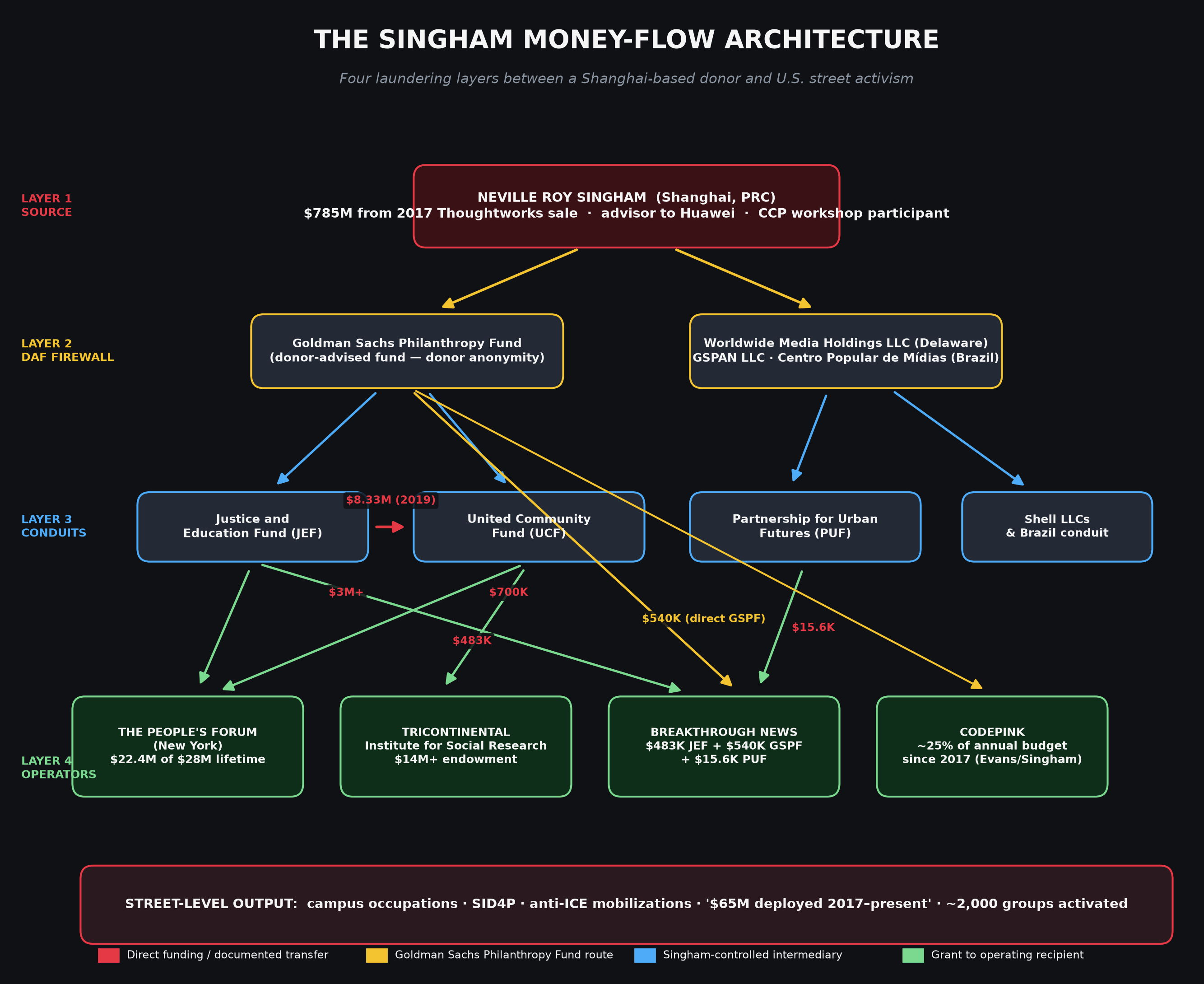
Singham’s giving flows almost entirely through two channels that are legally distinct but functionally identical:
donor-advised funds, primarily the
Goldman Sachs Philanthropy Fund, and shell LLCs — Worldwide Media Holdings, LLC (Delaware), GSPAN LLC, and Centro Popular de Mídias in Brazil (
Daily Beast, May 28, 2023;
InfluenceWatch: People’s Forum).
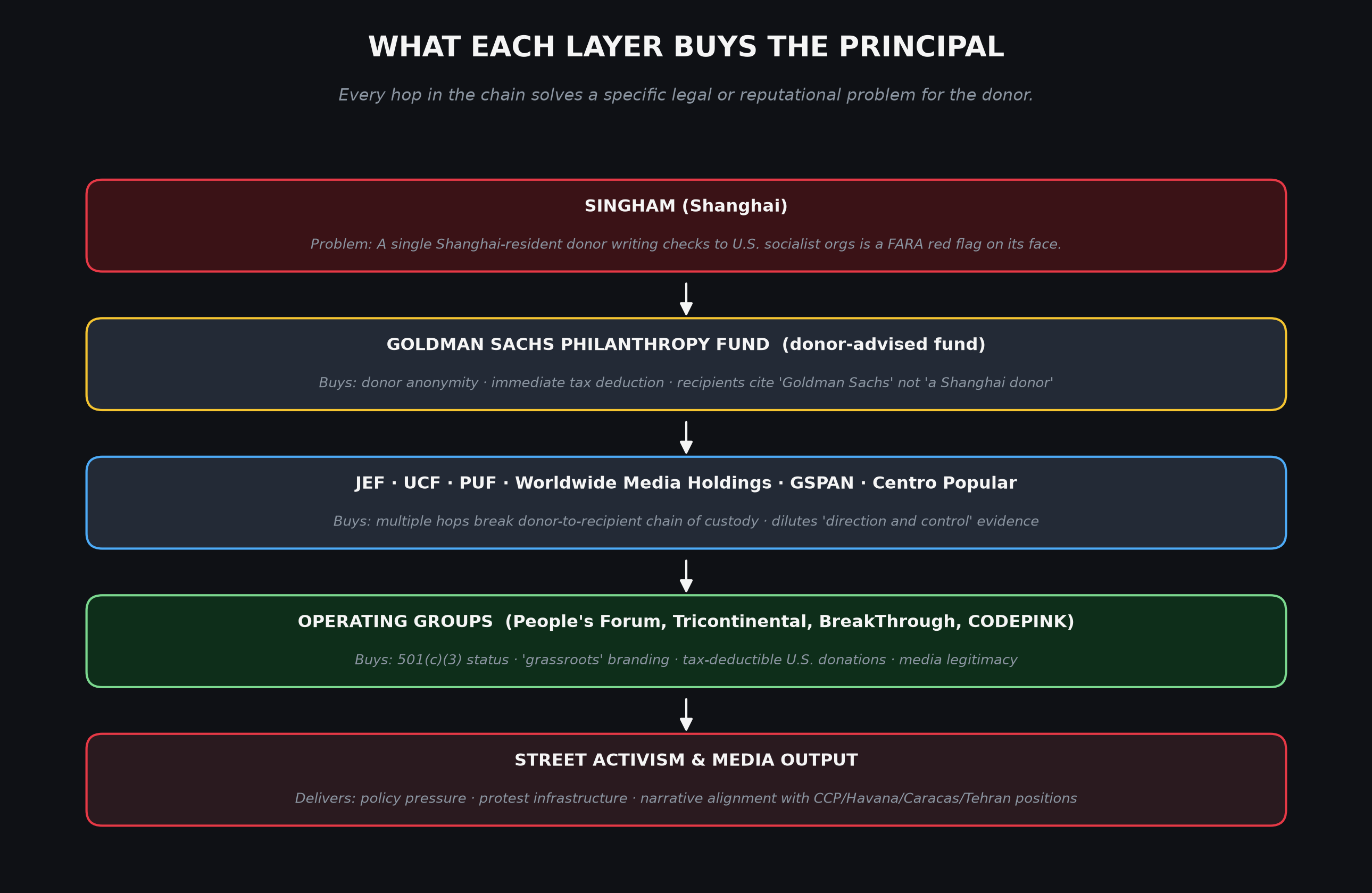
A donor-advised fund is the perfect firewall for this purpose. The donor irrevocably contributes assets to a sponsoring public charity (Goldman Sachs Philanthropy Fund is technically a 501(c)(3)), immediately claims the full tax deduction, and then “advises” the fund on where to grant the money. On paper, every downstream recipient receives money from
Goldman Sachs Philanthropy Fund, not from a Shanghai-based donor. The sponsoring organization is under no legal obligation to disclose who originated the money and generally does not. Recipients can — and do — truthfully state that their grants came from a mainstream American philanthropy.
The shell-LLC layer serves the same function for grants that don’t pass through the DAF, particularly overseas transfers to Tricontinental’s Brazilian arm and to the Chinese-language content operation (
The New York Times, 2023;
Daily Beast, 2023). Worldwide Media Holdings alone has been used to fund the news site Dongsheng and to underwrite operations in São Paulo.
Layer 3: The pass-through conduits
Between the DAF and the operating groups sit three ostensibly independent nonprofits that function as almost pure conduits: the
Justice and Education Fund (JEF), the
United Community Fund (UCF), and the
Partnership for Urban Futures (PUF). Their 990s show minimal independent programming and grant-making patterns that closely track the network’s operating priorities (
InfluenceWatch: Justice and Education Fund;
InfluenceWatch: United Community Fund).
The most revealing single transaction on the public record is a
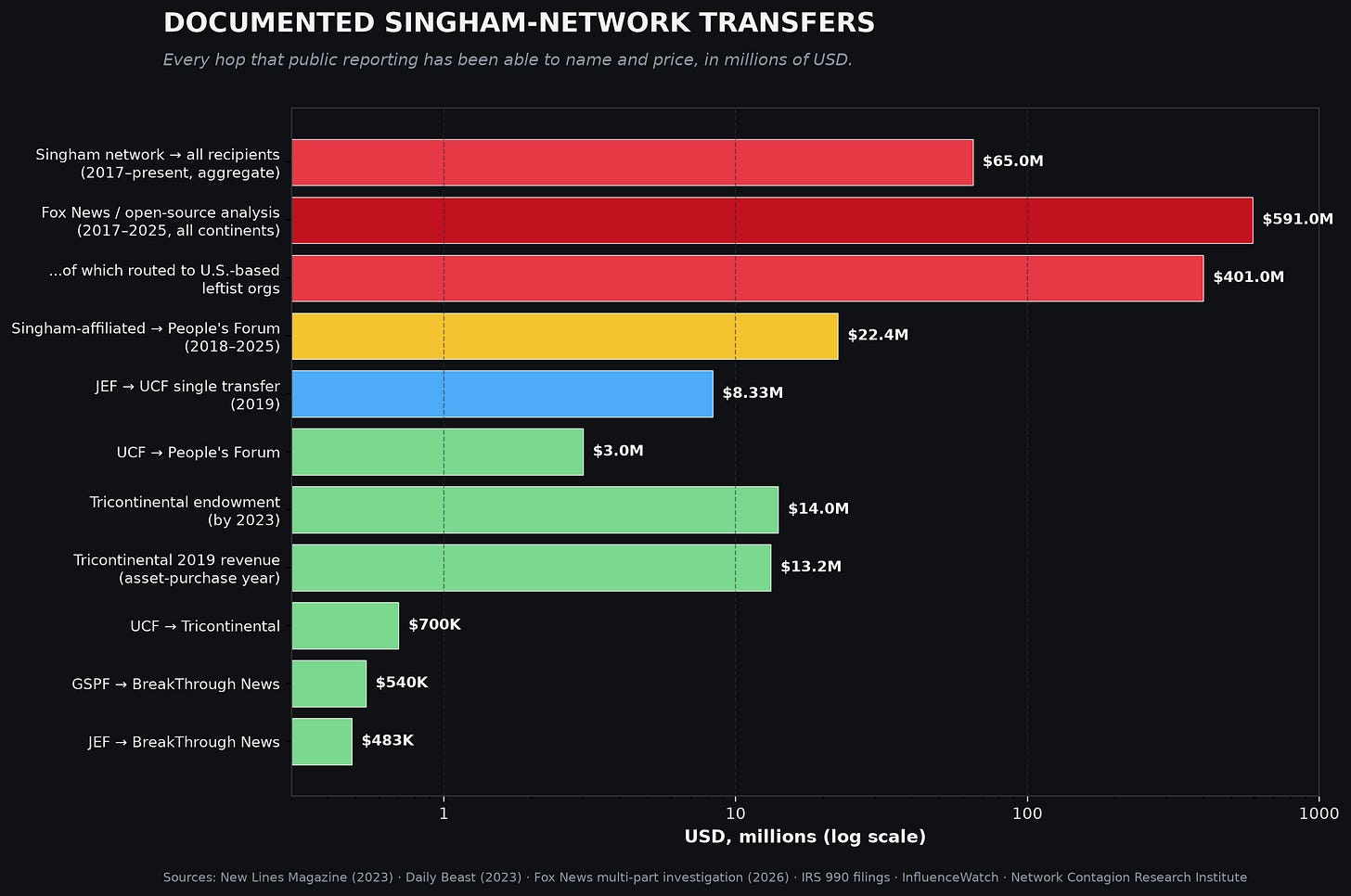
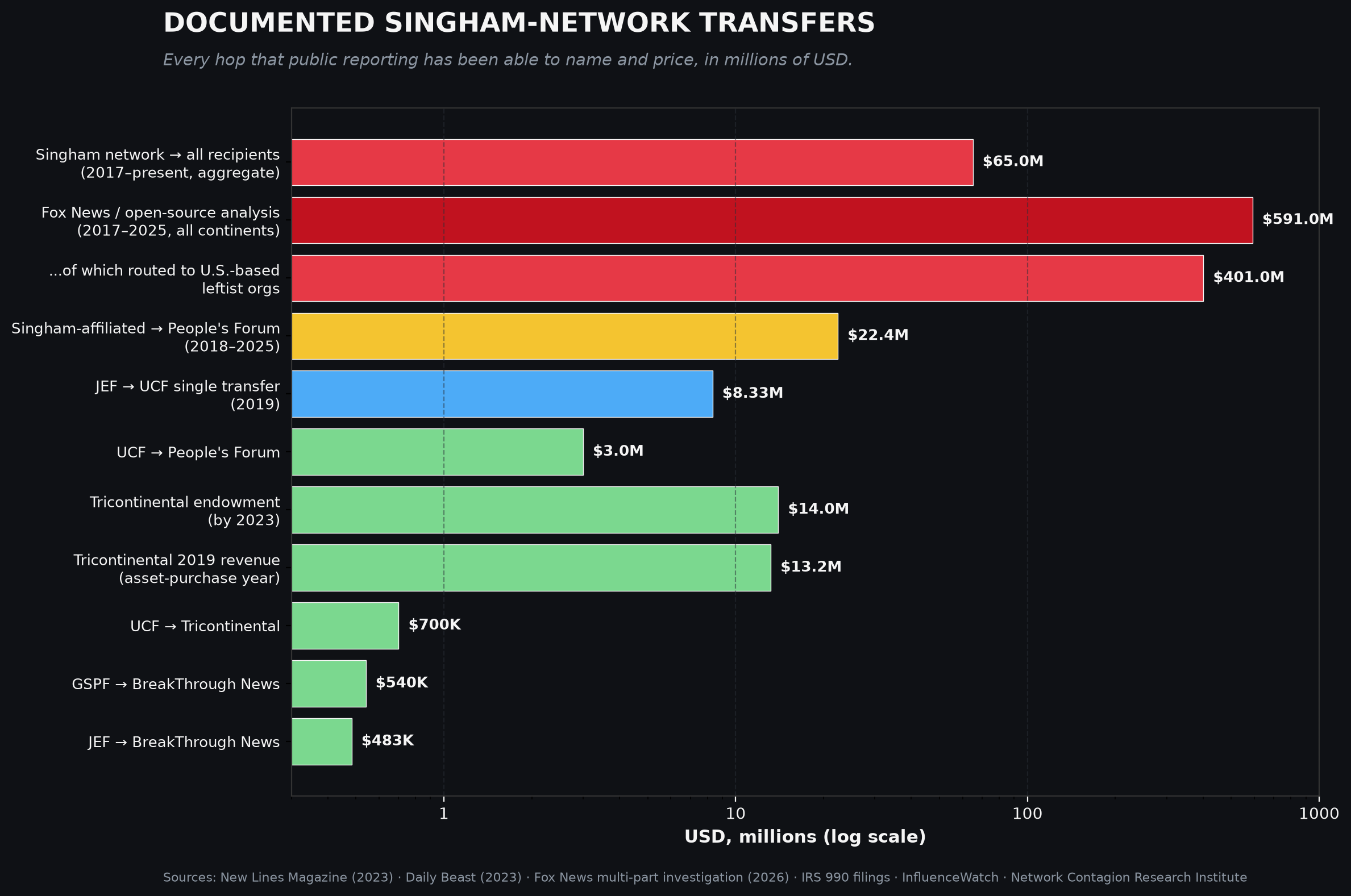
$8.33 million grant from JEF to UCF in 2019 — the year The People’s Forum acquired its $28 million Manhattan headquarters building on West 37th Street. UCF, in turn, granted $3 million to People’s Forum and $700,000 to Tricontinental. JEF granted $483,000 directly to BreakThrough News; PUF added another $15,600. Goldman Sachs Philanthropy Fund granted $540,000 directly to BreakThrough News, bypassing the intermediaries in a rare case where the donor evidently didn’t need the extra layer (
Fox News investigation, 2026;
InfluenceWatch: People’s Forum).
Layer 3 solves the
chain-of-custody problem. Even if a prosecutor were to establish that Goldman Sachs Philanthropy Fund distributions ultimately traced to Singham, the additional hop through JEF/UCF/PUF makes it materially harder to argue that Singham “directed” the operating recipient. Each intermediary has its own board minutes, its own grant-making procedures, its own paper trail of ostensibly independent decision-making. Direction-and-control evidence has to survive the dilution of multiple discretionary hand-offs.
Layer 4: The operating recipients
Four organizations do the visible work.
The People’s Forum, founded in 2018, is the flagship — a Manhattan “movement incubator” running out of a $28 million building on West 37th Street. Roughly $22.4 million of that lifetime funding traces to Singham vehicles (
Fox News;
Guardian). Its co-founders are Manolo De Los Santos, who the Rubio report says “was based out of Cuba for many years” before returning to New York to run the operation (
State Department, Ch. VII), and Claudia de la Cruz, the Party for Socialism and Liberation’s 2024 presidential candidate. De la Cruz now also runs the
Interreligious Foundation for Community Organization — the group Rubio identifies as the main U.S. logistical arm for evading the Cuba embargo.
Tricontinental: Institute for Social Research does the intellectual work. Vijay Prashad, the Marxist historian, directs it out of offices in São Paulo, New Delhi, Johannesburg, and Buenos Aires. By 2023 the institute had built a $14 million-plus endowment (
InfluenceWatch) — a number it discloses without ever telling its readers where the money came from. Revenue in 2019 alone hit $13.2 million. That was the year the network went on its buying spree.
BreakThrough News is the media arm. It launched in 2021 with staff pulled from the wreckage of RT America, and in its early years pulled $483,000 from JEF, $540,000 directly from Goldman Sachs Philanthropy Fund, and $15,600 from PUF (
Daily Beast). Its editorial line on China, Ukraine, Iran, and Venezuela is close enough to the
Global Times and RT that a reader flipping between them would struggle to name the difference.
CODEPINK, which Jodie Evans co-founded in 2002 as an anti–Iraq War group, is the case that gives the whole operation away. Since Evans married Singham in 2017, roughly a quarter of the group’s annual budget has come from his vehicles (
The New York Times). Its focus quietly migrated with the money: less about ending Middle East wars, more about defending Beijing’s line on Xinjiang, Hong Kong, and Taiwan. Former members have said as much on the record.
The point of this layer is legitimacy. These are 501(c)(3)s with American boards, American staff, American bank accounts, and American branding. Donations are tax-deductible. Speakers get booked at universities. Organizers testify at city councils. Producers land on cable news as peace activists or independent journalists. By the time anyone in that pipeline touches the money, Shanghai is three hops behind them, and nothing in the paperwork says otherwise.
How big is it, really
The $65 million number that New Lines Magazine landed on, and that most follow-up reporting has used, covers what could be documented flowing to Singham’s most visible American recipients between 2017 and roughly 2023. It’s a floor, not a ceiling. Fox News, working the story across a 2026 multi-part investigation, put the global figure at $591 million between 2017 and 2025, with $401 million of it going to organizations based in the United States (
Fox News). The House Ways and Means Committee, cross-referencing five years of IRS 990 filings, came in at the same order of magnitude (
Ways and Means, Sept. 3, 2025).
Pick the number you trust. None of them describe a scrappy protest movement getting by on bake sales. What they describe is a capitalized institution: a Manhattan headquarters, a translation and streaming stack, real estate on the books, and something like two thousand affiliated groups worldwide organized under the International Peoples’ Assembly umbrella (
Peoples Dispatch).
Why build it this way
Nothing about this structure is efficient. Genuine philanthropists move money in one or two hops because more hops cost more in legal fees, filing burdens, and lost tax efficiency. Four layers of donor-advised funds, offshore LLCs, and pass-through nonprofits exist to make one specific thing harder to prove: that a foreign principal is directing what the American recipients say and do.
That is the operative language of the
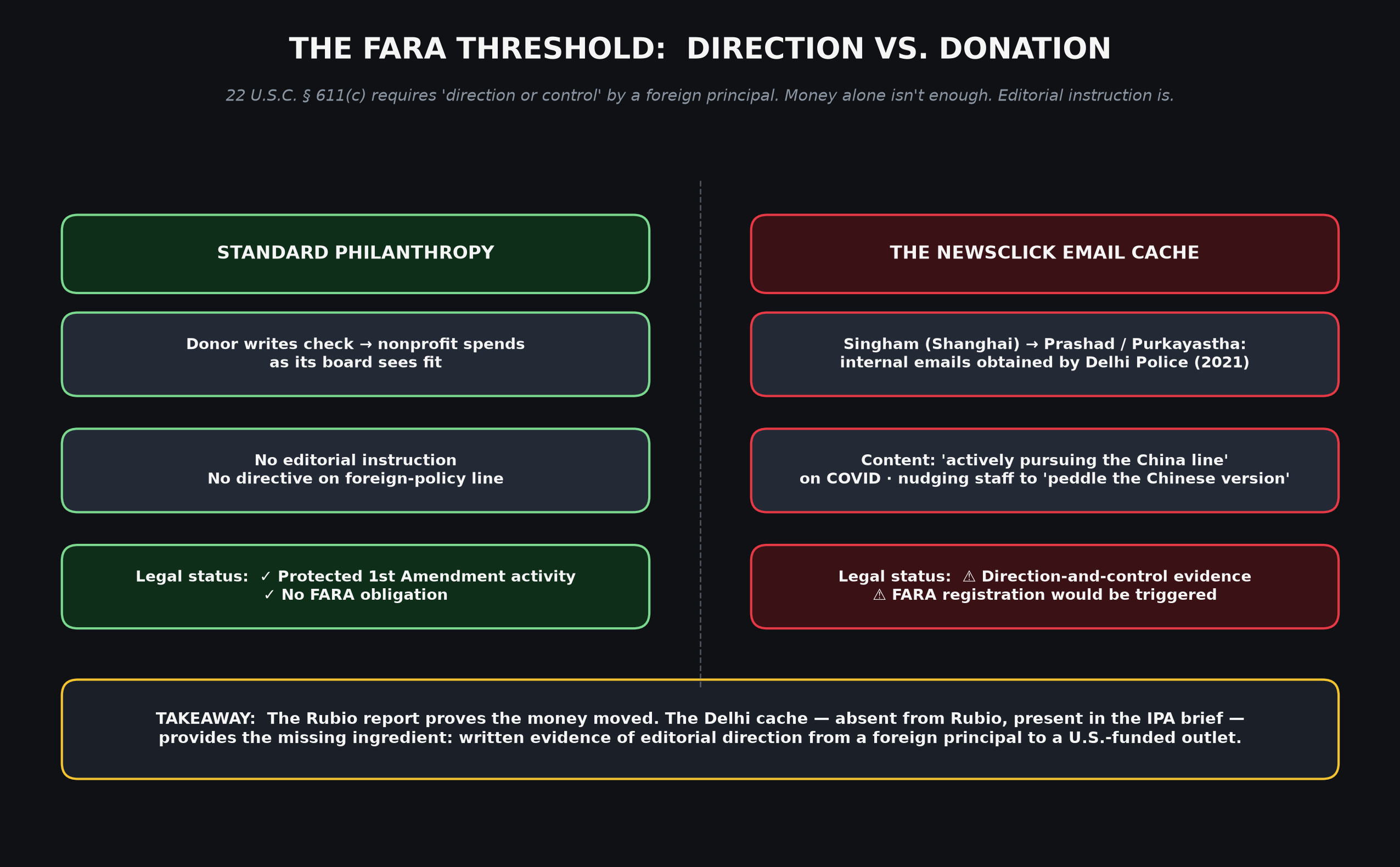
Foreign Agents Registration Act, 22 U.S.C. § 611(c). Foreign money in American politics is not itself illegal. What FARA requires is that anyone acting in the U.S. “at the order, request, or under the direction or control” of a foreign principal — to influence policy, opinion, or elections — register with the Justice Department, open their books, and stamp their output as foreign-agent material.
Ordinary philanthropy sits outside that regime. Write a check to a nonprofit, let the nonprofit’s board decide what to do with it, and you are exercising First Amendment rights that don’t depend on your passport or your politics. The load-bearing element is the recipient’s discretion.
The Singham operation is engineered to look like ordinary philanthropy from the outside and function as something else from the inside. Each of the four layers puts distance between the donor and the operating group in a way that a FARA case would have to unwind hop by hop — assuming a prosecutor could get near the internal communications, which for most of this network’s history has been the actual problem.
For most of this network’s history. Not all of it.
The Delhi cache
In 2021, Indian tax authorities opened a fraud investigation into NewsClick, the English-language outlet that anchors Singham’s South Asia operation and that shares personnel and editorial direction with Prashad’s Tricontinental. During the raid that followed, the Delhi Police pulled an internal email archive off NewsClick’s servers.
The New York Times obtained portions and reported them in August 2023. Indian outlets have published more.
The emails show Singham corresponding directly with NewsClick founder Prabir Purkayastha and with Prashad about what stories to run and how to frame them. In one exchange, on COVID-19 origins, he tells them to “actively pursue the China line” and “peddle the Chinese version” (
The New York Times).
That is not a donor being briefed on grantee activity. It is a foreign principal writing assignments. It is also, verbatim, the kind of contemporaneous written record that FARA cases are built on and rarely get. Indian authorities used it. Purkayastha was arrested under India’s Unlawful Activities (Prevention) Act in October 2023, and NewsClick’s operations have been substantially degraded since. The U.S. Department of Justice, which would have subpoena reach into the American end of the same correspondence, has not moved.
The Rubio report’s Chapter VII,
“Front Groups and Fellow Travelers,” names People’s Forum, CODEPINK, IFCO, and DSA — but on the Cuban side of the ledger, which is the report’s brief. It doesn’t address Singham, Prashad, Tricontinental, NewsClick, BreakThrough, or the IPA framework, because the Chinese vector is a different case file. A full FARA prosecution against these organizations would need both files on the desk. Rubio’s team delivered the harder one — the government has never before named this many American organizations as instruments of a hostile foreign state. The China half is still open.
Two principals, same nodes
The Cuban part of this is not news. The FBI documented Havana’s American front-group work through the entire Cold War, and the Rubio report is in many places surfacing material that has existed inside the government for decades. What’s new is that the same four organizations now serve as the American terminus for both Havana
and — via Singham — Beijing.
People’s Forum’s senior ranks include people the State Department describes as Cuba-embedded operatives (
Ch. VII). IFCO/Pastors for Peace, per the same chapter, has been the logistical backbone of the “Friendshipment Caravans” — the material shipments that have moved humanitarian and dual-use goods to Cuba in defiance of U.S. sanctions since 1992. The
National Network on Cuba, coordinating about forty solidarity groups, published a “National Rapid Response Plan” in June 2026 that names 1,335 U.S. military facilities as targets for protest and disruption, using a map produced by the
Black Alliance for Peace. And Rubio’s report is careful on DSA: the group’s foreign-policy positions track Havana’s not because DSA answers to Cuban intelligence — “the group is [not] controlled by Cuban agents, per se” — but because Havana’s line has become “the de facto policy orthodoxy on the American far left.”
Manolo De Los Santos and Claudia de la Cruz are where the two funding streams touch the same people. Both run People’s Forum. De Los Santos spent years living in Cuba. De la Cruz runs IFCO and was PSL’s presidential nominee in 2024. On one side of their desk, Singham-network money underwrites the payroll. On the other, Cuban political direction shapes what the payroll is asked to do. No one has to have coordinated anything. Both principals put money and attention into organizations that were already good at moving American opinion in useful directions, and the organizations were happy to take both.
What the file actually proves
Read together, the two documents say three things.
Rubio establishes that a network of U.S. organizations operates as a de facto extension of Havana’s foreign policy and is not registered under FARA. The IPA brief establishes that a China-based American citizen has been capitalizing much of the same network through a four-layer structure engineered to defeat direction-and-control analysis. The Delhi emails establish that the direction-and-control exists in writing anyway.
Any one of those, in a previous decade, would have opened a Justice Department file. None has yet. Rubio’s report is the first time in a generation that the U.S. government has been willing to name specific American organizations as instruments of a hostile foreign state’s foreign policy. The Chinese half of the same picture — the Singham file, the Delhi cache, the IPA architecture — has not yet gotten its own report. Whether it does, and who writes it, is the follow-up question this document leaves on the desk.
The bottom line
This is not an activist subculture that happens to attract foreign donors. It is a foreign-capitalized political infrastructure with an American activist subculture painted on the front. The four laundering layers exist because each one blocks a specific line of inquiry — donor identity at the DAF, chain of custody through the intermediaries, foreign-agent scrutiny at the operating groups.
The distance between what the Rubio report established on July 20 and what a full FARA case would need is one email archive that a foreign police service has already collected and that American reporters have already partially quoted. That is a much shorter distance than the coverage of either document has suggested. Closing it is the American national-security story of the next year.


 www.foxnews.com


en.wikipedia.org