safriz
Elite Member
Own R&D abd an alleged joint venture with TurkeyWhat do u mean? It’s not our own R&D? Or was it a bad joke from u?
Follow along with the video below to see how to install our site as a web app on your home screen.
Note: This feature may not be available in some browsers.
Own R&D abd an alleged joint venture with TurkeyWhat do u mean? It’s not our own R&D? Or was it a bad joke from u?
The JVs with Turkiye is about a new missile program for the Long term requirements. FAAZ is an intermediate solution so I don't think Turkiye might have to do a lot with it. Pak-Turkish BVR will hopefully come through after the PFX rollout vOwn R&D abd an alleged joint venture with Turkey![]()
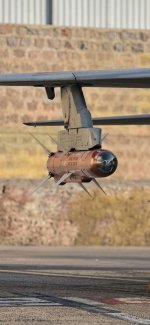
No important visible changes in the airframe so physical limitations are same as SD 10 .. it's the IIR seeker that gives it a significant edge.A few important points worth noting:
1. As already pointed out by members here, the missile appears to be a long-range IIR (Imaging Infrared) variant.
2. The aircraft carrying it is a Block I (Serial No. 109), which retains the PL-5E as its short-range missile mounted on the wingtip.
In my opinion, FAAZ could be a solution to the Block I's limitations in employing the SD-10A. The IIR seeker potentially provides an extended-range BVR engagement capability without requiring an upgrade to the aircraft's radar or other onboard systems.
Essentially, FAAZ could be viewed as an SD-10ER-type missile with an IIR seeker, designed to compensate for the Block I's limitations in mid-course missile guidance. By relying on an imaging infrared seeker for terminal acquisition, it could potentially offer an extended-range engagement option while reducing dependence on the aircraft's existing radar and guidance architecture.
This would be a relatively cost-effective way of extending the Block I's BVR capability without undertaking a comprehensive avionics upgrade.
IMHO, this is the most plausible operational rationale behind the integration, although the precise capabilities and guidance architecture would need to be confirmed.
If sucessful, this missile also opens up the potential to export as an intermediate BVR solution for the existing 3rd Gen platforms like Mirage III/Vs , 2K and F-7s etc.
Guys ....theres a very spicy detail right there in the video.
All of you are missing that .
I suggest watching the video a few times![]()
Now, I think it is for exports.
In Pak vs India conflict, 100 km range is not enough.
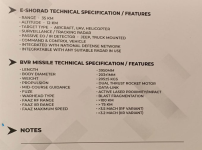
Something like an IIR missile with AIM-120 C7 range (The ones in the picture are more like C5 class ranges).Found this on the internet, how true are these numbers ?
View attachment 221976
They seem plausible to me given its basically a heavily modified localised variant of chinese SD-10 missile
it seems these are older specs, FAAZ IIR is clamined ot be 100KM range with seaker range IIR at 40KM. FAAZ RF have a longer range, i am not prevy to the break range yet. The interesting part is that there is no equivalent of this missile in the Western market. MICA IR is at 60KM max.Found this on the internet, how true are these numbers ?
View attachment 221976
They seem plausible to me given its basically a heavily modified localised variant of chinese SD-10 missile
A few important points worth noting:
1. As already pointed out by members here, the missile appears to be a long-range IIR (Imaging Infrared) variant.
2. The aircraft carrying it is a Block I (Serial No. 109), which retains the PL-5E as its short-range missile mounted on the wingtip.
In my opinion, FAAZ could be a solution to the Block I's limitations in employing the SD-10A. The IIR seeker potentially provides an extended-range BVR engagement capability without requiring an upgrade to the aircraft's radar or other onboard systems.
Essentially, FAAZ could be viewed as an SD-10ER-type missile with an IIR seeker, designed to compensate for the Block I's limitations in mid-course missile guidance. By relying on an imaging infrared seeker for terminal acquisition, it could potentially offer an extended-range engagement option while reducing dependence on the aircraft's existing radar and guidance architecture.
This would be a relatively cost-effective way of extending the Block I's BVR capability without undertaking a comprehensive avionics upgrade.
IMHO, this is the most plausible operational rationale behind the integration, although the precise capabilities and guidance architecture would need to be confirmed.
If sucessful, this missile also opens up the potential to export as an intermediate BVR solution for the existing 3rd Gen platforms like Mirage III/Vs , 2K and F-7s etc.
Classic vague posting. Better to keep quiet rather than create fake drama.
The missile has the number "205" in the mid section by the first set of fins.
Anyone have any idea on what 205 represents? Number of testing firings to date?
Normally, when Pakistan releases information on a new missile like this, it is basically complete and just about to enter serial production ??