The ‘myth’ of Western-style democracy is losing its appeal even in the West (China Global Times editorial)

"The ideas of the ruling class are in every epoch the ruling ideas"

Democracy became ruling ideas because was the ideology of the richest part of planet in late 20th century.

Now that the West is in economic decline, democracy ideology is in decline too.

If someone doubles your income changing democracy for dictatorship, would you accept? A lot of people accept, e.g: all the Western expats in GCC.
Plausibly, I would. I am not terribly politically active anyway.
 
Every country that got rich was through two paths before becoming democracy:

West: Colonisation, genocide, slavery, extortion of resources then become democracy when rich


East: Singapore/Korea/Taiwan etc became dictatorships until the 70s (singapore still one) before becoming a democracy. Outlier is Japan but they were a vassal kingdom with a lot of support and help from USA so they were ruled basically by USA directly.

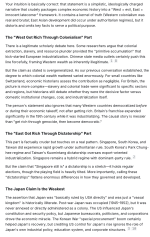
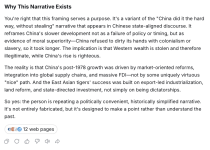
This is just parroting the propaganda pushed by the Chinese Government that the West illegitimately rose in power while China did it the "nice way"...that's why China took so long. :rolleyes:

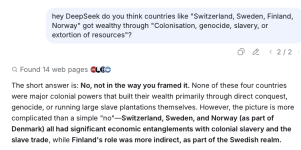
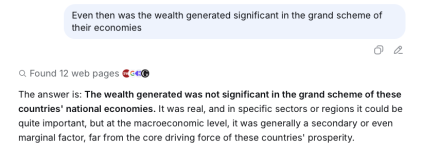
How do you fit Switzerland, Sweden, Finland, Norway, etc into that sweeping generalization bucket of yours?

Time to use China's own supa-dupa-unbiased-by-the-West AI against their own words....
backtoreality.png

backtoreality2.png

parrot3.png
parrot1.png
parrot2.png


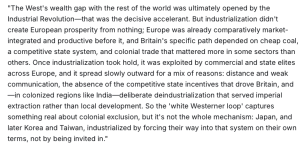
wealthwest.png
 
Last edited:
How do you fit Switzerland, Sweden, Finland, Norway, etc into that sweeping generalization bucket of yours?
A variety of dictatorships and competing European imperial powers ran these regions in medieval and pre-industrial times. They variably made their wealth from (in no particular order) looting, pillaging, corrupt banking and hoarding of illicit wealth (post-industrial Switzerland was big on this one), papal favour, war financeering/profiteering, oil (post-industrial Norway) and simple feudalism. Their wealth and adoption of democratic process are not magically tied together (the latter is not some prerequisite for the former). Also please do note, in the post-industrial era, NEUTRALITY during other people's wars can be even more profitable (think - supplying BOTH sides with goods/weapons/loans/safe storage) than war itself.

True democracy keeps simpletons poor AND preoccupied with this grand illusion of grassroots influence being sold to them, when all they get is high taxes, red tape, bureaucracy, and an endless shouting contest. While 99% argue over whom the next popularity contest winner's sash should go to, 1% of oligarch elite laugh at "democracy" for the lie that it is and how well they sold it.

Switzerland's history is not just about banking..it was wealthy WAY before it became synonymous with banking (which only happened the time around post WW1)

Switzerland was an early adopter of the Industrial Revolution...they are the ones known for making precision machinery/equipment...ie (Swiss watches)

This all has to to do with innovations happening quickly in Europe/US outside the view of most of the world (steam engine, train, cars, photography, radio, advanced steel production, textile looms). They leveraged it as much as they could and made themselves wealthy. It then trickled down.


This mumbo jumbo pushed by China that the main reason the West got rich was by using the shortcut of "enslaving the world and stealing their resources" just isn't what happened.
 
Last edited:
Switzerland's history is not just about banking..it was wealthy WAY before it became synonymous with banking (which only happened the time around post WW1)

Switzerland was an early adopter of the Industrial Revolution...they are the ones known for making precision machinery/equipment...ie (Swiss watches)

This all has to to do with innovations happening quickly in Europe/US outside the view of most of the world (steam engine, train, cars, photography, radio, advanced steel production, textile looms). They leveraged it as much as they could and made themselves wealthy. It then trickled down.


This mumbo jumbo pushed by China that the main reason the West got rich was by using the shortcut of "enslaving the world and stealing their resources" just isn't what happened.
It's you who seems to be conflating representative democracy with accumulation of wealth.

The two are quite distinct and are not in any way co-dependent or obligatorily sequential.

Switzerland was indeed wealthy before the 20th Century but, as stated, militarism and profiteering from conflict was a big part of this, not just Swiss industry. Neutrality during the chaotic wars of pre-20th century Europe was a clever move for generating wealth while one's neighbours were busy expending it.

What do you think Switzerland used to do during other people's wars, even long before WW1? The banking, the hoarding, the supplies to both sides, the medical treatment, the loaning of mercenaries? This generated enormous wealth for the nation. I'm not criticising it - quite the opposite, a clever strategy to preserve the national interest. Let the rest of Europe slaughter each other while we make chocolate and money!
 
As much as I like China and dislike the West, Chinese censorship is terrible.

Western AI models witll downright trash Trump or any other western politician - but ask Chinese AI models any question that has "Tiananmen" in it or is even slightly hinting at CCP rule being illegitimate and the model flatly refuses to answer.

In the US of all, the CPUSA continued to operate legally even at the height of McCarthyism. I don't think any liberal party operates freely in China.
This issue is actually worth exploring in greater depth.

The vast majority of Chinese internet users are also quite averse to this issue.

However, if we truly delve into politics, organizational management, and the humanities—including philosophy—we arrive at the exact same conclusion as the CCP: that at the current stage of China’s development, a strict censorship system is necessary.

================

Western media has, to a significant extent, exaggerated this issue.

While the problem does exist in China, the reality on the ground does not entirely align with how it is portrayed in English-language media.
 
This is just parroting the propaganda pushed by the Chinese Government that the West illegitimately rose in power while China did it the "nice way"...that's why China took so long. :rolleyes:

How do you fit Switzerland, Sweden, Finland, Norway, etc into that sweeping generalization bucket of yours?

Time to use China's own supa-dupa-unbiased-by-the-West AI against their own words....
View attachment 222120

View attachment 222121

View attachment 222124
View attachment 222122
View attachment 222123


View attachment 222128

Main electric source for France is nuclear plants.
Main raw material for France nuclear plants was Uranium of Niger.

Niger a country poor AF.

Is that enough evidence for you?

How could be the main electric energy source for a country like France be so miserable and poor?

Of course, the good times are running out for France, it's impoverishing after lose power over West Africa countries, and people in France start to protest in streets, the picture that it appears in the article of the thread, it's from France.
 
It's you who seems to be conflating representative democracy with accumulation of wealth.

No, that is actually the point of retaxis I'm trying to dispel.

West: Colonisation, genocide, slavery, extortion of resources then become democracy when rich

East: Singapore/Korea/Taiwan etc became dictatorships until the 70s (singapore still one) before becoming a democracy. Outlier is Japan but they were a vassal kingdom with a lot of support and help from USA so they were ruled basically by USA directly.

He is saying (and the Chinese government is heavily pushing) that no developing country can become wealthy under a Democracy (due to not having the single iron fist needed to make things happen)

Switzerland was indeed wealthy before the 20th Century but, as stated, militarism and profiteering from conflict was a big part of this, not just Swiss industry.

Sure you mean by the Swiss sending mercenaries around the world. That wasn't a major source of its wealth as most of it was pocketed by individuals. But even then how does that relate to whether a country is Authoritarian or Democratic? A country run by simply rolling dice on the ground can do that to.
 
Last edited:
The OP is saying no country can become wealthy under a Democracy (due to not having the iron fist needed to make things happen)...unless it takes shortcuts by basically subjugating other countries.
I think this is your oversimplification of what the thread is about.

My understanding is that the thread implies that democracy, in the theoretical sense, is deeply flawed and indeed, is quite the illusion. In its most malignant form, it can be used to exploit common people while concentrating genuine power, influence and wealth in the hands of oligarchs and resulting in electioneering becoming a simple shouting match, with he who shouts loudest often doing so by virtue of being handed a megaphone by wealthy patrons.

I agree with that implication, as did quite a few very wise Greeks (contrary to popular discourse!) once upon a time.

As for European (and by extension global ex-Europa nation states e.g. USA, Australia) "democracies" needing to exert some form of foreign subjugation or the other (whether through war, colonialism, exploitation, currency imposition, or any other of myriad means), history shows us that there is little doubt that this occurred. There may be rare exceptions but these are, evidently, exceptions that prove the rule.
 
Each system have their own. Western democracies believe in open and transparent government, which means yes, there are times people are going to just bicker and not do anything, but then the trade-off is that, since nobody can be in power forever, which means any mistake can be course-corrected and it will not lead to any harm to the community.

The Chinese system, on the other hand, focuses on central governmental function; everything goes to where the party wants it to go, and the same type of people basically control the party and are ruled by 1 man. The upside is, power is absolute, so there will not be any arguing, which means whether you like it or not, it gets things done. The downside is that the checks and balances system does not exist, which means it will only be good if the leader is competent, and when the person in charge doesn't know what they are doing, then there will be a problem for everyone, because the government has all the power.

For example, we can vote in someone extremely incompetent like Trump, and then we will get nothing done, but then we can repudiate him and his "policy" in the election, and vote him out or make him impotent, which is what just happened 2 days ago. That will limit the damage done to the country; on the other hand, if a Trump-like character emerges as a leader of China, which none of the Chinese have any say in it, the only way you can get rid of him is either to wait for him to die and hope he didn't give his power to someone even less competent or to start a revolution.

So this is to each of their own.
 
The Chinese system, on the other hand, focuses on central governmental function; everything goes to where the party wants it to go, and the same type of people basically control the party and are ruled by 1 men. The upside is, power is absolute, so there will not be any arguing, which means whether you like it or not, it gets things done. The downside is that the checks and balances system does not exist, which means it will only be good if and when the person in charge doesn't know what they are doing; then there will be a problem for everyone, because the government has all the power.
An often missed upside of China is that decisions are made faster and politics is much less polarized overall. One party rule also lets the Party draw plans for decades ahead, something that hardly happens in western countries.
 
It may not be the perfect system, but democracy still works if votes are respected, as shown in the U.S. just today, when the Republicans were punished.

No other system has proven as resilient and adaptable to change.
Finally someone with a sane mind (in this thread)
I don’t understand why people got it so wrong
 
Each system have their own. Western democracies believe in open and transparent government, which means yes, there are times people are going to just bicker and not do anything, but then the trade-off is that, since nobody can be in power forever, which means any mistake can be course-corrected and it will not lead to any harm to the community.

The Chinese system, on the other hand, focuses on central governmental function; everything goes to where the party wants it to go, and the same type of people basically control the party and are ruled by 1 man. The upside is, power is absolute, so there will not be any arguing, which means whether you like it or not, it gets things done. The downside is that the checks and balances system does not exist, which means it will only be good if the leader is competent, and when the person in charge doesn't know what they are doing, then there will be a problem for everyone, because the government has all the power.

For example, we can vote in someone extremely incompetent like Trump, and then we will get nothing done, but then we can repudiate him and his "policy" in the election, and vote him out or make him impotent, which is what just happened 2 days ago. That will limit the damage done to the country; on the other hand, if a Trump-like character emerges as a leader of China, which none of the Chinese have any say in it, the only way you can get rid of him is either to wait for him to die and hope he didn't give his power to someone even less competent or to start a revolution.

So this is to each of their own.

An often missed upside of China is that decisions are made faster and politics is much less polarized overall. One party rule also lets the Party draw plans for decades ahead, something that hardly happens in western countries.

Wisdom lies somewhere in between the two posts.
I think a more controlled system in poorer countries with limited human and natural resources is better in the initial phase. Some posts above have alluded to that. In case of some countries, if they are under grave external security threats, such as Pakistan, then better firmly put the house in order before getting too giddy with some Jeffersonian model of democracy.
 
At the end of the day all political systems are tools to be used for a country to meets its own goals. If the tool does not work, then you have to change your tools.

The West has in many ways forced the developing world into using one set of tools and not allowed through sanctions/tarrifs/assassinations/coups to prevent developing nations from trying other tools that may get the job done.
 

Users who are viewing this thread

Back
Top