The ‘myth’ of Western-style democracy is losing its appeal even in the West (China Global Times editorial)

Socialism originally meant (and still means) an economic system in which private ownership of the means of production has been abolished.

If you don't call German ordoliberalism and France under dirigisme socialist, you shouldnt call China socialist either.
It is normal for foreigners to hold such views about China.

From a political science perspective, the fundamental distinction between capitalism and socialism lies in the difference between public and private ownership, as well as in the mechanisms of distribution.

China does not fully subscribe to an idealized—or radical—form of socialism, nor would such a system be suitable for us. At the same time, we do not fully endorse a form of capitalism that operates strictly according to the "law of the jungle." Therefore, China at this stage has achieved a model that combines the two, namely socialism with Chinese characteristics.

In China, the terms "within the system" (*tizhi nei*) and "outside the system" (*tizhi wai*) are frequently used to distinguish between two distinct social and economic models. "Within the system" essentially refers to state ownership—a model leaning toward socialism—while "outside the system" refers to the private sector, which leans toward capitalism. Both systems coexist within Chinese society.

The "within the system" economy does not prioritize the pursuit of market profit; rather, its core objectives are national stability and state security. In contrast, the "outside the system" economy aligns with the Western capitalist model, operating according to the principles of a pure market economy.

It is often difficult for foreigners to grasp the full scope of China’s "within the system" economy; they are generally more familiar with the "outside the system" sector. That said, these two models are increasingly interpenetrating and merging. Many state-affiliated enterprises have begun to experiment with operational methods characteristic of the private sector, while some private enterprises have, in turn, begun to integrate into the state-led system.

In short: the "within-the-system" economy serves as the foundation and backbone of the Chinese state, while the "outside-the-system" economy acts as its branches and leaves.
Ok but what are the criteria that make China socialist that aren't just "China calls itself socialist so it's socialist"?

If you give 100 people a description of the economic system of China on one hand and Germany, France or Sweden on the other, what are the objective, neutral criteria that would allow the vast majority of them to deduce that country 1 (China) is socialist and countries 2, 3 and 4 (France, Germany, Sweden) are not?
 
Ok but what are the criteria that make China socialist that aren't just "China calls itself socialist so it's socialist"?
If we use "public ownership versus private ownership" to distinguish between capitalism and socialism, then yes, China does indeed fall under socialism.

This is a very simple, typical classification.

However, it is clear that socialism in China differs from socialism as understood in the West—at least in terms of its outward manifestations. Consequently, many Westerners conclude that China does not qualify as socialist.

In the official terminology of modern China, we use neither "socialism" nor "capitalism"; instead, we define the system as "socialism with Chinese characteristics(中国特色的社会主义)."
 
I am waiting for the day China overcomes USA as the world's largest economy in NOMINAL GDP. Then we can say China has truly done it.

Like China overcame Japan's NOMINAL GDP in 2010.
That would be a great moment for China, probably going to happen before 2049 the 100 years founding of PRC. Or it could happen much sooner with Chinese curency RMB expected to appreciate significantly in the coming year.

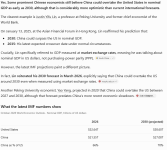
Considering the US has nearly caught China in terms of real growth added, China surpassing US GDP is highly unlikely at this point. US GDP will reach $40T by 2031 and exceed $50T before 2040.

An that’s with the US having 3X Chinas PPP per capita. The reality is China has massively underperformed pre Covid economic expectations and the US has exceeded them.
 
Are you fxxking kiding me?

How many high-ranking have been removed? The central military committee only has two left, including Xi.

The system is different, still pretty bad.

So it is more "smart people...who just also happen to think like the guy in charge"
 
I keep coming back to this whenever the socialism versus capitalism debate comes up: there is what the state says on paper, and then there is what is actually happening on the ground, and sometimes that disconnect is written into the law itself. The land in Vietnam is still, even today, "owned" by the people as a whole.
 
nowadays patriotic sovereign dictatorships (China) work far better than vassal democracies (Europe).

USA is a sovereign democracy, it works well if you have a good job, it has a stable future unlike vassal democracies who go straight and fast towards the cliff.

of course if there is something worst is a vassal dictatorship like current Ukraine or 1970s Latin America op condor regimes.

GCC enjoyed good life standards, but if they keep following Iran war stupid plans, it could be the end of all them.

You guys are generalizing things to "only the US and China are successes..everybody else doesn't count"
 
If Cuba abandons communism either peacefully or militarily, it would become an ordinary Latin country that is too far from heaven, too close to America. Communism brings order to Cuba, which is latin American countries need most.

No country became any better after color revolution conducted by US. Cuba won't be an exception. It is US you should blame for Cuba's poverty. Not communism.

Cuban diaspora in USA is one of the most successful diaspora in USA and they are next to Cuba, concentrated in Miami.

If they could invest in Cuba... the country economy would lift like a rocket.

Cuban people are very educated people but with little material means.
 
Considering the US has nearly caught China in terms of real growth added, China surpassing US GDP is highly unlikely at this point. US GDP will reach $40T by 2031 and exceed $50T before 2040.

An that’s with the US having 3X Chinas PPP per capita. The reality is China has massively underperformed pre Covid economic expectations and the US has exceeded them.
China already has a larger economy than USA's in GDP Power Purchasing Parity PPP.
 
Remember, the USA used to have no standing army. It gave anyone 50 acres, as long as you reached the Wild West.

No, that 50 acres was a British colonial policy. it was phased out by the US in all states by around 1800 before the notion of the "Wild West". You are conflating things.
 
This is becoming yet another $ick measuring contest. I will summarize what I myself believe in this debate: The Europe-based Western civilization is the flower of humanity. It had paid a heavy price over the last 5 centuries to come to this stage of contributing where there is respect for dissent, there are the human rights, and much more and has greatly contributed, directly and indirectly, to lifting billions out of poverty across the globe.

However, to get to the enlightened state of the Western civilization, the poorer nations should not automatically adapt some Western models of 'democracy'. Such nations should first, under strict state control, introduce literacy, lift up living standards, provide security to its citizens and once a higher state of existence is achieved in a nation then--and only then-- experiment with the lofty ideals of the West.
 
That would be a great moment for China, probably going to happen before 2049 the 100 years founding of PRC. Or it could happen much sooner with Chinese curency RMB expected to appreciate significantly in the coming year.
When do the Chinese Economists expect China to overtake USA economically in NOMINAL GDP? As soon as 2030?
 
China already has a larger economy than USA's in GDP Power Purchasing Parity PPP.

PPP doesn’t matter in terms of national economic power. Prices may be lower domestically but that doesn’t translate to having more wealth. China surpassed the US in PPP a decade ago and economists didn’t care and why everyone still recognizes the US as the number one economic power.
 

Users who are viewing this thread

Pakistan Defence Latest

Back
Top