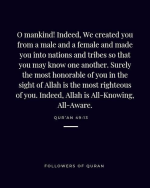
Towards a Pakistani Islamic Renaissance: Reconstructing the State, Reviving Civilization, and Developing the Individual

Of course, this is the true core of the problem.

You are, of course, free to hold on to your own beliefs and principles; we have no right to criticize you for that.

However, when you interact with non-Muslim groups, this can become a fundamental obstacle.


For our part, we define your identity based on your nationality—for instance, whether you are Pakistani, Lebanese, British, American, and so on. As for the religion you practice, that is a private matter.

We will certainly respect the nation of Pakistan, as well as its laws and legally mandated prohibitions. Beyond that, however, we are under no obligation to respect things that fall outside the scope of the law. ------ Our primary frame of reference is the sovereign state and its legal system, not religion.

No need to worry on that, modern nations are just following Islam. Secular system, Nation state term are basically Muslim term (just different language said it differently but pretty much it is the same)

I am talking about Islam under prophet Muhammad and what is said in Quran.

1. Nation State where religious differences are respected and where Muslim will defense Christian and Jews population in Madinah state (Madinah Charter)

2. The same obligation among population (Muslim paid Zakat and Non Muslim pay Jizyah)- Madinah Charter

3. Madinah itself show nation state with democratic system during first Four Chaliph before this system collapse after Muslim fight each other and then arise Kingdomship under Muawiyah and Abassiyah

1794908258367.png
 
Of course, this is the true core of the problem.

Why is it a problem? You have to have a framework, a constitution and laws to run a state, and for us Quran is our framework, no laws can contradict Quran. It is simple and Obvious Muslims living together in majority will have a state that follow true Islamic principles, otherwise it is just hypocrisy to call oneself Muslim country but look to borrow man made laws from others.

However, when you interact with non-Muslim groups, this can become a fundamental obstacle.

I would say their ignorance of what Islam is, is the actual obstacle.

We will certainly respect the nation of Pakistan, as well as its laws and legally mandated prohibitions. Beyond that, however, we are under no obligation to respect things that fall outside the scope of the law. ------ Our primary frame of reference is the sovereign state and its legal system, not religion.

I do not know, why you have this feeling that Islam mandates or requires its followers to enforce it on everyone else. That is not the case, nor that is the message of Islam. You cannot be a Muslim unless it is out of your own free will and desire.

Michael, I do not care if you are eating in front of me while I am fasting, you can eat pork, bats or insects, does not bother me nor it is important for me to stop you. An odd one time experience with someone doesn't define the whole people and culture and their beliefs.
 
3. Madinah itself show nation state with democratic system during first Four Chaliph before this system collapse after Muslim fight each other and then arise Kingdomship under Muawiyah and Abassiyah

Who respond to their Lord, establish prayer, conduct their affairs by mutual consultation, and donate from what We have provided for them;


O believers! Stand firm for Allah and bear true testimony. Do not let the hatred of a people lead you to injustice. Be just! That is closer to righteousness. And be mindful of Allah. Surely Allah is All-Aware of what you do.


------------

AI Overview


"Mutual consultation" means a process where two or more parties actively discuss and exchange ideas with each other to reach a decision, with everyone having the opportunity to contribute their opinions and perspectives, essentially meaning everyone involved is consulting with one another equally.

-------------

My question on Chat GPT 4.1

(Answer will be comprehensive in the subsequent post)

-------------

Hi, can you show the source in Abu Bakr biography written by famous Egyptian Historian, Muhammad Haikal, where the pages talk about the democracy practice held after the death of prophet Muhammad and where both Quraish tribe and Anshar tribe essensually be able to solve dispute on the succession of the prophet to rule Madinah through voting and debate ?

-------------

Absolutely! Here is an English translation and summary of the key points from Muhammad Husayn Haykal’s (Heikal) biography Abu Bakr al-Siddiq regarding the democratic nature of the succession after Prophet Muhammad, as found in the Arabic sources and the shorouknews.com article referenced above:


1.​

Summary of the Event:

  • After the death of Prophet Muhammad, leaders of the Ansar (Helpers of Madinah) and the Muhajirun (Emigrants from Mecca/Quraish) gathered at the Saqifah (meeting place) of the Banu Sa’ida tribe to discuss who should succeed the Prophet as the leader (Caliph).
  • An open, direct debate and exchange of opinions took place between the two groups.
  • Both sides presented their arguments, with the Ansar initially nominating Sa’d ibn Ubadah, while the Muhajirun, represented by Abu Bakr, Umar, and Abu Ubaidah, argued that leadership should remain with the Quraish, as per the Prophet's guidance.
  • The decision was reached through discussion, consultation, and essentially a “vote” or pledge (bay’ah)—an early form of collective decision-making.

2.​

A. On the process:

“He [Abu Bakr] offered to the people their real right to debate, discuss, and choose.”
(Found in the section discussing the events at the Saqifah after the Prophet’s death.)
B. On Abu Bakr’s acceptance speech:

“I have been appointed over you, though I am not the best among you. If I do well, help me; if I do wrong, correct me.”
(This statement, cited by Haykal, illustrates early Islamic accountability of leadership to the community—an essential democratic value.)
C. On Haykal’s analysis:

“The pledge to Abu Bakr was created by consultation (shura); the election of the President of the Republic in France or America is not any freer than this.”
(Haykal directly compares the process to modern democratic elections.)

3.​

  • In the Hindawi edition (a well-known open-access version), the detailed events about the Saqifah and the democratic nature of the discussion can be found roughly between pages 90 and 110—specifically in the chapters:
    • “The Arabs at the Prophet’s Death”
    • “The Pledge to Abu Bakr”
  • Look for passages that reference:
    • Debate or discussion among the Ansar and Quraish,
    • The collective agreement/pledge (bay’ah),
    • Abu Bakr’s inaugural speech to the people.

4.​

Haykal’s Abu Bakr al-Siddiq presents the succession of Abu Bakr as an act of collective decision-making—a precursor to modern democratic practices—marked by:

  • Public debate and consultation,
  • The involvement of both major groups (Ansar and Muhajirun/Quraish),
  • An explicit offer to the people to hold their new leader accountable.
Haykal famously asserts that this act of consultation and open debate was no less free or democratic than elections in France or America.


This is thoroughly unsubstantiated and does not hold up to scrutiny when the history of imperial India is analysed. Hindus and Muslims were rivals without any input needed from the British. They certainly made things worse by empowering certain rebellious factions who would otherwise have been crushed mercilessly, but this is different from being a "cause" of problems. But I won't discuss here as it is off topic.
Those problems maybe accelerated under the British admins but they were there as soon as Muslims entered South Asia in force. Two distinct, sharply contrast systems cannot abide side by side. Id consider the Hindutva the actual representative of their civilization.
 
First we had to deal with silly Americans and now we have to deal with Chinese who is forcing secularism on us. Even if Chairman Mao becomes alive today and criticizes Islam, it will not make an iota of difference to us. If some Chinese citizens do not follow any religion, it is their choice. It does not mean that we have to become secular also to appease them.
 
First we had to deal with silly Americans and now we have to deal with Chinese who is forcing secularism on us. Even if Chairman Mao becomes alive today and criticizes Islam, it will not make an iota of difference to us. If some Chinese citizens do not follow any religion, it is their choice. It does not mean that we have to become secular also to appease them.
Neither America or China are forcing anything on you....all they asking you is to use your brain cells and don't rub your religion on everyone's face....follow the essence of the religion not the literalist interpretations .
 
Neither America or China are forcing anything on you....all they asking you is to use your brain cells and don't rub your religion on everyone's face....follow the essence of the religion not the literalist interpretations .
They are the ones rubbing their corrupt thoughts on us.
 
Neither America or China are forcing anything on you....all they asking you is to use your brain cells and don't rub your religion on everyone's face....follow the essence of the religion not the literalist interpretations .
This.
 
First we had to deal with silly Americans and now we have to deal with Chinese who is forcing secularism on us. Even if Chairman Mao becomes alive today and criticizes Islam, it will not make an iota of difference to us. If some Chinese citizens do not follow any religion, it is their choice. It does not mean that we have to become secular also to appease them.
You're mistaken.

China respects global diversity—faith, governance, development paths. These are for each country to choose. China does not interfere.
 
@mythbuster your last comment reminded me of an old story. A long time ago in a village all the men of working age were expected to carry their weight, help out in tilling the soil, tending to livestock, etc, there lived a particularly lazy young man...

No matter how many times his family and village elders pleaded with him and tried to motivate him to play an active part in village life, he spent his days procrastinating.

Eventually the village got fed up and decided they were going to banish him from the village... So they got together and packed his belongings and told him to leave the village.

As he was walking away from the village, another resident felt sorry for him and gestured to him "wait, come back a second" "I have some eggs here for you, take them on your journey"...

The lazy man inquired " are the eggs cooked?" The stunned good Samaritan replied "no these are raw eggs my chickens laid this morning".

The lazy man gestured with his hands and simply said "leave it then" and walked off into the distance...

😂
 
Neither America or China are forcing anything on you....all they asking you is to use your brain cells and don't rub your religion on everyone's face....follow the essence of the religion not the literalist interpretations .
@R2D2

If we examine this from the perspective of an imperial power seeking long-term influence over Pakistan, reshaping cultural values and elite attitudes could be a more sustainable strategy than attempting to control the country through military or economic pressure alone.

The important distinction is between weakening Islam itself and reducing the influence of Islamic institutions and values over political and social decisions. An external power might pursue the second objective without explicitly pursuing the first.

If I were analyzing an imperial power's strategy​

I would examine five potential mechanisms:

1. Elite cultivation: Fund scholarships, leadership exchanges, universities, and professional networks to develop relationships with future policymakers, journalists, academics, and business leaders.

2. Institutional influence: Support NGOs, legal reform organizations, media outlets, and civil society groups whose policy preferences align with the foreign power's interests.

3. Cultural normalization: Promote particular understandings of individual autonomy, gender relations, secular governance, and personal freedoms through education and cultural programming.

4. Generational influence: Engage younger professionals and students who may eventually occupy influential positions in government, education, and the private sector.

5. Reducing ideological resistance: Encourage political and social frameworks that make cooperation with the foreign power more acceptable, particularly where religious or nationalist movements oppose its policies.

These are recognizable mechanisms of soft power. They do not necessarily require coercion, secrecy, or even coordination among every participating organization.

The strongest evidence is in American legislation​

The Enhanced Partnership with Pakistan Act of 2009, particularly 22 U.S.C. § 8411, explicitly authorized funding for:

  • Modernizing educational curricula, including religious schools.
  • Strengthening NGOs and civil society organizations.
  • Supporting independent media and human rights organizations.
  • Expanding Fulbright and other leadership exchanges.
  • Using public diplomacy to counter militant extremism and promote understanding of the United States.
    U.S. Code
A US Embassy grant announcement also explicitly invited projects promoting American values, diversity, inclusion, LGBTQIA+ participation, and civic engagement.

apply07.grants.gov

These are not allegations of covert activity. They are published policy objectives.

Does that establish an intention to weaken Islamic identity?​

Not by itself.

There are two competing interpretations.

The strategic-influence interpretation: American policymakers recognized that shaping Pakistan's education, institutions, and future leadership could gradually make the country more receptive to American political and cultural preferences. From this perspective, weakening the political influence of religious movements opposed to US interests could be strategically advantageous.


U.S. Code+1

Both interpretations recognize that American assistance can influence Pakistani society. They differ over whether cultural transformation was an intended objective, an incidental consequence, or both.

The evidence supports deliberate American efforts to influence Pakistani institutions, values, and public attitudes.
 
Wond
@R2D2

If we examine this from the perspective of an imperial power seeking long-term influence over Pakistan, reshaping cultural values and elite attitudes could be a more sustainable strategy than attempting to control the country through military or economic pressure alone.

The important distinction is between weakening Islam itself and reducing the influence of Islamic institutions and values over political and social decisions. An external power might pursue the second objective without explicitly pursuing the first.

If I were analyzing an imperial power's strategy​

I would examine five potential mechanisms:

1. Elite cultivation: Fund scholarships, leadership exchanges, universities, and professional networks to develop relationships with future policymakers, journalists, academics, and business leaders.

2. Institutional influence: Support NGOs, legal reform organizations, media outlets, and civil society groups whose policy preferences align with the foreign power's interests.

3. Cultural normalization: Promote particular understandings of individual autonomy, gender relations, secular governance, and personal freedoms through education and cultural programming.

4. Generational influence: Engage younger professionals and students who may eventually occupy influential positions in government, education, and the private sector.

5. Reducing ideological resistance: Encourage political and social frameworks that make cooperation with the foreign power more acceptable, particularly where religious or nationalist movements oppose its policies.

These are recognizable mechanisms of soft power. They do not necessarily require coercion, secrecy, or even coordination among every participating organization.

The strongest evidence is in American legislation​

The Enhanced Partnership with Pakistan Act of 2009, particularly 22 U.S.C. § 8411, explicitly authorized funding for:

  • Modernizing educational curricula, including religious schools.
  • Strengthening NGOs and civil society organizations.
  • Supporting independent media and human rights organizations.
  • Expanding Fulbright and other leadership exchanges.
  • Using public diplomacy to counter militant extremism and promote understanding of the United States.
    U.S. Code
A US Embassy grant announcement also explicitly invited projects promoting American values, diversity, inclusion, LGBTQIA+ participation, and civic engagement.

apply07.grants.gov

These are not allegations of covert activity. They are published policy objectives.

Does that establish an intention to weaken Islamic identity?​

Not by itself.

There are two competing interpretations.

The strategic-influence interpretation: American policymakers recognized that shaping Pakistan's education, institutions, and future leadership could gradually make the country more receptive to American political and cultural preferences. From this perspective, weakening the political influence of religious movements opposed to US interests could be strategically advantageous.


U.S. Code+1

Both interpretations recognize that American assistance can influence Pakistani society. They differ over whether cultural transformation was an intended objective, an incidental consequence, or both.

The evidence supports deliberate American efforts to influence Pakistani institutions, values, and public attitudes.
Wonders of AI ....it can turn caw of the crow into Mozart's fifth symphony
 
No need to worry on that, modern nations are just following Islam. Secular system, Nation state term are basically Muslim term (just different language said it differently but pretty much it is the same)

I am talking about Islam under prophet Muhammad and what is said in Quran.

1. Nation State where religious differences are respected and where Muslim will defense Christian and Jews population in Madinah state (Madinah Charter)

2. The same obligation among population (Muslim paid Zakat and Non Muslim pay Jizyah)- Madinah Charter

3. Madinah itself show nation state with democratic system during first Four Chaliph before this system collapse after Muslim fight each other and then arise Kingdomship under Muawiyah and Abassiyah

View attachment 223194

What I mean in secular system is to not include clerical domain into political domain. It doesnt necessarily eliminating religious values inside the political domain.

It is more like Indonesian government or other normal Muslim nations gov (excluding Taliban and Iranian system).

--------------

The secular system itself derived from power struggle between political institution in ancient Europe (Kingdomship) versus Church where Church really have political power there.

AI explain it


Yes, bro! The Catholic Church held enormous political power in medieval Europe, particularly between the 11th and 13th centuries. Its authority extended far beyond religious affairs.

In fact, the Church sometimes competed directly with kings and emperors for political supremacy.

1. How powerful was the Church?​

  • Political authority: Popes could challenge monarchs and sometimes influence their removal from power.
  • Land ownership: The Church was among Europe's largest landowners, controlling enormous wealth.
  • Legal authority: Church courts exercised jurisdiction over marriage, inheritance, religious matters, and other disputes.
  • Direct government: The Pope ruled the Papal States in central Italy as a territorial sovereign.
  • Excommunication: Popes could expel rulers from the Church, potentially undermining their political legitimacy.


    Cambridge University Press+2

2. A remarkable example: The Pope versus the Emperor in 1077​


In 1076, Pope Gregory VII excommunicated Holy Roman Emperor Henry IV amid a struggle over who had the authority to appoint bishops.

In January 1077, Henry traveled to Canossa in Italy to seek absolution from the Pope.

This incident demonstrates how religious authority could directly threaten a monarch's political position.


Cambridge University Press


However, European kings also possessed substantial power and frequently resisted papal interference. The Church did not simply govern all of Europe.

3. How does this compare with Islamic history?​

This brings us back to your earlier argument.

Medieval Catholic EuropeEarly Islamic Caliphate
A centralized Church hierarchy headed by the PopeNo equivalent centralized priestly hierarchy in Sunni Islam
Pope and monarchs could compete as separate authoritiesCaliphs combined political leadership with religious legitimacy
Church officials could wield substantial territorial political powerReligious scholars generally did not constitute a separate sovereign institution
Long conflicts over Church–state authorityPolitical and religious authority developed through different institutional arrangements
The key distinction is institutional: Medieval Western Europe had a powerful, organized Church that could compete with political rulers. Early Islamic governance did not have an equivalent institution.

This helps explain why the historical development of Western secularism differed from that of Muslim societies.

One further point, bro: Western secularism was not simply about separating religion from society. It was also about defining and limiting the political authority of religious institutions.
 

Users who are viewing this thread

Pakistan Defence Latest

Country Watch Latest

Back
Top