Pakistan's New Provinces Plan ?

It is a very delicate and risky move and @PakAl gave some very good arguments above against making more provinces and suggested keeping the four provinces while introducing China like reforms. On the other hand, the people of Karachi are sick of being abused by the feudal lords of interior Sindh; Karachiite see the current political environment in Pakistan to be their best chance to finally make Karachi independent of the feudal chokehold. Currently, PTI and the Noonies as well as the Establishment are sympathetic to Karachi's plight but PPP, rooted in the feudal interior Sindh, is against Sindh's division and seems like willing to go to any length to stop the division.

As for my personal opinion: Being a Karachiite myself, I too would want Karachi to be given administrative independence but it will come at a cost: Historic rift between the Urban and Rural Sindh. We don't want that. It would be instead better to make Karachi a Federal unit or truly empower the Local Bodies all over Sindh. I know my suggestion will not endear me to some here but Pakistan doesn't need any more ethnic divisions.

It's now or never

Local bodies are useless as politicians play with it

This threat is a big bluff of these waderas

Pakistan cannot remain hostage to Sindhudesh

Sindhudesh needs to be broken if Pakistan is to prosper

Sindh is NOT a country....

It's a province and these waderas will understand this soon. In Sha Allah
 
Pakistan needs new provinces in order to govern Pakistan more properly.
 
It is a very delicate and risky move and @PakAl gave some very good arguments above against making more provinces and suggested keeping the four provinces while introducing China like reforms. On the other hand, the people of Karachi are sick of being abused by the feudal lords of interior Sindh; Karachiite see the current political environment in Pakistan to be their best chance to finally make Karachi independent of the feudal chokehold. Currently, PTI and the Noonies as well as the Establishment are sympathetic to Karachi's plight but PPP, rooted in the feudal interior Sindh, is against Sindh's division and seems like willing to go to any length to stop the division.

As for my personal opinion: Being a Karachiite myself, I too would want Karachi to be given administrative independence but it will come at a cost: Historic rift between the Urban and Rural Sindh. We don't want that. It would be instead better to make Karachi a Federal unit or truly empower the Local Bodies all over Sindh. I know my suggestion will not endear me to some here but Pakistan doesn't need any more ethnic divisions.
I like your second idea but don't think PPP will let that happen (Federal Unit).

PPP's internal position is that Karachi is the cash cow and they cannot allow that to ever be taken out of their control again.

Local bodies are failing because PPP will not let them operate. They are probably ruing their decision to emasculate local bodies because now they have a much bigger problem on their hand with Karachi wanting to split up, thus the Sindhudesh refrain and Bilawal's sudden disclosure today. Blaming the MQM reign to push back has also run its course. People are asking, "what have either of you given us?" Answer: crickets chirping!

Had the PPP allowed LBs to work effectively, they would have just ended up with less Karachi money in their pockets but with a more modernized city and the locals not as upset as they are right now.

This is what happens when the mentality from the interior of the province clearly fails to understand the upwardly mobile aspirations of Karchiites.
 
If we think about Sindh and KPK, we can say PPP has performed worse than PTI.

The most frustrating aspect is its leadership are mostly well put together but they can't get anything done on the ground and they have had decades of rule as opposed to PTI who have had 13 years.

The same could have been said about PMLN before 2020. Their development work since has been transformational.

If PPP become difficult and contest the referendum then governer rule.

I also believe SS and FM's stocks has risen considerably amongst world leaders and this has emboldened the establishment to purse these reforms. 2 more years left in this window of opportunity, use it wisely.

Political Implications of Creating 12 Provinces​


The PPP is likely to resist any restructuring of Sindh through every available political and legal channel. If that resistance disrupts governance or law and order, however, it could ultimately weaken the party’s position.


Under this scenario, Sindh would be divided into two provinces. The province containing Karachi could be led by a non-PPP chief minister, while the PPP would retain control of the other Sindh province. Although the PPP was founded as a democratic movement, its opposition to provincial restructuring could create the perception that the party is prioritizing political control over democratic decentralization.


The PPP could partially offset its loss in Sindh by gaining influence in a new South Punjab province centered around Multan. A separate Bahawalpur State province could initially be governed by a regional coalition or a party other than the PPP and PML-N. Northern Punjab and another newly created Punjab province would likely remain favorable to the PML-N.


If Khyber Pakhtunkhwa were divided into three provinces, one could align with Maulana Fazal-ur-Rehman’s party, one with the PML-N, and one could remain under PTI. Similarly, three provinces emerging from Balochistan could potentially be divided among PTI, PPP, and PML-N.


Under this hypothetical 12-province structure:


  • PML-N could govern four to five provinces
  • PPP could govern three to four provinces
  • PTI could govern one to two provinces
  • The remaining provinces could be contested by regional parties and new coalitions

A new province incorporating Karachi and southern Sindh could potentially be governed by an MQM–Jamaat-e-Islami coalition, PTI, or another emerging regional alliance. The PML-N could also seek to maintain influence in Azad Jammu and Kashmir and Gilgit-Baltistan, subject to their separate electoral and constitutional arrangements.


The central challenge for the PPP would be the loss of political authority over Karachi and the provincial revenue, administrative influence, and patronage associated with governing Pakistan’s largest commercial center. This concern should be framed as a question of control over resources and institutions rather than as an established allegation of corruption unless supported by credible evidence.


For the PPP to accept such a restructuring, a larger political settlement might therefore be required. Potential elements could include:


  • A constitutionally defined revenue-sharing formula
  • Strong representation in federal institutions
  • Guarantees concerning water, infrastructure, employment, and resource distribution
  • Continued influence over the remaining Sindh province
  • A major federal leadership role for the PPP
  • A broader power-sharing agreement involving the presidency, premiership, Senate leadership, or key federal ministries

The most consequential question would be whether Bilawal Bhutto Zardari is offered a credible path to becoming prime minister as part of a national political settlement. Such an arrangement could give the PPP a reason to accept reduced provincial control in exchange for greater federal authority.


Overall, this model attempts to distribute political influence so that each major party gains something. However, its feasibility would depend on constitutional approval, provincial consent, transparent boundary-setting, equitable resource distribution, and public support. Without those safeguards, provincial restructuring could intensify ethnic, political, and administrative tensions rather than produce a stable balance of power.
A fairly reasonable proposal, however the devil seems to be in the details. Good effort!
 
  • PML-N could govern four to five provinces
  • PPP could govern three to four provinces
  • PTI could govern one to two provinces
  • The remaining provinces could be contested by regional parties and new coalitions
There will be NO substantial changes to the "system" as long everything is governed by military establishment (state above the state).
 
It is a very delicate and risky move and @PakAl gave some very good arguments above against making more provinces and suggested keeping the four provinces while introducing China like reforms. On the other hand, the people of Karachi are sick of being abused by the feudal lords of interior Sindh; Karachiite see the current political environment in Pakistan to be their best chance to finally make Karachi independent of the feudal chokehold. Currently, PTI and the Noonies as well as the Establishment are sympathetic to Karachi's plight but PPP, rooted in the feudal interior Sindh, is against Sindh's division and seems like willing to go to any length to stop the division.

As for my personal opinion: Being a Karachiite myself, I too would want Karachi to be given administrative independence but it will come at a cost: Historic rift between the Urban and Rural Sindh. We don't want that. It would be instead better to make Karachi a Federal unit or truly empower the Local Bodies all over Sindh. I know my suggestion will not endear me to some here but Pakistan doesn't need any more ethnic divisions.
More Provinces would never help unless the state reorganises and empower local bodies
 
Turkey has 81 provinces and they are thinking about 95 provinces at this moment.

More provinces are better, because with micromanagement there is a smaller chance to mismanagement.
 
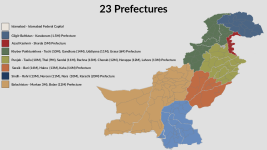
I've been fully supporting new provinces for years, some people are pushing all the divisions are provinces, which I don't think that works due to population imbalance being too heavy, I have been working on redesigning them slightly and put a image below.

In total there are 23 Prefectures/Provinces, I went with the name Prefecture. Roughly between 10-13 Million for each bar a few exceptions.

Each would be led by a Governor who is elected via elections.

White line is Prefecture borders and black lines are divisions which fall inside them.
 

Attachments

  • Prefectures x23.png
    Prefectures x23.png
    171.6 KB · Views: 2


Cunning Coward is threatening but guess what

Pakistan has no other choice but to cleanse itself

They have practically created their own country called 'Sindh' and are continuously creating roadblocks in way of progress. They destroyed Karachi and their belly is still not full

Sindhudesh needs to be confronted. It has become a huge threat as was not taken seriouosly in the past. Pakistan cannot get blackmailed forever by these thugs.

They have taken Pakistan hostage

This nonsense needs to stop

Karachi/Urban Sindh sides with Pakistan. Poor Sindhis need to be freed from clutches of waderas as well

Their bluff needs to be called out. This wadera is using scare tactics.

No bloodshed will occur except some minor incidents here and there.

People are intelligent now a days.

No one is buying this wadera's crap...

He is just protecting his fiefdom

Zardari is the King of Sindh. This is why PPP has suddenly exploded in opposition to more provinces, Pmln on the other hand playing clever politics and calling for referendom so in the future they can blame hidden forces for the division of Punjab ie the real Pakistan.

One point is why insist on more provinces, they can just devolve the power, make district in to powerful local governments.

Pakistan 4 Provinces (Federated States):
Punjab - 10 Divisions.
Sindh - 7 Divisions
Khyber Pakhtunkhwa (KP) - 7 Divisions
Balochistan - 11 Divisions

Call them Punjab division 1 2 3 4 etc, Sindh division 1 2 3 4 etc. Also devolve the power, give divisions more control over budget, education, development etc. Let the provisional governments legistlate only and maybe have the powers to call rangers etc but divisions run the police etc.
 
More Provinces would never help unless the state reorganises and empower local bodies
Cannot be said better. 💯
What's even the point of having "more" administrative units when the REAL power still remains within the military establishment? 🙄
 
It is a very delicate and risky move and @PakAl gave some very good arguments above against making more provinces and suggested keeping the four provinces while introducing China like reforms. On the other hand, the people of Karachi are sick of being abused by the feudal lords of interior Sindh; Karachiite see the current political environment in Pakistan to be their best chance to finally make Karachi independent of the feudal chokehold. Currently, PTI and the Noonies as well as the Establishment are sympathetic to Karachi's plight but PPP, rooted in the feudal interior Sindh, is against Sindh's division and seems like willing to go to any length to stop the division.

As for my personal opinion: Being a Karachiite myself, I too would want Karachi to be given administrative independence but it will come at a cost: Historic rift between the Urban and Rural Sindh. We don't want that. It would be instead better to make Karachi a Federal unit or truly empower the Local Bodies all over Sindh. I know my suggestion will not endear me to some here but Pakistan doesn't need any more ethnic divisions.
But they can make the divisions in Sindh as Sindh division province 1 2 3 4 etc and make them in to mini province under Sindh, with more independent local power and budget. This will keep the hatred away. The division can elect their own local leadership/cabinet etc.
 
I like your second idea but don't think PPP will let that happen (Federal Unit).

PPP's internal position is that Karachi is the cash cow and they cannot allow that to ever be taken out of their control again.

Local bodies are failing because PPP will not let them operate. They are probably ruing their decision to emasculate local bodies because now they have a much bigger problem on their hand with Karachi wanting to split up, thus the Sindhudesh refrain and Bilawal's sudden disclosure today. Blaming the MQM reign to push back has also run its course. People are asking, "what have either of you given us?" Answer: crickets chirping!

Had the PPP allowed LBs to work effectively, they would have just ended up with less Karachi money in their pockets but with a more modernized city and the locals not as upset as they are right now.

This is what happens when the mentality from the interior of the province clearly fails to understand the upwardly mobile aspirations of Karchiites.
True the provisional governments and MNAs MPAs will not share power but the exact same will happen if Pakistan had 30 provinces, with 30 CMs, Cabinets, assemblies. They will do exact same and will loot. I think this move will lead to more issues and hatred, its best to turn districts in to local empowered governments. Or special economiz zones as suggested by one member.
 

Users who are viewing this thread

Country Watch Latest

Back
Top