‘Holy S—, That’s Tehran!’: B-2 Pilots Tell the Story of Operation Midnight Hammer
A sliver of moon hung low in the sky: blood red, eerie, and ominous. Already 18 hours into their mission, the two pilots were, for now, focused and alert. They checked their switches, eyed the moving map display, watched the clock. Outside, a city emerged from the gloom.
“Holy s—, that’s Tehran!”
They had practiced this type of mission time and time again before, but this was not a drill. “We’re doing this. This is real.”
Minutes later, precisely on schedule, they opened the bomb bay doors, two clunks amidst the hum of engines and air, and then, after a brief pause, the release: Two 30,000-pound bombs, the first Massive Ordnance Penetrators ever dropped on an enemy target, plunged earthward. The unburdened airplane, so long laboring under the strain of its load, suddenly felt light and maneuverable.
“Let’s get out of here!”
“No, wait.”
They turned the plane, craned their necks, prayed the bombs would not be duds. Five seconds, 10, 15, and then the payoff: Tens of thousands of feet below, the bombs hit their target, a fireball blasting 10 stories into the sky, illuminating the mountain landscape as if it were day. The U.S. attack on Iran’s Fordow Fuel Enrichment Plant had begun.
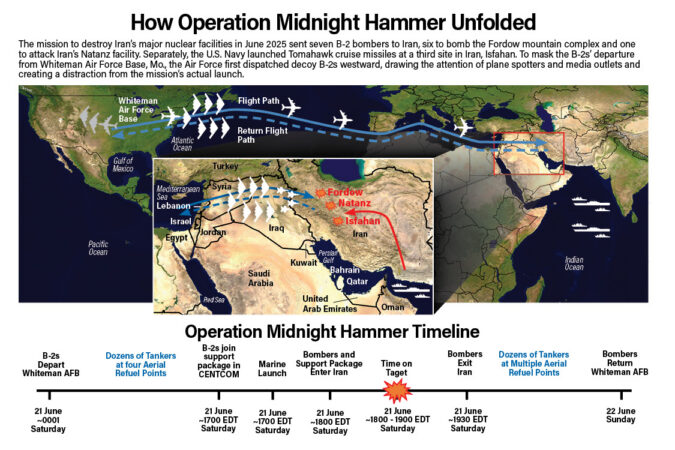
This is the inside story of Operation Midnight Hammer, reported here for the first time, based on interviews with crew members from the B-2s that took part in the mission, including those that acted solely as decoys. The 14 pilots who flew roundtrip from Whiteman Air Force Base in Missouri to Iran were evenly split from among the 509th and 131st Bomb Wings, half Active-Duty, half from the Missouri Air National Guard. Those planes struck the Fordow and Natanz nuclear sites from above, while submarine-launched Tomahawk cruise missiles rained down that same night on a third site, Isfahan, 80 miles away.
Due to security concerns, participants’ real names have been withheld at their request, replaced with pseudonyms selected by the authors.
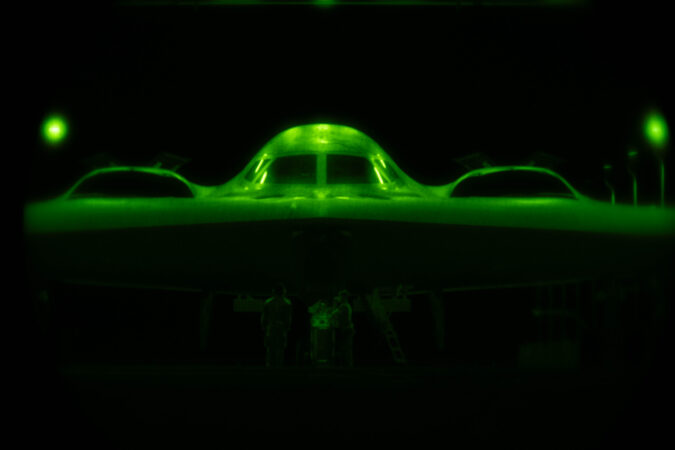
A U.S. Air Force
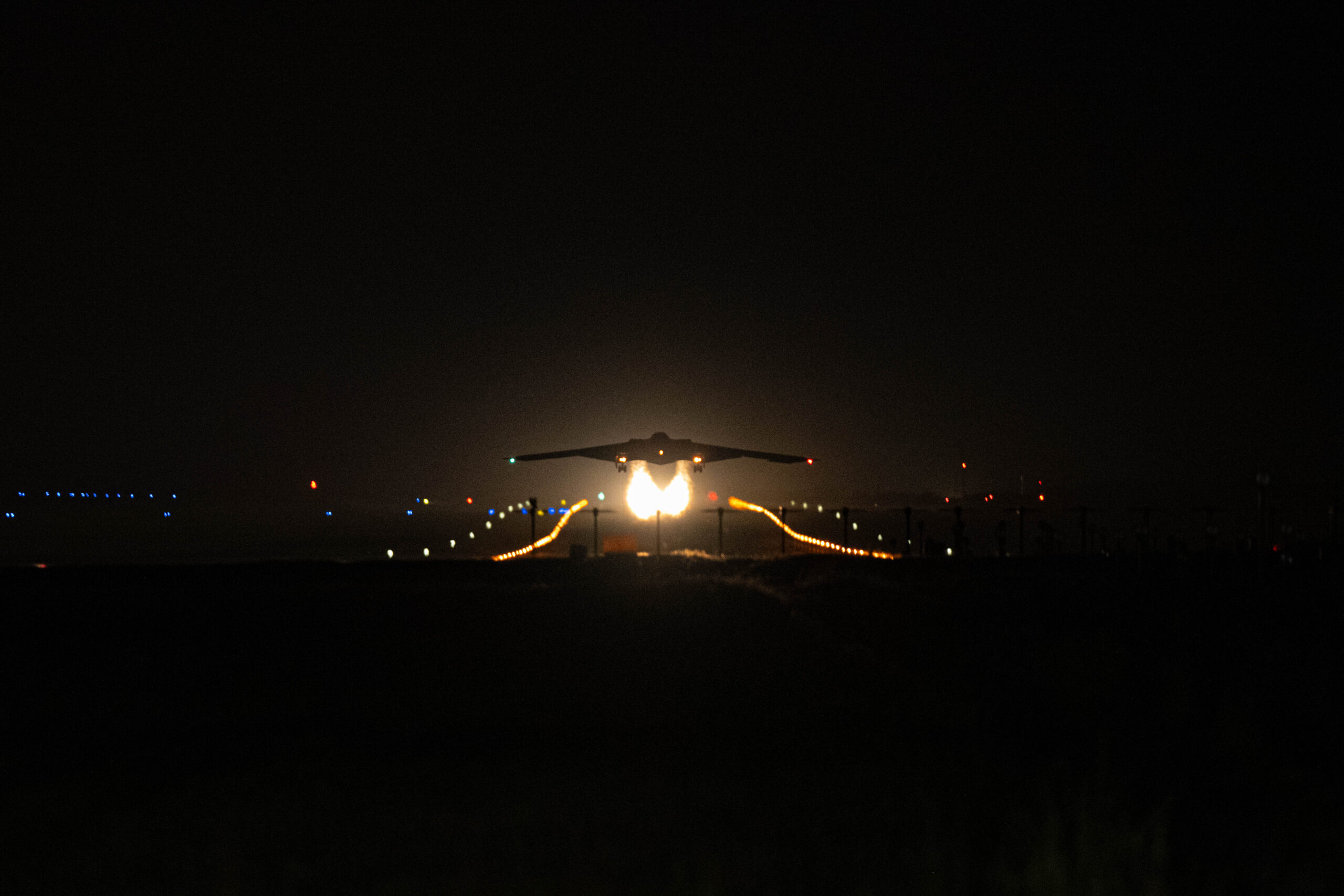
B-2 Spirit prior to takeoff at Whiteman Air Force Base, Mo., prior to the kickoff of Operation Midnight Hammer in June 2025.
Operation Midnight Hammer was the culmination of some 15 years of planning, a 37-hour human endurance test for 14 highly trained pilots, all of them graduates of the Air Force Weapons School, the premier training ground for operators. It was also a high-stakes gamble on American military technology that had never before been used in combat, a total of 14 bombs weighing a combined 210 tons, carefully fused and tuned to detonate in a particular way. After-action assessments concluded the bombs destroyed much of Iran’s ability to enrich nuclear material to weapons-grade, a body blow to what the U.S. sees as Iran’s unacknowledged ambitions of developing the option to build a nuclear weapon.
The air armada assembled to support the B-2s included
F-22 Raptors,
F-35 Lightning IIs,
F-16 Fighting Falcons, and
A-10 Thunderbolt II attack jets. Only some of those joined the B-2s in penetrating Iranian airspace. Dozens of KC-135 and KC-46 tankers supported the flights, refueling the jets enroute to their targets and again on their way home. In all, some 125 aircraft supported the mission.
The damage to Iran’s nuclear program was significant, but exactly how extensive remains a mystery.
David Albright, the president of the nonpartisan Institute for Science and International Security and a former United Nations weapons inspector, characterized the damage this way for Air & Space Forces Magazine: “The centrifuge program, as it was, no longer exists. And what we’re essentially discussing are remnants,” he said. “[Iran]’s going to have a very hard time reconstituting anything close to what it had for years and years.”
Waiting for Midnight
The U.S. started planning how to destroy Iran’s Fordow nuclear complex almost as soon as the Iranians started to build it.
Intelligence analysts studying satellite imagery in 2009 discovered an unusual construction project underway in the remote mountains southwest of Tehran. Later that year, then-President Barack Obama revealed U.S. concerns publicly during an international summit in Pittsburgh, citing a heavily buried site in Iran which he said “was not consistent with a peaceful nuclear program.”
Understanding and destroying the Fordow site would become a life’s work and obsession for Matthew, a former B-2 pilot who had stayed on at Whiteman after retirement, taking a job with the Defense Threat Reduction Agency. Over the next 15 years, he and others studied every facet of the facility, compiling classified intelligence from all possible sources to learn its secrets: how it operated, how deep it was buried, and all its hidden weaknesses.
As Chairman of the Joint Chiefs of Staff Gen. Dan Caine would recount at a Pentagon briefing days after the strike in June 2025, they studied its “air vents, electrical systems, environmental control systems, and all the equipment going in or out.”
The Air Force, meanwhile, developed a weapon designed to penetrate deeply buried, reinforced facilities to destroy them—exactly the scenario they would eventually face in Iran. Experts modeled and experimented, creating variations to overcome various scenarios, devised tactics to deliver the weapons, flew flights and simulations, pondered over and over how such a mission might best be executed.
The fruits of their effort is what came to be known as the MOP; the
GBU-57 Massive Ordnance Penetrator was designed to pack every cubic inch of the B-2’s spacious bomb bay with massive weapons. Officially rated to carry up to 80 500-pound bombs—a payload of 40,000 pounds—two MOPs top that weight by 50 percent. MOPs come in about eight varieties, each designed to produce a specific set of effects. The bombs communicate in flight with the airplane, registering location and altitude. Minor changes to mission plans can be executed and communicated to the weapon in flight.
The MOPs were intended to leverage Fordow’s ventilation shafts, the vertical tunnels that carried air down to the enrichment facilities. U.S. planners hoped to exploit the shafts using their penetrating explosives. By attacking the shafts and adjusting the bombs’ fusing to explode at precise depths and coordinated times, U.S. military planners hoped to devastate the facility.
Years of experiments followed, test detonations leading to design adjustments and subsequent tests. Government and industry technical experts collaborated closely, while experiments in the desert continued haltingly, one expensive bomb at a time. “It put a real strain on the acquisition system as you might imagine,” Matthew said. “But we had a lot of people involved to make sure that we iterated our way to success.”
“I’ll tell you this,” Matthew added: “The version they ended up flying is nowhere near the tech demo version that DTRA had come up with way back in the mid-to-early 2000s.”
Only the B-2 could carry the MOP.
Manufacturer Northrop Grumman designed the stealthy batwing B-2 as a dual-use attack platform capable of carrying both conventional and nuclear arms. Only 21 were built; then-Secretary of Defense Dick Cheney ended the program in 1992 as the military began to draw down its forces following the collapse of the Soviet Union in 1991. Only 20 remain in use today, each a bespoke work of art, no two exactly alike, making them, as a group, a capability unmatched in all the world.
So unique are the B-2s that when, from December 2022 to May 2023, the B-2 fleet was grounded, concern about the aircraft’s return was a constant agenda item for the Secretary of Defense himself. The B-2’s ability to penetrate well-defended airspace makes its threat crucial to nuclear deterrence, insurance against nuclear war. Its ability to put MOPs on target was likewise an insurance policy against the potential failure of diplomacy to defuse Iran’s nuclear ambitions, the preferred option of four successive presidential administrations.
Warmups
In August 2024, the International Atomic Energy Agency determined that Iran had increased its stockpiles of near-weapons grade uranium, enriched to 60 percent, which is only weeks away from reaching the 90 percent level needed to produce weapons-grade uranium. The clock was ticking, and President Joe Biden’s administration needed options.
At Whiteman, it looked as if the B-2s might be part of the plan.
“We started talking about it then, pulling the plans off the shelf, and refreshing them. There were massive mission planning cell meetings,” said Alpha, a senior B-2 instructor pilot, who would later lead the June 2025 Midnight Hammer mission.
Instead of an attack on Iran, however, the Pentagon chose to use B-2s to deliver a message. B-2s were
dispatched instead to Yemen, where they bombed an underground weapon storage site belonging to Iran-backed Houthi rebels. The message to Iran: The U.S. is equipped to launch long-range strikes against buried targets. Take note.
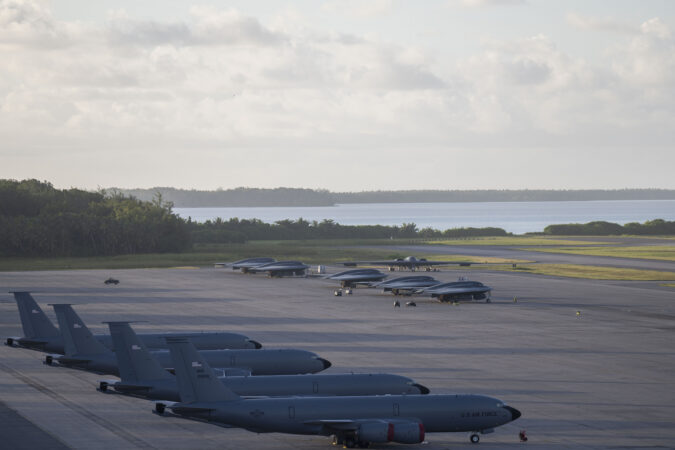
For a while, it looked like the message was received and understood. But soon after the inauguration of President Donald Trump in January 2025, Houthi attacks on commercial shipping in the Gulf of Aden and the Red Sea picked up and the Pentagon launched Operation Rough Rider, a U.S.-led combined air campaign against the Houthis featuring Air Force and Navy aircraft. Six B-2s were deployed to the Indian Ocean island of Diego Garcia that March, filling the base, Alpha said, with “all of the combat power that matters.”
Six Air Force B-2 Spirit stealth bombers and four KC-135 Stratotanker refuelers line the flightline in Diego Garcia, British Indian Ocean Territory, April 16, 2025. The timing of Midnight Hammer had to take into account all of those jets returning and getting maintenance performed before the mission could be launched. U.S. Air Force photo by Tech. Sgt. Anthony Hetlage
Meanwhile, U.S. talks with Iran were going nowhere. Just about that time, Oscar, a major with the 509th, took a call from his commander: Start planning an attack.
Within days, planning calls were underway. Within a week, 50-60 tacticians were formalizing a plan to integrate the B-2s with the fighter jets and other aircraft necessary to safely execute an attack.
The first order of business was timing. With six B-2s deployed to Diego Garcia, getting them home for maintenance was the first order of business. Big-picture planning at CENTCOM and the Pentagon continued as tactical plans came together at Whiteman. Officers worked up to 18 hours a day across time zones putting the pieces together, calling in favors from past colleagues in useful jobs at intelligence agencies, pulling together the insights and understanding needed to plan routes, anticipate threats and problems, and understand myriad requirements.
Pressure mounted to bring the B-2s home to get them ready. Then the U.S. reached a surprising
ceasefire with the Houthis in early May. Days later the B-2s returned to Whiteman, replaced by B-52s at Diego Garcia.
Daily calls connected Whiteman to fellow Airmen at Al Udeid Air Base in Qatar and elsewhere in the Middle East. “We were on a VTC with the actual fighter pilots down range for much of the day, and we were figuring out how to weave this plan into the bigger plan,” Oscar recalled. “Everybody else’s plan builds off of this one. We build ours first.”
The challenge in building such a plan is integrating and timing the pieces. The B-2s were to be supported by F-22 and F-35 stealth fighters, the highly capable escorts assigned to counter any potential threats. F-16s, A-10s, and E-11A communications aircraft would also contribute, as would dozens of airborne tankers needed to refuel aircraft on the way in and on the way out of the target area.
“The first thing I worry about when something like a Midnight Hammer starts to take shape is what’s the tanker force looking like,” said Lt. Gen. Jason R. Armagost, deputy commander of Air Force Global Strike Command and Air Forces Strategic-Air at U.S. Strategic Command in January 2026 at AFA’s Mitchell Institute for Aerospace Studies Airpower Forum. “It’s not an easy thing.”
Maj. Claire Randolph, chief of Weapons and Tactics at Air Forces Central and a key planner for fighters supporting Operation Midnight Hammer, speaking at the same event, called tankers “the limiting factor” that ultimately determines the size and shape of the escort force. “It’s not sexy, it’s not a weapon, and it’s not a fighter and it’s not a bomber—the tankers are often really left out of this conversation,” she said.
Planners also dug into precise routes and timing, the effects of weather and anticipated winds, where to expect or look for potential threats, and what the right weapons load out would be for each aircraft. The U.S. planners needed to carve a corridor for the B-2s through Iran’s heavily defended air space by degrading or destroying Iran’s integrated air defense systems. They also needed contingency plans to send in rescuers, in case any aircraft went down. After the attack, they needed to be ready in case Iran retaliated and launched ballistic missiles at U.S. bases in the region. In that case, the fighters might have to fly elsewhere rather than return to base.
Rising Lion
On June 13, Israel launched Operation Rising Lion, what would come to be known as the 12-day war. Motivated by the same
IAEA conclusions and convinced that peace talks were not going to be productive, Israel set out to defang Iran with a series of attacks, at the same time urging the U.S. to contribute the one blow it could not: Destroying Iran’s three buried and heavily fortified nuclear sites.
“It wasn’t a surprise to us because of U.S. diplomatic and military communications,” Alpha said. “But it did change the threat.”
Israeli Air Force F-35 and F-15 jets systematically eliminated many of the threats that had occupied the Midnight Hammer planners for the prior three months. “It was a master’s class of Western airpower: How you target the right things to enable yourself to own the skies,” Alpha said. “They killed a whole lot of threats and made it a lot safer for us.”
The Israeli operation fueled revisions for Midnight Hammer planning to take into account the changing situation.
A second unplanned contingency emerged about the same time. “In the days preceding the attack against Fordow, the Iranians attempted to cover the shafts with concrete,” Caine told reporters in his post-mission briefing.
At Whiteman, this meant rethinking the entire attack plan, which had been designed and modeled without having to deal with that new mass of concrete. Now the order of business was changed: They would have to first create a blast that would remove the concrete cap, and only then begin to deal with what lay underneath.
Back to the drawing board they went. “How to put the pieces together for what the world is now?” Alpha recalled. “That happened pretty fast.”
Changing Plans
Things kept changing even as the B-2 pilots went into mandatory crew rest ahead of the mission. Input poured in from Air Force Global Strike Command, Air Forces Central, U.S. Central Command, the Pentagon, even the White House
Not until two hours before the fighter escorts went into their crew rest—16 hours before the mission—was the final plan confirmed.
“Things were changing—north, south, all over—up until after they were already in bed,” said Oscar, the mission integration planner. “We got a call that said, ‘Hey, by the way, we’re going to change the plan again.’ So the plan that they all went to bed with—they mission planned it, they knew it, they loved it—changed.”
Backups made the changes and executed the final preparations, Alpha said, “while we’re all sleeping.”
The Deception
From the beginning, one of the biggest concerns to leaders at the highest levels of the Pentagon was operational security—how to keep the mission a complete surprise. Launching one or two B-2s in the middle of the night might not cause much of a stir. Launching seven, however, would be hard to hide. Oscar and the others believed they could launch the jets, get them across the Eastern United States, over the Atlantic, through the Mediterranean, and across the Middle East into Iran without anyone noticing. Few believed them, including some who’d flown the B-2.
The solution was to muddy the waters by sending out even more planes. Additional B-2s took off in the open, headed west ahead of the others, capturing the notice of media, which duly reported their movement. Reasonable observers took the bait, imagining those planes repositioning for an attack from Guam or perhaps Diego Garcia. But that was just a ruse. Meanwhile, the mission pilots went through their routines. Some told families they had training missions planned; others made no mention. Secrecy meant no one divulged where they were headed or why. All the late nights and changes had a benefit: The families were used to the pilot’s preoccupation with work, and paid little heed.
“I told her nothing,” Alpha said of his wife. “I just went to work and didn’t come back.”
Others said they had to fly, but didn’t say where. They stocked up on meals and snacks for the ride. Candy, beef jerky, sandwiches—even a hamburger from Culver’s, the fast casual Midwest chain known for its “butter burgers” and frozen custard. Some spouses wondered if something was up. Others willed themselves not to think too much about it.
Midnight Riders
Finally, at midnight on June 21, seven B-2s took off from Whiteman, a rural outpost 70 miles from Kansas City. Just about no one seemed to notice.
The mood in the cockpits was calm. Radio silence was the rule. The mission was so secret and the plans changed so many times that the pilots took off before the mission had been given an official name. They departed without designated call signs.
Taking off with 30 tons of explosives makes for a slow flight. The planes burned off fuel, moved up to higher altitudes, then worked their way back down to rendezvous with their tankers to refuel. Timing was a constant concern. Evading weather or air traffic could cost time, which might be made up if a refueling operation went extra smoothly.
The B-2 cockpit seats the two pilots side by side, with enough space behind for an average size man or woman to lay down. It’s cramped for the taller guys. There’s a microwave to warm food, endless coffee, a toilet. The air is thin and dry. Short naps are workable, either in the seat or lying down with a sleeping bag or mat behind the seats. Some pilots have been known to bring in a cot or foldable chaise. Overall, it’s more comfortable than sleeping in the back of a C-17 airlifter, but not by a lot.
In between naps, there’s work to do. “You’re always prepping for the next air refueling or the next checklist item, prepping the weapons, prepping the systems,” said Bravo, one of the pilots. “So it’s not like a time to take a four-hour nap. Really, it’s 30-, 45-minute short catnaps.”
Sitting for long stretches in the cabin risks blood clots, so the pilots know to get up and move. Some use “go pills”—doctor-sanctioned amphetamines—to stay awake. Others rely on coffee or energy drinks. Some snack continuously, while others savor a single meal on the way in and a second on the way out.
“Once you get on the go pills, they kill your appetite,” one pilot said.
The B-2 produces its own oxygen. “It’s like the world’s driest desert in there,” Alpha said. “You are just sitting in your own moisture for thirty-eight hours.”
Talk ranges from mission to nothing to sports. There’s enough mission work to keep things flowing in between naps. Another refueling is always coming up.
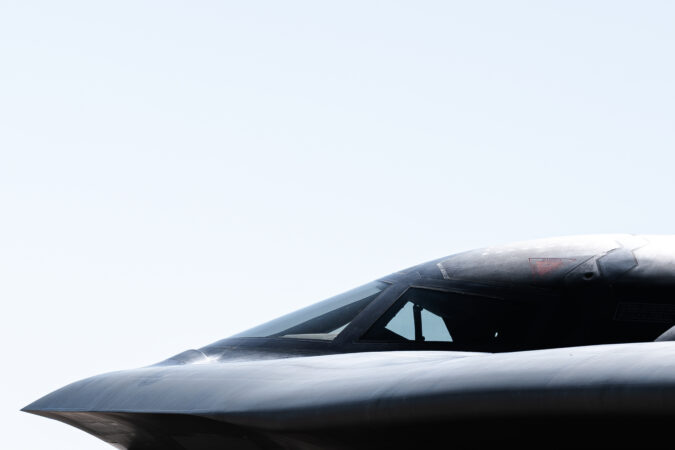
A B-2 Spirit on the flightline at Whiteman Air Force Base, Missouri, in May 2025, a month before Midnight Hammer. U.S. Air Force photo by Staff Sgt. Joshua Hastings
Somewhere over the Strait of Gibraltar, the mood shifted. Pilots donned their combat vests, just in case they had to eject over water or hostile territory.
Not long after, Bravo tried to stand up for one last stretch, but something snagged his armrest and the cockpit was rocked by an explosive BOOM!
Alpha and Bravo struggled to understand what just happened.
Looking to his right, Alpha did a double take as he saw his copilot looking like the Michelin Man beside him, his life preserver now fully inflated, his arm flailing frantically as he tried to stab at it with a knife.
Now the pilots come to an understanding. In case of a water ejection, Bravo is to steer his parachute towards Alpha’s, and they will share a single flotation device. Bravo wants to swear Alpha to secrecy over the incident, but here, Alpha refuses. This is a story he will tell his children — and the rest of the tight-knit B-2 community.
Departing European airspace and entering U.S. Central Command’s area of responsibility, the pilots checked in with command and control—the only time before crossing into Iran. They radioed their plans to proceed with their Air Tasking Order Fragment—“The Frag.”
“Seven B-2s checking in as fragged,” they radioed.
“Say again?”
“Seven B-2s checking in as fragged,” Alpha repeated.
There was a click on the radio, as the pilots line was patched to the speaker in the Combined Air Operations Center. “Everyone in the CAOC just starts cheering in the background,” Bravo recalled.
Fight’s On
Time for last-minute checks on timing, speed, and attitude. Small errors could throw off the weapons. Six B-2s were headed to Fordow, and one was routed further south to Natanz, which had already been hit by the Israelis.
Iran was rife with danger below, and the pilots periodically peeked out the window to see if air defense interceptors were headed their way. The biggest nightmare was a “flaming donut:” an interceptor headed straight in, presenting a ring of fire around the missile body.
“Flaming donut means it’s coming for you.”
Thankfully none came into view. After-action reviews indicated the Iranians never fired a shot at the B-2s. They alone delivered the blows.
The Drop
The bombs that hit Fordow dropped at short intervals. The GPS-guided MOPs get their data directly from the B-2s, and the quality of the signal is crucial. “If you think that you simply just turn GPS on and navigate like you’re going to the store, that’s not how Midnight Hammer goes,” said then-Chief of Space Operations Gen. B Chance Saltzman in an interview well after the mission. “Now we’ve got to do this in a specific time, and when is that time? When the aircraft releases the munition. … If you know all that and integrate, then you can backward process it to make sure that the constellation is perfectly aligned to make sure you get as much accuracy as possible.”
Alpha’s B-2 was the first in. Its mission was to blow up the concrete cap that Iran had poured over the ventilation shafts in a last-ditch attempt to protect their investment. Next, the five follow-on crews would drop their bombs in sequence to destroy what was buried below. Arriving at precisely 2:10 a.m. local time, the mission would mark the first time a MOP would detonate at night. No one had ever seen what such a thing would look like.
Once the first two 30,000-pound bombs struck their targets, the next plane in had to be ready with two options: Either strike as planned or—if the first plane failed in anyway—change their bombs’ settings so they could deliver that initial cap-destroying blow.
“Everything had to go right at the right time, in the right order, for everything to work out,” said Charle, one of the pilots on the second B-2. “So if he missed something, he was supposed to voice it back.”
Timing was absolutely critical, he said. “You could be plus or minus 15 seconds.”
Aboard the first two bombers, four pilots waited anxiously, seconds ticking by.
“I was like, ‘Let’s go push it up! Come on, throttles up! Let’s go!’” Bravo recalled. But Alpha just peered down into the dark, waiting.
“I think the bomb is about to blow up,” he said with anticipation.
And then it did. Some 80 miles to the south, the seventh B-2, the lone plane sent to Natanz, had a full view of the action. “The first one was big,” said Mike, one of the B-2 pilots over Natanz. “It’s like a 10-story building worth of fire.”
The next two bombs hit the ventilation shaft. It would take five seconds to know if they had the desired effect—“the longest five seconds of your life,” the crews said.
“What happened was you’re checking 1,000 times to make sure your switches are up, and you’re going to drop your weapons and not jack it up,” Charlie said. “Open the doors, hear ‘plunk, plunk,’ the jet climbs a little bit, and then keep heading west.”
The seconds tick by and the third B-2 is in place, repeating the process; then again with the fourth, two more bombs; and then the fifth. The Fordow enrichment site was largely destroyed.
The last bombs to fall were on Natanz, from the seventh bomber, which was also the highest in the formation.
“The higher you get, the less maneuverable you are,” Mike said. “Your climb rates, how much you can bank and all of that. We zoomed the aircraft to get it up.” The autopilot, typically engaged for the final maneuver, did not at that altitude, “so we hand-flew … just maneuvering to make timing correct.”
With all the bomb bays empty, the race began to get out of Iranian airspace. They had stomped on the hornets’ nest. Warnings sounded in their cockpits. “We’re hearing that there’s stuff shooting at us, so there’s a lot of worry that keeps me distracted,” Alpha said. “So I don’t get to just sit there with nothing going on. I’m worried about it.”
One pilot had resolved years before what he would do if he ever got over the target site. “Nobody thought we could do this—it was too dangerous, it wasn’t going to work,” he said. “So out of bravado, I always said, ‘It’s gonna be so good there, I’ll be able to eat a sandwich.’”
And so he did—one bite, anyway. The potential for getting hit by an enemy missile hung clearly in his imagination and one bite was enough to live up to his promise. The rest of the sandwich would have to wait.
Up to this point, pilots Alpha and Bravo in the lead B-2 had made just one radio call. Once safely out of Iranian airspace, they made a second.
“We’re done, we’re safe!” they called.
President Trump announced the mission late June 22, unbeknownst to the pilots who were still making their way home. Some time later, when the B-2s searched out their tankers to refuel—“Nobody kicks ass without tanker gas,” as any tanker crew will tell you—they learned that their secret was now in the open: “You guys are all over the news!” a tanker crew member told them.
In the wee hours of the morning, approaching the United States, Alpha guided the team over Washington, D.C. “We gave ourselves a parade,” he recalled, an impromptu celebration before he headed them to Missouri.
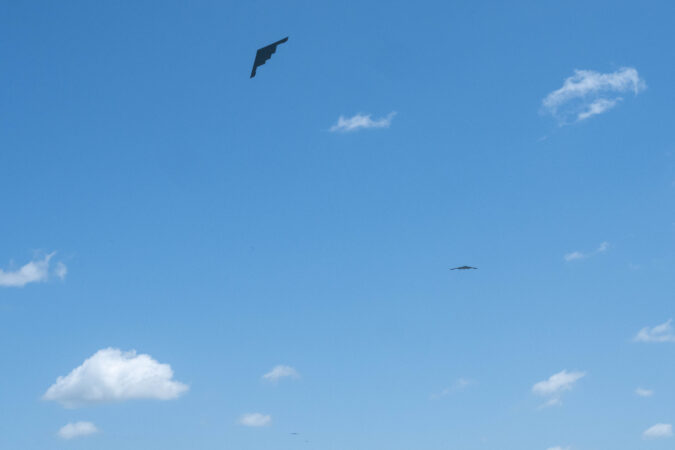
Three B-2 Spirits return from their 37-hour bombing mission as Operation Midnight Hammer concluded at Whiteman Air Force Base, Mo., in June 2025.
Families learned about the mission on TV when they woke up or, in one case, in church from a pulpit announcement. They were told they were invited to the base for a welcome ceremony.
After more than 36 hours in the cozy confines of their cockpits, pilots descended from their jets feeling smelly and tired, beards having sprouted since departure, clothes reeking. One had preplanned his return, made up a bed on base, promised himself a long snooze there before going home to see his family later. Others came off the plane exhilarated, hugged their crewmates, congratulated each other. Out of their planes, they climbed into buses that drove them to waiting families, a welcome surprise no one anticipated.
It was brief. Soon they were whisked off for after-action care: intravenous fluids to ensure they were hydrated, celebratory beers, and finally they were taken to a secure, compartmented facility to debrief the strike and view satellite photos of the destroyed targets.
Only then did they learn the name of their mission: The crews had lowered the “Midnight Hammer.”
B-2 pilots who flew Operation Midnight Hammer to level Iran’s nuclear program detail the planning and execution of the historic mission.

www.airandspaceforces.com