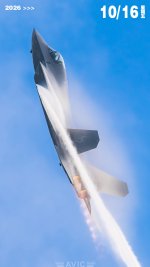
Chinese SAC - FC-31/J-35 5th Gen Stealth Aircraft

Sorry in case I was misleading!

My argument is that this J-35 clearly bears an individual tactical number (bort number) below the cockpit, as well as an 'H' serial number (on the air intake). This suggests it could be one of the four already known aircraft — numbered 80, 81, 82, or 93 — or perhaps a new, previously unconfirmed airframe, possibly bearing the number 87. However, the image is too blurry to be certain.

Otherwise, I am well aware that there are various systems; in this instance, however, I was only concerned with the PLAN serial number.

View attachment 224282


In keeping with this, there’s this one—possibly bearing the number 07, which would also be something new.

View attachment 224284
Sorry!

I was misled by your phrase: "and thus it would be another hitherto unknown one."
 
Sorry!

I was misled by your phrase: "and thus it would be another hitherto unknown one."


Sorry my friend ... I should also add the phrase "All (at least most) my activities on PDF have to be machine translated. Please forgive me if these statements cause you misunderstanding or offense." ;)
 
@Deino Are you a German born and raised?


Yes ... and later became a Minion!

Deino als Minion.jpg

Yes, indeed—I am German, born and raised in Germany; and as for why I have such a crazy passion for China—and, above all, for Chinese aviation—well, that’s a long story.

PS:
 
I know we get these F35 v J35 posts, peeps need to remember 5th gen aircraft purpose is to function as part of a broader system. That is what matters overall in combat. So lots of factors which IMO are too complex to predict one way or another.
 
(Loud sigh) 🙄

You brought it up.

The only "trade offs" between F-35 and F-22 is the F-22 is faster and can fly a bit higher other than that the F-35 is actually a more superior air to air fighter due to its SA, SF, EW/ECM and yes the F-35 "beats the F-22 in stealth" which is a quote from USAF General Hostage former head of F-35 program.

There's no doubt F-35 is just overall a much more capable networked system than F-22 and therefore more effective than the F-22 under most relevant modern parameters. I guess what he means is that if the F-22 were of the same era as the F-35, it would no doubt be superior to the F-35.

Neither program were compromises. The superiority of the F-35 is mainly derived from its modernity relative to the Raptor. The USAF is currently upgrading F-22 as much as the frame and digital architecture allows without sinking so much into it that it takes from future programs.

J-20 and J-35 timeline difference is shorter than the F-22 F-35 gap and while many like to believe the J-35 is a lower tier fighter than the J-20 (I am of that belief myself), the difference between the two just isn't quite as great and it's not obvious to observers whether or not the J-35 is designed from the get go to be a cheaper 5th gen that China can mass produce at a faster pace and lower cost than the J-20A and J-20AS that are currently in production.
 
There's no doubt F-35 is just overall a much more capable networked system than F-22 and therefore more effective than the F-22 under most relevant modern parameters. I guess what he means is that if the F-22 were of the same era as the F-35, it would no doubt be superior to the F-35.

I don't think he means that or he would have said it I think he suffers from what the majority of PDF Chinese suffer and that is ignorance. They make assumptions on feelings or what they are told and never get into the minutia of the aircraft not bothering to research the aircrafts.
Neither program were compromises. The superiority of the F-35 is mainly derived from its modernity relative to the Raptor. The USAF is currently upgrading F-22 as much as the frame and digital architecture allows without sinking so much into it that it takes from future programs.

The F-22 upgrades on the F-22 will make it a much deadlier fighter but even then it will not be anywhere as capable as the F-35 in block 3F and once block 4 enters service the F-35 will pretty much become a different fighter.
J-20 and J-35 timeline difference is shorter than the F-22 F-35 gap and while many like to believe the J-35 is a lower tier fighter than the J-20 (I am of that belief myself), the difference between the two just isn't quite as great and it's not obvious to observers whether or not the J-35 is designed from the get go to be a cheaper 5th gen that China can mass produce at a faster pace and lower cost than the J-20A and J-20AS that are currently in production.

The whole top and low tier discussion was relevant during the cold war, 90s and early 00's when fighters were bult or were in service with specific roles which isn't the case for 5th gen/ stealth fighters. If the J-35 has the J-20s capabilities in sensors, missiles, ECM and SA you can't call it low-tier in my opinion. The USAF at one time called the F-35 low-tier because the way they were going to use it, it had the F-22 and wanted more F-22's and the upgrades, but reality is the F-35 is way more capable than the F-22 and it is the premier air to air fighter for many countries.

J-35 like the F-35 are the fighters they can built in mass for cheaper price because of lessons they learned from their first 5th gen fighters in the J-20 and F-22.
 
I don't think he means that or he would have said it I think he suffers from what the majority of PDF Chinese suffer and that is ignorance. They make assumptions on feelings or what they are told and never get into the minutia of the aircraft not bothering to research the aircrafts.
Keep your ignorance and arrogance. It just makes me smile.

The "Low-End" Reality of the F-35: A Structural Compromise, Not a Technological Marvel


To objectively evaluate the F-35, we must strip away the PR filters of the Western military-industrial complex and examine the fundamental design logic and official test reports. The F-35’s "low-end" status is not a failure of engineering, but a series of structural compromises made to force-tri-service commonality (especially the STOVL requirements of the F-35B) and strict cost control.

Based on authoritative data, these compromises are evident in four core dimensions:

1. Power and Agility: The "Energy Disadvantage" Locked by a Single-Engine ArchitectureTo cut costs and meet the deployment limits of amphibious assault ships, the F-35 was forced into a single-engine design, leading to a comprehensive lag in flight performance.
  • Lack of Thrust-to-Weight Ratio and Supercruise: The twin-engine F-22 has a thrust-to-weight ratio well over 1, easily achieving supersonic cruise at Mach 1.5 to 1.8. Despite the F-35 boasting the most powerful single engine in the world (F135), its bulky airframe limits its combat-configured thrust-to-weight ratio to merely 0.87 (with full fuel). This completely eliminates any true supersonic cruise capability, capping its maximum level flight speed at Mach 1.6.
  • Total Concession in Super-Maneuverability: The F-22 features ±20-degree 2D thrust vectoring for extreme pitch maneuvers. The F-35A/C lack thrust vectoring entirely. While the F-35B uses a lift fan for vertical takeoff, this drastically increases structural dead weight and wing loading, making its close-range dogfighting capabilities inferior even to some 4th-gen fighters.
2. Stealth and Survivability: Downgraded from an "Omni-Directional Ghost" to "Frontal Stealth"Stealth is the cornerstone of 5th-generation fighters, yet the F-35 made significant concessions here.
  • Inferior Radar Cross Section (RCS): The F-22’s stealth design is optimized purely for air dominance, achieving an RCS as low as 0.01 square meters. To accommodate longer internal weapon bays and complex avionics, the F-35’s airframe is bulkier, resulting in a typical frontal RCS of about 0.065 to 0.1 square meters—an order of magnitude higher than the F-22.
  • Blind Spots in Omni-Directional Stealth: The F-35’s stealth optimization is heavily focused on the frontal aspect, with its lateral and rear RCS significantly higher than the F-22. In complex combat scenarios, the probability of the F-35 being detected by enemy radar is substantially higher.
3. System Architecture and Logistics: Combat Effectiveness Undermined by "Thermal Management" and "Supply Chain"Western propaganda often packages the F-35 as a "multi-role data integration platform," but official audits reveal its systemic capabilities are being consumed by engineering flaws and logistical black holes.
  • Thermal Bottlenecks Locking Avionics Potential: The cooling capacity of the F-35’s current Power and Thermal Management System (PTMS) peaks at around 32 kW. However, the full Block 4 upgrade demands cooling capabilities that approach or exceed this limit. Official tests indicate that during high-speed flight in high-temperature environments, closing the weapon bay doors for more than about 10 minutes can cause overheating—while opening them breaks stealth.
  • Logistical Nightmare Crashing Readiness Rates: A June 2026 report by the U.S. Government Accountability Office (GAO) revealed that due to uncontrolled parts management, spare part shortages, and software delivery delays, the F-35 fleet's Full Mission Capability rate plummeted to just 25% in FY2025. Out of 100 F-35s, only 25 can perform all assigned missions simultaneously; the rest are grounded for maintenance or awaiting parts.
4. Strategic Positioning: Downgraded from an "Air Superiority Assassin" to a "Multi-Role Node"The F-22’s design philosophy is "air combat performance above all," whereas the F-35 was defined as a "multi-role fighter" from its inception.
  • Compromises in Weapon Payload: The F-22’s internal bays are optimized for air combat, capable of carrying 6 AIM-120 AMRAAMs and 2 AIM-9 Sidewinders—a pure air superiority killer. To balance air-to-ground and anti-ship roles, the F-35’s bays are designed to prioritize heavy precision-guided munitions, ironically limiting its air-to-air payload capacity.
  • Shift in Systemic Role: The U.S. military does not view the F-35 as a "next-generation air dominance machine," but rather as a "multi-role data integration platform" and an aerial "quarterback." It relies on advanced sensor fusion and electronic warfare to compensate for its lack of flight performance—essentially letting the F-22 "kick down the door" while the F-35 directs traffic from the rear.

Conclusion:The F-35’s "low-end" status is a deliberate trade-off by the U.S. military based on its strategic needs and budget constraints. It sacrificed core flight performance, omni-directional stealth, and operational reliability in exchange for advanced avionics, lower unit costs, and massive production scale. This is fundamentally different from the PLAA's "heavy-light mix" strategy, where the J-35 maintains core 5th-generation performance metrics without such severe downgrades.

07.jpg
 
Last edited:
Keep your ignorance and arrogance. It just makes me smile.

The "Low-End" Reality of the F-35: A Structural Compromise, Not a Technological Marvel


To objectively evaluate the F-35, we must strip away the PR filters of the Western military-industrial complex and examine the fundamental design logic and official test reports. The F-35’s "low-end" status is not a failure of engineering, but a series of structural compromises made to force-tri-service commonality (especially the STOVL requirements of the F-35B) and strict cost control.

Based on authoritative data, these compromises are evident in four core dimensions:

1. Power and Agility: The "Energy Disadvantage" Locked by a Single-Engine ArchitectureTo cut costs and meet the deployment limits of amphibious assault ships, the F-35 was forced into a single-engine design, leading to a comprehensive lag in flight performance.
  • Lack of Thrust-to-Weight Ratio and Supercruise: The twin-engine F-22 has a thrust-to-weight ratio well over 1, easily achieving supersonic cruise at Mach 1.5 to 1.8. Despite the F-35 boasting the most powerful single engine in the world (F135), its bulky airframe limits its combat-configured thrust-to-weight ratio to merely 0.87 (with full fuel). This completely eliminates any true supersonic cruise capability, capping its maximum level flight speed at Mach 1.6.
  • Total Concession in Super-Maneuverability: The F-22 features ±20-degree 2D thrust vectoring for extreme pitch maneuvers. The F-35A/C lack thrust vectoring entirely. While the F-35B uses a lift fan for vertical takeoff, this drastically increases structural dead weight and wing loading, making its close-range dogfighting capabilities inferior even to some 4th-gen fighters.
2. Stealth and Survivability: Downgraded from an "Omni-Directional Ghost" to "Frontal Stealth"Stealth is the cornerstone of 5th-generation fighters, yet the F-35 made significant concessions here.
  • Inferior Radar Cross Section (RCS): The F-22’s stealth design is optimized purely for air dominance, achieving an RCS as low as 0.01 square meters. To accommodate longer internal weapon bays and complex avionics, the F-35’s airframe is bulkier, resulting in a typical frontal RCS of about 0.065 to 0.1 square meters—an order of magnitude higher than the F-22.
  • Blind Spots in Omni-Directional Stealth: The F-35’s stealth optimization is heavily focused on the frontal aspect, with its lateral and rear RCS significantly higher than the F-22. In complex combat scenarios, the probability of the F-35 being detected by enemy radar is substantially higher.
3. System Architecture and Logistics: Combat Effectiveness Undermined by "Thermal Management" and "Supply Chain"Western propaganda often packages the F-35 as a "multi-role data integration platform," but official audits reveal its systemic capabilities are being consumed by engineering flaws and logistical black holes.
  • Thermal Bottlenecks Locking Avionics Potential: The cooling capacity of the F-35’s current Power and Thermal Management System (PTMS) peaks at around 32 kW. However, the full Block 4 upgrade demands cooling capabilities that approach or exceed this limit. Official tests indicate that during high-speed flight in high-temperature environments, closing the weapon bay doors for more than about 10 minutes can cause overheating—while opening them breaks stealth.
  • Logistical Nightmare Crashing Readiness Rates: A June 2026 report by the U.S. Government Accountability Office (GAO) revealed that due to uncontrolled parts management, spare part shortages, and software delivery delays, the F-35 fleet's Full Mission Capability rate plummeted to just 25% in FY2025. Out of 100 F-35s, only 25 can perform all assigned missions simultaneously; the rest are grounded for maintenance or awaiting parts.
4. Strategic Positioning: Downgraded from an "Air Superiority Assassin" to a "Multi-Role Node"The F-22’s design philosophy is "air combat performance above all," whereas the F-35 was defined as a "multi-role fighter" from its inception.
  • Compromises in Weapon Payload: The F-22’s internal bays are optimized for air combat, capable of carrying 6 AIM-120 AMRAAMs and 2 AIM-9 Sidewinders—a pure air superiority killer. To balance air-to-ground and anti-ship roles, the F-35’s bays are designed to prioritize heavy precision-guided munitions, ironically limiting its air-to-air payload capacity.
  • Shift in Systemic Role: The U.S. military does not view the F-35 as a "next-generation air dominance machine," but rather as a "multi-role data integration platform" and an aerial "quarterback." It relies on advanced sensor fusion and electronic warfare to compensate for its lack of flight performance—essentially letting the F-22 "kick down the door" while the F-35 directs traffic from the rear.

Conclusion:The F-35’s "low-end" status is a deliberate trade-off by the U.S. military based on its strategic needs and budget constraints. It sacrificed core flight performance, omni-directional stealth, and operational reliability in exchange for advanced avionics, lower unit costs, and massive production scale. This is fundamentally different from the PLAA's "heavy-light mix" strategy, where the J-35 maintains core 5th-generation performance metrics without such severe downgrades.

View attachment 224426
Next time don't let AI do your homework.
 

Users who are viewing this thread

  • Pakistan Defence Latest

    Back
    Top