PA MLRS, Self Propelled and towed artillery [BM-11, Fatah-I GMLRS, Fatah-II] - News, Updates & Discussions

I don't think Fatah-II is meant for S400s. Fatah-II follows a mostly predictable path, easily intercepted by S400.
Does the unique fight trajectory ring any bells, Do u know himars grilled the so called S400. Good luck with intercepting anything at high supersonic speeds, Guided projectile change their trajectory, chinese have even done it on A300s. Fatah 1 have also fins and mostly likelt this variant does have manuverability if not why thrown in any term like uniques trajectory or hell why build a missile, that can't cope with modern defences, no one's that Nut head, Not even the fools in GHQ.
 
I may be wrong but its just my guess that probably it is the in house production and adoption of CM-400 missile for ground launch variantView attachment 5678

View attachment 5697
Exactly, it looks like either a much more powerful rocket motor to carry it to required altitude or booster, below those fins. otherwise the shape of the entire missile is same
 
Do u think any country would wait for another country,to say oh we launched an coventional missile on u instead of Nuclear, so chill out, dude what are u smoking.
And For another it is most probably an Ws 2d kinda kinda rocket watch the video carefully those of Fatah 1 and Fatah 2 and Ws 2d test by the chinese test, the pods look the same and also the projectiles.
The difference between ballistic missile and rocket is their max altitude and warhead Size, rockets have max, altitude around 50km
It looks more of an evolution of Nasr, fired at rocket trajectory and more powerful engine.
At minimum it carries around Four of the Fatah 2's
I'm not smoking anything, please remain respectful.

Think of the Brahmos incident. But imagine a launch from Pakistan. It would make a lot of difference if it was a Ghaznavi or a Fatah. Also, imagine a world where there are NO nonnuclear options. All launches must be assumed to be nuclear. Not anymore.

The distinction between a "rocket" and "ballistic missile" is not as clear you seem to imply. Even a thrown rock follows a ballistic path. A 400 km range "rocket" is following a ballistic path. You can choose to call it artillery rocket or ballistic missile - it doesn't matter. I have no idea what you mean by a "rocket trajectory".

It is evident from the video that it is carrying two Fatah-2s. Or at least the current launcher is.
Does the unique fight trajectory ring any bells, Do u know himars grilled the so called S400. Good luck with intercepting anything at high supersonic speeds, Guided projectile change their trajectory, chinese have even done it on A300s. Fatah 1 have also fins and mostly likelt this variant does have manuverability if not why thrown in any term like uniques trajectory or hell why build a missile, that can't cope with modern defences, no one's that Nut head, Not even the fools in GHQ.
Sorry, doesn't ring any bells. Perhaps you can explain what a unique flight trajectory is.

"HIMARS grilled the so called s400". Very much doubt it. The HIMARS in Ukraine have been used to target command and supply nodes, not air defense systems. Ukraine has no need for SEADing Russian AD as they do not plan to establish air superiority over Russian territory.

The thing about taking out an air defense system is that your missile is trying to get to a region where the air defense system is most effective - that is closest to it.

Guided projectiles are about accuracy and very little about avoiding an air defense missile. If a regular warhead maneuvered enough to dodge an air defense missile, it would tumble and disintegrate. This is why hypersonic vehicles are a thing these days.

Your best bet for taking out an air defense system is a terrain-hugging cruise missile that doesn't get detected until the last moment or a hypersonic system that also delays detection by flying relatively lower than a ballstic missile but maneuvering more at very high speeds. Also you want to be deploying lots of physical and electronic countermeasures to force the system to expend its missiles and be generally confused.

Since Pakistan does not have HGVs, I would suspect that the SEAD mission would be up to H2/H4 and Ra'ads together with jamming aircraft or Ra'ads with jamming/decoy payloads. This is all super guesswork because obviously these things will be the most classified things ever.
 
Some of the keywords we have obtained from press releases are " Fatah-2 Missile ", " Unique Flight trajectory "& " sophisticated navigation system ". These basically point towards a maneuverable Ballistic Missile like M20/Pralay/Iskander.
For the sake of discussion lets split Fatah2 into 2 variants, F2 GMRLS & F2 SSM.
There is obviously a big gap in PA's rocket inventory since we have F1 & F2 GMRLS systems and then larger tactical ballistic missiles. Nothing to fill in the conventional between that. Indians on the other hand already have Brahmos which fills that gap and are going to be fielding pralay soon. So PA fielding a smaller SSM does make sense.
 
I'm not smoking anything, please remain respectful.

Think of the Brahmos incident. But imagine a launch from Pakistan. It would make a lot of difference if it was a Ghaznavi or a Fatah. Also, imagine a world where there are NO nonnuclear options. All launches must be assumed to be nuclear. Not anymore.

The distinction between a "rocket" and "ballistic missile" is not as clear you seem to imply. Even a thrown rock follows a ballistic path. A 400 km range "rocket" is following a ballistic path. You can choose to call it artillery rocket or ballistic missile - it doesn't matter. I have no idea what you mean by a "rocket trajectory".

It is evident from the video that it is carrying two Fatah-2s. Or at least the current launcher is.

Sorry, doesn't ring any bells. Perhaps you can explain what a unique flight trajectory is.

"HIMARS grilled the so called s400". Very much doubt it. The HIMARS in Ukraine have been used to target command and supply nodes, not air defense systems. Ukraine has no need for SEADing Russian AD as they do not plan to establish air superiority over Russian territory.

The thing about taking out an air defense system is that your missile is trying to get to a region where the air defense system is most effective - that is closest to it.

Guided projectiles are about accuracy and very little about avoiding an air defense missile. If a regular warhead maneuvered enough to dodge an air defense missile, it would tumble and disintegrate. This is why hypersonic vehicles are a thing these days.

Your best bet for taking out an air defense system is a terrain-hugging cruise missile that doesn't get detected until the last moment or a hypersonic system that also delays detection by flying relatively lower than a ballstic missile but maneuvering more at very high speeds. Also you want to be deploying lots of physical and electronic countermeasures to force the system to expend its missiles and be generally confused.

Since Pakistan does not have HGVs, I would suspect that the SEAD mission would be up to H2/H4 and Ra'ads together with jamming aircraft or Ra'ads with jamming/decoy payloads. This is all super guesswork because obviously these things will be the most classified things ever.

I'm not smoking anything, please remain respectful.

Think of the Brahmos incident. But imagine a launch from Pakistan. It would make a lot of difference if it was a Ghaznavi or a Fatah. Also, imagine a world where there are NO nonnuclear options. All launches must be assumed to be nuclear. Not anymore.

The distinction between a "rocket" and "ballistic missile" is not as clear you seem to imply. Even a thrown rock follows a ballistic path. A 400 km range "rocket" is following a ballistic path. You can choose to call it artillery rocket or ballistic missile - it doesn't matter. I have no idea what you mean by a "rocket trajectory".

It is evident from the video that it is carrying two Fatah-2s. Or at least the current launcher is.

Sorry, doesn't ring any bells. Perhaps you can explain what a unique flight trajectory is.

"HIMARS grilled the so called s400". Very much doubt it. The HIMARS in Ukraine have been used to target command and supply nodes, not air defense systems. Ukraine has no need for SEADing Russian AD as they do not plan to establish air superiority over Russian territory.

The thing about taking out an air defense system is that your missile is trying to get to a region where the air defense system is most effective - that is closest to it.

Guided projectiles are about accuracy and very little about avoiding an air defense missile. If a regular warhead maneuvered enough to dodge an air defense missile, it would tumble and disintegrate. This is why hypersonic vehicles are a thing these days.

Your best bet for taking out an air defense system is a terrain-hugging cruise missile that doesn't get detected until the last moment or a hypersonic system that also delays detection by flying relatively lower than a ballstic missile but maneuvering more at very high speeds. Also you want to be deploying lots of physical and electronic countermeasures to force the system to expend its missiles and be generally confused.

Since Pakistan does not have HGVs, I would suspect that the SEAD mission would be up to H2/H4 and Ra'ads together with jamming aircraft or Ra'ads with jamming/decoy payloads. This is all super guesswork because obviously these things will be the most classified things ever.
I am no expert, but still why would one design a missile that cope with modern missiles, the A300 changes it trajectory, Iskander does, CM400AKG does so why can't a missile do it that traveling at same speeds than above mentioned missiles or chinese are lying about their missiles.
what i am saying is its trajectory could be like Nasr-CM400 or much simpler like A300.
 
I am no expert, but still why would one design a missile that cope with modern missiles, the A300 changes it trajectory, Iskander does, CM400AKG does so why can't a missile do it that traveling at same speeds than above mentioned missiles or chinese are lying about their missiles.
what i am saying is its trajectory could be like Nasr-CM400 or much simpler like A300.
Fair question. An REK with its guidance corrections is also technically changing its trajectory. If you give it a new target mid-flight, it will change its trajectory in a major way. But this changing of trajectory is not very useful for dodging a missile flying at 1000 km/h at you.

The level that the missiles like Iskandar change their trajectory isn't that great. We are pretty sure that Iskandar(Kinzhal) were shot down by Patriots in Ukraine. Yes, the Iskandar has better odds of surviving than a SCUD, but not as much as you seem to be thinking. We cannot send enough Fatah-IIs to overwhelm an S400.

What I am arguing is that a ballistic missile/rocket/whatever system is going to have a predictable trajectory. There is a limit to how much you can maneuver it. That limit is not great. And you're trying to get as close as possible to hit the air defense system, which is exactly where that system can handle most difficult targets. So these systems are not designed to take out air-defense targets. I believe they are designed to take out command and supply nodes. Yes, command and supply nodes doesn't sound very sexy but they might be more important than taking out an S400 battery.
 
O
Fair question. An REK with its guidance corrections is also technically changing its trajectory. If you give it a new target mid-flight, it will change its trajectory in a major way. But this changing of trajectory is not very useful for dodging a missile flying at 1000 km/h at you.

The level that the missiles like Iskandar change their trajectory isn't that great. We are pretty sure that Iskandar(Kinzhal) were shot down by Patriots in Ukraine. Yes, the Iskandar has better odds of surviving than a SCUD, but not as much as you seem to be thinking. We cannot send enough Fatah-IIs to overwhelm an S400.

What I am arguing is that a ballistic missile/rocket/whatever system is going to have a predictable trajectory. There is a limit to how much you can maneuver it. That limit is not great. And you're trying to get as close as possible to hit the air defense system, which is exactly where that system can handle most difficult targets. So these systems are not designed to take out air-defense targets. I believe they are designed to take out command and supply nodes. Yes, command and supply nodes doesn't sound very sexy but they might be more important than taking out an S400 battery.
its also a question of economics of interceptions, reload times and saturation.

Can Pakistan affords to fire more rocket towards an S400 site than there are interceptors ready to fire at the site?

What will happen when all missiles are spent?

Of course, the sole purpose is not S400. But it does give an additional option to target it or to force it further back.
 
Some of the keywords we have obtained from press releases are " Fatah-2 Missile ", " Unique Flight trajectory "& " sophisticated navigation system ". These basically point towards a maneuverable Ballistic Missile like M20/Pralay/Iskander.
For the sake of discussion lets split Fatah2 into 2 variants, F2 GMRLS & F2 SSM.
There is obviously a big gap in PA's rocket inventory since we have F1 & F2 GMRLS systems and then larger tactical ballistic missiles. Nothing to fill in the conventional between that. Indians on the other hand already have Brahmos which fills that gap and are going to be fielding pralay soon. So PA fielding a smaller SSM does make sense.
The key word that is bothering me the most is the 400 km range. You have to admit that that is a pretty significant number. Especially, for something that is being carried in twos on a TEL. The ATACMS is 300 km for comparison and that is the US of A. I find the 400 km number very hard to believe.
 
I think they got a sense of how/why guided rockets can be valuable via the Ukraine war. IMO, the key in this sense isn't just the range and capability of the missile, but scalability. We need the industrial back-end to produce guided rockets (of diff calibers and ranges) in large numbers to both build up stocks as well as replenish them during war. I imagine the rocket part is manageable, but mass-producing the guidance stack is still a mystery to me. I guess that we'll just build a massive stockpile of INS/SAT kits from China (e.g., enough for 100,000 missiles of different types?)
The Ukraine war (and the Swift Retort episode) probably allowed our strategic planners to grasp that such strictly conventional systems (which are separate from the nuclear ones) gave them a lot of options for 'controlled escalation' (to 'punish' India) in the event of a low-intensity/localized conflict while remaining under the nuclear threshold.

Also, I would be very surprised if we had the industrial capability to be able to achieve the production scale that such large numbers would demand. It is still a ballistic missile with a lot of 'moving parts' so to speak and it is a fact that we are not self-reliant in sourcing all the mechanical/structural/propulsion inputs. This doesn't include the electronics, which might be the easier part.

Not that difficult as imagined.

Guidance kit for the original Babur was a combo of a commercial dsp and control unit. Readily available -

Now you can get it all from China at fairly reasonable costs(if you want to get mid quality)

The original testing versions. As far as I know, the production and deployed versions all had domestic guidance kits. Of course strategic systems are a different kettle of fish.

The engineer in me would give anything to be able to see the actual electronic hardware that goes into these systems.


What Pakistanis and Indians say on forums doesn't usually translate to the actual strategic tit-for-tat that happens between Pakistan and India.

I don't think Fatah-II is meant for S400s. Fatah-II follows a mostly predictable path, easily intercepted by S400. I doubt Pakistan can launch enough Fatah-II's to saturate an S400 battery. Our planners certainly know this. And they know that the Indians know it too.

I believe dealing with S400 will be a purely PAF mission, for which they must have developed the tools and tactics.
Regarding Babur. That is a cruise missile, which I think will see very limited use in a Pak-India conflict simply because cruise missiles are a first-world weapon - only countries like USA can use them in enough numbers to be effective. Ballistic rockets and missiles are way cheaper. Also, we have assigned Babur a nuclear role so it has the same problem as Ghaznavi.

This would also explain the sudden appearance of the Taimoor ALCM at int'l defence fairs without any publicly revealed flight tests or any news about its integration with any of the PAF's platforms.

I would say that this shift towards strictly 'conventional' systems is part of broader strategic signaling, reflecting post-Swift Retort learning regarding the need for options for controlled escalation. It would be safe to assume that Swift Retort shook up some people in our higher echelons because of India's brinkmanship (preparing missiles for launch, etc) and our inability to respond with any 'strategic' system without initiating a nuclear conflict.

Perhaps I'm reading too much into this, but there also may be a realization that in a similar future conflict, there might be too much of a risk for aircraft to carry out Swift Retort-style precision strikes to 'punish' India.
 
The key word that is bothering me the most is the 400 km range. You have to admit that that is a pretty significant number. Especially, for something that is being carried in twos on a TEL. The ATACMS is 300 km for comparison and that is the US of A. I find the 400 km number very hard to believe.
PrSM is 500Km. ATACM was a product of INF treaty limitations not technical capabilities. Also if I remember correctly, during the exercises China carried out after Nancy Pelosi visit, they were shooting 600Km MRLS rockets.
 
I think the range of Fatah-2 system is something nobody was expecting,
 
I believe they are designed to take out command and supply nodes
if F-2s can't evade an ADS,how they are going to take out these command and supply nodes?
Pakistan can't afford them in numbers too. one CM-400AKG costs us nearly $1.6M.

F-2 will certainly cost us at least $1.0M.
 
Shiny toys... they can be lethal weapons if the leadership was different, till then shiny toys.
 
The key word that is bothering me the most is the 400 km range. You have to admit that that is a pretty significant number. Especially, for something that is being carried in twos on a TEL. The ATACMS is 300 km for comparison and that is the US of A. I find the 400 km number very hard to believe.
Based on what? Solid rocket motors are a well understood and mature technology.

I don't think Fatah-II is meant for S400s. Fatah-II follows a mostly predictable path, easily intercepted by S400. I doubt Pakistan can launch enough Fatah-II's to saturate an S400 battery. Our planners certainly know this. And they know that the Indians know it too.
Fatah is for (very) long range precision fires. It can be used against S-400 batteries. The fact it can be shot down easily is not the point, in that role it will operate as a sort of a lethal decoy, the operators have to engage them, expending missiles, making the task of air assets and ALCM a lot easier.
 
PrSM is 500Km. ATACM was a product of INF treaty limitations not technical capabilities. Also if I remember correctly, during the exercises China carried out after Nancy Pelosi visit, they were shooting 600Km MRLS rockets.
PrSM is under development ...and by LM...so I wouldn't think that to be something we can even get close to.

Chinese exercise with 600 km MRLS is not something I have seen but would be glad to be proven wrong. I feel like this would be stupid long range for any kind of system that can be multiple (more than one).

EDIT: The Ghaznavi is supposed to have a 300 km range.
Based on what? Solid rocket motors are a well understood and mature technology.
Based on experience doing these sorts of calculations. What are you basing your disagreement off of?
Fatah is for (very) long range precision fires. It can be used against S-400 batteries. The fact it can be shot down easily is not the point, in that role it will operate as a sort of a lethal decoy, the operators have to engage them, expending missiles, making the task of air assets and ALCM a lot easier.
The key problem is how many Fatah-IIs can you reliably deploy against an S400 battery. An s400 battery might have a hundred missiles. 10 Fatah-II's will do little to distract an S400. There are better things that can serve as decoys such as Azb. If you dont engage the Azb, it is equally lethal. A Fatah-II rocket is going to be expensive to produce and expend.


if F-2s can't evade an ADS,how they are going to take out these command and supply nodes?
Pakistan can't afford them in numbers too. one CM-400AKG costs us nearly $1.6M.

F-2 will certainly cost us at least $1.0M.
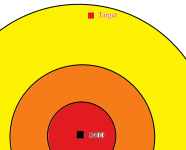
Great question. The ability of an AD battery to intercept targets is roughly like this (very simplified obviously), intense means higher probability of intercept.
1704040225964.png
Trying to hit the S400 itself will be hard as the region closest to it, is where the missiles from the AD battery will have the highest probability of intercept. Not all targets can have s400 next to them so intercepting the target will be relatively easier. It is all about probabilities and nothing can be said for certain of course.
 
Last edited:

Users who are viewing this thread

Pakistan Defence Latest

Latest Posts

Back
Top