kaku
Registered Member

Looks like Indians are biggest enemies of themselves, and dont want to do hardwork. Indeed they are never meant to be in same class, but lets compare.1020 TRMs.
Please stop comparing the Tejas to the F-16 - they are not, and were never meant to be in the same class.
1) Databus :- The databus used by F-16 Block 70/72 is 1553, but for integrating with radar Lockheed have used ethernet based databus for providing high resolution SAR images to Center Pedestal Display.
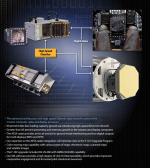
As we know Mk1A use 1553 databus for all connections. While LCA Mk2 will use ethernet based databus for all data tranmissions, including Radar, IRST,LDP, HMDS, and even SDR for D/L.
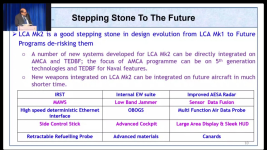
Ethernet interface/databus for LCA MK2
2) Radar :- For the fact I know, in F-21, SABR was only coming with frequency hopping rather than ultra low side lobe waveform of Uttam. Also Uttam is coming with dedicated SLC/SLB antenna, to work in heavy EW environment, which was non existent in export variant of SABR. Furthur, there were heavy restriction on NCTR modes. Also if you want to compare T/R modules, I have did it in previous posts, and even tried to calculate peak power of radar on Tejas Mk1A.
3) Airframe life- Tejas airframe was designed for 12,000 hours, while F-16 was 6000/8000 hours. Right now Tejas is undergoing stress test, where it already certified for 1000 hours, and work in undergoing in MAFT to certify it initially for 3000 hours, and then 5000 hours. Ultimately, NAL is confident to certify it for 9000 hours or beyond.
For propulsion, from what I read from different forums and articles, F404/F414 have a hot section life of 2000 hours, and after that it require overhaul. While technical life is of 4000 hours.
The F414 has a 2000-hour hot section life and a 4000-hour specification life for all other engine rotating components and structure. Critical rotating disks, shafts and engine structure have been designed using GE's robust, damage-tolerant design practice. This delivers a three-fold improvement in low cycle fatigue compared to previously used design methods.
F414
With constant T5,engine operability and hot section life are maintained. In actualoperation, the F404 control concept has been extremely successful. Although fleet average age is over 1000 flight hours,engine performance and stall-free operability remain outstanding and the full 2000 hour hot section life is expected to beachieved.
The hotsection life of F110 and F100 is around 1500 hours.
3) EW Suite:- F-16 developed new DRWR and DRFM based jammers.
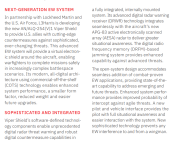
While Tejas Mk1A use GaN based DRFM jammed and digital wide band RWR (1-40 GHz).
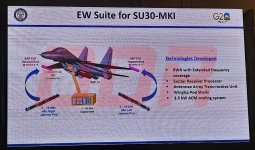
New Digital RWR (1-40 GHz)
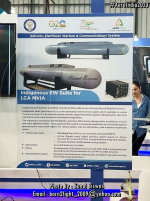
4) NCW Capabilities :- Block 70 is equipped with MIDS LVT, which provide IP based MANET, and link 16 for D/L.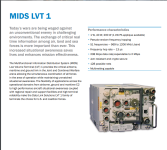
MIDS for Block 70
This is similar to BNET, which is equipped in Tejas Mk1A, and SDR-1 for Mk2.
IP MANET SDR for Tejas Mk1A
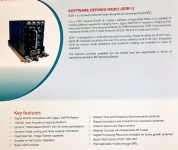
IP MANET SDR for Mk2
For Tactical D/L, F-16 use Link-16, while we are on IAF's ODL. Capability wise SDR and D/L is almost similar.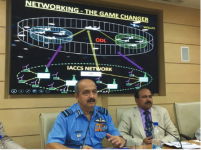
5) Weaponary and Payload :-
I dont think we need go into , Astra vs AAMRAAM or Tara vs JDAM. But on payload, obviosly Mk1A is inferior, not only because of light weight, but also 1 extra pylon go into carrying ASPJ pod. And this only be overcome by LCA Mk2.
Disclaimer :- I am only comparing with export variants of F-16, as we dont know how much USAF's versions are capable of, but most likely that is more capable than export variants.
Last edited:


