Why Indians are the highest earning ethnic group in US? Harsh Goenka explains

Status
Not open for further replies.

ST1976

Banned
Joined
Jul 25, 2006
Messages
3,311
Reaction score
436
Reputation
271.9
Country of Origin
Country of Residence
Why Indians are the highest earning ethnic group in US? Harsh Goenka explains

According to the latest US Census data, the Indians now have an average household earning of $123,700, i.e a little over ₹1 crore, PTI reported. The median earnings of the Indians there is nearly double the nationwide average of $63,922.


Industrialist Harsh Goenka has taken to Twitter to explain why Indians are earning the highest in the United States. In a tweet. he shared an infographic on median household income in the United States by ethnic group.

According to Goenka, Indians value good education and are the most educated ethnic group. He added that Indians work very hard along with being frugal in their habits. “We are smart. We are in IT, engineering and medicine- the highest paying jobs”. he tweeted.

https://pbs.twimg.com/media/FmbjuuHaUAIQcn5?format=jpg&name=small

The infographic has the US Census Bureau data of 2013-15 American Community Survey. It shows that the median household income of Indian-Americans stands at $100,000, which translates to ₹81.28 lakh as per the current exchange rate. The Chinese-Americans and Pakistani-Americans are lower on the list with median incomes of $69,100 and $66,200 respectively.

“Definitely proud of these Indians, many of whom are no longer Indian citizens but really sad about the fact that India has not been able to retain the likes of them - shouldn't we talk about this as well?” a Twitter user replied to Goenka's tweets.

Another user wrote, "Indians Mostly due to tech and doctors. Filipinos as well, doctors. So our international household in top two. Our kids 3 country trifecta. maybe even 4 or 5 since Spanish Filipino heritage and possibly British India"

According to the latest US Census data, the Indians now have an average household earning of $123,700, i.e a little over ₹1 crore, PTI reported. The median earnings of the Indians there is nearly double the nationwide average of $63,922.

Why Indians are the highest earning ethnic group in US? Harsh Goenka explains - Hindustan Times
 
Indian Americans: The New Model Minority

The 2008 election barely ended before the GOP began touting the presidential prospects of Louisiana Gov. Piyush "Bobby" Jindal, the son of Indian immigrants. Tuesday, Jindal becomes the new face of his party when he delivers the official Republican response to President Obama's speech to Congress. Whether or not he actually runs for president in 2012, Jindal symbolizes a remarkable but rarely discussed phenomenon--the amazing success of Indian Americans in general, and what that success says about our immigration policy.

Most Americans know only one thing about Indians--they are really good at spelling bees. When Sameer Mishra correctly spelled guerdon last May to win the 2008 Scripps National Spelling Bee, he became the sixth Indian-American winner in the past 10 years. Finishing second was Sidharth Chand. Kavya Shivashankar took fourth place, and Janhnavi Iyer grabbed the eighth spot. And this was not even the banner year for Indian Americans--in 2005, the top four finishers were all of Indian descent.

It's tempting to dismiss Indian-American dominance of the spelling bee as just a cultural idiosyncrasy. But Indian success in more important fields is just as eye-catching. Despite constituting less than 1% of the U.S. population, Indian-Americans are 3% of the nation's engineers, 7% of its IT workers and 8% of its physicians and surgeons. The overrepresentation of Indians in these fields is striking--in practical terms, your doctor is nine times more likely to be an Indian-American than is a random passerby on the street.

Indian Americans are in fact a new "model minority." This term dates back to the 1960s, when East Asians--Americans of Chinese, Japanese and Korean descent--were noted for their advanced educations and high earnings.

East Asians continue to excel in the U.S, but among minority groups, Indians are clearly the latest and greatest "model." In 2007, the median income of households headed by an Indian American was approximately $83,000, compared with $61,000 for East Asians and $55,000 for whites.

About 69% of Indian Americans age 25 and over have four-year college degrees, which dwarfs the rates of 51% and 30% achieved by East Asians and whites, respectively. Indian Americans are also less likely to be poor or in prison, compared with whites.

So why do Indian Americans perform so well? A natural answer is self-selection. Someone willing to pull up roots and move halfway around the world will tend to be more ambitious and hardworking than the average person. But people want to come to the U.S. for many reasons, some of which--being reunited with other family members, for example--have little to do with industriousness. Ultimately, immigration policy decides which kinds of qualities our immigrants possess.

Under our current immigration policy, a majority of legal immigrants to the U.S. obtain green cards (permanent residency) because they have family ties to U.S. citizens, but a small number (15% in 2007) are selected specifically for their labor market value. The proportion of Indian immigrants given an employment-related green card is one of the highest of any nationality. Consequently, it is mainly India's educated elite and their families who come to the U.S.

The success of Indian Americans is also often ascribed to the culture they bring with them, which places strong--some would even say obsessive--emphasis on academic achievement. Exhibit A is the spelling bee, which requires long hours studying etymology and memorizing word lists, all for little expected benefit other than the thrill of intellectual competition.

But education and culture can take people only so far. To be a great speller--or, more importantly, a great doctor or IT manager--you have to be smart. Just how smart are Indian Americans? We don't know with much certainty. Most data sets with information on ethnic groups do not include IQ scores, and the few that do rarely include enough cases to provide interpretable results for such a small portion of the population.

The only direct evidence we have comes from the 2003 New Immigrant Survey, in which a basic cognitive test called "digit span" was administered to a sample of newly arrived immigrant children. It is an excellent test for comparing people with disparate language and educational backgrounds, since the test taker need only repeat lengthening sequences of digits read by the examiner. Repeating the digits forward is simply a test of short-term memory, but repeating them backward is much more mentally taxing, hence a rough measure of intelligence.

When statistical adjustments are used to convert the backward digit span results to full-scale IQ scores, Indian Americans place at about 112 on a bell-shaped IQ distribution, with white Americans at 100. 112 is the 79th percentile of the white distribution. For more context, consider that Ashkenazi Jews are a famously intelligent ethnic group, and their mean IQ is somewhere around 110.

Given the small sample size, the rough IQ measure and the lack of corroborating data sets, this finding of lofty Indian-American intelligence must be taken cautiously. Nevertheless, it is entirely consistent with their observed achievement.

The superior educational attainment, academic culture and likely high IQ of Indian Americans has already made them an economic force in the U.S., and that strength can only grow. Does this continuing success imply they will become a political force? Here, Gov. Jindal is actually a rarity. Indians are still underrepresented in politics, and they do not specialize in the kinds of fields (law and finance) most conducive to political careers. Time will tell if they are able to convert economic power into serious political influence, as a Jindal presidency could.

A much clearer implication of Indian-American success is that immigrants need not be unskilled, nor must their economic integration take generations to achieve. In sharp contrast to Indian Americans, most U.S. immigrants, especially Mexican, are much less wealthy and educated than U.S. natives, even after many years in the country.

A new immigration policy that prioritizes skills over family reunification could bring more successful immigrants to the U.S. By emphasizing education, work experience and IQ in our immigration policy, immigrant groups from other national backgrounds could join the list of model minorities.

There is nothing inevitable about immigration. Who immigrates each year is a policy decision, free to be modified at any time by Congress. Constructing new legislation is always difficult, but I propose a simple starting point for immigration selection: Anyone who can spell guerdon is in!

Jason Richwine is a National Research Initiative fellow at the American Enterprise Institute in Washington.

Indian Americans: The New Model Minority (forbes.com)
 
Last edited:

Asian Americans[edit]​

In the 2021 American Community Survey, the following figures regarding detailed Asian ethnicities are reported.[3]

S0201: ACS 1-Year Estimates Selected Population Profiles (2021)

CodePopulationMedian household income (US$)CodePopulationMedian household income (US$)
Detailed RaceAloneAlone or in Combination with Other Races
Indian0134,402,223141,9060324,797,210138,418
Taiwanese018257,430119,022037310,503117,652
Filipino0192,960,811101,1570384,426,90496,883
Pakistani026555,917100,730045629,94695,747
Sri Lankan02772,27196,79004686,69094,034
Chinese0174,360,466 :)93,0070365,549,29393,431
Japanese022742,54987,7890411,636,63490,566
Indonesian02185,95787,377040161,80786,751
Korean0231,445,31582,9460421,962,18483,354
Hmong020345,33880,702039368,60980,175
Thai028180,36478,616047319,61778,434
Nepalese076217,15078,375084229,32578,043
Vietnamese0291,896,69077,8840482,288,08278,845
Laotian024181,45875,241043248,92076,962
Cambodian015272,40873,819034369,56275,424
Bangladeshi014245,13167,187033261,88566,641
Burmese073233,34760,376081248,82262,352

.​

=> https://en.wikipedia.org/wiki/List_..._States_by_household_income#Detailed_ancestry
 
here we have a news about competency of Indian-Asian students, as compared to other global Institutes. here, QS Global translated GMAT-GRE scores of different institutes of world.
what you people think, what would be share of Asian students in western institutes like Stanford-INSEAD? :coffee:
.
=>
Indian MBA students world’s most academically distinguished

BANGALORE: It is students from IIM-Bangalore, not from Harvard or Stanford or even MIT, who excel at GMAT, the entrance test for the creme de la creme of B-schools across the world.

According to the QS Global 200 Business Schools report, Indian MBA candidates are the world's most academically distinguished, with students of the IIM-B, scoring the highest average of 780. IIM-B students are ahead of the leading US institution Stanford and INSEAD in Europe, the survey said.

While the average GMAT score of Stanford is 730, INSEAD lies at 704. Second to IIM-B students in GMAT score are their counterparts from IIM, Ahmedabad with 767.

The survey says, "IIM Ahmedabad is notable for the extraordinarily high average GMAT scores of its students, with its figure of 767 exceeded only by fellow Indian institution, IIM Bangalore (780). This places the two ahead of any North American or European school for the academic quality of their student intake. The fact that students enrolled at both schools have an average of just two years of professional experience underlines the tendency for academically gifted students to move quickly on to the MBA qualification at the outset of their careers, rather than using it to up-skill at mid career, as is more common in Europe and North America."

IIM-B also appears in the survey as one of the emerging global business schools across the world, overtaking Melbourne Business School.

"It is the testimony to high quality talent that our country has. It is no surprise that Indian students have outscored others from across the globe. What is needed now is the establishment of premier institutes like Harvard and Stanford in India as well, so that these young minds could express their intelligence in best possible manner. This is possible only when full autonomy is provided to the universities," said T V Mohandas Pai, chairman, Manipal Global Education Services.

"At the time of independence, our universities at Mumbai, Chennai, Calcutta, Mysore and Baroda were among the top 200 in the world. Today, they do not fare in any ranking at all. This is the result of bad government policy. Full autonomy, independent board of governors and focus on research are the factors crucial for a good university," said Pai.

The colleges were also judged on different subjects under their programme. In corporate social responsibility, IIM-B ranked 21 among the top 50 business colleges across the globe, whereas IIM-A grabbed 19th ranked.

When it comes to emphasis on start-ups and small businesses to kick-start private sector growth ( entrepreneurship), IIM-B ranked 25 and IIM-A ranked 17. Under 'innovation', IIM-B was placed at 17th with a score of 90.6, whereas IIM-A ranked 13, with a score of 97.4 out of 100.

QS is an online and offline meeting place for aspiring managers, B-schools and businesses for career and educational -related decisions.

Many leaders in India

For the leadership development programme, four colleges from India feature among top 50 universities. They are: IIM-A, IIM-B, IIM-C and Indian School of Business (ISB).


Highlights of the survey

Schools ranked for employer reputation in 10 subject specializations. Harvard tops the table in three subjects, ahead of Stanford and MIT with two apiece. Wharton is number one for finance

Three Asian schools make the Elite global category: INSEAD Singapore, IIM-A and NUS Business School, National University of Singapore

No Elite Global schools in either Africa and Middle East, or Latin America :)

timesofindia.indiatimes.com

Indian MBA students world’s most academically distinguished: Survey - Times of India

News News: It is students from IIM-Bangalore, not from Harvard or Stanford or MIT, who excel at GMAT, the entrance test for the crème de la crème of B-schools ac
timesofindia.indiatimes.com
.
 
Super-rich Indians account for more than 20% of the wealth of ultra-high net worth (UHNW) individuals in Britain, a new list showed on Tuesday. As a national group, they are second only to expat Russians.

 
Why Indian Americans are not the new Jews by Razib Khan

Why Indian Americans are not the new Jews – Brown Pundits


www.brownpundits.com

Indians are not nearly as culturally coherent and cohesive as Jews. Genetically, Ashkenazi Jewish genealogies tend to coalesce 500-1,000 years ago. Indian genealogies for different communities coalesce 2 to 4 thousand years ago. Jewish Americans arrived in the United States with a common language, Yiddish. Only the more assimilated Jews were only fluent in the national vernacular. Indian Americans share one language, English, which is the same as that of the nation to which they migrated. The overwhelming majority of Jewish Americans in the 20th century remained Jewish if they were religious. A minority of Indian Americans are Muslim or Christian, and even among Hindus religion and caste distinctions are important enough there are North Indian and South Indian temples. Sikhs are overrepresented amongst the migrants. Jewish Americans tended to create their common American culture in a few large urban areas, in particular New York City. Though Edison and Cupertino have large Indian communities, the size and concentration of these communities are not analogous to Jews in terms of magnitude.

In short, Indian Americans don’t have what it takes to create a coherent catchall ethnic group similar to Amerian Jews except for the fact that outsiders perceive themselves as a singular group. I don’t think that “push” is ultimately that strong.

--------------------------------------------------------------------------

‘Indian-Americans are taking over the country’: Joe Biden at NASA meet


US President Joe Biden lauded the contributions of Indian Americans during a conversation with NASA scientists who were involved in the historic landing of Perseverance landing at Mars. ‘Indian- Americans are taking over the country. You (Swati Mohan), my Vice President (Kamala Harris), my speech writer,’ Joe Biden said. Indian-American scientist Swati Mohan leads the guidance, navigation, and control operations of NASA's Mars 2020 mission. The President further added that the achievement of the team was exemplary and thanked them for instilling a dose of confidence in the American people. Watch the full video for all the details.
 
America’s Wealthiest Religions?

osted by Sundari in General, USA on 02 25th, 2010 | 14 responses
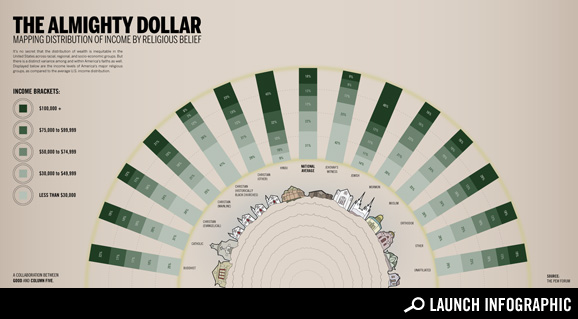
An interesting infographic circulating the Web has many people talking about the relationship between wealth and religion. The graphic, titled The Almighty Dollar, was created by GOOD and Column Five Media and breaks down income levels in the U.S. by religion. Data is based on information from the Pew Forum and it compares the income level of each religion to the national average. From the website: It’s no secret that the distribution of wealth is inequitable in the United States across racial, regional, and socio-economic groups. But there is a distinct variance among and within America’s faiths as well.

header_GOOD_ALMIGHTY_DOLLAR_R3.jpg


If you click on the image above, it will enlarge and you’ll see information broken down by several religious groups such as Jewish, Christian (divided into several groups), Buddhist, Mormon, Muslim etc. You’ll notice that Sikhism is not one of them (not sure why?). There are five income brackets (Less than $30,000 to $100,000+) listed and numbers signifying what percentage of each religious group falling into which income bracket.

43% and 46% of Hindus and Jews, respectively, fell into the $100,000+ income bracket while 8% and 9% of Christians (Historically Black Churches) and Jehovah’s Witnesses, respectively, fell into this same income bracket. Interestingly, Buddhists look to have the most equal distribution for each income bracket.

Many conversations on the internet have focused on the idea that immigrants make up a large portion of religious groups such as Hindus and Muslims. This is probably quite true. Individuals from these groups who are in the United States today, are probably more educated. The representation of these groups in this data sample is highly selective. Wealth is therefore probably more related to education rather than religion.

Other conversations suggest that those religious groups who have the lowest percentage in the $100,000+ also give the most money to their place of worship.

Having said that, what religious group’s distribution would Sikhs most likely follow? How would those individuals, who identify as Sikhs, be represented on this infographic?

America’s Wealthiest Religions? | The Langar Hall
 
Why Indians are the highest earning ethnic group in US? Harsh Goenka explains

According to the latest US Census data, the Indians now have an average household earning of $123,700, i.e a little over ₹1 crore, PTI reported. The median earnings of the Indians there is nearly double the nationwide average of $63,922.


Industrialist Harsh Goenka has taken to Twitter to explain why Indians are earning the highest in the United States. In a tweet. he shared an infographic on median household income in the United States by ethnic group.

According to Goenka, Indians value good education and are the most educated ethnic group. He added that Indians work very hard along with being frugal in their habits. “We are smart. We are in IT, engineering and medicine- the highest paying jobs”. he tweeted.

https://pbs.twimg.com/media/FmbjuuHaUAIQcn5?format=jpg&name=small

The infographic has the US Census Bureau data of 2013-15 American Community Survey. It shows that the median household income of Indian-Americans stands at $100,000, which translates to ₹81.28 lakh as per the current exchange rate. The Chinese-Americans and Pakistani-Americans are lower on the list with median incomes of $69,100 and $66,200 respectively.

“Definitely proud of these Indians, many of whom are no longer Indian citizens but really sad about the fact that India has not been able to retain the likes of them - shouldn't we talk about this as well?” a Twitter user replied to Goenka's tweets.

Another user wrote, "Indians Mostly due to tech and doctors. Filipinos as well, doctors. So our international household in top two. Our kids 3 country trifecta. maybe even 4 or 5 since Spanish Filipino heritage and possibly British India"

According to the latest US Census data, the Indians now have an average household earning of $123,700, i.e a little over ₹1 crore, PTI reported. The median earnings of the Indians there is nearly double the nationwide average of $63,922.

Why Indians are the highest earning ethnic group in US? Harsh Goenka explains - Hindustan Times
Focus is on education
 
Focus is on education

South Asians racial difference :)

To view this content we will need your consent to set third party cookies.
For more detailed information, see our cookies page.
 
America’s Wealthiest Religions?

osted by Sundari in General, USA on 02 25th, 2010 | 14 responses
An interesting infographic circulating the Web has many people talking about the relationship between wealth and religion. The graphic, titled The Almighty Dollar, was created by GOOD and Column Five Media and breaks down income levels in the U.S. by religion. Data is based on information from the Pew Forum and it compares the income level of each religion to the national average. From the website: It’s no secret that the distribution of wealth is inequitable in the United States across racial, regional, and socio-economic groups. But there is a distinct variance among and within America’s faiths as well.

header_GOOD_ALMIGHTY_DOLLAR_R3.jpg


If you click on the image above, it will enlarge and you’ll see information broken down by several religious groups such as Jewish, Christian (divided into several groups), Buddhist, Mormon, Muslim etc. You’ll notice that Sikhism is not one of them (not sure why?). There are five income brackets (Less than $30,000 to $100,000+) listed and numbers signifying what percentage of each religious group falling into which income bracket.

43% and 46% of Hindus and Jews, respectively, fell into the $100,000+ income bracket while 8% and 9% of Christians (Historically Black Churches) and Jehovah’s Witnesses, respectively, fell into this same income bracket. Interestingly, Buddhists look to have the most equal distribution for each income bracket.

Many conversations on the internet have focused on the idea that immigrants make up a large portion of religious groups such as Hindus and Muslims. This is probably quite true. Individuals from these groups who are in the United States today, are probably more educated. The representation of these groups in this data sample is highly selective. Wealth is therefore probably more related to education rather than religion.

Other conversations suggest that those religious groups who have the lowest percentage in the $100,000+ also give the most money to their place of worship.

Having said that, what religious group’s distribution would Sikhs most likely follow? How would those individuals, who identify as Sikhs, be represented on this infographic?

America’s Wealthiest Religions? | The Langar Hall

Why Diwali spending is primed to rocket in the US​

Diwali's profile is growing, particularly in the US. In 2022, President Joe Biden marked Diwali at the White House with the biggest-ever celebration. Recognition has also appeared at the state and city levels: the Pennsylvania State Senate passed a bill earlier in April this year making Diwali an official holiday state holiday; and in New York City, Mayor Eric Adams announced in June that Diwali will become a school holiday in the city's public school system, the largest in the country.

"Diwali is coming out from a liminal space and becoming a part of our national lexicon of holidays," says Soni Satpathy-Singh, a New York-based entrepreneur, who owns meal delivery review site Meal Matchmaker and works as a private chef and content creator.

To celebrate the holiday, consumers spend on gifts, food for parties, festive decor and floral arrangements. "Diwali is the equivalent of Christmas for consumption for South Asians in terms of buying new clothes, buying new things, painting the house," says Nirmalya Kumar, a professor of marketing at Singapore Management University.

1699610041168.png


In 2022, President Biden hosted the largest-ever Diwali celebration at the White House (Credit: Alamy)

Major retailers such as Target, Walmart and Costco have begun to cater to Diwali in the past few years, stocking shelves with Diwali-specific goods, including decorative productive products for the home, food and gift boxes. Greeting card aisles also display Diwali-themed cards alongside Christmas ones.

In India, consumers who celebrate Diwali represent a major revenue opportunity for businesses – and research shows purchasing from this group may grow this year, with approximately 70% of Indians ready to spend more this Diwali than last. Among those who planned to spend more, 68% said they are more likely to increase spending on new clothes, 65% on gold and jewellery, 64% on Diwali food items and gifts for family and 64% on friends and colleagues.

And there's a big potential market. At nearly 4.4 million, the Indian-American population has grown by more than 50% between 2010 and 2020, according to 2020 US Census data, which includes groups that celebrate Diwali. The median household income among the country's Indian-American population was $119,000 (£96,220) in 2019, according to Pew Research Center, standing significantly higher than median incomes for the broader US population.

www.bbc.com

Why Diwali spending is primed to rocket in the US

As Diwali festivals become increasingly mainstream, businesses are hoping to capture celebrants' holiday dollars.
www.bbc.com
www.bbc.com
 
Education and focus on learning. and the other factor is Indians help eachother out, They form Teams of Indians, more than outsiders, keep money within their community. Whereas Pakistanis lack education focus and the biggest disadvantage is that they cut eachother growth.
 
America’s Wealthiest Religions?

osted by Sundari in General, USA on 02 25th, 2010 | 14 responses
An interesting infographic circulating the Web has many people talking about the relationship between wealth and religion. The graphic, titled The Almighty Dollar, was created by GOOD and Column Five Media and breaks down income levels in the U.S. by religion. Data is based on information from the Pew Forum and it compares the income level of each religion to the national average. From the website: It’s no secret that the distribution of wealth is inequitable in the United States across racial, regional, and socio-economic groups. But there is a distinct variance among and within America’s faiths as well.

header_GOOD_ALMIGHTY_DOLLAR_R3.jpg


If you click on the image above, it will enlarge and you’ll see information broken down by several religious groups such as Jewish, Christian (divided into several groups), Buddhist, Mormon, Muslim etc. You’ll notice that Sikhism is not one of them (not sure why?). There are five income brackets (Less than $30,000 to $100,000+) listed and numbers signifying what percentage of each religious group falling into which income bracket.

43% and 46% of Hindus and Jews, respectively, fell into the $100,000+ income bracket while 8% and 9% of Christians (Historically Black Churches) and Jehovah’s Witnesses, respectively, fell into this same income bracket. Interestingly, Buddhists look to have the most equal distribution for each income bracket.

Many conversations on the internet have focused on the idea that immigrants make up a large portion of religious groups such as Hindus and Muslims. This is probably quite true. Individuals from these groups who are in the United States today, are probably more educated. The representation of these groups in this data sample is highly selective. Wealth is therefore probably more related to education rather than religion.

Other conversations suggest that those religious groups who have the lowest percentage in the $100,000+ also give the most money to their place of worship.

Having said that, what religious group’s distribution would Sikhs most likely follow? How would those individuals, who identify as Sikhs, be represented on this infographic?

America’s Wealthiest Religions? | The Langar Hall

To view this content we will need your consent to set third party cookies.
For more detailed information, see our cookies page.


r5jasytmauo61[1].jpg

To view this content we will need your consent to set third party cookies.
For more detailed information, see our cookies page.


Education and focus on learning. and the other factor is Indians help eachother out, They form Teams of Indians, more than outsiders, keep money within their community. Whereas Pakistanis lack education focus and the biggest disadvantage is that they cut eachother growth.
Tbf, in the US, immigrants will also always have a higher wage average than the locals, if they are educated, because immigration itself filters out low skilled people.
 
Tbf, in the US, immigrants will also always have a higher wage average than the locals, if they are educated, because immigration itself filters out low skilled people.

It is just a matter of who works hard, immigrant or not. Work hard, get the rewards you work for. Simple.
 
Status
Not open for further replies.

Users who are viewing this thread

Latest Posts

Back
Top