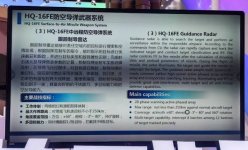
●The vertical coverage is stated to be from 3° to 80°. This means the radar cannot detect or track targets directly overhead (90°) or very close to the ground (below 3°), which could limit its effectiveness against low-flying or high-altitude targets at certain angles.
Well duh, it's a medium-area SAM system, not a bloody SHORAD, anything short of a sub-orbital object that attempts to fly directly above it would've been shot several times over. As for terrain skimming targets, the Tombstone-esque radar isn't the only radar in an HQ-16 battery, there's also a 76N6-esque low-altitude compliment radar.
●The use of mechanical scanning for 360-degree coverage means that there could be delays in target tracking as the radar rotates. Mechanical systems can also be more prone to wear and failure compared to fully electronic systems, potentially impacting reliability and maintenance needs.
Dude, it's a tracking and guidance radar, it's supposed to receive info from early surveillance radar and command vehicle, furiously beam a "narrow" cone and guide missiles at baddies till they all bite the dust.
Also, "mechanical systems more prone to wear and failure", is not wrong, but it's 2024, we can make things spin for a few thousand hours without breaking, okay?
●The radar can intercept up to 8 batches among 12 different targets. This indicates a limitation in handling large-scale, simultaneous attacks. If the system is confronted with more than 12 targets at once, it might struggle to effectively track and engage all of them.
...which is why there should be multiple such radars in each battery
I think what you are trying to suggest is that SAM batteries should carry their own little fixed array AEGIS-like systems, strapping multiple radars on a single platform. Sure you get higher refresh time with no gaps, sure you don't need to mechanically spin anything, and sure the system would be able to simultaneously track and engage more targets, but the downside is obvious,
you are sticking multiple phased array radars on a single platform.
People seem to forget that there's a difference between putting systems on a truck chassis and putting systems on a truck trailer. A truck chassis system can actually go off-road, while a trailer system would have to stick to 2-lane roads without tight turns or rough bumps. To stick a multiple array system on trucks, each individual array would either have to be small, and you are essentially trading effective range for reaction time and flexibility.
So yes, you can make something like the GBMMR for your NASAM-esque, IRIS-T-esque short-ranged systems, but for something like S-350, PAC-3, and HQ-16, you are gonna need a more traditional radar set-up.
And that's before we consider the fact that
none of these have
anything to do with HHQ-16 on 054A frigates, completely different systems except the missiles themselves!