
Gotta agree with all thatWill continue to serve SP role for some time. Not going anywhere. Excellent thing for Counter bombardment and harassing fire. Packs quiet a punch.

Follow along with the video below to see how to install our site as a web app on your home screen.
Note: This feature may not be available in some browsers.
Gotta agree with all thatWill continue to serve SP role for some time. Not going anywhere. Excellent thing for Counter bombardment and harassing fire. Packs quiet a punch.

Small arms fire from their side, then we replied, then they fired some artillery... And then all hell broke loose from our side... Their side kept pleading us to stop fire, but....How did the clashes start? Was there actual reason or just one side randomly started
It is couple of millions euros per unit.Given, the risk of NBC warfare, something like the Archer would have been more appropriate, but........
For terrain like this i would opt for 105 light howitzers which could be moved and manned by minimal labour and animal assistance.:-(
Mountain warfare 101 is required and Im not the expert, PK is.
Pack howitzers are taken apart in pieces, transported on mules(or through helis) and then deployed on peaks or forward positions where there is no route for wheels.
The major issue for vehicles in mountains is everything stops when the lone winding road is blocked, be it enemy fire or land slide or bridge taken out. Then its helis or mules.
Below is Leepa valley - look at that terrain. would deploying SP guns here be a good idea for fire and maneuver ? shoot and scoot ?
View attachment 42488

True. I didn't ask for the Archer to be inducted, but something similar, that lets the crew operate without dismounting, and provides NBC protection at the same time.It is couple of millions euros per unit.
You got the idea from this image ?I think you did not get what i was trying to say.
For the sake of this discussion lets break down our Mountainous Terrain Artillery requirement into 3 major areas>
A. Dense Jungle + Mountainous terrain (LOC/Kargil Side) with little to no road network:
>Supports the use of artillery pieces that are either air lifted in or small enough to be carried by mules i.e 105 to 122mm for us given out helo limitations.
B. Mountainous terrain (LOC/AFG) with presence of a small and largely broken road network:
>Supports the use of 4x4 SPH or smaller arty pieces like 105 that can be towed by smaller trucks/hilux.
C. Mountainous terrain (LOC) with presence of a extensive and well spread road network:
>Support the use of 6x6/8x8 trucks with large arty pieces towed.
So as you can see the different requirements are there, PA just needs to pick what it suits best, In my opinion for current peace time ops & LOC skirmishes only the options B & C are valid in LOC/AFG areas where there is no need for units to disassemble artillery pieces.
While as far Leepa valley is concerned there is a light road network is there too in some places only 500m away from the LOC line.
View attachment 42581
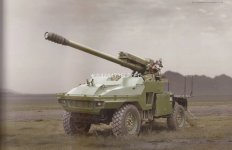
it would be interesting to see 105mm gun placed on smaller platform with better mobility and with possibility to dismount it and be operated manually, trade off would be needed crew of 6 men at least.

The issue with 105mm howitzer systems is that it's stuck in a very awkward spot with both limited range and damage potential.it would be interesting to see 105mm gun placed on smaller platform with better mobility and with possibility to dismount it and be operated manually, trade off would be needed crew of 6 men at least.
i was thinking about mortar solution too, thing is that this weapon system we are talking about would operate in limited geographical conditions of mountains were range is not essential, mobility, weight and fire rate would be more important by my opinion, impact of the shells would be limited anyway due rocky terrain, so there are lot of pro and cons for each option but none would be perfect probably mobile mortar system 120mm with rocket fuel assisted ammo would be best compromise among available options.The issue with 105mm howitzer systems is that it's stuck in a very awkward spot with both limited range and damage potential.
The key criteria for consideration for the suitability of artillery systems (mortars, howitzers, MLRS) include unit weight delivery (how much shell weight can you throw per unit time), demolition force (punching power against permanent structures made out of brick/concrete), and firing range.
Generally speaking, mortars have the greatest unit weight delivery (great shell weight + fast RoF) at the expense of demolition force and range, vice versa for howitzers. The issue with legacy 105mm howitzer systems is that because of the limitations in the overall design, it is severely limited in firing range (~7.5km max with unguided shells) and poor demolition force (~2kg TNT for HE shells), while still having much inferior unit weight delivery compared to 120mm mortars, all the while having a larger and heavier gun carriage (it is still a howitzer after all)
You might as well just go with a self-propelled gun-mortar system similar to 2S9 Nona or the PLL-05

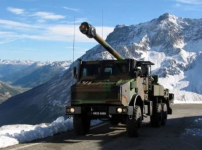
Is that a French Caesar Mk1 155mm SPH ?

Yes off course.Is that a French Caesar Mk1 155mm SPH ?
Another rarely talked about issue with wheeled SPH is accuracy.View attachment 43798
More like something like this, compact and low silhouette
the SH15 has hydraulics which enable it to basically kiss the ground with the entire chassis, that combined with the stablizer under neath and behind the truck make it extremely stable.Another rarely talked about issue with wheeled SPH is accuracy.
Lighter wheeled SPH systems typically have less inertia and less dampening structure to absorb and delay the recoiling motion, which means the entire structure could start to deviate before the projectile have left the gun barrel and this resulting in decreased accuracy. For reference, typical truck howitzer like Caesar have dispersion diameter around 1/200th or 1/300th of the firing range, for example at 20km 50% of the shells would land within 100 meters of the target. In comparison, tracked howitzers can typically achieve around 1/1000th in terms of accuracy, which really can make a difference since in most cases guided shells would not come into play.
And this is another reason why PA may have chosen the SH-15/PCL-181 system, which is one of the first truck guns that features high degrees of chassis-gun carriage integration, both designed as a part of a system instead of an existing gun modified to be mounted on an existing truck. Norinco figures suggest that SH-15 can managed accuracy beyond 1/1000th and is on par with their tracked systems, which is quite outstanding compared to even larger and far more complicated competitors, such as the archer.
And this is also why ultra-light self propelled artillery designs may not always be the most ideal.
It’s not just the hydraulics, if you mean hydraulic recoil mechanism. Obviously most howitzer have some sort of hydraulic system built into the gun carriage to dampen instantaneous impact within a reasonable recoil distance.the SH15 has hydraulics which enable it to basically kiss the ground with the entire chassis, that combined with the stablizer under neath and behind the truck make it extremely stable.


