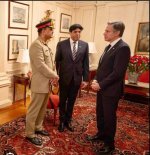
PTI freedom movement against Judiciary and Establishment: News, Discussion & Updates

Status
Not open for further replies.
He got retired and he took retirement for his son as he is running for his safty it is a lesson for other people as well. Never betray your mother land.. he will move to USA or Canada. But Pakistani in abroad will not welcome him he will face lot of music here.
To view this content we will need your consent to set third party cookies.
For more detailed information, see our cookies page.

Eh?
Only lesson i see is that do betray your country so you can enjoy good retirement and lots of money 🤑🤑

Pakistani dont care about other Pakistanis..there are plenty of gora in those countries and many ex military intelligence people..they share common hobbies like electricuting balls of innocent Pakistanis
 
IK also married Bushra Bibi recently who was a nani and she left her family for her lover and his wealth plus power.
If you were married to that cuck of a husband of Bushra Bibi's, you would have left him as well. Nothing wrong in getting a divorce Islamically.
 
He has traveled to Australia many times recently, so there is a chance he may move there, as there aren't many Pakistanis living in Australia. I believe he feels that if he moves to the West, he will be named and shamed, so there's a higher chance he will choose Australia instead. Otherwise, Europe, America, and Arab countries are likely to face a lot of trouble.

Thats what Kiyani end up doing as well. Australia seems to be the destination of these traitors. Big country, less polulation, million miles away from the spot light , good life style, and not many Pakistanis to deal with.
 
This was the reason Anjum was angry to khan. As he was very low iq officer and he was afraid that khan was going to reject him..

To view this content we will need your consent to set third party cookies.
For more detailed information, see our cookies page.
 
Last edited:
Why are you spamming siasat articles in the security section


Saaar why people with different political opinions to me iz allowed saar

Please stfu, if you want a PTI forum go find it elsewhere
saaarrr boot licking jindabad saaar!!!

leather for lyfeeeee!!!
 
This was the reason Anjum was angry to khan. As he was very low iq officer and he was afraid that khan was going reject him..

To view this content we will need your consent to set third party cookies.
For more detailed information, see our cookies page.

it would be a mircale to find even average iqs officer is this corrupt mafia!
 
Share article/thread source and mention author of the article.
The relationship between the United States and Pakistan has long been marked by an asymmetric power dynamic, where Pakistan's sovereignty has frequently been compromised in favour of U.S. interests. This quasi-colonial relationship can be traced back to the 1950s and has evolved through various phases of manipulation, military alliances, and economic dependence.

The Cito Centre Agreement in 1954 was one of the first major events that signalled the beginning of U.S. control over Pakistan's foreign policy. Officially a military pact to counter the Soviet threat, it allowed the U.S. to establish military bases on Pakistani soil in exchange for financial and military aid. This marked the beginning of a pattern where Pakistan was forced into a position of dependence, its sovereignty undermined as U.S. personnel enjoyed privileges that made them exempt from local laws—similar to how colonial powers once treated their subjects.

The U-2 incident in 1960 was another glaring example of Pakistan’s compromised sovereignty. The U.S. was using Pakistani airbases to launch spy missions over the Soviet Union without Pakistan's consent, and when a U-2 spy plane was shot down, it was Pakistan that bore the diplomatic fallout. Pakistan’s role as a pawn in Cold War geopolitics was exposed, with the U.S. treating its territory as a mere staging ground for its own global strategies regardless of the potential dangers to Pakistan.

During the 1971 Indo-Pak war, the U.S. betrayed its supposed ally. Pakistan, under Yahya Khan, believed it had American support, but the Nixon administration was playing a double game, secretly favouring India. The U.S. manipulated Pakistan, using the war to further its own geopolitical goals, only to abandon Pakistan when it was defeated, leading to the loss of East Pakistan (now Bangladesh). This betrayal underscored the colonial nature of the relationship, where Pakistan's interests were disposable in the face of American objectives.

In the 1980s, Pakistan became a critical tool for the U.S. during the Afghan Jihad against the Soviet Union. The Reagan administration funnelled billions of dollars through Pakistan to arm the Afghan Mujahideen, but Pakistan paid a steep price for this so-called alliance. The country became a hub for weapons and drugs, and its internal stability deteriorated as a result. While the U.S. achieved its strategic goals by weakening the Soviet Union, Pakistan was left to deal with the fallout: an influx of radicalised fighters, refugees, and a growing culture of extremism. Once again, Pakistan had been used to serve U.S. interests with little regard for the consequences it would face.

After the Cold War ended, the U.S. discarded Pakistan once more, imposing sanctions through the Pressler Amendment in 1990 over Pakistan’s nuclear ambitions. This was a clear signal that Pakistan’s value to the U.S. was purely transactional. During the Afghan war, Pakistan had been a key ally, but once the Soviets were gone, it became expendable. India, meanwhile, pursued its own nuclear ambitions with far less interference from Washington, exposing the double standards in U.S. foreign policy.

The post-9/11 era saw Pakistan thrust into the frontlines of America’s War on Terror. Under immense pressure, President Pervez Musharraf had little choice but to comply with US demands. Pakistan became a battleground for drone strikes, which killed thousands of civilians and caused widespread destruction. America’s War on Terror was, in many ways, a propaganda line that cost Pakistan more than $150 billion in economic losses, infrastructure damage, and human lives. NATO supply convoys heavily damaged Pakistan's roads, and the Taliban, seeing Pakistan as an American ally, took revenge by launching attacks across the country. It was a bizarre situation where, on one hand, the U.S. called Pakistan an ally, yet on the other, it conducted deadly drone strikes on Pakistani soil. The toll on Pakistan was immense: over 100,000 people were killed, and its internal security and economy were pushed to the brink.
IMG_7807.jpeg
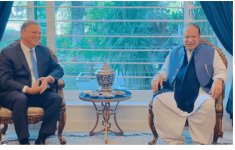
Pakistan's role in America's global strategy is as crucial as that of Ukraine or Palestine. The U.S. sees Pakistan as key to its survival in the current world order, controlling not only the South Asian region but also Central Asia and the broader Muslim world. Pakistan, with its population of 250 million, the second-largest Muslim population in the world, and its nuclear arsenal, is far too important for the U.S. to lose control over. American influence in Pakistan has long been maintained with the complicity of Pakistani generals and politicians like Nawaz Sharif and Asif Ali Zardari, who have been key facilitators of U.S. interests. The U.S. is deeply aware that losing Pakistan would mean losing a major geopolitical asset, which is why American diplomats, such as Donald Lu, were allegedly involved in the political machinations that led to the ousting of Pakistani Prime Minister Imran Khan.
IMG_7806.jpeg
The stakes for the U.S. in Pakistan are as high as they are in Ukraine or Palestine. America will do everything in its power to maintain control over Pakistan, because controlling Pakistan means influencing the entire Central Asian region and maintaining leverage over the Muslim world. Pakistan’s nuclear capability makes it even more critical to U.S. strategy. A weak Pakistan, with a crippled economy, is easier for the U.S. to control. The International Monetary Fund (IMF) and World Bank, both heavily influenced by the U.S., have been key tools in keeping Pakistan dependent on foreign loans, forcing it to adopt policies that weaken its economic sovereignty. A weakened economy forces Pakistan to bend to U.S. demands, ensuring it remains on its knees and unable to challenge American interests.

The U.S. also exerts control through Pakistan’s military. Hillary Clinton once commented that the U.S. uses Pakistan’s army to control the country. Washington deals with both Pakistan’s political leaders and its military, often playing one against the other to maintain its grip. Pakistani generals, eager for U.S. military aid and support, have historically facilitated American operations in the region, further entrenching Pakistan in its role as a client state.

This ongoing manipulation, where America plays a decisive role in Pakistan’s political and military affairs, reflects the deeper colonial mindset that has defined U.S.-Pakistan relations. Despite being an independent nation, Pakistan remains tethered to U.S. influence, with its leaders often forced to prioritise American interests over their own. Whether through military pacts, economic dependency, or covert operations, the U.S. continues to treat Pakistan as a modern colony, ensuring that it remains under Washington’s control in the broader game of global power politics.
 
I think it's less America's intention to treat us like this and more of our own leaders just bending over backwards everytime a white man speaks to them.

Then they probably think, these guys have no self respect so why should we even bother dealing with them as equals.

I am sure we could maintain a very healthy relationship with the US if we politely put our foot down on certain matters.
 
I think it's less America's intention to treat us like this and more of our own leaders just bending over backwards everytime a white man speaks to them.

Then they probably think, these guys have no self respect so why should we even bother dealing with them as equals.

I am sure we could maintain a very healthy relationship with the US if we politely put our foot down on certain matters.


Shouldn't you be happy to be on a low gear with the Americans given the last thirty years

Now it's obvious there is a lot of blame to go around
 
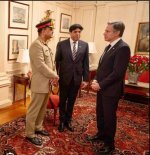
Just look at how the wild boars stand obediently before their master and how he treats his people in Pakistan—pure assets for them.IMG_7807.jpeg
 
Last edited:
I think it's less America's intention to treat us like this and more of our own leaders just bending over backwards everytime a white man speaks to them.

Then they probably think, these guys have no self respect so why should we even bother dealing with them as equals.

I am sure we could maintain a very healthy relationship with the US if we politely put our foot down on certain matters.
I can attest to this, personally. Americans are fair minded when it comes to their allies and friends. They accept the limitation in some countries like Pakistan.
It’s the fools in Pakistan that think the US didn’t wisen up to their treachery in Afghanistan - taking the money and still arming the taliban.

Every country has their own interest and I’m not singling out Pakistan, but the fact remains, the Americans saw the utter sleazy nation of Pakistanis. They noticed the utter disregard for its own people and taking money to sell its women and children. The US is a hyper masculine society. Don’t let the LGBT crap fool you. They firmly believe that the man should be a protector and a provider, but unfortunately Pakistanis can’t cut the mustard.
This likely shocked them selling women to a foreign power for $$$. They would never do shut a thing. Watching Pakistanis giving up the full house just because the other person is a westerner also contribute to this.
The Uncle Tom behavior, enslaved mindedness.
Americans take great pain to treat its allies with respect as they learned long time ago that allies make or break your country’s power. Pakistanis junta like low iq clowns that they are still think that things can be fixed when they can’t. They know that you overthrew a nationalist government just to fill your own pockets and nothing in return. They know your took $33bn from the US without even applying those funds to your education, medical, infrastructure sectors but instead end corrupts used it to purchase properties outside of Pakistan.

Americans see all of that and what do you expect to treat Pakistan as?
 
During the 1971 Indo-Pak war, the U.S. betrayed its supposed ally. Pakistan, under Yahya Khan, believed it had American support, but the Nixon administration was playing a double game, secretly favouring India. The U.S. manipulated Pakistan, using the war to further its own geopolitical goals, only to abandon Pakistan when it was defeated, leading to the loss of East Pakistan (now Bangladesh). This betrayal underscored the colonial nature of the relationship, where Pakistan's interests were disposable in the face of American objectives.

USA could do nothing short of sending military troops to help out on East Pakistan. Nixon was already knee deep in SE Asia
 
I think it's less America's intention to treat us like this and more of our own leaders just bending over backwards everytime a white man speaks to them.

Then they probably think, these guys have no self respect so why should we even bother dealing with them as equals.

I am sure we could maintain a very healthy relationship with the US if we politely put our foot down on certain matters.

That would start with IMF loans
 
Shouldn't you be happy to be on a low gear with the Americans given the last thirty years

Now it's obvious there is a lot of blame to go around

It happened because we didn't deal with it right. Strategic depth, Kashmir, CPEC could all be in a much better position today.
 
Status
Not open for further replies.

Users who are viewing this thread

Country Watch Latest

Latest Posts

Back
Top