Navigation
Install the app
How to install the app on iOS
Follow along with the video below to see how to install our site as a web app on your home screen.
Note: This feature may not be available in some browsers.
More options
Style variation
You are using an out of date browser. It may not display this or other websites correctly.
You should upgrade or use an alternative browser.
You should upgrade or use an alternative browser.
The Economic History of the Last 2,000 Years in 1 Little Graph
- Thread starter ST1976
- Start date
More options
Who Replied?

Joe Shearer
Professional
So does that make it 1,000 years or 4,000 years?double post

ST1976
Trusted Member
- Thread starter
- #33
So does that make it 1,000 years or 4,000 years?
how do you see the post#4? the report of 'The Economists'.
its the same report we find in many credible references. here we find, the Labour cost of Western countries was 'cheaper' than South Asia till 1818, till the Fall of Maratha's, and the same Labour Cost Difference was somehow-someway maintained till late 1800s, and upto early 1900,......
how do you people see posts of this thread?
Joe Shearer
Professional
It was a brilliant thread, and one that will be neglected by everyone busy carrying around their Tommy Guns from thread to thread, intent on shooting wars rather than on reading.how do you see the post#4? the report of 'The Economists'.
its the same report we find in many credible references. here we find, the Labour cost of Western countries was 'cheaper' than South Asia till 1818, till the Fall of Maratha's, and the same Labour Cost Difference was somehow-someway maintained till late 1800s, and upto early 1900,......
how do you people see posts of this thread?
ST1976
Trusted Member
- Thread starter
- #35
.The Economic History of the Last 2,000 Years in 1 Little Graph
That headline is a big promise. But here it is: The economic history of the world going back to Year 1 showing the major powers' share of world GDP, from a research letter written by Michael Cembalest, chairman of market and investment strategy at JP Morgan.
https://cdn.theatlantic.com/media/mt/business/Screen Shot 2012-06-20 at 9.37.55 AM.png
View attachment 197
In Year 1, India and China were home to one-third and one-quarter of the world's population, respectively. It's hardly surprising, then, that they also commanded one-third and one-quarter of the world's economy, respectively.
Before the Industrial Revolution, there wasn't really any such thing as lasting income growth from productivity. In the thousands of years before the Industrial Revolution, civilization was stuck in the Malthusian Trap. If lots of people died, incomes tended to go up, as fewer workers benefited from a stable supply of crops. If lots of people were born, however, incomes would fall, which often led to more deaths. That explains the "trap," and it also explains why populations so closely approximated GDP around the world.
https://www.theatlantic.com/busines...he-last-2-000-years-in-1-little-graph/258676/
ST1976
Trusted Member
- Thread starter
- #36
One study found that, in Mughal times, Bengal contributed 25% of the 'Indian' GDP, that is, 25% of 25%. Around 6.25% of world GDP.
Non-cooperation movement (1919–1922)
The non-cooperation movement was a political campaign launched on 4 September 1920 by Mahatma Gandhi to have Indians revoke their cooperation from the British government, with the aim of persuading them to grant self-governance.This came as result of the Indian National Congress (INC) withdrawing its support for British reforms following the Rowlatt Act of 18 March 1919 – which suspended the rights of political prisoners in sedition trials, and was seen as a "political awakening" by Indians and as a "threat" by the British which led to the Jallianwala Bagh massacre of 13 April 1919.

The movement was one of Gandhi's first organized acts of large-scale satyagraha. Gandhi's planning of the non-cooperation movement included persuading all Indians to withdraw their labour from any activity that "sustained the British government and also economy in India," including British industries and educational institutions.
Through non-violent means, or ahimsa, protesters would refuse to buy British goods, adopt the use of local handicrafts, and picket liquor shops. In addition to promoting "self-reliance" by spinning khadi, buying Indian-made goods only, and boycotting British goods, Gandhi's non-cooperation movement also called for stopping planned dismemberment of Turkey (Khilafat Movement) and the end to untouchability. This resulted in publicly-held meetings and strikes (hartals), which led to the first arrests of both Jawaharlal Nehru and his father, Motilal Nehru, on 6 December 1921.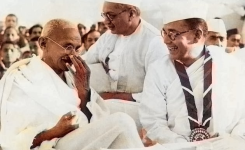
The non-cooperation movement was among the broader movement for Indian independence from British rule and ended, as Nehru described in his autobiography, "suddenly" on 4 February 1922 after the Chauri Chaura incident. Subsequent independence movements were the Civil Disobedience Movement and the Quit India Movement.

Non-cooperation movement (1919–1922) - Wikipedia
=>
Neta Ji Subhash Chandra Bose became the President of the Congress Party in 1938. In 1919, Bose headed to London to give the Indian Civil Services (ICS) examination and he was selected. Bose, however, resigned from Civil Services as he believed he could not side with the British.


[Solved] Subhash Chandra Bose became the President of the Congress Pa
The correct answer is 1938. Key Points Subhash Chandra Bose became the President of the Congress Party in 1938. In 1919, Bose headed to London to give
 testbook.com
Last edited:

Oscar
Moderator


What’s interesting to note is that until the US was colonized - despite it’s size it had no influence due to lack of population but more so due to lack of trade and cross pollination of technology.It was a brilliant thread, and one that will be neglected by everyone busy carrying around their Tommy Guns from thread to thread, intent on shooting wars rather than on reading.
India was massive because it had both resources to exploit and trade - so did(does) China and India can return to its relative position somewhat - but the US is truly that odd case study of abundance of resources and enabled trade taking stance even if done so in a highly inefficient manner at times.
Because of the nature of the US - it’s truly absorbing the best of the world which the Brits regardless of their conquests were never able to efficiently exploit the lands they held as colonies.
ST1976
Trusted Member
- Thread starter
- #38
What’s interesting to note is that until the US was colonized - despite it’s size it had no influence due to lack of population but more so due to lack of trade and cross pollination of technology.
India was massive because it had both resources to exploit and trade - so did(does) China and India can return to its relative position somewhat - but the US is truly that odd case study of abundance of resources and enabled trade taking stance even if done so in a highly inefficient manner at times.
Because of the nature of the US - it’s truly absorbing the best of the world which the Brits regardless of their conquests were never able to efficiently exploit the lands they held as colonies.
we have been discussing in India, "Did Mr Jinnah ever been to Jail till becoming Governor of Pakistan, a dominion of Britain during period of governor Jinnah?"
as mentioned in my last post#36, British government was seen less successful in collecting Taxes from Indian subcontinent till Rule of Congress till Independence, before birth of 'dominion' Pakistan by 1947 led by 'governor' Jinnah.....
if you can't have taxes from Congress Ruled Indian Subcontinent, little bit seen on few areas of Undivided India, then how you say India, "a colony"?
the Congress which was led, as President, by Mr Gandhi and Mr SC Bose both till 1947 as mentioned in my last post#36.....
similarly, we discussed the same about "Afghanistan", how many cities you had for Tax Collection under President Rule of USA? they answered, it was visible only in Kabul, remaining Afghan never paid taxes to US Tax Payers, who spent a lot in Afghan stay....
Last edited:
Oscar
Moderator
Not sure I am following - @Joe Shearer perhaps help me make sense of thiswe have been discussing in India, "Did Mr Jinnah ever been to Jail till becoming Governor of Pakistan, a dominion of Britain during period of governor Jinnah?"
as mentioned in my last post#36, British government was seen less successful in collecting Taxes from Indian subcontinent till Rule of Congress till Independence, before birth of 'dominion' Pakistan by 1947 led by 'governor' Jinnah.....
if you can't have taxes from Congress Ruled Indian Subcontinent, little bit seen on few areas of Undivided India, then how you say India, "a colony"?
the Congress which was led, as President, by Mr Gandhi and Mr SC Bose both till 1947 as mentioned in my last post#36.....
similarly, we discussed the same about "Afghanistan", how many cities you had for Tax Collection under President Rule of USA? they answered, it was visible only in Kabul, remaining Afghan never paid taxes to US Tax Payers, who spent a lot in Afghan stay....
j_hungary
Professional

The short answer is age of sail changes everything.What’s interesting to note is that until the US was colonized - despite it’s size it had no influence due to lack of population but more so due to lack of trade and cross pollination of technology.
India was massive because it had both resources to exploit and trade - so did(does) China and India can return to its relative position somewhat - but the US is truly that odd case study of abundance of resources and enabled trade taking stance even if done so in a highly inefficient manner at times.
Because of the nature of the US - it’s truly absorbing the best of the world which the Brits regardless of their conquests were never able to efficiently exploit the lands they held as colonies.
Before the age of sail, trade is domestic or road bound or in other word, localised, which mean population and land size dictate trade. This isn't about resource when most of the trade are primary product (like produce, meat and such) So big country like China and India, would have a larger percentage of production, because their local market is bigger. And Europe is at that time fragmented, and US does not exist, so the bulk of the productivities are in Asia
Trade then gets complicated when age of sail comes in during 15 and 16th century, when smaller country but with advance naval technology started to make contact with outside world. And establishing global trade route, that increase the market viability (as more market opened), unique import and such but still limited by the production capability, since this is pre-industrialization, production is heavily related to manpower
Then Industrialisation hit around 18 and 19 centuries, that offset the manpower and now smaller country with limited manpower can produce twice or thrice as much as bigger country with large population, this changes the math of production distribution in the world. Now advanced industrialised country in Europe out producing China and India since the latter was behind in technology, The shift is dynamic.
The US wasn't an odd case, it just sits on a different period, US was established at the beginning of industrialisation.
ST1976
Trusted Member
- Thread starter
- #41
we have been discussing in India, "Did Mr Jinnah ever been to Jail till becoming Governor of Pakistan, a dominion of Britain during period of governor Jinnah?"
as mentioned in my last post#36, British government was seen less successful in collecting Taxes from Indian subcontinent till Rule of Congress till Independence, before birth of 'dominion' Pakistan by 1947 led by 'governor' Jinnah.....
if you can't have taxes from Congress Ruled Indian Subcontinent, little bit seen on few areas of Undivided India, then how you say India, "a colony"?
the Congress which was led, as President, by Mr Gandhi and Mr SC Bose both till 1947 as mentioned in my last post#36.....
similarly, we discussed the same about "Afghanistan", how many cities you had for Tax Collection under President Rule of USA? they answered, it was visible only in Kabul, remaining Afghan never paid taxes to US Tax Payers, who spent a lot in Afghan stay....
Pandit Jawaharlal Nehru’s Notes on India’s Discovery
In this book, Pandit Nehru begins with the ancient history of India and continues all the way up to the years immediately following the end of the British Raj. Pandit Nehru brings to life an ancient culture and land that has been the base and headquarters of some of the world’s great traditions of philosophy, science, and art, as well as almost all of the world’s major religions, by analysing texts ranging from the Vedas to the Upanishads, epics such as the Mahabharata and the Ramayana, and personalities such as the Buddha and Mahatma Gandhi.During his time spent in jail for his involvement in the Quit India Movement (1942–1946), Jawaharlal Nehru published the book “The Discovery of India.” He did it while he was incarcerated at the Ahmednagar fort. This book was written by Nehru during his four years of solitary confinement in prison. It is his way of paying tribute to the country that he cherished so much as well as the vibrant culture that it possessed.
The book begins with early history, and Nehru writes at length about the Vedas, the Upanishads, and other textbooks on the subject. The book concludes during the time of the British raj. The book provides a comprehensive examination of the history, culture, and philosophy of India; the television series likewise follows the same format. This book is widely regarded as one of the most significant literary works on Indian history. This book served as the inspiration for the television series Bharat Ek Khoj, which debuted in the year 1988.
The Discovery of India: A Critical Analysis
When taken as a whole, The Discovery of India is an intriguing mishmash of historical facts, philosophical ideas, and reflective essays on a variety of topics written in attractive prose that frequently reaches artistic heights. It is a dissertation on Indian culture and history written by Nehru, a man whose thinking was both catholic and cosmopolitan. He approaches India as a “friendly stranger,” admires her wisdom, criticises her follies, and studies her history in order to turn it into a launchpad for action, to push and steer the flow of history into innovative future pathways. But it is impossible to count it entirely as a book of history or culture, because what interests us more in “The Discovery” is its intimate autobiographical tone, its lucid style and literary graces, and most importantly, its expression of the ideas and opinions, tastes and temperament, refined sentiments, and noble passions of our cherished leader and the chief disciple of Mahatma Gandhi.Written during India’s discovery
Regarded as a piece of historical writing The Discovery is not without its flaws, but it does have a lot of going for it. It can be understood and appreciated as an introduction to the cultural history of India, as a study of the various phases in the gradual development of the national mind from the early dawn of civilization to the feverish, twentieth century when British India stood at the threshold of liberty and light. This can be done by viewing it as a study of the various phases in the gradual development of the national mind from the early dawn of civilisation to the feverish, twentieth century when British India stood at the is nothing more than a brief introduction geared toward the average reader. Nehru is not a professional academic historian, and the purpose of his work is not to recount the events of history with painstaking accuracy. He views himself more as a historian than a philosopher, and the objective of his work is to offer constructive advice on the basis of historical expertise. The future is what matters to a philosopher of history; the past just serves to shed light and give experience that can be used to skilfully shape the events of the future. However, his understanding of the past needs to be reliable, and he needs to maintain an objective stance toward it; he can leave out minor particulars, but he can’t get the big picture wrong about what happened in the past, or else all of his predictions about the future will be inaccurate. Nehru is an excellent candidate for the duty of narrating and interpreting history since he possesses the necessary skills. His reading is extensive and varied, his approach is sane, empathetic, and objective, his account of the national events is sincere and faithful, his judgement is good, and his ideas are forward-thinking. His description of the national events is sincere and faithful. Only in some situations do we get the impression that he is governed by certain inherent biases and is primarily concerned with pragmatic factors.Discovery of India was written by Jawaharlal Nehru
This book gives the reader a comprehensive understanding of Indian history, philosophy, and culture from the perspective of an Indian who is fighting for the independence of his nation. During the time that he was locked up, he authored the book. Nehru maintained in his book “The Discovery of India” that India was an ancient nation with the inherent right to its own sovereignty.Conclusion
The adventure that is shown in “The Discovery of India” starts off in ancient times and continues all the way up until the final years of the British Raj. Nehru uses his knowledge of the Upanishads, Vedas, and textbooks on ancient history to introduce the reader to the development of India from the Indus Valley Civilization, through the changes in socio-political scenario each foreign invader brought, to the conditions that exist today. He does this by beginning with the Indus Valley Civilization and working his way up to the present day.Nehru maintained in his book “The Discovery of India” that India was an ancient nation with the inherent right to its own sovereignty.
Pandit Jawaharlal Nehru's Notes on India's Discovery
The Indian Independence leader Jawaharlal Nehru (who would go on to become India's first Prime Minister) wrote The Discovery of India while he was imprisoned at Ahmednagar fort from 1942 to 1945.
 unacademy.com

Alter_Ego
Registered Member


The economy of the Mughal Empire was large and prosperous.[1] India producing about 28% of the world's industrial output up until the 18th century.[2][3] Mughal India's economy has been described as a form of proto-industrialization, like that of 18th-century Western Europe prior to the Industrial Revolution.[4]
Economy of the Mughal Empire - Wikipedia
en.wikipedia.org
Not India but Bengal.
Btw. OPs article includes entire subcontinent in the terminology India. While in reality subcontinent was never a unified country, and still isnt.
Of course historic realms in the modern day territory of India also had large population and good economy in the past.
Last edited:
ST1976
Trusted Member
- Thread starter
- #43
Bal Gangadhar Tilak: Freedom Fighter Who Said, "Swaraj Is My Birth Right"
Bal Gangadhar Tilak Death Anniversary: Freedom Fighter Lokmanya Tilak's 100th death anniversary is being observed today.
One of the firebrand freedom fighters and the strongest proponent of 'purna swaraj' or 'total self-rule', Lokmanya Bal Gangadhar Tilak's 100th death anniversary is being observed today. Lokmanya Tilak's slogan 'Swaraj is my birth right and I shall have it' caught the imagination of a country fighting to free itself from the colonial rule. Lokmanya Bal Gangadhar Tilak died on August 1, 1920 in Mumbai.Bal Gangadhar Tilak tirelessly contributed to help the country break free from the British rule. Part of the Lal-Bal-Pal (Lala Lajpat Rai, Bal Gangadhar Tilak and Bipin Chandra Pal) troika, Bal Gangadhar Tilak was called 'father of the Indian unrest" by British colonial rulers.
Taking to Twitter Prime Minister Narendra Modi paid his tribute to Lokmanya Bal Gangadhar Tilak. "India bows to Lokmanya Tilak on his 100th Punya Tithi. His intellect, courage, sense of justice and idea of Swaraj continue to inspire...": PM Modi said.

Lokmanya Bal Gangadhar Tilak's 100th death anniversary is being observed today
Lokmanya Bal Gangadhar Tilak Death Anniversary: One of the firebrand freedom fighters and the strongest proponent of 'purna swaraj' or 'total self-rule', Lokmanya Bal Gangadhar Tilak's 100th death anniversary is being observed today. Lokmanya Tilak's slogan 'Swaraj is my birth right and I shall have it' caught the imagination of a country fighting to free itself from the colonial rule. Lokmanya Bal Gangadhar Tilak died on August 1, 1920 in Mumbai.
Bal Gangadhar Tilak tirelessly contributed to help the country break free from the British rule. Part of the Lal-Bal-Pal (Lala Lajpat Rai, Bal Gangadhar Tilak and Bipin Chandra Pal) troika, Bal Gangadhar Tilak was called 'father of the Indian unrest" by British colonial rulers.
Taking to Twitter Prime Minister Narendra Modi paid his tribute to Lokmanya Bal Gangadhar Tilak. "India bows to Lokmanya Tilak on his 100th Punya Tithi. His intellect, courage, sense of justice and idea of Swaraj continue to inspire...": PM Modi said.
Bal Gangadhar Tilak was a scholar, a writer, mathematician and a philosopher. He was given the title, 'Lokmanya', which means 'beloved leader' by his followers.
Lokmanya Tilak received his education at the Deccan College in Pune and he earned his Bachelor's degree in 1876, in mathematics and Sanskrit. Later he also studied law at the University of Bombay. He founded the Deccan Education Society in 1884 with an aim to educate common people in English.
He was imprisoned a number of times including a long stint at Mandalay in Myanmar. During his years in prison, he spent his time reading and writing. He wrote the famous 'Gita Rahasya' - an analysis of the Karma Yoga which finds its source in The Bhagavad Gita.
Post a commentWhile Jawaharlal Nehru called him the 'father of Indian revolution', Mahatma Gandhi described Lokmanya Bal Gangadhar Tilak as 'the maker of modern India'.
Bal Gangadhar Tilak: Freedom Fighter Who Said, "Swaraj Is My Birth Right"
Bal Gangadhar Tilak Death Anniversary: Lokmanya Bal Gangadhar Tilak's 100th death anniversary is being observed today. Lokmanya Tilak's slogan 'Swaraj is my birth right and I shall have it' caught the imagination of a country fighting to free itself from the colonial rule. Lokmanya Bal Gangadhar...
 www.ndtv.com
ST1976
Trusted Member
- Thread starter
- #44
we have been discussing in India, "Did Mr Jinnah ever been to Jail till becoming Governor of Pakistan, a dominion of Britain during period of governor Jinnah?"
as mentioned in my last post#36, British government was seen less successful in collecting Taxes from Indian subcontinent till Rule of Congress till Independence, before birth of 'dominion' Pakistan by 1947 led by 'governor' Jinnah.....
if you can't have taxes from Congress Ruled Indian Subcontinent, little bit seen on few areas of Undivided India, then how you say India, "a colony"?
the Congress which was led, as President, by Mr Gandhi and Mr SC Bose both till 1947 as mentioned in my last post#36.....
similarly, we discussed the same about "Afghanistan", how many cities you had for Tax Collection under President Rule of USA? they answered, it was visible only in Kabul, remaining Afghan never paid taxes to US Tax Payers, who spent a lot in Afghan stay....
Not India but Bengal.
Btw. OPs article includes entire subcontinent in the terminology India. While in reality subcontinent was never a unified country, and still isnt.
Of course historic realms in the modern day territory of India also had large population and good economy in the past.
Further to the above post, Taliban was proved Son of Soils of afghan during Western stays ..
Further to the above post, Mughal Rule proved a 'total tax range' in Hindustan during its period. During Mughal Rule, a Rule was on 'accaptance' by regional kings, for the Mughal's Central government.
And this 'acceptance' was missing in British rule upto 1947....

ST1976
Trusted Member
- Thread starter
- #45
Not India but Bengal.
Btw. OPs article includes entire subcontinent in the terminology India. While in reality subcontinent was never a unified country, and still isnt.
Of course historic realms in the modern day territory of India also had large population and good economy in the past.
Did you study from India? How you see my last 2 posts #38 & #44 about difference between Mughal's and British Rule?
What’s interesting to note is that until the US was colonized - despite it’s size it had no influence due to lack of population but more so due to lack of trade and cross pollination of technology.
India was massive because it had both resources to exploit and trade - so did(does) China and India can return to its relative position somewhat - but the US is truly that odd case study of abundance of resources and enabled trade taking stance even if done so in a highly inefficient manner at times.
Because of the nature of the US - it’s truly absorbing the best of the world which the Brits regardless of their conquests were never able to efficiently exploit the lands they held as colonies.
Users who are viewing this thread
Total: 1 (members: 0, guests: 1)
Pakistan Defence Latest


Country Watch Latest
Latest Posts
-
 Let me share a truth with the Hindus: In Modi's 12 years in power, GDP growth has been almost zero (15 Viewers)
- Latest: Vikramaditya1
-

-
 At least 14 newborn babies killed after fire breaks out in Pakistan hospital (4 Viewers)
- Latest: Jango
-
-