GIDS - Global Industrial Defence Solutions

100 km range AZB-83 Guidance Kit developed by Global Industrial Defence Solutions (GIDS) for Mk-83 class of General-Purpose Bomb.

It employs autonomous guidance by means of an on board AHRS (Attitude and Heading Reference System) & aided by a Global Positioning System (GPS).


View attachment 62031


View attachment 62032
Can it use chinese guidance system?
 
Global Conflict Watch
@_ConflictsWatch

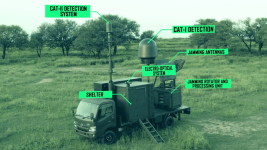
GIDS of Pakistan has developed a soft kill anti-drone system called 'Spider'. It has the capability of making enemy drones useless or destroying them through
-RF Scanning & Interception
-GNSS Jamming
-GPS Spoofing
-EO/IR Sensors
-RF Jamming
-Direction Finding


1729277724236.png
 
I wonder if AZB-I and II can be used on Super Mushaks>
That gives us potentially 200 plus strike aircraft,, especially in the immediate forward area...
50KM stand off distance will increase survivability.

@Quwa @JamD @Oscar
Unlikely for two reasons:
1. Weight: The heaviest thing we've seen on the Mushaak is Barq/AR1, which is 100 lbs. Even the SDB, which is like the smallest Azb variant, is 250 lb.
2. Kinematics: The range of these glide bombs us heavily dependent on launch speed and altitude. JF17 could launch at 500 kts from 35k ft and a Mushaak can maybe do 100 kts from 10k ft. I would guess that even if somehow the Mushaak could carry an SBD it's range would drop to at least a quarter, probably even less.

All of this could make it not practical. It would have to get really close to the target and get shot down by MANPADs.
 
Last edited:
Unlikely for two reasons:
1. Weight: The heaviest thing we've seen on the Mushaak is Barq/AR1, which is 100 lbs. Even the SDB, which is much smaller than any Azb variant, is 250 lb.
2. Kinematics: The range of these glide bombs us heavily dependent on launch speed and altitude. JF17 could launch at 500 kts from 35k ft and a Mushaak can maybe do 100 kts from 10k ft. I would guess that even if somehow the Mushaak could carry an SBD it's range would drop to at least a quarter, probably even less.

All of this could make it not practical. It would have to get really close to the target and get shot down by MANPADs.
I have some code back home using which I can give you representative numbers comparing the range of an SDB like weapon launched from Mushaak vs JF17.
 
Thanks. I appreciate it. Guessing a booster isn't an option.
As an aside, I have heard from sources that PAF is going the USAF/USN route of converting all dumb bombs to REK? Is that true, from what you have heard?

Someone did point out that the guidance system for JDAM is equivalent to a low end feature phone, and we have a lot of manufacturing of those, even if we divert and reprorgam as opposed to adapt.
 
Thanks. I appreciate it. Guessing a booster isn't an option.
As an aside, I have heard from sources that PAF is going the USAF/USN route of converting all dumb bombs to REK? Is that true, from what you have heard?

Someone did point out that the guidance system for JDAM is equivalent to a low end feature phone, and we have a lot of manufacturing of those, even if we divert and reprorgam as opposed to adapt.
Formula was just Range = L/D(h2-h1). A google search led to a value of 8 for SDB-type munition. So JF-17 would be 85 km and Mushaak would be 24 km. Keep in mind that this formula assumes that the launch speed is the cruise speed of the SDB - the JF-17 is probably much faster than this and the Mushaak is close to or less than this so the speed effect is absent from this formula.

Regarding your question, I have not heard anything. I don't think REK is like the JDAM. The REK has a wingkit that takes up space and aircraft have to be certified for it. Also, I believe the mission computer must talk to the REK. So I think not all bombs will be converted to REKs. There is a mission set for dumb bombs. If we create a JDAM equivalent, then the math will be different. I believe the JDAM only needs to be fed target info and is very uncomplicated to mount and launch unlike a glide kit.
 
Formula was just Range = L/D(h2-h1). A google search led to a value of 8 for SDB-type munition. So JF-17 would be 85 km and Mushaak would be 24 km. Keep in mind that this formula assumes that the launch speed is the cruise speed of the SDB - the JF-17 is probably much faster than this and the Mushaak is close to or less than this so the speed effect is absent from this formula.

Regarding your question, I have not heard anything. I don't think REK is like the JDAM. The REK has a wingkit that takes up space and aircraft have to be certified for it. Also, I believe the mission computer must talk to the REK. So I think not all bombs will be converted to REKs. There is a mission set for dumb bombs. If we create a JDAM equivalent, then the math will be different. I believe the JDAM only needs to be fed target info and is very uncomplicated to mount and launch unlike a glide kit.
JDAM can be configured by armory personnel and potentially needs just the typical Mk series fuze and lug triggers to know it’s to be on its way.

The PAF is hoarding its JDAM kits for a reason.

The CM-400 is somewhat like this in that potentially you can give it preloaded coordinates but it still needs the MC to provided it launch control.
 
The Pakistan Army has officially started operating an indigenous short-range ballistic weapon system called Fatah-II (Fatah-II) since March 2024.

This ballistic missile was developed by Global Industrial and Defense Solutions (GIDS), a Pakistani state-owned company.

Previously, GIDS produced the Fatah-I system with a launch range of 150 km.

According to GIDS, development of the Fateh-2 began in early 2021 and its first test firing was conducted in late December 2023.

1730328466260.webp

The Fatah-2 system was demonstrated to the public at the WDS 2024 defense exhibition in Karachi, Pakistan in February 2024.

The Fateh-2 missile is 7.5 meters long and has a warhead weighing 365 kg. The missile can be loaded with a single or split warhead.

As a long-range precision weapon, the Fateh-2 is equipped with an inertial navigation system (INS) and the Global Navigation Satellite Service (GNSS). Circular error probability (CEP) is less than 50 metres.

Fateh-2 uses a solid-propellant rocket motor, a thermal protection system and a programmable trajectory to improve guidance and precision in flight.

1730328745924.jpeg

With a range of 400 km, the Fateh-2 competes directly with the Russian Iskander-M system, which has a range of 500 km.

Like the Iskander-M system, the Fateh-2 system also carries a pair of missiles mounted on an 8X8 self-propelled launcher.

Following the success of the Fateh-2 system, GIDS is reportedly developing new versions of the system named Fateh-3 and Fateh-1V, with a range of 450 km and 700 km respectively.

Fatah-1 and Fatah-2 are designed to “precisely attack and destroy enemy groups and targets in the area, such as military bases, assembled armored forces, missile launch sites, large airfields, ports, and other important facilities.” The Fatah system is mounted on the Chinese Taian TAS5450 8×8 chassis (two missiles per vehicle for the Fatah-2 system; eight missiles per vehicle for the Fatah-1 system).
 
GIDS (Global Defense and Industrial Solutions) to showcase Harbah-NG anti-ship weapon system at IDEAS 2024.

Harabh anti-ship missile features dual-attack capability and can hit target exceeding 280 kilometers.
 

Users who are viewing this thread

Latest Posts

Back
Top