Japan in shock as India set to overtake Their Gdp ranking in 2025

Again, you are confusing two different things. Trade deficit and economic growth are NOT same thing and are very losely related to each other.

Take example of Singapore. From 65-84 Singapore experienced massive growth while its Current account balance was in negative and MASSIVELY negative.

GDP Growth:
View attachment 80985

Current account balance

View attachment 80984

There's actually economic logic to why Singapore has large current account deficit back then. We needed huge investments to grow but we had insufficient savings, so we had to run a current account deficit to finance our investments.


5.3 Why does Singapore have a current account surplus?

The current account should be understood in the context of the evolution of national saving and domestic investment. Long-term trends in Singapore’s saving and investment rates are well explained by the shifting stages of Singapore’s development, its demographics, as well as the fact that as a small country, risk diversification dictates that it invests a portion of its saving abroad.

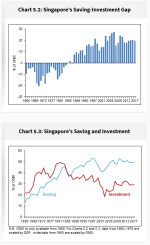
Charts 5.2 and 5.3 show Singapore’s saving-investment gap, as well as its constituent series, scaled by Gross National Disposable Income (GNDI).

1731891841762.png

In the early stages of development after independence in 1965, Singapore had a young population and a rapidly growing economy. As domestic investment needs could not be met with national saving alone, foreign capital was sought to finance this investment. Singapore ran a current account deficit until the mid-1980s, which enabled the rapid build-up of capital stock in the economy and the catch-up of labour productivity and incomes to near-developed economy levels. (Chart 5.3)

Subsequently, Singapore switched to a current account surplus, as saving rose while the need for domestic investment moderated.

As the economy matured, the rate of investment in fixed capital declined, as signalled by a fall in the returns to capital. At the same time, national saving has grown in line with rising incomes and as Singaporeans stepped up saving for old age. Singapore has a fully-funded, defined contribution pension scheme called the Central Provident Fund (CPF) in which Singaporeans save for retirement and medical needs.

In addition, the government had deemed it prudent from the beginning that Singapore diversify some of its saving abroad. Singapore is a small economy, and cannot diversify its risk domestically, unlike a large country. As an economy with no natural resources, there is also a need to preserve Singapore’s international purchasing power during crises, since a large proportion of domestic consumption is imported.

Thus, Singapore’s economic development and the shift in demographics over the years resulted in it having a current account surplus since the mid-1980s, which gradually rose to a peak of 27% of GNDI in 2007 before trending down to an average of around 20% of GNDI in recent years.

Over the last decade, the trend growth rate of the maturing Singapore economy has slowed, while expenditure to provide for an ageing population has grown. This demographic-driven trajectory of the current account surplus has been broadly as predicted.

Singapore’s current account trajectory is thus the outcome of shifting saving and investment behaviours in the domestic economy.
 
Japans in no shock! I live here so I know.

No Japanese wants to visit India.

Thank you. 🙏

That's interesting. I've also heard that Japan is considered very restrictive towards Islam, with strict policies discouraging Muslim immigration. While Japan is known for its hospitality, there are claims from some Muslim visitors that they feel unwelcome or mistreated. Is this perception accurate from your experience?
 
Why is Japan surprised?

Japan has a population of 125 million people.

While India has a population of 1.42 billion people.

India will eventually have a larger economy than Japan.

Pakistan too should have a larger economy than Japan since Pakistan has a population of 252 million people.
 

i would say, 'now' countries like Japan-Korea are truly compared to Laos-Cambodia........
there is no comparison of India-China to countries like Japan-Korea :)
 
  • Haha
Reactions: ety
Why is Japan surprised?

Japan has a population of 125 million people.

While India has a population of 1.42 billion people.


India will eventually have a larger economy than Japan.

Pakistan too should have a larger economy than Japan since Pakistan has a population of 252 million people.

how you see GDP comparison on PPP? as below?
 
This video was about Obama running for US president in 2008, two years before China overtook Japan's GDP, back then China had already had one of the best infrastructure in the world.

Obama Says China's Infrastructure Is Better Suited Than U.S.

To view this content we will need your consent to set third party cookies.
For more detailed information, see our cookies page.


What the US spends on upholdig the US foreign engagement and tax relief for the ultra rich, China spends on infrastructure and incentivizing the up and coming tech industries.
 
@Guru Dutt

Your infatuation with everything Pakistani is getting tedious. Stop bringing Pakistan into everything.

OP changes the title - no Japanese arent in shock at all. Its just little Indians getting excitable. @harpy1 dont change the title of an article like this - so childish.......
 
Nothing to be shocked about ...
Country has 1.4 billion people
Indian gdp should be 14 trillion dollars by now
 
God these click bait headlines. Japanese have more to worry about earthquakes than India surpassing them in absolute GDP.

Yeah, a country of 1.4 billion consumes and produces more goods and services than a country 1/10 of its size.

Who would have thought that? /s

countries like Japan-Korea are compared to Laos-Cambodia type countries...... Japan lacks guts to be compared to India......

i doubt GDP measures which compare heavily indebted Japanese economy with India...
 
Wrong example -- India has 11 times more people than Japan and 16 times more people than Germany. Even with a living standard 1/10th of those countries it will exceed the GDP of those countries. the living standards in India are way crappier than Japan and Germany.

@F-22Raptor

we know Living standard of Japanese also. here, is it right to say them have 10 times living standard than India, is it enough?
the GDP on PPP also matters as below:

while its still not enough, developing economies have large share of 'undocumented' part of GDP. the GDP which can't be documented.....

in sum, i would say that Japanese and German would be having living standard close to the 31% population of India as below:

.
=>
  • The middle class now represents 31% of India’s population.
  • It is projected to hit 38% by 2031 and 60% by 2047.
 
Last edited:
Nothing to be shocked about ...
Country has 1.4 billion people
Indian gdp should be 14 trillion dollars by now

along with post#101, we have list of Billionaires of India as below:-
How Japanese would be compared to Indians in this field? :coffee:
.

==>

India’s ultra wealthy population to grow by 58.4% in next five years, Knight Frank​

India’s ultra-high-net-worth individuals (UHNWI) with net worth over $30 million is estimated to rise by 58.4% in the next five years to 19,119 individuals in 2027 from 12,069 in 2022. India’s billionaire population is expected to move up to 195 individuals in 2027 from 161 individuals in 2022, showed a Knight Frank India report.

 
along with post#101, we have list of Billionaires of India as below:-
How Japanese would be compared to Indians in this field? :coffee:
.

==>

India’s ultra wealthy population to grow by 58.4% in next five years, Knight Frank​

India’s ultra-high-net-worth individuals (UHNWI) with net worth over $30 million is estimated to rise by 58.4% in the next five years to 19,119 individuals in 2027 from 12,069 in 2022. India’s billionaire population is expected to move up to 195 individuals in 2027 from 161 individuals in 2022, showed a Knight Frank India report.

I'll be very honest here. There is no point in this chest beating, about who has more millionaires. India would obviously have more HNI considering its population and widespread economic inequality.
Japan is a post industrial society with a much smaller population. They have their own problems but way different requirements and geopolitical concerns. But they as a society are way beyond us.

India and Japan cannot be equated together. While India has crossed various milestones it's too early to celebrate, the widespread inequality, unemployment and the countless internal problems needs to be solved first. Maybe in the next couple of decades we'll get close to US/China standards but it's a long way to go.
 
I'll be very honest here. There is no point in this chest beating, about who has more millionaires. India would obviously have more HNI considering its population and widespread economic inequality.
Japan is post industrial society with a much smaller population. They have their own problems but way different requirements and geopolitical concerns. But they as a society are way beyond us.

India and Japan cannot be equated together. While India has crossed various milestones it's too early to celebrate, the widespread inequality, unemployment and the countless internal problems needs to be solved first. Maybe in the next couple of decades we'll get close to US/China standards but it's a long way to go.

here is the details of Indian Middle Class of Asian standard.
how you see growing Middle class of India of Asian standard which is estimated at 31% at present?
.
=>
The middle class is the fastest-growing major segment of the Indian population in both percentage and absolute terms, rising at 6.3 percent per year between 1995 and 2021. It now represents 31 percent of the population and is expected to be 38 percent by 2031 and 60 percent in 2047. More than one billion Indians will make up the middle-class when India will turn 100. These are the figures from PRICE ICE 3600 surveys based on primary data.

 
Last edited:
Well it didn't consume more for the first 70 years

If it was that simple why is 250 million Pakistan people languishing in number sixty along side African states in gdp terms

It's a bit more than population no's buddy
India is below per capita GDP terms than many African countries and talking of Pakistan, we aren't doing much better than them despite this supposedly being the worst economic period of their existence and this being our best. Our GDP per capita is barely twice that of Pakistan, now compare that to China which is 5 times more than ours. Even Bangladeshis next door who were less than half our GDP per capita like 10 years ago are now equal to us, so we don't really have much to gloat about. As for the topic itself, comparing India to Japan is a joke, one is a manufacturing superpower, one of the cleanest countries in the world that fell into decay because they decided to have less kids and one is a country that lacks toilet ranks 100 on hunger index and is rated one of the filthiest countries in the world.
 

Users who are viewing this thread

Back
Top