Navigation
Install the app
How to install the app on iOS
Follow along with the video below to see how to install our site as a web app on your home screen.
Note: This feature may not be available in some browsers.
More options
Style variation
You are using an out of date browser. It may not display this or other websites correctly.
You should upgrade or use an alternative browser.
You should upgrade or use an alternative browser.
Indian Politics and Internal News
- Thread starter culivert
- Start date
More options
Who Replied?

Everything about India is interesting.
This is the country they worship rats and elephants and where the world’s software engineers are produced. Mighty skyscrapers sit next to crowded slums. A food exporting nation while nutrition rates are worse than sub-Saharan Africa.
Parts of India are desolate and disconnected from the world ( Nicobar Islands) while the country is one of the premier space powers of the world sending satellites and robots to distant corners of space.
India is a country of contrasts and contradictions.
sir, how you see a report by Forbes as below:

.
=>
When statistical adjustments are used to convert the backward digit span results to full-scale IQ scores, Indian Americans place at about 112 on a bell-shaped IQ distribution, with white Americans at 100. 112 is the 79th percentile of the white distribution. For more context, consider that Ashkenazi Jews are a famously intelligent ethnic group, and their mean IQ is somewhere around 110.
There is nothing inevitable about immigration. Who immigrates each year is a policy decision, free to be modified at any time by Congress. Constructing new legislation is always difficult, but I propose a simple starting point for immigration selection: Anyone who can spell guerdon is in!

Jason Richwine is a National Research Initiative fellow at the American Enterprise Institute in Washington.
Indian Americans: The New Model Minority (forbes.com)
Indian Americans: The New Model Minority (forbes.com)
Interesting Facts about India
India never invaded any country in her last 100000 years of history.
When many cultures were only nomadic forest dwellers over 5000 years ago, Indians established Harappan culture in Sindhu Valley (Indus Valley Civilization)
The name 'India' is derived from the River Indus, the valleys around which were the home of the early settlers. The Aryan worshippers referred to the river Indus as the Sindhu.
The Persian invaders converted it into Hindu. The name 'Hindustan' combines Sindhu and Hindu and thus refers to the land of the Hindus.
Chess was invented in India.
Algebra, Trigonometry and Calculus are studies, which originated in India.
The 'Place Value System' and the 'Decimal System' were developed in India in 100 B.C.
The World's First Granite Temple is the Brihadeswara Temple at Tanjavur, Tamil Nadu. The shikhara of the temple is made from a single 80-tonne piece of granite. This magnificent temple was built in just five years, (between 1004 AD and 1009 AD) during the reign of Rajaraja Chola.
India is the largest democracy in the world, the 7th largest Country in the world, and one of the most ancient civilizations.
The game of Snakes & Ladders was created by the 13th century poet saint Gyandev. It was originally called 'Mokshapat'. The ladders in the game represented virtues and the snakes indicated vices. The game was played with cowrie shells and dices. In time, the game underwent several modifications, but its meaning remained the same, i.e. good deeds take people to heaven and evil to a cycle of re-births.
The world's highest cricket ground is in Chail, Himachal Pradesh. Built in 1893 after leveling a hilltop, this cricket pitch is 2444 meters above sea level.
The world's first university was established in Takshila in 700 BC. More than 10,500 students from all over the world studied more than 60 subjects. The University of Nalanda built in the 4th century was one of the greatest achievements of ancient India in the field of education.
Ayurveda is the earliest school of medicine known to mankind. The Father of Medicine, Charaka, consolidated Ayurveda 2500 years ago.
India was one of the richest countries till the time of British rule in the early 17th Century. Christopher Columbus, attracted by India's wealth, had come looking for a sea route to India when he discovered America by mistake.
The Art of Navigation & Navigating was born in the river Sindh over 6000 years ago. The very word Navigation is derived from the Sanskrit word 'NAVGATIH'. The word navy is also derived from the Sanskrit word 'Nou'.
Bhaskaracharya rightly calculated the time taken by the earth to orbit the Sun hundreds of years before the astronomer Smart. According to his calculation, the time taken by the Earth to orbit the Sun was 365.258756484 days.
The value of "pi" was first calculated by the Indian Mathematician Budhayana, and he explained the concept of what is known as the Pythagorean Theorem. He discovered this in the 6th century, long before the European mathematicians.
Algebra, Trigonometry and Calculus also originated in India.Quadratic Equations were used by Sridharacharya in the 11th century. The largest numbers the Greeks and the Romans used were 106 whereas Hindus used numbers as big as 10*53 (i.e. 10 to the power of 53) with specific names as early as 5000 B.C.during the Vedic period.Even today, the largest used number is Terra: 10*12(10 to the power of 12).
Until 1896, India was the only source of diamonds in the world
(Source: Gemological Institute of America).
The Baily Bridge is the highest bridge in the world. It is located in the Ladakh valley between the Dras and Suru rivers in the Himalayan mountains. It was built by the Indian Army in August 1982.
Sushruta is regarded as the Father of Surgery. Over2600 years ago Sushrata & his team conducted complicated surgeries like cataract, artificial limbs, cesareans, fractures, urinary stones, plastic surgery and brain surgeries.
Usage of anaesthesia was well known in ancient Indian medicine. Detailed knowledge of anatomy, embryology, digestion, metabolism,physiology, etiology, genetics and immunity is also found in many ancient Indian texts.
India exports software to 90 countries.
The four religions born in India - Hinduism, Buddhism, Jainism, and Sikhism, are followed by 25% of the world's population.
Jainism and Buddhism were founded in India in 600 B.C. and 500 B.C. respectively.
Islam is India's and the world's second largest religion.
There are 300,000 active mosques in India, more than in any other country, including the Muslim world.
The oldest European church and synagogue in India are in the city of Cochin. They were built in 1503 and 1568 respectively.
Jews and Christians have lived continuously in India since 200 B.C. and 52 A.D. respectively
The largest religious building in the world is Angkor Wat, a Hindu Temple in Cambodia built at the end of the 11th century.
The Vishnu Temple in the city of Tirupathi built in the 10th century, is the world's largest religious pilgrimage destination. Larger than either Rome or Mecca, an average of 30,000 visitors donate $6 million (US) to the temple everyday.
Sikhism originated in the Holy city of Amritsar in Punjab. Famous for housing the Golden Temple, the city was founded in 1577.
Varanasi, also known as Benaras, was called "the Ancient City" when Lord Buddha visited it in 500 B.C., and is the oldest, continuously inhabited city in the world today.
India provides safety for more than 300,000 refugees originally from Sri Lanka, Tibet, Bhutan, Afghanistan and Bangladesh, who escaped to flee religious and political persecution.
His Holiness, the Dalai Lama, the exiled spiritual leader of Tibetan Buddhists, runs his government in exile from Dharmashala in northern India.
Martial Arts were first created in India, and later spread to Asia by Buddhist missionaries.
Yoga has its origins in India and has existed for over 5,000 years.
Interesting Facts about India - My India, My Pride - Know India: National Portal of India
More 2,000 years in a single graphic
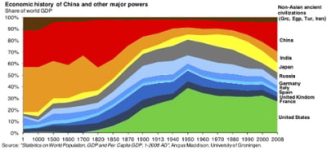
The Economist has developed its own infographics of 2,000 years of economic history with Mr Maddison's data. One in 2010, nicknamed "GDP since Jesus" charts just that (below, with commentary here). We encountered the same layout difficulties as Mr Cembalest, so chose a bar chart to distinguish specific years, and fiddled with the spacing of increments on the x-axis to designate missing chunks of time. The result is imperfect, but we did as much as possible to disclose, not camouflage, the imperfections. (In retrospect, we should have done more on the right-hand side of the chart, such as perhaps making the bar widths proportionately thinner….)
A second chart from last year (below, and with a commentary here) is both simple and startling. Among the points it presents is that in the first decade of the 21st century, the population of the world produced more economic output than in the first 19 centuries of the common era combined.
More 2,000 years in a single graphic
Did JP Morgan's striking chart on 2,000 years of economic history bungle the x-axis? Why yes, it did.

markhor
Registered Member


<Deleted by Moderator>
Anyway, here's something interesting;
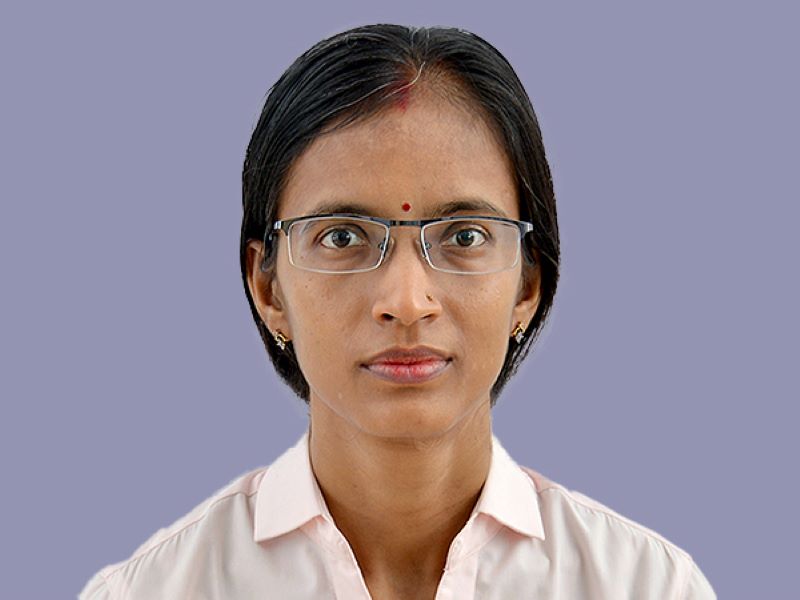
ISI Kolkata's Prof Neena Gupta wins Infosys Prize 2024 for her exemplary work in the field of Mathematical Sciences
 www.indiablooms.com
(couldn't really find a better news link, so this has to do)
www.indiablooms.com
(couldn't really find a better news link, so this has to do)
Summarizing, Dr. Gupta solved the Zariski Cancellation Theorem, which had been unsolved for 70-ish years. She solved it 2014 but received the Infosys prize recently. This is a rather big achievement, and I'm surprised all the gun-ho chest-thumpers are not discussing it here. I think it might be the best news for India this whole year.
Here is she delivering a lecture on it:
And finally heres the paper (not the original, but from the same author):
Like it usually happens, mathematicians would pose problems and then die lol. This guy Oscar Zariski came with it, and from then on it had been a major unsolved problem in algebraic geometry.
So basically, how do you make a plane in 2d? with 2 lines. So if Q is a line the cross-product QxQ would make a plane. Lets call this plane Z. Its in 2d, so what would happen if we cross it once again with Q? The result would be a 3d plane. and so on to the nth dimensional space. Note that all these resultant spaces are affine in nature, which means that in the same plane there are pairs of lines which are parallel to each other but never meet. easy peasy. This was us going forward, the problem concerns going backwards. so if, lets say we are given a product DxQ which is a 3d plane, can we prove that the D here is a 2d plane? and so on going backwards to a singular point. This was understood to generally the case, Dr. Gupta proved that its not necessarily the case. the lady says, assume you are given a 5f space (not affine space, simple euclidean space) U (running out of letters lol), if you cross it with a line Q the result can be a 6 dimensional affine space. generally, given k dimensional euclidean space, crossed with a line Q, can give k+1 dimensional affice space.
(algebraic geometry is not my area of expertise so take my explanation with a grain of salt, also because I didn't understand the proof either lol.)
I like to hear from others about how they found reading the work and generally the work itself. I really think that the best investments India made early on was in the IITs (ik shes not from there, but same-same), alongside the keynesian reforms from the great Dr. Monmohan Singh. @VCheng @Joe Shearer and others.
It's 2am and I'm writing about an Indian math witch on a Pakistani forum. Need to get myself a life.
Edit: there are so many spelling and grammar mistakes and I'm not gonna correct them now
Anyway, here's something interesting;
ISI Kolkata's Prof Neena Gupta wins Infosys Prize 2024 for her exemplary work in the field of Mathematical Sciences
ISI Kolkata's Prof Neena Gupta wins Infosys Prize 2024 for her exemplary work in the field of Mathematical Sciences | Indiablooms - First Portal on Digital News Management
Kolkata: Professor Neena Gupta has been awarded The Infosys Prize 2024 in Mathematical Sciences for her work on the Zariski Cancellation Problem, a statement said on Thursday. | One of India's leading Digital News Agency offering Breaking News round the clock. Why not read our informative news...
www.indiablooms.com
Summarizing, Dr. Gupta solved the Zariski Cancellation Theorem, which had been unsolved for 70-ish years. She solved it 2014 but received the Infosys prize recently. This is a rather big achievement, and I'm surprised all the gun-ho chest-thumpers are not discussing it here. I think it might be the best news for India this whole year.
Here is she delivering a lecture on it:
And finally heres the paper (not the original, but from the same author):
Like it usually happens, mathematicians would pose problems and then die lol. This guy Oscar Zariski came with it, and from then on it had been a major unsolved problem in algebraic geometry.
So basically, how do you make a plane in 2d? with 2 lines. So if Q is a line the cross-product QxQ would make a plane. Lets call this plane Z. Its in 2d, so what would happen if we cross it once again with Q? The result would be a 3d plane. and so on to the nth dimensional space. Note that all these resultant spaces are affine in nature, which means that in the same plane there are pairs of lines which are parallel to each other but never meet. easy peasy. This was us going forward, the problem concerns going backwards. so if, lets say we are given a product DxQ which is a 3d plane, can we prove that the D here is a 2d plane? and so on going backwards to a singular point. This was understood to generally the case, Dr. Gupta proved that its not necessarily the case. the lady says, assume you are given a 5f space (not affine space, simple euclidean space) U (running out of letters lol), if you cross it with a line Q the result can be a 6 dimensional affine space. generally, given k dimensional euclidean space, crossed with a line Q, can give k+1 dimensional affice space.
(algebraic geometry is not my area of expertise so take my explanation with a grain of salt, also because I didn't understand the proof either lol.)
I like to hear from others about how they found reading the work and generally the work itself. I really think that the best investments India made early on was in the IITs (ik shes not from there, but same-same), alongside the keynesian reforms from the great Dr. Monmohan Singh. @VCheng @Joe Shearer and others.
It's 2am and I'm writing about an Indian math witch on a Pakistani forum. Need to get myself a life.
Edit: there are so many spelling and grammar mistakes and I'm not gonna correct them now
Last edited by a moderator:

Joe Shearer
Professional
Stop bickering about lungi-wearing-pendu-looking-whip-lash warriors, it is embarrassingly stupid. lol.
Anyway, here's something interesting;
ISI Kolkata's Prof Neena Gupta wins Infosys Prize 2024 for her exemplary work in the field of Mathematical Sciences
(couldn't really find a better news link, so this has to do)ISI Kolkata's Prof Neena Gupta wins Infosys Prize 2024 for her exemplary work in the field of Mathematical Sciences | Indiablooms - First Portal on Digital News Management
Kolkata: Professor Neena Gupta has been awarded The Infosys Prize 2024 in Mathematical Sciences for her work on the Zariski Cancellation Problem, a statement said on Thursday. | One of India's leading Digital News Agency offering Breaking News round the clock. Why not read our informative news...
Summarizing, Dr. Gupta solved the Zariski Cancellation Theorem, which had been unsolved for 70-ish years. She solved it 2014 but received the Infosys prize recently. This is a rather big achievement, and I'm surprised all the gun-ho chest-thumpers are not discussing it here. I think it might be the best news for India this whole year.
Here is she delivering a lecture on it:
And finally heres the paper (not the original, but from the same author):
Like it usually happens, mathematicians would pose problems and then die lol. This guy Oscar Zariski came with it, and from then on it had been a major unsolved problem in algebraic geometry.
So basically, how do you make a plane in 2d? with 2 lines. So if Q is a line the cross-product QxQ would make a plane. Lets call this plane Z. Its in 2d, so what would happen if we cross it once again with Q? The result would be a 3d plane. and so on to the nth dimensional space. Note that all these resultant spaces are affine in nature, which means that in the same plane there are pairs of lines which are parallel to each other but never meet. easy peasy. This was us going forward, the problem concerns going backwards. so if, lets say we are given a product DxQ which is a 3d plane, can we prove that the D here is a 2d plane? and so on going backwards to a singular point. This was understood to generally the case, Dr. Gupta proved that its not necessarily the case. the lady says, assume you are given a 5f space (not affine space, simple euclidean space) U (running out of letters lol), if you cross it with a line Q the result can be a 6 dimensional affine space. generally, given k dimensional euclidean space, crossed with a line Q, can give k+1 dimensional affice space.
(algebraic geometry is not my area of expertise so take my explanation with a grain of salt, also because I didn't understand the proof either lol.)
I like to hear from others about how they found reading the work and generally the work itself. I really think that the best investments India made early on was in the IITs (ik shes not from there, but same-same), alongside the keynesian reforms from the great Dr. Monmohan Singh. @VCheng @Joe Shearer and others.
It's 2am and I'm writing about an Indian math witch on a Pakistani forum. Need to get myself a life.
Edit: there are so many spelling and grammar mistakes and I'm not gonna correct them now
Definitely beyond me, but I will submit it to a dear friend whose academic record was Physics, followed by Operations Research, followed by Game Theory, his PhD subject, followed by Economics, where he was practically ambushed by known and well-accepted economists and dragged away to write papers with them, kicking and screaming. He has lately been educating the rest of us on some of the finer aspects of mathematical development, within a group where the other members (@Nilgiri excepted) have had no crimes to stain their spotless record with regard to mathematics since the group started.
Thanks for the write-up. It will be useful.
Joe Shearer
Professional
No worries. Your post has enough structure and shape to brush those aside.Edit: there are so many spelling and grammar mistakes and I'm not gonna correct them now
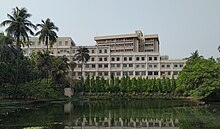
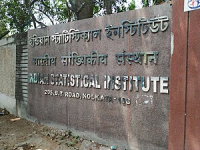
Incidentally, the Indian Statistical Institute was founded by Mahalanobis, and was roughly opposite us on the old IIMC campus on BT Road. It has always been in the forefront of statistical practice and theory in India, and was responsible for the design of the world-recognised NSS, until it was corrupted and the figures manipulated by a person or persons unknown.
Joe Shearer
Professional
markhor
Registered Member
Your friend is everything I'd wanna be, except for the economics part. yuck. That guy has bragging rights.a dear friend whose academic record was Physics, followed by Operations Research, followed by Game Theory, his PhD subject, followed by Economics,
I don't know what your thesis is. Indian-Americans are extremely successful. But that has little to nothing to do with Indian government. Only thing great about Indian government is the quality of education is high enough that Indian-Americans are successful. What is not good is the inability of Indian government to utilize the talent of these people like East Asian countries have done (like Japan, South Korea, Taiwan, Singapore, China).
how would you see the post#30, about growing Middle Class of India
India is now Listed among the Newly Industrialised Countries, like East Asian countries. we are catching up
=> https://corporatefinanceinstitute.com/resources/economics/newly-industrialized-country-nic/
.
=>
Very good news. But a long way to go still. India currently has a lower per capita GDP than Bolivia.
with reference of post#30, India is supposed to have more than 31% population as Middle class.....
the GDP calculation for Developing countries has many issues. there are many 'undocumented' parts of GDP, the ratio of GDP we dont document for developing countries....
a more close to GDP on PPP per capita is given as below . here GDP of India is measured above $16.0tn, which has yet to include many segments of 'undocumented' parts of GDP, as in case of a developing country

List of countries by GDP (PPP) - Wikipedia

VCheng
THINK TANK: CONSULTANT

It's 2am and I'm writing about an Indian math witch on a Pakistani forum. Need to get myself a life.
The beauty of science is that it knows no religion or nationality. Knowledge is knowledge, and it serves those who seek it well.

Countries with the highest outbound tourism expenditure worldwide from 2019 to 2023
(in billion U.S. dollars)
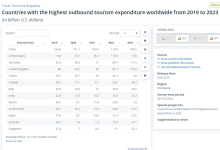
we would list countries in Purchasing Power of currency term......
the US$ comparison doesn't who the true picture
.
=>
Countries with the highest outbound tourism expenditure worldwide from 2019 to 2023
(in billion U.S. dollars)
View attachment 46900
in the above picture, we see India's data rising from 22.9 to 33.3 during 5 years time..... here, Russia is able to maintain its level, nearing India....
China's data is fantastic. Chinese growth were mainly driven from demands from OECD markets. during fall of developed/'saturated' economies, in between 2019 upto 2024, China could stand by with little fall from 254.6 to 196.5
Last edited:
how would you see the post#30, about growing Middle Class of India
India is now Listed among the Newly Industrialised Countries, like East Asian countries. we are catching up
=> https://corporatefinanceinstitute.com/resources/economics/newly-industrialized-country-nic/
.
=>
with reference of post#30, India is supposed to have more than 31% population as Middle class.....
the GDP calculation for Developing countries has many issues. there are many 'undocumented' parts of GDP, the ratio of GDP we dont document for developing countries....
a more close to GDP on PPP per capita is given as below . here GDP of India is measured above $16.0tn, which has yet to include many segments of 'undocumented' parts of GDP, as in case of a developing country
List of countries by GDP (PPP) - Wikipedia
en.wikipedia.org
A map of all the developed, newly industrialized, developing, and least developed countries according to the IMF and the UN.
![v5pyl8ou1o281[1].png](https://defencepk.com/forums/data/attachments/86/86282-28af85a94a94326194c3342641522d32.jpg?hash=kJ2y_K-pxJ "v5pyl8ou1o281[1].png")
Last edited:
List of states with nuclear weapons
Eight sovereign states have publicly announced successful detonation of nuclear weapons.[1] Five are considered to be nuclear-weapon states (NWS) under the terms of the Treaty on the Non-Proliferation of Nuclear Weapons (NPT). In order of acquisition of nuclear weapons, these are the United States, Russia (the successor of the former Soviet Union), the United Kingdom, France, and China. Of these, the three NATO members, the UK, US, and France, are sometimes termed the P3.[2]
Other states that possess nuclear weapons are India, Pakistan, and North Korea. Since the NPT entered into force in 1970, these three states were not parties to the Treaty and have conducted overt nuclear tests. North Korea had been a party to the NPT but withdrew in 2003.
Israel is also generally understood to have nuclear weapons,[3][4][5][6][7] but does not acknowledge it, maintaining a policy of deliberate ambiguity.[8] Israel is estimated to possess somewhere between 75 and 400 nuclear warheads.[9][10] One possible motivation for nuclear ambiguity is deterrence with minimum political cost.[11][12]
![1280px-Nuclear_weapons_states_2023.svg[1].png](https://pdf.defence.pk/attachments/1280px-nuclear_weapons_states_2023-svg-1-png.963344/ "1280px-Nuclear_weapons_states_2023.svg[1].png")
Map of nuclear-armed states of the world
NPT-designated nuclear weapon states (China, France, Russia, United Kingdom, United States)
Other states with nuclear weapons (India, North Korea, Pakistan)
Other states presumed to have nuclear weapons (Israel)
NATO or CSTO member nuclear weapons sharing states (Belgium, Germany, Italy, Netherlands, Turkey, Belarus)
States formerly possessing nuclear weapons (Kazakhstan, South Africa, Ukraine)
Overview of nuclear states and their capacities
https://en.wikipedia.org/wiki/List_of_states_with_nuclear_weapons#
The Power not to sign NPT was more than those who signed NPT including P5s
as above, i would say that a day it will be proved that, the Power not to sign NPT was more than those who signed NPT including P5s.
here we find, Moscow and Beijing supported many crimes of NATO against developing countries which Delhi could deny by never signing NPT....
Circadian Rhythm
Banned
a map is what available on Internet-on Wikipedia, before British Entered India
.
=>
Ultimately, the Third Anglo-Maratha War (1817–1818) resulted in the loss of Maratha independence. It left the British in control of most of the Indian subcontinent. The Peshwa was exiled to Bithoor (Marat, near Kanpur, Uttar Pradesh) as a pensioner of the British.
View attachment 85678

Maratha Empire - Wikipedia
You need a map when there were trading companies called "East INDIA company" and "Dutch East INDIA company" and when a man called "Christopher columbus" was tasked and Paid by the Queen and King of Spain to find a "new sea passage" to the country of India and ended up "discovering" America in the 14th Century ?
Users who are viewing this thread
Total: 4 (members: 0, guests: 4)
Pakistan Defence Latest
-
-
 PAF pilot highlights how chinese J10C fighters have left US F16's Obsolete (8 Viewers)
- Latest: TOPGUN
-
-


Country Watch Latest
-
 Iran - Israel/US War: Israel-US declare war on Iran, Iran responds (85 Viewers)
- Latest: Persian Gulf
-
-

-

-
Latest Posts
-
-
-

-
Iran - Israel/US War: Israel-US declare war on Iran, Iran responds (85 Viewers)
- Latest: Persian Gulf
-