Indian Politics and Internal News

High Commission of India, Suva, Fiji

High Commission of India

Suva, Fiji

ICCR Scholar Awardee

1701933094_ICCR%20Scholar.jpg


ICCR Scholarship Newspapoer Advert for Academic Year 2021-22...16.03.2021.


Current schemes

The Indian Council for Cultural Relations (ICCR), Government of India, is offering twenty (20) Scholarships for nationals of Fiji and four (4) for nationals of Tuvalu under Atal Bihari Vakpayee Scholarship Scheme (Formally General Scholarship Scheme) for every academic session. The scholarship covers courses from Undergraduate to Postgraduate to Ph.D. levels in all streams except Medicine. :coffee:

The courses include (BA, BSc, B.Com, BE), postgraduate (MA, MSc, M Com, MBA, ME) & Research Studies in renowned Indian Universities. These include Accounting, Agricultural Science, Arts, Commerce, Engineering, Humanities, Hindi, Indian Classical Music and Dance, Information Technology, Languages, Mass Communication (Journalism), Painting, Science, Social Science etc. Ayurveda and Yoga are also covered.
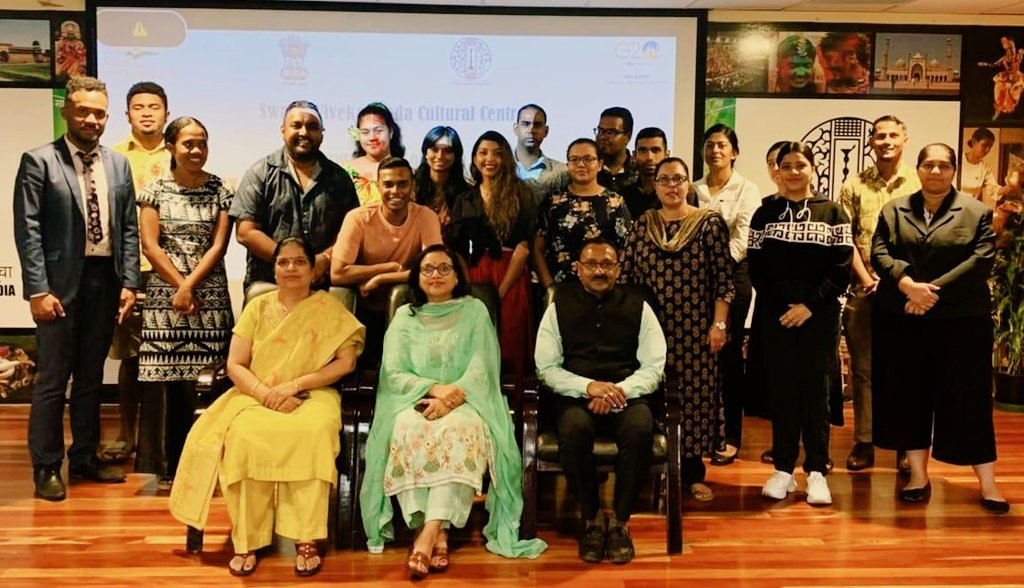
The scheme has been administered by ICCR with the support of High Commission of India and Swami Vivekananda Cultural Centre.

The scholarship covers return international airfare by economy class, tuition fees and living allowances. ☕

The council has developed a scholarship portal named A2A (Admission 2 Alumni). The portal consists of all relevant information available for student abroad including names and details of all State and central Universities and Instituites, college affiliated with them information like availability of hostels, academic courses, guidelines, eleigibility criteria, etc.., Portal link: http://a2ascholarships.iccr.gov.in/

Ayush Scholarships for pursuing undergraduate and postgraduate courses in Ayurveda, Unani, Sidha and Homeopathy under the Ayush Scholarship offered to Non-Bay of Bengal initiative for Multi Sectorial Technical and Economic Cooperation (NON-BIMSTEC) Member Countries. Tuition fees, living allowance, hostel or house rent allowance would be covered under the Ayush Scholarship Scheme. Candidates will have to appear for personal interview.

222222222222222.jpg


ICCR Fellow

Distinguished Visitors Programme

ICCR Alumini registration

 
Last edited:
Interesting Facts about India

India never invaded any country in her last 100000 years of history.

When many cultures were only nomadic forest dwellers over 5000 years ago, Indians established Harappan culture in Sindhu Valley (Indus Valley Civilization)

The name 'India' is derived from the River Indus, the valleys around which were the home of the early settlers. The Aryan worshippers referred to the river Indus as the Sindhu.


The Persian invaders converted it into Hindu. The name 'Hindustan' combines Sindhu and Hindu and thus refers to the land of the Hindus.

Chess was invented in India.

Algebra, Trigonometry and Calculus are studies, which originated in India.

The 'Place Value System' and the 'Decimal System' were developed in India in 100 B.C.

The World's First Granite Temple is the Brihadeswara Temple at Tanjavur, Tamil Nadu. The shikhara of the temple is made from a single 80-tonne piece of granite. This magnificent temple was built in just five years, (between 1004 AD and 1009 AD) during the reign of Rajaraja Chola.


India is the largest democracy in the world, the 7th largest Country in the world, and one of the most ancient civilizations.

The game of Snakes & Ladders was created by the 13th century poet saint Gyandev. It was originally called 'Mokshapat'. The ladders in the game represented virtues and the snakes indicated vices. The game was played with cowrie shells and dices. In time, the game underwent several modifications, but its meaning remained the same, i.e. good deeds take people to heaven and evil to a cycle of re-births.

The world's highest cricket ground is in Chail, Himachal Pradesh. Built in 1893 after leveling a hilltop, this cricket pitch is 2444 meters above sea level.

The world's first university was established in Takshila in 700 BC. More than 10,500 students from all over the world studied more than 60 subjects. The University of Nalanda built in the 4th century was one of the greatest achievements of ancient India in the field of education.

Ayurveda is the earliest school of medicine known to mankind. The Father of Medicine, Charaka, consolidated Ayurveda 2500 years ago.

India was one of the richest countries till the time of British rule in the early 17th Century. Christopher Columbus, attracted by India's wealth, had come looking for a sea route to India when he discovered America by mistake.

The Art of Navigation & Navigating was born in the river Sindh over 6000 years ago. The very word Navigation is derived from the Sanskrit word 'NAVGATIH'.
The word navy is also derived from the Sanskrit word 'Nou'.

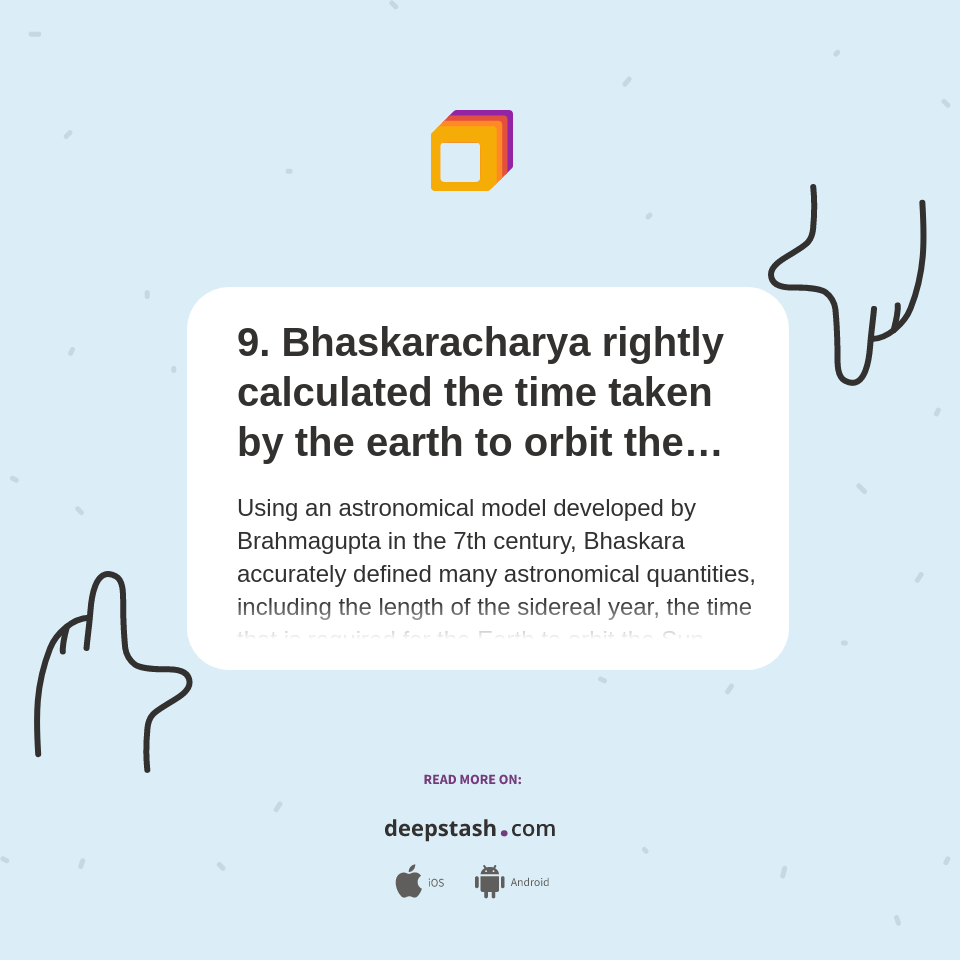
Bhaskaracharya rightly calculated the time taken by the earth to orbit the Sun hundreds of years before the astronomer Smart. According to his calculation, the time taken by the Earth to orbit the Sun was 365.258756484 days.

The value of "pi" was first calculated by the Indian Mathematician Budhayana, and he explained the concept of what is known as the Pythagorean Theorem. He discovered this in the 6th century, long before the European mathematicians.

Algebra, Trigonometry and Calculus also originated in India.Quadratic Equations were used by Sridharacharya in the 11th century.
The largest numbers the Greeks and the Romans used were 106 whereas Hindus used numbers as big as 10*53 (i.e. 10 to the power of 53) with specific names as early as 5000 B.C.during the Vedic period.Even today, the largest used number is Terra: 10*12(10 to the power of 12).

Until 1896, India was the only source of diamonds in the world
(Source: Gemological Institute of America).

The Baily Bridge is the highest bridge in the world. It is located in the Ladakh valley between the Dras and Suru rivers in the Himalayan mountains. It was built by the Indian Army in August 1982.

Sushruta is regarded as the Father of Surgery. Over2600 years ago Sushrata & his team conducted complicated surgeries like cataract, artificial limbs, cesareans, fractures, urinary stones, plastic surgery and brain surgeries.

Usage of anaesthesia was well known in ancient Indian medicine. Detailed knowledge of anatomy, embryology, digestion, metabolism,physiology, etiology, genetics and immunity is also found in many ancient Indian texts.


India exports software to 90 countries.

The four religions born in India - Hinduism, Buddhism, Jainism, and Sikhism, are followed by 25% of the world's population.

Jainism and Buddhism were founded in India in 600 B.C. and 500 B.C. respectively.

Islam is India's and the world's second largest religion.

There are 300,000 active mosques in India, more than in any other country, including the Muslim world.

The oldest European church and synagogue in India are in the city of Cochin. They were built in 1503 and 1568 respectively.

Jews and Christians have lived continuously in India since 200 B.C. and 52 A.D. respectively

The largest religious building in the world is Angkor Wat, a Hindu Temple in Cambodia built at the end of the 11th century.

The Vishnu Temple in the city of Tirupathi built in the 10th century, is the world's largest religious pilgrimage destination. Larger than either Rome or Mecca, an average of 30,000 visitors donate $6 million (US) to the temple everyday.


Sikhism originated in the Holy city of Amritsar in Punjab. Famous for housing the Golden Temple, the city was founded in 1577.
Varanasi, also known as Benaras, was called "the Ancient City" when Lord Buddha visited it in 500 B.C., and is the oldest, continuously inhabited city in the world today.

India provides safety for more than 300,000 refugees originally from Sri Lanka, Tibet, Bhutan, Afghanistan and Bangladesh, who escaped to flee religious and political persecution.

His Holiness, the Dalai Lama, the exiled spiritual leader of Tibetan Buddhists, runs his government in exile from Dharmashala in northern India.

Martial Arts were first created in India, and later spread to Asia by Buddhist missionaries.

Yoga has its origins in India and has existed for over 5,000 years.

Interesting Facts about India - My India, My Pride - Know India: National Portal of India


The Art of Navigation & Navigating was born in the river Sindh over 6000 years ago. The very word Navigation is derived from the Sanskrit word 'NAVGATIH'. The word navy is also derived from the Sanskrit word 'Nou'. :coffee:

The art of Navigation was born in the river Sindhu 6000 years ago. The very word Navigation is derived from the Sanskrit word ‘Navgatih’. The word navy is also derived from Sanskrit ‘Nou’.

In those days India had colonies, in Cambodia (Kambuja in Sanskrit) in Java, (Chavakam or Yava dwipa) in Sumatra, in Borneo, Socotra (Sukhadhara) and even in Japan. Indian traders had established settlements in Southern China, in the Malayan Peninsula, in Arabia, in Egypt, in Persia, etc., Through the Persians and Arabs, India had cultivated trade relations with the Roman Empire. ☕

Sanskrit and Pali literature has innumerable references to the maritime activity of Indians in ancient times. There is also one treatise in Sanskrit, named Yukti Kalpa Taru which has been compiled by a person called Bhoja Narapati. (The Yukti Kalpa Taru (YKT) had been translated and published by Prof. Aufrecht in his ‘Catalogue of Sanskrit Manu scripts.

A panel found at Mohenjodaro, depicting a sailing craft. Vessels were of many types Their construction is vividly described in the Yukti Kalpa Taru an ancient Indian text on Ship-building. This treatise gives a technocratic exposition on the technique of shipbuilding. It sets forth minute details about the various types of ships, their sizes, the materials from which they were built. The Yukti Kalpa Taru sums up in a condensed form all the available information

The Yukti Kalpa Taru gives sufficient information and date to prove that in ancient times, Indian shipbuilders had a good knowledge of the materials which were used in building ships. Apart from describing the qualities of the different types of wood and their suitability in shipbuilding, the Yukti Kalpa Taru also gives an elaborate classification of ships based on their size.

The primary division is into 2 classes viz. Samanya (ordinary) and Vishesha (Special). The ordinary type for sea voyages. Ships that undertook sea voyages were classified into, Dirgha type of ships which had a long and narrow hull and the Unnata type of ships which had a higher hull. The treatise also gives elaborate directions for decorating and furnishing the ships with a view to making them comfortable for passengers. Also mentioned are details about the internal seating and accommodation to be provided on the ships. Three classes of ships are distinguished according to their length and the position of cabins. The ships having cabins extending from one end of the deck to the other are called Sarvamandira vessels.

These ships are recommended for the transport of royal treasure and horses. The next are the Madhyamarnandira vessels which have cabins only in the middle part of their deck. these vessels are recommended for pleasure trips. And finally there is a category of Agramandira vessels, these ships were used mainly in warfare.

To view this content we will need your consent to set third party cookies.
For more detailed information, see our cookies page.
 
India's manufacturing sector's share of the country's GDP was around 13% in 2023. This is down from 17% in 2010. The manufacturing share of Vietnam's GDP in 2023 was 24%, Malaysia 23 % and Thailand 25%. And all these three countries GDP per capita are much higher than that of India too, but these countries are not classified as NIC but India, lol.

Indian GDP is in many forms, ratios. the current more than 31% Middle Class of India is the main GDP ratio of India, who let it India get place in NICs.

as you mentioned, as compared to Vietnam, Malaysia, Thailand and China, India declined to invite 'smoke' for other countries since early 90s. i mean, the Manufacturing industries for 'export' and related 'smoke', India refused......

further, an example, as mentioned in post#62 of thread as below, Indian data's are of rising trend, ☕


the OECD economies are falling and its related GDP growth for exporting countries like Vietnam-China-Malaysia etc, is different than Home Demand based Manufacturing industries of India :coffee:
India never let manufacturing growth driven by Export order......
.
=>

Haha. Then, why India is dying to invite the "smoke" industries from other countries now ? That still doesn't explain that India should be included in NIC with only 13% manufacturing of GDP.

here, mere 13%-14% of Manufacturing ratio in India's GDP on PPP at $16.0tn+, is it less? :)
check this GDP on PPP table as below...
 
Lol, only the industrialization rate of a country matters, not the only total manufacturing volume.

bro, as per in post#21, its the only 31% Middle Class of India who drive Manfacturing & Service sector of India.
more than 50% population of India is based on agriculture, and they might having Per Capita income compared to agriculture countries like Nepal.....

I would say, India is "self sufficient" for Its wide range of industries with countries like Russia. India-Russia-Iran dont have to trade with US-NATO :)
.

=>

Haha. Then, why India is dying to invite the "smoke" industries from other countries now ? That still doesn't explain that India should be included in NIC with only 13% manufacturing of GDP.

here, mere 13%-14% of Manufacturing ratio in India's GDP on PPP at $16.0tn+, is it less? :)
check this GDP on PPP table as below...
 
These last two posts are taken from a blog site that specialises in romantic fiction about an imaginary Indian past.

Readers are advised to ignore the content, as there is nothing to substantiate these tall claims.

@ST1976 habitually spreads this kind of propaganda, hitherto seen only in the systematic propaganda campaigns of a dedicated Chinese poster who shall remain unnamed to conform to forum rules.
 
The Art of Navigation & Navigating was born in the river Sindh over 6000 years ago. The very word Navigation is derived from the Sanskrit word 'NAVGATIH'. The word navy is also derived from the Sanskrit word 'Nou'. :coffee:

The art of Navigation was born in the river Sindhu 6000 years ago. The very word Navigation is derived from the Sanskrit word ‘Navgatih’. The word navy is also derived from Sanskrit ‘Nou’.

In those days India had colonies, in Cambodia (Kambuja in Sanskrit) in Java, (Chavakam or Yava dwipa) in Sumatra, in Borneo, Socotra (Sukhadhara) and even in Japan. Indian traders had established settlements in Southern China, in the Malayan Peninsula, in Arabia, in Egypt, in Persia, etc., Through the Persians and Arabs, India had cultivated trade relations with the Roman Empire. ☕

Sanskrit and Pali literature has innumerable references to the maritime activity of Indians in ancient times. There is also one treatise in Sanskrit, named Yukti Kalpa Taru which has been compiled by a person called Bhoja Narapati. (The Yukti Kalpa Taru (YKT) had been translated and published by Prof. Aufrecht in his ‘Catalogue of Sanskrit Manu scripts.

A panel found at Mohenjodaro, depicting a sailing craft. Vessels were of many types Their construction is vividly described in the Yukti Kalpa Taru an ancient Indian text on Ship-building. This treatise gives a technocratic exposition on the technique of shipbuilding. It sets forth minute details about the various types of ships, their sizes, the materials from which they were built. The Yukti Kalpa Taru sums up in a condensed form all the available information

The Yukti Kalpa Taru gives sufficient information and date to prove that in ancient times, Indian shipbuilders had a good knowledge of the materials which were used in building ships. Apart from describing the qualities of the different types of wood and their suitability in shipbuilding, the Yukti Kalpa Taru also gives an elaborate classification of ships based on their size.

The primary division is into 2 classes viz. Samanya (ordinary) and Vishesha (Special). The ordinary type for sea voyages. Ships that undertook sea voyages were classified into, Dirgha type of ships which had a long and narrow hull and the Unnata type of ships which had a higher hull. The treatise also gives elaborate directions for decorating and furnishing the ships with a view to making them comfortable for passengers. Also mentioned are details about the internal seating and accommodation to be provided on the ships. Three classes of ships are distinguished according to their length and the position of cabins. The ships having cabins extending from one end of the deck to the other are called Sarvamandira vessels.

These ships are recommended for the transport of royal treasure and horses. The next are the Madhyamarnandira vessels which have cabins only in the middle part of their deck. these vessels are recommended for pleasure trips. And finally there is a category of Agramandira vessels, these ships were used mainly in warfare.

To view this content we will need your consent to set third party cookies.
For more detailed information, see our cookies page.


River "Sindh" is not in India and neither is Mohenjodaro.
Here's a fun fact for you:
The name for the cannabis strain "Indica" comes from the Latin word "Indicus," meaning "of India"

Which strain have you been smoking?
 
River "Sindh" is not in India and neither is Mohenjodaro.
Here's a fun fact for you:
The name for the cannabis strain "Indica" comes from the Latin word "Indicus," meaning "of India"

Which strain have you been smoking?
You are wrong, too, but presumably these two mis-statements cancel each other out.

Good going.
 
You are wrong, too
Please tell me what I'm wrong about and if the evidence is reliable and supports your claim I'll gladly change my text and provide you with credit for illuminating me. Thank you Mr. Moderator.

presumably these two mis-statements cancel each other out.
I'm sorry is this some ancient vedic math? I'm not familiar with how this works.
 
Please tell me what I'm wrong about and if the evidence is reliable and supports your claim I'll gladly change my text and provide you with credit for illuminating me. Thank you Mr. Moderator.
Today, it is not in the nation-state called India. At the time of the discovery of the ruins of Mohenjodaro, it was well within the Crown Colony of India, and was referenced in the literature as an Indian site. Obviously not as a Pakistani site, as that would have been an anachronism.

The Sindhu was a uniquely Vedic name, and was used thrice by different ethnic groups - as Sindhu, with a sibilant, by speakers of Indo-Aryan; as Hindu, with an aspirate, by speakers of Indo-Iranian languages that descended into East Iranian and other parallel languages; as 'Indus, with neither sibilant nor aspirate by Greek subjects of the Achaemenids who came this far east well before Alexander.

My objection to that messy source is that there is not the slightest effort at referencing the information scattered all over.

I hope you feel illuminated, Mr. Member.
 
Today, it is not in the nation-state called India.
Nothing in correct about my statement about Mohenjodaro. We agree.

The Sindhu was a uniquely Vedic name, and was used thrice by different ethnic groups - as Sindhu, with a sibilant, by speakers of Indo-Aryan; as Hindu, with an aspirate, by speakers of Indo-Iranian languages that descended into East Iranian and other parallel languages; as 'Indus, with neither sibilant nor aspirate by Greek subjects of the Achaemenids who came this far east well before Alexander.
Thanks for the etymology lesson (even though I knew this info already) but my post doesn't mention anything contrary to this information.

I hope you feel illuminated, Mr. Member.
Per the forum I am titled "Contributor", please refrain from mislabeling me. Thank you for your cooperation.
 
Nothing in correct about my statement about Mohenjodaro. We agree.


Thanks for the etymology lesson (even though I knew this info already) but my post doesn't mention anything contrary to this information.


Per the forum I am titled "Contributor", please refrain from mislabeling me. Thank you for your cooperation.
I sit corrected, Mr. Contributor.

OTOH, other than the use of the present tense, your statements about Mohenjodaro and the Sindhu are both misleading.
 
I sit corrected, Mr. Contributor.

OTOH, other than the use of the present tense, your statements about Mohenjodaro and the Sindhu are both misleading.

The present tense was absolutely intentional and as such my statements are not misleading. 🥸

Personally I think the title of the thread is misleading if you (a poster) want to include "facts" about things located in Pakistan then Pakistan should be mentioned in the title as well. But that's not up to me so I'll try to call such misstatements out.
 
Personally I think the title of the thread is misleading if you (a poster) want to include "facts" about things located in Pakistan then Pakistan should be mentioned in the title as well. But that's not up to me so I'll try to call such misstatements out.
That may not have been the intention of the original poster. He is citing a website given to preparing a profusion of such propaganda pieces.

Given that however, I see no earthly reason to keep up a bracketed analysis, that would lead to "Mohenjodaro (now presently within the boundaries of the Islamic Republic of Pakistan) or the Sindhu (a large part of which lies within the national boundaries of the Islamic Republic of Pakistan)".

After all, the mention was of things that related to India before Pakistan was created. Wrong mention or not, trying to convert every reference to a specific place is futile.
 
=>
Bhaskaracharya rightly calculated the time taken by the earth to orbit the Sun hundreds of years before the astronomer Smart. According to his calculation, the time taken by the Earth to orbit the Sun was 365.258756484 days. :coffee:

9. Bhaskaracharya rightly calculated the time taken by the earth to orbit the sun:​

Using an astronomical model developed by Brahmagupta in the 7th century, Bhaskara accurately defined many astronomical quantities, including the length of the sidereal year, the time that is required for the Earth to orbit the Sun.

=>
To view this content we will need your consent to set third party cookies.
For more detailed information, see our cookies page.


Basant Kunj Yojana Lucknow (PMAY) New Update 10 September 2022, | कब्ज़ा कब मिलेगा | Pm Awas Yojana​

To view this content we will need your consent to set third party cookies.
For more detailed information, see our cookies page.


PM Awas Yojna: Apply Online and Get a Pucca House with Government Assistance​


View attachment 85654


To view this content we will need your consent to set third party cookies.
For more detailed information, see our cookies page.
 

Users who are viewing this thread

Back
Top