Syrian Civil War and The future of Syria after liberation

'The streets are empty in Damascus'​

Aleks Phillips
BBC News

A short while ago, I spoke to Zaina Shahla, a 42-year-old journalist living in the centre of Damascus.

She described how the mood of people in the city had transitioned throughout the day, from a "normal" morning to a "sense of fear" as news emerged of rebel fighters approaching the Syrian capital.

Around 16:00 local time (13:00 GMT), people were going "crazy" trying to purchase some last-minute supplies.

"Many shops were closing," Zaina said. "I tried to enter a shop and they closed, they say ‘we are not accepting anyone’. A lot of people were trying to buy bread, some vegetables."

But then, around 18:00 (15:00 GMT), "the streets were somehow empty", she said, and have remained that way since - a sign that "everyone is scared and everyone prefers to go back home – especially people who live, maybe, in the suburbs".
 
To view this content we will need your consent to set third party cookies.
For more detailed information, see our cookies page.
 

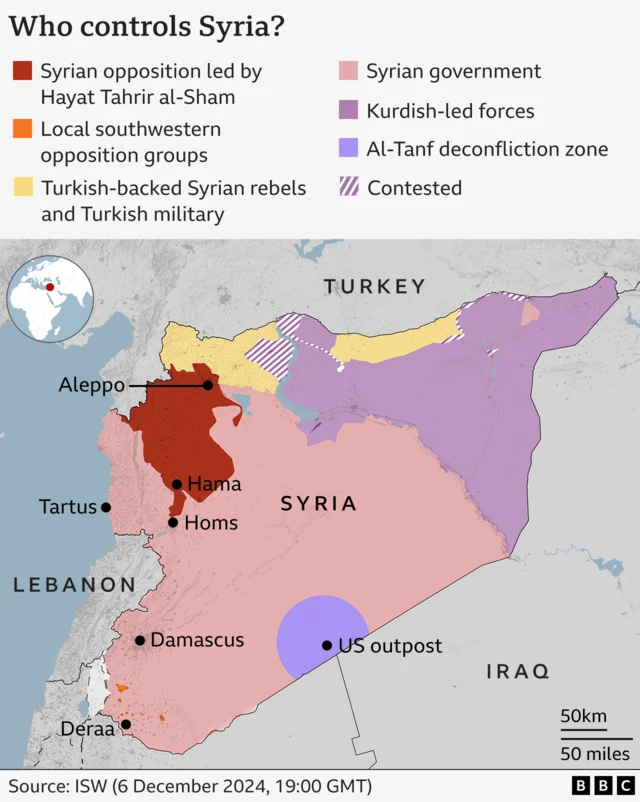
Who controls Syria?​

BBC

We've been reporting on key territorial gains made by rebel groups in Syria so let's have a look at who they are and the areas they now control.

Islamist militant group Hayat Tahrir al-Sham (HTS) and its allies launched a surprise offensive on 27 November, capturing Aleppo and Idlib in the north-west and later, Hama and the southern area of Deraa.

Aleppo and Idlib provinces have been dominated by HTS - designated a terrorist organisation by the UN, US, Turkey and other countries due to its former ties with al-Qaeda - along with a number of allied rebel factions and jihadist groups.

Turkish-backed factions launched a separate offensive near Aleppo that was controlled by a Kurdish-led militia alliance, the Syrian Democratic Forces. Turkey considers Kurds in Syria as a threat.

More than half a million people have been killed in Syria since a civil war erupted in 2011 when President Bashar al-Assad's government violently cracked down on peaceful pro-democracy protests.

Map showing Syria with the title Who controls Syria? The country is colour-coded into seven categories: Syrian opposition led by Hayat Tahrir al-Sham, Local southwestern opposition groups, Turkish-backed Syrian rebels and Turkish military, Syrian government, Kurdish-led forces, Al-Tanf deconfliction zone and Contested
 

Assad regime in Syria may fall in days, US increasingly believes​


By Alex Marquardt, Katie Bo Lillis and Natasha Bertrand, CNN
4:21 PM EST, Sat December 7, 2024

RenameThisHorizontal.00_00_30_12.Still003.png


CNN correspondent reports from chaotic protests after failed South Korea impeachment , CNN —

Biden administration officials, watching the remarkable speed of the Syrian rebel advance, increasingly see the possibility of the regime of Bashar al-Assad falling within days, five US officials told CNN.

If the American analysis proves true, it would represent a spectacularly fast fall from power for the Syrian dictator after a 14-year war, one that had been relatively stagnant until just last week.

Officials cautioned that a formal assessment on Assad’s fate hasn’t emerged and that views vary, saying his demise isn’t a forgone conclusion.

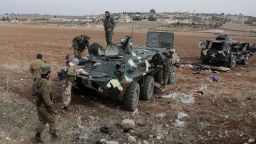
A rebel fighter stands on a military vehicle in Homs, Syria, on December 7.


“The emerging consensus is that is an increasingly plausible scenario,” one senior US official said.

“Probably by next weekend the Assad regime will have lost any semblance of power,” another official said.

“Only thing that would delay a rebel conquest would be a well-organized coup and reorganization, but Assad’s folks have done a good job of stifling any potential competitors,” the official added.

Another source familiar with US intelligence about the developments noted that so far, the opposition has made progress because regime forces have largely not stayed in the fight. But the areas the opposition forces have advanced the most — Aleppo, Idlib and Hama — also are not flush with regime support, so they encountered less resistance, this person said.

“The question is whether regime forces actually stand their ground when it comes to Damascus,” they added.
 
To view this content we will need your consent to set third party cookies.
For more detailed information, see our cookies page.
 
8 years of ceasefire the Syrian Mujahideen trained and the syrian army deteriorated. Why is the Syrian army retreating without putting up any resistance? They are simply leaving, judging by the media reports . They have not built any fortifications in so many years... Or are they waiting for others to fight for their country? Shame.

Afghan national army all over again

Over trillion spent by the yankee idiots, to train ANA, but gave them very little support to actually maintain and use weapons, no air force

So when the yanks finally had been broken and tucked tail and ran from Afghanistan, the ANA collapsed within days

It's vital for Syrias future

That all rebel groups are bought under one umbrella
The Kurds/SDF are dealt with and territory retaken
No U.S backed rebels tolerated
A new unified Syrian army emerges, that's prepared and able to defend Syria
Get back the Golan, no Syrian territory should be occupied
NO civilians whether alewite, Shia, Christian or kurd and sunni should be hurt, harmed tortured, unite syria
 
To view this content we will need your consent to set third party cookies.
For more detailed information, see our cookies page.
 
One of the US officials said the Pentagon, which has around 900 troops in Syria, is not making plans to change its force posture in the country and is waiting to see what happens while taking additional force protection measures.

The US has long partnered with the Kurdish-led Syrian Democratic Forces for anti-ISIS operations in Syria. The SDF has maintained contact with the rebel group known as HTS, the US official said, but the US does not communicate with HTS because it is considered a terrorist organization.

HTS does not appear to have the overt support of Assad adversary Turkey, but US officials believe Turkey gave the group a green light to launch its operation.

One significant concern the administration has is the safety of Assad’s stockpile of chemical weapons, thought to include both chlorine and sarin, which Assad has infamously used in rebel areas to the horror of the international community.

It is unclear where Assad would flee to, US officials said. His patrons could offer refuge in Moscow or Tehran, and it remains to be seen whether the rebels will set their sights on Latakia, an enclave of the Alawite sect to which Assad belongs.
 
To view this content we will need your consent to set third party cookies.
For more detailed information, see our cookies page.
 
The incoming president is already making his views clear, taking to social media Saturday to call for the US to stay out of any potential regime change and let the conflict unfold.

“Syria is a mess, but is not our friend,” he wrote, urging a hands-off approach and concluding with the message: “LET IT PLAY OUT. DO NOT GET INVOLVED!”

Early in his first term, Trump ordered strikes against Assad’s regime in response to a chemical weapons attack that killed dozens of civilians. Trump later sought to withdraw US troops involved in the fight against ISIS from northern Syria, though hundreds remained in the country.

Sen. Lindsey Graham, a Trump ally, warned Friday on social media that the US government needs to ensure ISIS prisoners detained in northeast Syria are not set free and that US troops in the country have the support they need.

“If there is a further collapse of the Syrian government, I fear that U.S. forces could be put in jeopardy. It is therefore imperative that we have contingency plans to reinforce our troops to make sure the anti-ISIS mission does not collapse,” the South Carolina Republican wrote on X.

This story has been updated with additional information.

CNN’s Sam Fossum contributed to this report.
 
To view this content we will need your consent to set third party cookies.
For more detailed information, see our cookies page.
 
To view this content we will need your consent to set third party cookies.
For more detailed information, see our cookies page.
 
To view this content we will need your consent to set third party cookies.
For more detailed information, see our cookies page.
 
19 min ago

Syrian rebels say they have entered city of Homs


From CNN’s Mohammed Tawfeeq and Christian Edwards


Syrian rebels say they have entered the city of Homs, which — if captured — would effectively split President Bashar al-Assad’s regime in two, severing pockets of territory on the coast from the capital Damascus.

“After several qualitative night operations, the remnants of the criminal regime are escaping the city of Homs, and the city’s neighborhoods are now being penetrated and combed in preparation for declaring it completely liberated, God willing,” a spokesperson for the northern rebels said around midnight local time on Saturday.

The statement comes just two days after the rebels captured the city of Hama, to the north of Homs, and just over a week after they captured Aleppo. Meanwhile, southern rebel groups say they are working to encircling Damascus.

After the rebels captured Hama, videos overnight into Friday showed hundreds of vehicles lining the highway out of Homs — Syria’s third-largest city — ahead of expected clashes between regime forces and the rebels.
 

Users who are viewing this thread

Country Watch Latest

Back
Top