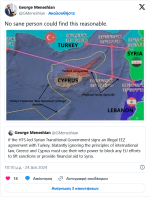
More and more people are realising the inevitable:
There are two contradicting narratives, two different nations and two separate states on the island. A unification is simply impossible.
It's time that Greeks and Turks move on.
Follow along with the video below to see how to install our site as a web app on your home screen.
Note: This feature may not be available in some browsers.

More and more people are realising the inevitable:
There are two contradicting narratives, two different nations and two separate states on the island. A unification is simply impossible.
It's time that Greeks and Turks move on.
Two state solution + lifting embargos = Southern Cyprus will immediately conclude an agreement with the North and Turkiye will very, very likely do the same. We all receive a Peace Nobel price and that's that.Do you agree or disagree with the Akar and Çavusoglu narrative of 2019-2022 that "it's one island so you must share the wealth",when the Greek Cypriots wanted to drill on their side for oil and gas?
But that's not what I askedTwo state solution + lifting embargos = Southern Cyprus will immediately conclude an agreement with the North and Turkiye will very, very likely do the same. We all receive a Peace Nobel price and that's that.
In their efforts to present themselves as an endangered and downtrodden minority at the mercy of the genocidal Greek Cypriots, and thus to justify the invasion and partition of Cyprus by Turkey, the Turkish Cypriots have made frequent, widespread, and effective propaganda use of the photograph of the “bathtub murders” of 1963.
They have even converted the house in Nicosia in which the “bathtub murders” took place into a “Museum of Barbarism”, with displays calculated to show the Greek Cypriots as callous murderers. Naturally the museum does not include displays covering Turkish Cypriot attacks on Greek Cypriots, for the propaganda requires that the Turkish Cypriots be seen as innocent victims.
The Museum of Barbarism, so named by a local Turkish Cypriot committee in 1966, aims to record for posterity “the story of our innocent people who were brutally murdered and forced to leave their homes as a result of the Greek Genocide”. [My emphasis.][1]
There never was, of course, a “Greek Genocide”, except in rumours wilfully fabricated by Turkish Cypriot fanatics in order to incite indiscriminate attacks upon Greek Cypriots. Nor, given the actions of the TMT, could the Turkish Cypriots as a group be described as innocent. The truth is that all decent Cypriots, both Greek and Turkish, should be ashamed of some of the things that were done in their name. Fanatics on both sides committed atrocities. To cite just one small example from the days of crisis in question, the Times of 23 December 1963 reports the following:
Two Greek Cypriot men were later beaten and stabbed by a crowd of Turkish Cypriots in the central Atatürk Square. The Turkish Cypriots halted a car in which the two men were travelling, overturned it and dragged the men to the footpath. The two men were admitted to hospital where their condition was reported as satisfactory.[2]
Some visitors quickly realise that the “Museum” is a propaganda exercise,
(“We don’t bring foreign tour groups to see it since they get a sense it is propaganda and resent being taken here,” says custodian Lutfi Gurkhan.)[3]
but not apparently the author of the 2003 Lonely Planet guide to Cyprus, Paul Hellander. His entry for the “Museum of Barbarism” is wholly lacking in scepticism, and is, like the “Museum”, completely one-sided. Here it is:
While the Turkish Cypriots may have taken down the gruesome posters and photographs to greet arrivals at the Ledra Palace Hotel crossing, they have not forgotten the atrocities committed by Greek Cypriots and in particular EOKA thugs against the Turkish Cypriot community. The Museum of Barbarism is in a quiet suburb to the west of the Old City and takes a bit of seeking out. On 24 December 1963 a mother and her children, along with a neighbour, were shot dead in their bath by EOKA gunmen [sic]. The bloodstained bath is retained as one of the exhibits in this rather macabre museum. There are other photodocumentary displays, particularly of Turkish Cypriots murdered in the villages of Agios Sozomenos and Agios Vasilios.[4]
Despite being a neohellenist academic, and a fluent reader of Greek, Hellander seems to be unaware that in 2000, the official Turkish Cypriot version of events was called into question by Costas Yennaris, when he revealed in his book Εξ Ανατολών that the Turkish photojournalist Ahmed Baran claimed to have taken the photograph of the “bathtub murder” victims under orders and in suspicious circumstances. Curious about what had really happened in that bathroom, Baran had investigated and discovered that:
The children’s father had gone berserk, killing his children and his wife in cold blood. The killer disappeared, spirited away by the Turkish authorities... [5]
Since then, other evidence has been brought to light by the Turkish Cypriot journalist Sener Levent, including a photograph which shows an empty bathtub and what seem to be bodies on the floor. The photograph suggests that the official story is, at the very least, inaccurate—the mother and children were not shot in the bath as claimed—and that the photographs which were chosen for propaganda use were staged, in what would seem to be a callous exploitation of a terrible family tragedy.
I present below the accounts of Costas Yennaris and Sener Levent, as well as various relevant extracts from other sources. There is no certainty as to who committed the crime of the bathtub murders. What is certain is that the crime has been effectively exploited by Turkey and the Turkish Cypriots to paint the Greek Cypriots in the blackest of colours, and, judging from Sener Levent's testimony, it is still being used to sow hatred and fear in the hearts of Turkish Cypriot schoolchildren long after the events of 1963.[6]
From Costas Yennaris’ book
The idea for this book arose from a personal experience, which has left an indelible mark on my mind. In an armed conflict there are always innocent people who pay for the extremes of the two sides. But the picture of three small children and their mother immersed in their own blood in a bathtub is one that can only provoke a reaction of horror. One such photograph has been used ad infinitum by Turkish propaganda to ‘prove’ the ‘barbarity’ of the Greek Cypriots and to illustrate Turkish claims of alleged organised genocide plans against the Turkish Cypriots. In the photograph are the wife and children of a Turkish army officer serving the Turkish Contingent (TURDYK) during the intercommunal clashes caused by the Turkish Cypriot rebellion against the Cypriot state at Christmas 1963. I had always believed this horrific crime to have been carried out by Greek Cypriot irregulars at a time when various groups had been formed to deal with the rebellion. Silently, I had always carried the guilt of all the Cypriots inside me. I had looked at the photograph on many occasions and tried to understand how anyone could reach the point of cold-bloodedly executing three small children, even if they were children of ‘the enemy’. What purpose could such a crime possibly serve?
In Athens in the 1980s, I got to know many Turkish journalists in my own capacity as a professional journalist. Towards the end of 1985, one of them, Ahmed Baran, was put in charge of the semi-official Turkish news agency ‘Anadolu’ and he invited me to the official opening. After the ceremony, a group of foreign journalists and I went to a bar. Ahmed, who was a very quiet person, never spoke a great deal, but he smoked and drank a lot. At the bar he listened to the discussions but did not take part. At some point, after quite a few whiskies, Ahmed took me by the arm and we went into a corner. He wanted to talk to me. We had often chatted before and had a mutual appreciation of each other’s work and opinions. That evening, however, he rendered me speechless. Without warning, without any prologue or introduction, Ahmed said:
‘You know that photograph of the three children and their mother dead in the bathtub? I took it.’
I was literally speechless. It took several minutes for me to register what he had said and to stammer:
‘How? Where?’
And Ahmed told me.
He had gone to Cyprus, he said, as a photojournalist to cover the intercommunal clashes of 1963. One evening, when he was drinking with friends in a bar in the Turkish quarter of Nicosia, two armed men entered and asked him to go with them. They took him by car to the house where the crime had been committed. Some armed men were already there, as were officers belonging to TURDYK, who ordered him to photograph the scene - which he did. And then, gun raised, one of them told him to hand over the film and to forget that he had ever been in that house and what he had seen there. But Ahmed wanted to know what had happened, who had committed the crime in a house in the heart of the Turkish quarter, far from any points of conflict, far from the Greek Cypriot areas. And he found out.
The children’s father had gone berserk, killing his children and his wife in cold blood. The killer disappeared, spirited away by the Turkish authorities, only to resurface after 24 years of silence, serving somewhere in the depths of Anatolia, having remarried. In an interview with a Turkish newspaper—his first and last—he recalled, with those who asked him to ‘remember’, his ‘drama’.
Ahmed could not bear to keep the secret. He had always wanted to share it with someone, someone connected to the country. The Turks had lied about the identity of the killer of the three children and their mother. The crime had not taken place at Omorphita, an area where many battles were indeed fought and where excesses were doubtless committed by both sides. No Greeks could have reached the house where the murder actually happened in the heart of the Turkish quarter of Nicosia. Ahmed had lived for many years with this terrible secret.
He begged me not to use it and I am only revealing it now that Ahmed is dead. While researching this book, however, I came across many similar instances which served the objectives that Ankara had set TMT, the main vehicle for its policy on the island.
Sener Levent on the Bathtub Crime
50 Years of Lies
From “Turkish Cypriot and Turkish Media Review No. 02/15 03-05.01.15”
Writing in his column in Turkish Cypriot daily Afrika newspaper (04.01.15), Sener Levent continues a series of articles regarding the murder of the wife and the three children of a Turkish army major in a house at Kumsal area of Nicosia in [December] 1963. Levent reports that we have not been able to definitely find out... who committed this crime. At the front page of his paper Levent covers the issue under the title "50 years of lies", pointing out that those who know something about the issue do not talk and it cannot be understood who is lying and who is not lying.
Editor’s Note: Sener Levent publishes his articles in Turkish in his newspaper Afrika. It is to these that the above snippet refers. Some of these articles are also then published in Greek in the newspaper Politis. I give these below in English translation.
The Bathtub Crime
(Translated from the Greek. The original is “Το έγκλημα του μπάνιου” by Sener Levent in Πολίτης, 7 Jan. 2015.)
Part 1
This photograph is iconic of our political propaganda. The crime of the bathtub. Three children with their bloody little pyjamas lying dead in the bath with their mother. Is there anyone who would be left unmoved by this photograph? If there is, they cannot be considered human. It is the most painful, the most tragic memory of Christmas 1963. This photo went around the world. It was published in all the well-known media of the world as an illustration of Greek Cypriot barbarity in Cyprus. It is through this photo that we tried hardest to convince everybody about the attacks carried out by Greek Cypriots against Turkish Cypriots on the island, and the crimes they committed. Later we turned the house in which this crime was committed into a “Museum of Barbarism”. And we took all our schoolchildren there in turn, and told them about Greek Cypriot barbarity. We still take them there.
Over the years we have published extensive reports in our newspaper on this subject. We opened up the folder for this crime. We started digging. In the minds of the people there were still questions that had not been elucidated. And a thousand and one rumours were still circulating. However, certain people did not like the fact that we were reopening the folder. They got angry and attacked us again, calling us “traitors”, as they always do.
When we reopened the folder certain truths emerged which were previously unknown. For example, the victims had not been murdered in the way we thought. The crime had been given a new “form”, so that the propaganda would be more effective. And, as we ascertained, the person who did that was a journalist from Turkey, Ömer Sami Coşar. Coşar was an expert on Cyprus, and was among us then as a correspondent for the newspaper Milliyet, but he worked more as an officer of the Turkish secret service than as a journalist.
Nobody came forward to explain to us why this scene was created. However as word of our publications spread and reached Turkey, our nationalists brought the aggrieved Major Ilhan back to Cyprus after forty years. They put him on television and got him to speak, but I think that later they regretted bringing him. The man’s speech was rambling. He said they brought him a captive Greek Cypriot woman and man to the Turkish embassy for him to kill them and avenge his wife and children. And giving him a gun, they said to him, “Go on, kill them and be avenged.” The Greek Cypriot woman was pregnant, he says. Major Ilhan did not kill her.[*]
Today we publish a photograph of the crime of the bathtub that has never been published before. This is its first publication both in our own and in the world press. We hope that this photograph will contribute to the elucidation of some more truths. Take a good look at the photo, at the bathtub. Are there any traces of blood in the bathtub? There are not. Where are the corpses? Out, next to the bathtub. If they had been murdered in the bathtub, is this how they would be?
[*]TRANSLATOR’S NOTEThe following extract from the Times may or may not be relevant here: “Two cases were reported today of Greek Cypriots being kidnapped by Turks. The first was when Mrs. Jacovides, living in an area held by the Turks during the fighting, began to experience labour pains. Her husband appealed to an R.A.F. Regiment patrol for assistance, and a vehicle was sent to take the woman to hospital. At a road-block Turks halted the vehicle and ordered the couple at gunpoint to accompany them to the Turkish Embassy, where the husband was ordered from the vehicle and taken inside, and the escort was then told to accompany the woman to hospital.” (From “British Soldier Shot [Nicosia, 27 Dec.]”, The Times 28 Dec. 1963, p. 6.)

Part 2
In my recent article entitled “The Secrets of the Bloodstained Bathtub”, I put forward six questions. I will repeat those questions here for they still await clear answers.
First, is it not strange that the mother is beneath and the children are above? Wouldn’t a panic-stricken mother trying to protect her children put her body in front as a shield?
Second, it is claimed that the brains of the children were splattered on to the wall. For this to be the case they would have to have been shot in the head. And indeed at close range with the gun against the chin. However, Major Ilhan, who said that he washed the bodies of his children with his own hands, says that none of them was shot in the head. So why is the lie that the brains of the children were splattered on to the wall still told?
Third, there is serious evidence that the murders were not committed in the bath. There are photographs which show the dead children not in the bath. So then, who picked the bodies of the children up and put them in the bath? And why did they do this?
Fourth, there are several versions of the photograph which constitutes the propaganda image. Versions which show the children in the bathtub in different positions. Who created this theatrical scene? Aren’t you, my readers, also curious to find out who was so shameless that they could play with the bloody corpses of children for the sake of propaganda?
Fifth, there are some who survived in that house of crime. And they still live among us. But for some reason they will not speak at all. Why? Who and what do they fear? Will something happen to them if they speak? Have they perhaps been threatened? This too is a mystery. Have any of you ever seen a Turkish Cypriot afraid to talk about some Greek Cypriot crime? I haven’t.
Sixth, the crime in the bathroom was published in the national press three days after it was committed. And back then there were only two newspapers, Halkin Sesi and Bozkurt. Although other news was reported immediately, why was this news delayed so much?
The nationalists who took offense because we began investigating the bathtub crime, should stop talking of treason and explain these things to us. And in particular, let them explain the photograph we are publishing today. Why do they lie, when no child has been shot in the head and nobody’s brains are splattered on the wall? Why tell falsehoods to the press, that the crime was committed in the bathtub? And, most importantly, why do they feel the need to tell these lies? That is what they should explain to us. We grew up with lies which continue to this very day. Bombs were placed in mosques, and they told us lies that “the Greek Cypriots did it.” A bomb was placed at the Turkish Embassy’s Press Office. They told us lies. Shots were fired at the statue of Ataturk. They told us lies. They told us lies even when they bombed us. “They planted it themselves,” they said. After so many lies, how can we believe what they say about the bathtub crime?
Blood Does Not Speak, But Photographs Do
(Translated from the Greek. The original is “Το αίμα δεν μιλά, αλλά μιλά η φωτογραφία” by Sener Levent in Πολίτης, 8 Jan. 2015.)
So far we have not found out for certain who committed the bathtub crime in the bloody Christmas of 1963. We are not saying that it was committed by Turkish extremists to ensure Turkey’s intervention on the island. The official propaganda says that it was a Greek Cypriot barbarity. If indeed it was committed by Greek Cypriots, we are exploring how it was committed.
The Greek Cypriot militiamen who were taking just about everyone hostage that night in the district of Kumsal did not kill anyone except Erdoğan Rifat, who came out to face them with a hunting rifle. Why would they kill this mother and her children?
There are many more questions like this. Were the victims murdered in or out of the bathtub? The official propaganda says that they were murdered in the bathtub, where they were hiding. But the photograph we obtained and are publishing here for the first time after fifty years proves that they were not murdered in the bathtub. There is no blood in the bathtub!
This report of ours has provoked a big reaction both in the north and in the south. Some in the press in the south have asked why we are publishing this photograph now, and why did we not publish it earlier. This is a very pointless question. It only just came into our hands and we published it. Had we found it earlier, we would have published it earlier. It is as simple as that.
In the north our journalist friend Serhat Incirli for some reason avoided showing the first page of our newspaper in the overview of the press which he presents on TV, and said “let’s not bother with such things anymore.” We were surprised.
Serhat, instead of giving us this advice, should ask why some people still take schoolchildren to the Museum of Barbarism and tell them so many lies. In addition, let him contribute to ascertaining the truth, instead of objecting to the investigation of a crime which constituted a cause for the creation of hatred between the two communities, and to the composition of the well-known poem “Hate”.[*]
The issue was also addressed by Phileleftheros in the south. It seems they were bothered by our publication. Strange is it not? We try to get to the root of a crime about which it is said that “it was committed by the Greek Cypriots”, and this newspaper seems to be saying that we are trying to conceal the fact that the Turks did it. “What is the problem?” they say. “We shed light on this event long ago. The father, Major Dr. Ilhan, suffered an attack of hysteria and killed both his children and his wife.”
What is this claim based on? On statements by the journalist Costas Yennaris. Yennaris refers to a Turkish journalist named Ahmet Uran Baran, who told him that the father became hysterical and killed his family. Why did he kill them? “Rather than let the Greek Cypriots murder them, I will kill them,” he said. That is the claim.
Ahmet Uran Baran was the first correspondent of the Anadolu News Agency in Moscow and in Athens. He also worked for the newspaper Istanbul Express. And indeed during a very critical period. In 1955 this newspaper was the main instigator of the events of 6 and 7 September against Greeks and non-Muslims. That is where Baran came from. We do not know if he said something to Yennaris about the bathtub crime. In the book Yennaris published in 2000 entitled Εξ Ανατολών, he writes that he too met with Major Dr Nihat Ilhan. “They’ve deceived you,” Dr Ilhan told him. He rejected the claim. “You do not know Turkish customs and traditions,” he told him, and so on. When Yennaris’ book was published, Ahmed Uran Baran had already died. Thus there was no one to verify or deny these allegations. If he had been alive, we do not know whether he would have confirmed Yennaris’ testimony. It would be wrong to consider the event clarified on this basis. Why should Phileleftheros be bothered that we are conducting further research?
Who took the photo with the “bloodless bathtub” which we published for the first time? Yesterday we learned that it was Foto Osman Rekor. Osman Rekor is one of the oldest and most experienced photographers and journalists. He has a very rich archive. Thousands of unpublished photographs. Are there other photos of the bathtub crime in this archive? I do not know. Maybe we will find out if someone buys it.
Will India evacuate from Kashmir?Cyprus is an independent country and both Turkiye and Greece has no business staying there..... both should immediately evacuate from Cyprus......

Do you agree or disagree with the Akar and Çavusoglu narrative of 2019-2022 that "it's one island so you must share the wealth",when the Greek Cypriots wanted to drill on their side for oil and gas?
One way or another, yes. Just like the pundits.Will India evacuate from Kashmir?
Back in 2019Sounds like nonsense that Akar and Cavusoglu cooked up to have the Greeks drop their guard. Haiti and Dominican Republic share an island and not the resources. If there is a "two state solution" the same will happen on Cyprus.
 www.tovima.gr