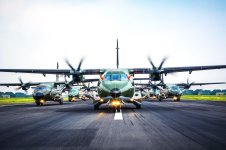
CN235 Transport Plane

Indos

INT'L MOD
Joined
Jul 25, 2013
Messages
31,720
Reaction score
26,186
Reputation
3,125.7
Country of Origin
Country of Residence
To view this content we will need your consent to set third party cookies.
For more detailed information, see our cookies page.


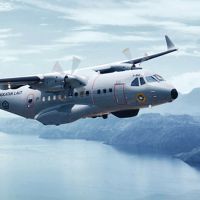
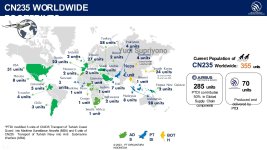
Stepping up in size, CASA and IPTN began a joint development of the larger CN235 in January 1980, leading to a first flight in November 1983. With active production continuing today at the Airbus industrial facility near Seville, Spain, more than 280 of these pressurised twin turboprop-powered, rear-ramp equipped aircraft have been ordered by military operators, civilian carriers and transport companies, as well as for government and paramilitary operators.

The versatility of this aircraft – which has a maximum take-off weight in the 16,000-kg. category – is demonstrated by the CN235’s diverse applications, covering the spectrum from airline flights, patrol and anti-drug trafficking to cargo, VIP duties and special missions.

The CN235 has even been configured as a gunship with a side-mounted 30mm cannon and integrated weapons pylons for missiles and rockets, while the U.S. Coast Guard acquired CN235s as its medium-range surveillance aircraft in the service’s Integrated Deepwater System Program – with equipment including a roll-on, roll-off electronics suite accommodated through the rear ramp.

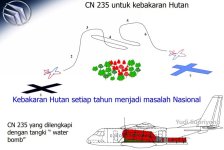
Topping off Airbus’ product range in the light- and medium-weight airlifter sector is a stretched CN235 fuselage version, designated the C295, which first flew in 1998. The C295 is equipped with more powerful turboprop engines, and has a maximum take-off weight of approximately 51,145 lbs. Built on the same final assembly line as the CN235, it is a robust and highly versatile platform with an extensive list of configuration possibilities: for intelligence surveillance and reconnaissance (ISR); as a water bomber with a roll-on/roll-off system carrying up to 7,000 litres of water/retardant; in maritime patrol and anti-submarine warfare duties; as an airborne early warning variant with a top-mounted 360-deg. radar dome; along with gunship and aerial tanker versions.

 
Source:
Not Applicable
To view this content we will need your consent to set third party cookies.
For more detailed information, see our cookies page.


On October 17, 1979, IPTN and CASA (now Airbus Defense & Space) established a new joint-venture company, Aircraft Technology (Airtech) to design the CN235. This new multi-purpose aircraft has a Short Take-Off and Landing (STOL) capability at 800 meters rugged airstrips, ramp door for out/coming goods easily, and low cost maintenance characteristics.

The first prototype “Elena” produced by CASA made the maiden flight on November 11, 1983 and the second prototype “Tetuko” produced by IPTN (now PTDI) flew for the first time on December 1983. The serial production began in 1986 for the 10 and 100 versions

Later on PTDI developed the improved version such as 110 and 220 versions; while Airbus Defense & Space with 200 and 300 versions. Nowadays, more than 300 CN235s have been produced in many versions with the latest two General Electric CT7-9C engines (each has 1,750 SHP).

In the collaboration for export purpose, PTDI produces outer wings, horizontal stabilizers, vertical fins and doors for Airbus Defense & Space; while Airbus Defense & Space produces disassembled noses, disassembled cockpit, and center wings for PTDI.

 
The story of CASA and IPTN's collaboration in meeting the needs of Spain and Indonesia resulted in the CN-235, Flight Global 1983.

To view this content we will need your consent to set third party cookies.
For more detailed information, see our cookies page.
 
Currently under development and certification for fire fighting version in Indonesian Aerospace

1736950726183.jpeg
 
CN235 Flying Test Bed for development. The plane is also used to test bioavtur produced by PT Pertamina.

To view this content we will need your consent to set third party cookies.
For more detailed information, see our cookies page.
 
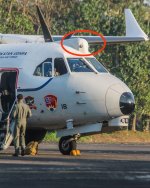
CN235 Gunship
.
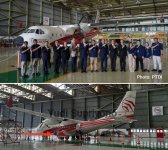
Since several months ago, the CN235 FTB has been in the Final Assembly Line (FAL) hangar to undergo modification into a gunship variant.
.
The first photo was taken on January 14, 2025 during a visit by the Royal Thai Navy (RTN).
The second photo was taken around January 17, 2025.
.
From the second photo, a hole is seen in the front of the fairing to accommodate the needs of the gunship variant.

1737443255977.jpeg

---------------

Post from Yudi Supriono, wellknown Indonesian journalist in aerospace sector
 
Indonesia government plan to order 20 CN235 planes from Indonesian Aerospace in stages

1741785810217.jpeg
 
To view this content we will need your consent to set third party cookies.
For more detailed information, see our cookies page.


On October 17, 1979, IPTN and CASA (now Airbus Defense & Space) established a new joint-venture company, Aircraft Technology (Airtech) to design the CN235. This new multi-purpose aircraft has a Short Take-Off and Landing (STOL) capability at 800 meters rugged airstrips, ramp door for out/coming goods easily, and low cost maintenance characteristics.

The first prototype “Elena” produced by CASA made the maiden flight on November 11, 1983 and the second prototype “Tetuko” produced by IPTN (now PTDI) flew for the first time on December 1983. The serial production began in 1986 for the 10 and 100 versions

Later on PTDI developed the improved version such as 110 and 220 versions; while Airbus Defense & Space with 200 and 300 versions. Nowadays, more than 300 CN235s have been produced in many versions with the latest two General Electric CT7-9C engines (each has 1,750 SHP).

In the collaboration for export purpose, PTDI produces outer wings, horizontal stabilizers, vertical fins and doors for Airbus Defense & Space; while Airbus Defense & Space produces disassembled noses, disassembled cockpit, and center wings for PTDI.


The CEO of join venture company, Airtech, who design CN235 is Indonesian, BJ Habibie

====================

Brilliant in science and mathematics from childhood, Habibie received his postsecondary education at the Bandung Institute of Technology in Bandung, Indonesia, and furthered his studies at the Institute of Technology of North Rhine–Westphalia in Aachen, West Germany. After graduating in 1960, he remained in West Germany as an aeronautics researcher and production supervisor.


Suharto took power as Indonesia’s second president in 1966, and in 1974 he asked Habibie—whom he had known for 25 years—to return to the country to help build advanced industries. Suharto assured him that he could do whatever was needed to accomplish that goal. Initially assigned to the state oil company, Pertamina, Habibie became a government adviser and chief of a new aerospace company in 1976.

Two years later he became research minister and head of the Agency for Technology Evaluation and Application. In these roles he oversaw a number of ventures involving the production and transportation of heavy machinery, steel, electronics and telecommunications equipment, and arms and ammunition.

 
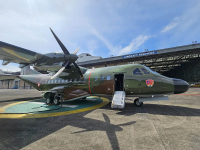
Indonesian Air Force's CN-235 N063 Reg.A-2318 aircraft and Radome Antenna Unit (RAU) of the Leonardo SAGE 600 digital Electronic Support Measure (ESM)

Source: Yudi Supriono

1744097000517.jpeg
 

CN-235 Aircraft Involved in U.S. Secret Operation to Capture Maduro​

January 5, 2026
1767575399505.png

CN-235 Special Operations Squadron USAF
(photo: Mark Bess)


Jakarta, Beritasatu.com — The United States deployed a massive air armada in Operation Absolute Resolve, a highly classified mission that culminated in the arrest of Venezuelan President Nicolás Maduro. More than 150 aircraft of various types were involved to establish complete air superiority, open access corridors for special forces, and extract the target from the heart of Caracas.

“This operation was the culmination of months of planning and rehearsals, executed with precision during the darkest hours to preserve tactical surprise and ensure the safety of all personnel,” said Chairman of the U.S. Joint Chiefs of Staff, General Dan Caine, in an official summary of the operation quoted by The Guardian on Sunday (January 4, 2026).


Amid a long list of advanced combat and support aircraft, one platform drew particular attention from Indonesian observers: the CN-235. The light transport aircraft—developed through cooperation between Spain’s CASA and Indonesia’s PT Nurtanio, now PT Dirgantara Indonesia—has for decades been closely associated with Indonesia’s air power.

1767575587052.png
CN-235 Special Operations Squadron USAF
(photo: FlightSim)


During Operation Absolute Resolve, the United States Armed Forces employed the CN-235 as part of the operation’s support elements. The aircraft was tasked with logistical missions, special forces mobility, and communications and surveillance support, complementing frontline fighter jets and strategic intelligence aircraft.

The involvement of the CN-235 in such a high-risk mission reinforces its reputation as a reliable and versatile military platform. Although commonly associated with the Indonesian Air Force (TNI AU) and humanitarian missions, the aircraft proved capable of supporting a complex U.S. operation involving the capture of a foreign head of state.

1767575631755.png
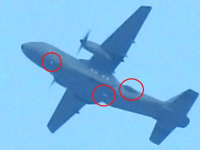
Signals Intelligence (SIGINT) equipment on the CN-235,
USAF Special Operations Squadron
(photo: Harry Boone via TWZ)


The overall air package in Operation Absolute Resolve included F-22 Raptor and F-35 Lightning II stealth fighters, F/A-18 Super Hornet strike aircraft, B-1B Lancer strategic bombers, and EA-18G Growler electronic warfare platforms. These assets formed a layered protective shield, enabling special forces helicopters to safely penetrate and exit Caracas.

In addition, airborne command and reconnaissance platforms such as the E-3 Sentry (AWACS), E-2D Hawkeye, and RC-135 Rivet Joint were deployed to maintain full situational awareness throughout the mission. Long-range drones provided real-time intelligence and precision fire support.


1767575679628.png
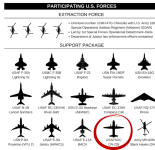
Types of aircraft involved in Operation Absolute Resolve
(infographic: Ian Ellis)


Within this high-intensity operational environment, the CN-235 played a critical role among support aircraft, ensuring operational continuity, smooth troop movements, and joint-force coordination, particularly during the withdrawal phase from Venezuelan territory.

Air dominance ultimately proved decisive. With the adversary’s air defense systems neutralized early, Delta Force helicopters were able to reach the target compound, secure Maduro, and evacuate him without any U.S. casualties.

For Indonesia, the presence of the CN-235 in a major U.S. global military operation is noteworthy. The aircraft—born from Indonesia’s aerospace industry—has demonstrated that it is not limited to domestic or regional missions, but is also trusted in one of the world’s most sensitive and high-risk military operations.


To view this content we will need your consent to set third party cookies.
For more detailed information, see our cookies page.


1768029758932.png
 
To view this content we will need your consent to set third party cookies.
For more detailed information, see our cookies page.
 

Users who are viewing this thread

Back
Top