Navigation
Install the app
How to install the app on iOS
Follow along with the video below to see how to install our site as a web app on your home screen.
Note: This feature may not be available in some browsers.
More options
Style variation
You are using an out of date browser. It may not display this or other websites correctly.
You should upgrade or use an alternative browser.
You should upgrade or use an alternative browser.
India Economy Thread
- Thread starter indushek
- Start date
More options
Who Replied?

Bhalla International - Vinex
BHALLA INTERNATIONAL is pioneer in manufacturing Athletics & Sports Equipment and doing business since 1957 under the brand name VINEX. We are manufacturing more than 3600+ products and have the largest facility in India for manufacturing wide range of sports and non-sports equipment. We have 100+ World Athletic and 1250 EN 71 certifications on a varied range of our Athletics & Sports Equipment, which is evidence that our products offer superior quality and performance. We have been Awarded No. 1 since 2004-05 for Highest Exports of Athletic Equipment from India by SGEPC (Sports Goods Export Promotion Council, a Government of India Sponsored Organization). Our Sports Equipment are being used in a good range of International and National Sports Championships across the globe. We also customize and develop products as per customer’s requirement. A highly skilled workforce and state-of-the-art technology ensures the highest quality product with most recent technology delivered to the customers.Sporting Goods Manufacturer, Supplier and Exporter in Meerut, India
Bhalla International - Vinex is a leading Sporting Goods Manufacturer, Supplier, and Exporter located in Meerut, India.
 www.vinex.co.in






hembo
Trusted Member

Tax relief for Indian middle class - but will it boost economy?
Almost 90% Indians will fall under zero income tax regime (through no tax, tax exemption or tax rebate) under the new budget. Big boost to the middle class.
nahtanbob
Elite Member

India prepares for Trump trade disruption by dropping taxes for manufacturers
Certain iPhone components including iPhone circuit boards will no longer face import taxes in India as the country positions itself to weather changes in global trade.
 appleinsider.com
Certain iPhone components including iPhone circuit boards will no longer face import taxes in India as the country positions itself to weather changes in global trade.
In 2024, the Indian government reduced its import taxes on chargers, printed circuit board assembly (PCBA) and smartphones themselves, from 20% to 15%. That 5% cut was estimated to mean Apple would earn between $35 million and $50 million more annually.
According to Reuters, though, India has now entirely dropped import taxes on certain components and accessories, although not on smartphones. India's Finance Minister Nirmala Sitharaman announced the removal of the tax during her annual budget speech and the government has prepared a list of affected components.
That list is said to include a range of components and accessories that again feature PCBA, but also parts of camera modules. USB cables that were previously taxed at 2.5%, will now also face no import taxes.
The 2024 cut had been announced as being in the "interests of consumers." This 2025 cut is being seen as India positioning itself and its market in preparation for the effects of any Trump Administration tariffs. The move is to help incentivize companies to relocate manufacturing there and away from countries such as China that are at least likely to face tariffs.
The benefits to Apple and others
Cutting component import taxes will make it cheaper for firms to assemble devices in India. Apple's manufacturing partners such as Foxconn, currently make iPhones and chargers in India. In December 2024, it was claimed that Apple was also looking to move some AirPods production to India, specifically to help avoid tariffs.Separately, Sitharaman said in 2024 that she would be leading a review of the country's whole customs duty rate, in order to simplify the complex process and boost trade. This is expected to also attract more manufacturing to the country, which is competing against Vietnam for Apple-related orders
The component import tax news follows the announcement in early January 2025 that India planned to offer subsidies to attract firms. That subsidy, estimated at around $2.7 billion, was then announced in Sitharaman's budget speech.
India has already become progressively more important to Apple, as the company works to reduce its over-reliance on China. Apple plans to make 25% of all its iPhones in India by the year 2028.
nahtanbob
Elite Member
China’s export ban on engineers and equipment disrupts manufacturing overseas
China is seen to be using its power in global supply chains as a weapon ahead of anticipated Trump tariffs. Read more at straitstimes.com.
China’s export ban on engineers and equipment disrupts manufacturing overseas
BENGALURU/SINGAPORE – Since January, Apple supplier Foxconn’s factories in India have been waiting for technicians and machinery from China that have still not arrived.
The delay is due to what sources tell The Straits Times are new export controls on crucial equipment and manpower, in what appears to be a bid by China to keep investment and manufacturing jobs within its borders.
This comes as tariffs loom under newly inaugurated US President Donald Trump’s administration, which would make China-made products more expensive and less competitive.
China’s export controls have thrown a spanner in the Taiwanese company’s immediate plans to expand the production of Apple iPhones, laptops and AirPods in India until it can develop alternatives.
A senior official in the Indian government confirmed that three private sector companies have reported delays in imports of capital equipment from China. He spoke on condition of anonymity because the discussions are private.
The official told ST that India’s ministries of electronics and external affairs are aware of the blockade, but were “gathering more information” about whether it was targeted particularly at India.
He declined to name the companies affected.
Manufacturing sources in India, China and Taiwan told ST that the impact on Foxconn, the world’s largest iPhone manufacturer and a bellwether of American companies diversifying from China, is significant, but it was not the only company impacted by China’s export blockade.
Bloomberg reported disruptions in imports of technical equipment for the Indian unit of Chinese automaker BYD and Waaree Energies, India’s largest solar-panel maker, but ST could not independently verify this.
China, bracing itself for Mr Trump’s tariffs on US$500 billion (S$676 billion) worth of Chinese goods that the US imports, is trying to scuttle attempts by American companies like Apple to diversify manufacturing outside the Asian manufacturing giant.
Amid the slowest growth rates in decades in 2024, analysts say China has been trying to retain foreign manufacturers to protect its export earnings and offset a worrying property slump, falling household spending, high local government debt and youth unemployment.
But Beijing’s export controls might instead end up pushing inconvenienced companies to find suppliers in other countries, sources told ST.
The blockade began without any official announcement from China, leaving companies scrambling to investigate the reason for delays and Customs hold-ups of equipment exports from there. Companies are also planning workarounds to prevent falling behind on production targets.
Exit bans on Chinese technicians began in December, while equipment from China has been blocked since January.
Lack of crucial machinery affects Foxconn’s production
Apple makes around 85 per cent of its iPhones in China, but has been expanding its production in India since 2017 to tap the latter’s smartphone demand and low labour costs that are a third of China’s. The American company now makes iPhone models 12, 13, 14, 15 and 16 in India, and exported iPhones worth a record 1.08 trillion rupees (S$16.9 billion) from there in 2024. This comprises about 14 per cent of the global total – that is, one in seven iPhones worldwide.Foxconn’s Sriperumbudur plant in south India accounts for the lion’s share of iPhones made in India, followed by Taiwan’s Pegatron and India’s Tata Electronics. Over 70 per cent of the India iPhone output is exported, primarily to the US.
All three contract manufacturers in India are affected by China’s equipment blockade to different degrees based on the size of their operations, said a former supply manager for Apple in India. But as the largest producer of iPhones outside China, Foxconn’s Sriperumbudur factory in south India is the most visibly impacted.
“Foxconn is like a seaside villa first to be hit by a tsunami, but the smaller villas in the second line might be affected later,” the former supply manager told ST, requesting anonymity as they were not authorised to speak to the media.
A Taiwanese trade official said Foxconn India imports specialised equipment from China such as voltage and heat testing machines, precision metal works, motorised tracks in assembly lines, as well as circuit boards and tool-making machines.
“There is 70 per cent to 80 per cent reliance on machinery produced in China. Not all of the equipment is blocked, but enough crucial machinery is stopped to stall production,” the trade official noted.
The former supply manager told ST that since the start of 2025, there have been unprecedented delays in the arrival of equipment categorised under international import-export codes HS 84 and 90.
HS Code 84 applies to 87 types of machines including nuclear reactors, boilers, forklifts, mechanical appliances, machines to make semiconductor wafers, and integrated circuits. HS Code 90 includes 33 types of optical, photographic, measuring, checking, and precision instruments and their parts.
Despite diversifying its supply chain since Covid-19 disruptions, Apple remains dependent on China for components such as batteries, magnets and high-precision tools, making a complete production shift out of the country unlikely in the near term.
This dependency means that even minor shipment delays could disrupt production elsewhere.
A source familiar with Apple’s operations confirmed that China’s move is already affecting Vietnam, Indonesia, Thailand, Malaysia and Mexico, too, where Apple and other American companies are expanding supply chains.
Hard to secure alternatives swiftly
Although Foxconn and its suppliers had managed to move some equipment out of China in 2024 before the exit ban, it is hard to operate them in isolation, a Foxconn contractor operating in China and India told ST.For example, one of Foxconn’s suppliers managed to move to India one of the six factory lines for making the iPhone screen. But that alone is insufficient because all six lines need to run at the same time to produce the volume of screens necessary for the next set of production processes to be efficient.
In November 2024, Apple through Foxconn began early manufacturing of its upcoming iPhone 17 in India, a notable shift from its usual practice of handling this key phase in China. This stage turns prototype designs into blueprints ready for mass production.
When asked if the production of iPhone 17 would now be stalled, the Foxconn contractor said Foxconn could pull it off if it spent more time and money “to replicate the production lines and training new hires” outside China.
Apple and Foxconn did not respond to ST’s queries.
Sending Taiwanese and Vietnamese workers to China for training
About 1,000 “lu gan”, or mainland-hired managers – as opposed to “tai gan”, or Taiwan-hired managers – will have to return to China from India when their work visas expire in March. They include engineers responsible for designing the new factories and planning the production lines.Their replacements will not be able to leave for India because of the exit ban, according to the Foxconn contractor.
He said Foxconn is now going on a massive hiring drive in Taiwan for managers, but it will take time before they get trained to be as competent as the experienced mainland managers.
He expected more Taiwanese and Vietnamese workers to be sent to Foxconn’s factory in Shenzhen, China, for training.
The trade official in India told ST that in the past year, Foxconn India has also been trying to hire directly from Indian engineering schools, and training locally recruited line managers.
The manufacturer has been planning for local recruitment since India-China relations worsened following military clashes in 2020. At the time, the Indian government blocked visas for Chinese engineers, somewhat easing the rule only in 2024 following persistent corporate requests. China’s current exit bans make replacements even more urgent.
China adds US companies to export control list
This phase of machine and material blockades began after the Chinese government published an Export Control List on dual-use machinery and minerals in October 2024, and later on Jan 2, 2025, issued a watch list of 28 American companies of strategic importance making defence, aviation and related equipment.However, the ban’s implementation has also been applied more broadly to categories and companies not mentioned in the official lists.
Mr Pranay Kotasthane, who heads Indian think-tank Takshashila Institution’s high-tech geopolitics programme, inferred that Chinese officials are blocking equipment beyond this list to be safe, especially after the Jan 2 notification.

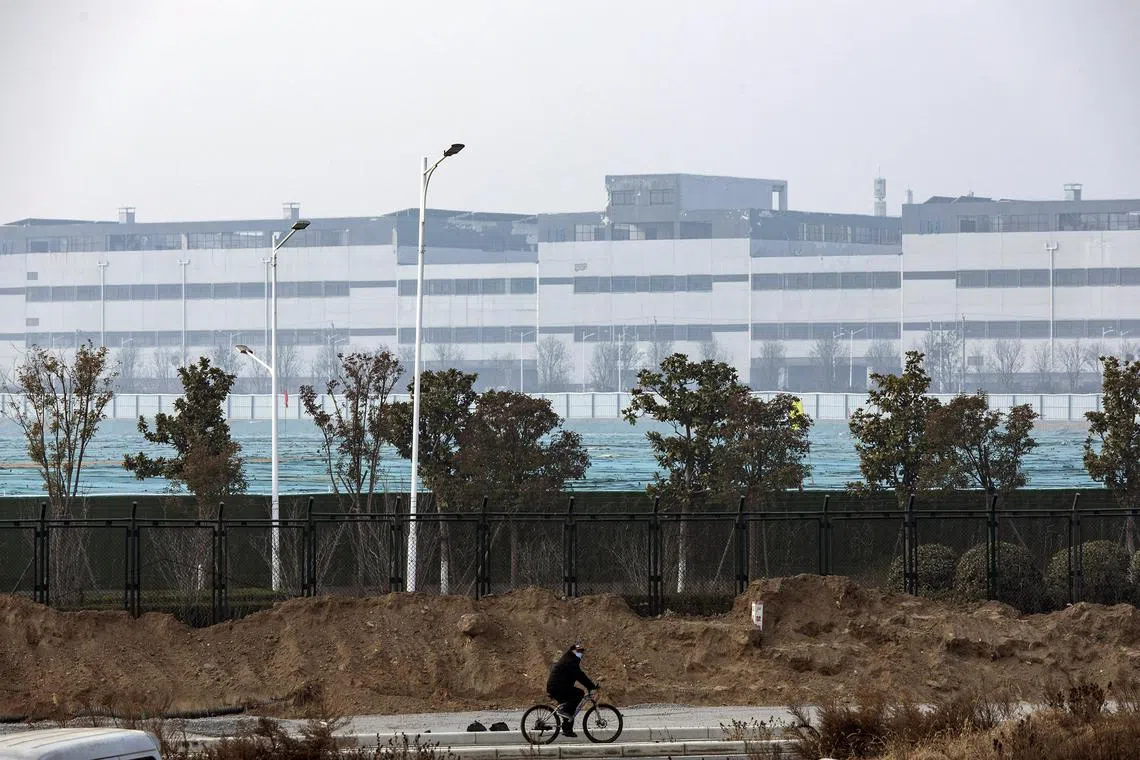
The trade official in India told ST that in the past year, Foxconn India has also been trying to hire directly from Indian engineering schools, and training locally recruited line managers. PHOTO: REUTERS
China at risk of losing advantage it holds
Experts told ST that China’s export restrictions will cause short-term trouble, but will end up incentivising companies to further move their production ecosystem elsewhere.Mr Kotasthane called it “an own goal for China”.
“A lot of companies chose contract manufacturers in China because it’s cheaper, there is policy consistency and the ability to export to the world. Once export controls are in place, and companies can’t export seamlessly, they will shift to other countries,” he said.
He gave the example of German manufacturer Herrenknecht, which faced bottlenecks at Chinese Customs in 2024 to export its tunnel-boring machines assembled there that are used in Indian metro rail projects.
It has since assembled more in its factory in Chennai, India.
Foxconn is also expanding its supplier base in India, Vietnam and Thailand.
“For the first time in years, Foxconn is participating in trade shows in India to network with potential local suppliers”, like the upcoming Source India summit of electronics suppliers in Chennai in February, said the Taiwanese trade official.
On Jan 24, Indian conglomerate Tata Electronics announced it had bought a majority stake in Pegatron, marking the gradual indigenisation of Apple’s manufacturing in India.
The economic benefits of having Apple contract manufacturers in any city are immense, as shown by the experience of the city of Zhengzhou in China’s southern Henan province.
The Foxconn manufacturing hub there hired over 300,000 workers at peak production, according to research by Associate Professor Chen Xiaofei from Henan University.
The army of companies that serve as contractors to Foxconn also provided tens of thousands of jobs for Chinese workers.
Foxconn’s landing in Zhengzhou in 2010 turned the backwater city into one of the top exporting cities in central China.
At its latest peak in 2019, the combined value of imports and exports generated by Foxconn in Zhengzhou was 28.6 per cent of the city’s gross domestic product.
Zhengzhou stands to lose both the trade and the jobs should Foxconn pull out.
“The local government has told Foxconn that as long as you are willing to stay in Zhengzhou, anything can be discussed,” said a source who is privy to the discussions between Foxconn and the Zhengzhou government.
“But I don’t think Foxconn will want to stay. This episode has made clear to a private enterprise like Foxconn that what by right belongs to you – equipment and people – is not yours to use, but can end up being beholden to the Communist Party or to the country China,” he added.
With the double whammy of pressure from Apple to move more of its production out of China and China’s new export controls, the exit of Foxconn, its suppliers and other companies from China might be inevitable.
Mr Kotasthane said: “China’s attempts to use export restrictions will only force further diversification, and thus diminish whatever leverage it holds.”
- Rohini Mohan is The Straits Times’ India Correspondent covering politics and business in the South Asian region.
- Yew Lun Tian is a senior foreign correspondent who covers China for The Straits Times.
Proud Thamizhan
Registered Member
r u sure you're Chinese? CCP is going to be mad at you for saying thatBeing a sweatshop is nothing proud of.
nahtanbob
Elite Member
it is always do as I sayr u sure you're Chinese? CCP is going to be mad at you for saying that
but don't do what I do
ChineseTiger1986
Trusted Member


r u sure you're Chinese? CCP is going to be mad at you for saying that
China will soon have fully automatic robot sweatshop.
nahtanbob
Elite Member
it is good for everyoneChina will soon have fully automatic robot sweatshop.
Proud Thamizhan
Registered Member
good one. Frankly CCP already has just thatChina will soon have fully automatic robot sweatshop.
nahtanbob
Elite Member
Apple supplier list 2021
nahtanbob
Elite Member
Apple's made-in-India iPhone Pro models to debut shipping this year - report
Apple (NASDAQ:AAPL) will produce its iPhone Pro and Pro Max models in India for the first time this year, Bloomberg News reported.
Apple's manufacturing partner Foxconn Technology (OTCPK:FXCOF) — which is formally known as Hon Hai Precision (OTCPK:HNHAF) (OTCPK:HNHPF) — will assemble the new phones within weeks of their worldwide launch this fall, the report added citing people with knowledge of the matter.
Foxconn has started training thousands of workers at its factory in the Indian state of Tamil Nadu state in an effort to make the iPhone 16 Pro and Pro Max as close to the global launch as possible, the report noted.
The production efforts indicate the tech giant is advancing efforts to reduce its dependence on China amid rising geopolitical tensions. In June, it was reported that Apple assembled about $14B of iPhones in India in the fiscal year ended March 2024. The Cupertino, Calif.-based company made nearly 14% or about 1 in 7 of its iPhones in India. Foxconn had assembled about 67% of the India-made iPhones, while Pegatron assembled about 17%.
Apple is expected to produce the India-made standard iPhone 16 available on the same day the latest generation starts selling worldwide, the report added.
Apple's other partners, Pegatron's Indian unit and conglomerate Tata Group, could also soon start making the Pro models, which require more specialized manufacturing lines.
By the end of the year, India-made iPhones will be able to satisfy the local demand, the report noted. Local assembly will likely help Apple reduce the prices of the Pro models by up to 10% versus the imported devices, on which India imposes import duties, according to the report.
However, expensive component imports and domestic taxes would keep the prices of iPhone 16 Pro and Pro Max higher in India, compared to some foreign markets which have little to no taxation.
The U.S. tech giant will export the bulk of the India-made Pro and Pro Max models to Europe, the Middle East and the U.S. as the demand for the higher, costlier versions is relatively less in India, however, the upcoming holiday season could increase sales, the report stated.
Last month, Apple cut the prices of iPhones in India by up to 6,000 rupees (about $71.7) following a reduction in basic customs duty on mobile phones in the country, and a potential slowdown in China sales.
China remains Apple's largest iPhone-making hub and the largest overseas market. However, the company has been facing tough competition by rivals such as Huawei Technologies and an expanding scrutiny on the use of foreign technology in the workplace.
Apple ranked sixth in China with a market share of 14%, a decrease of 2% percentage points, compared to the second quarter of 2023. Chinese companies dominated all the top five spots in phone shipments for the second quarter of 2024 in the Asian country, according to data from research firm Canalys.
Meanwhile, it was reported last month that Apple's (AAPL) annual sales in India hit a record of almost $8B, with iPhones accounting for more than half of the sales.
nahtanbob
Elite Member
According to a new supply chain report, Apple is reportedly shifting its production strategy by scaling back its plans to expand MacBook manufacturing in Vietnam while placing greater emphasis on India.
Citing industry sources, the report notes that Apple’s strategic realignment is driven by three key factors: the unpredictable stance of the Trump administration, the evolving local market environment, and strategic considerations of the company’s diverse product portfolio.
As the report highlights, Apple had previously sought to reduce its reliance on Chinese manufacturing by shifting iPhone production to India while designating Vietnam as a hub for AirPods, iPad, and Mac production. By September 2023, Vietnam had become Apple’s fourth-largest production center, as the report notes.
However, the report citing sources states that Apple has taken an increasingly cautious approach toward production in Vietnam. In contrast, the report notes that the company continues to strengthen iPhone manufacturing in India.
The report points out that Apple is rapidly expanding its manufacturing network in India, leveraging local subsidies, a skilled workforce, and the country’s advancing technological capabilities, making India a crucial part of Apple’s broader strategy to reduce dependence on China.
Sources cited in the report indicate that between April and September 2024, Apple exported nearly USD 6 billion worth of India-made iPhones (based on factory prices), marking a one-third increase compared to the same period in 2023. Apple’s total export value from India for the 2024 fiscal year is on track to exceed USD 10 billion, as highlighted by the report. for more, read the full report by Aijiwei.
nahtanbob
Elite Member
This is another Apple factory outside of China
nahtanbob
Elite Member
Apple Considering iPhone Manufacturing Facilities in Indonesia: Report
The move could be part of the U.S. tech giant’s strategy to lift a government-imposed sales ban on its latest model.By Sebastian Strangio
Apple is in talks with its suppliers about potentially manufacturing iPhones in Indonesia, which would mark a victory for the government in its attempts to force the tech giant to make more substantial investments in exchange for access to the Indonesian market.
According to a report late yesterday by Nikkei Asia, Apple is exploring the possibility of setting up a manufacturing facility for the handsets in Indonesia as part of its strategy to lift a government-imposed sales ban on its latest models.
As the Nikkei report notes, this “would mark Apple’s first-ever iPhone production in the Southeast Asian nation, where it has almost no supply chain ecosystem.” It would also “significantly boost Indonesia’s efforts to create jobs and elevate its tech manufacturing industry.”
It would also mark a victory for Indonesia’s government, which back in October banned the sale of Apple’s new iPhone 16 handsets, which were released globally in September, on the grounds that the tech giant had failed to fulfill its local content requirements. These rules, which require certain smartphone handsets to contain at least 40 percent locally manufactured components, are designed to force foreign companies to make substantial investments that transfer technology to Indonesia and create high-quality jobs. Jakarta has also banned the sale of Google’s Pixel smartphone on the same grounds.
In response to the October ban, Apple has held several rounds of talks with the Indonesian government to see how it might fulfill the Indonesian requirements. Apple initially moved in with a low-ball offer to invest $100 million in building an accessory and component manufacturing plant in the country. But the Indonesian government said that this was insufficient to reverse the iPhone 16 ban, with one minister comparing the proposal to Apple’s much more substantial investments in neighboring Vietnam and Thailand.
Apple then promised to invest $1 billion, including in an AirTag production facility on the island of Batam, which is expected to begin operations in 2026. While Indonesia welcomed this, it said that this was also not enough to reverse the iPhone ban, with Industry Minister Agus Gumiwang Kartasasmita pointing out that AirTag production “has no direct relations” with the manufacturing of iPhones.
The Nikkei report did not include many details about the Apple investment, and even if it is confirmed, building factories and shifting sophisticated supply chains is likely to take some time. As Apple Insider noted, the tech giant “will presumably make it a condition of committing to such manufacturing that the iPhone 16 ban be lifted immediately.”
Whatever the conditions, the report suggests that Indonesia has been successful in using its considerable leverage – it is both the world’s fourth-most populous nation and its fourth-largest mobile market – to extract concessions from one of the world’s most powerful companies.
Apple has a lot of reasons to play ball, given the risk of ceding an important market to its rivals. As of last month, China’s Oppo was the most popular smartphone brand in Indonesia, with a share of 19.14 percent of the market. This was followed by South Korea’s Samsung (17.95 percent) and the Chinese brands Xiaomi (15.53 percent) and Vivo (14.52 percent). Apple made up just 7.3 percent of sales in January, down from 12.8 percent in October, when the ban on the latest iPhone was imposed.
As Hilman Palaon noted last month in an article for the Lowy Institute’s Interpreter blog, Chinese smartphone manufacturers like Oppo, Vivo, and Xiaomi “have become market leaders in Indonesia by establishing local manufacturing operations,” aligning themselves with the government’s domestic production requirements. Huawei, too, recently announced that it would be releasing its smartphones in Indonesia beginning in March, and “appears to be meeting Indonesia’s requirements by partnering with a local manufacturing firm,” according to Apple Insider.
Apple has seemingly recognized the reality that if it wants to play ball in Indonesia, it has to do so according to the government’s rules.

Apple Considering iPhone Manufacturing Facilities in Indonesia: Report
The move could be part of the U.S. tech giant’s strategy to lift a government-imposed sales ban on its latest model.
thediplomat.com
Users who are viewing this thread
Total: 7 (members: 0, guests: 7)


