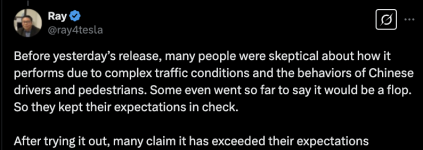
Tesla screwed up. In front of hundreds of millions of viewers
Wow Tesla is far far far far more popular in China than PDF members want to admit.
Tesla FSD's live broadcast gets 27 traffic violations. Is this Tesla's comedy show?
So it's saying the main reason is the street map data Baidu is giving Tesla is incomplete.
2月26日,特斯拉官方宣布,首批焕新Model Y开始交付,并将该车亮相时的态度再次强调一遍:尽管对比! 此时,人们才恍然大悟:特斯拉敢在中国市场如此“嚣张”,原来是有所依仗。此前一天,他们为已...
m.autohome.com.cn
Is this a wolf or a paper tiger? Tesla FSD sets off a "anti-encirclement war" against China's intelligent driving
DeepSeek: Here’s the English translation of the provided text:
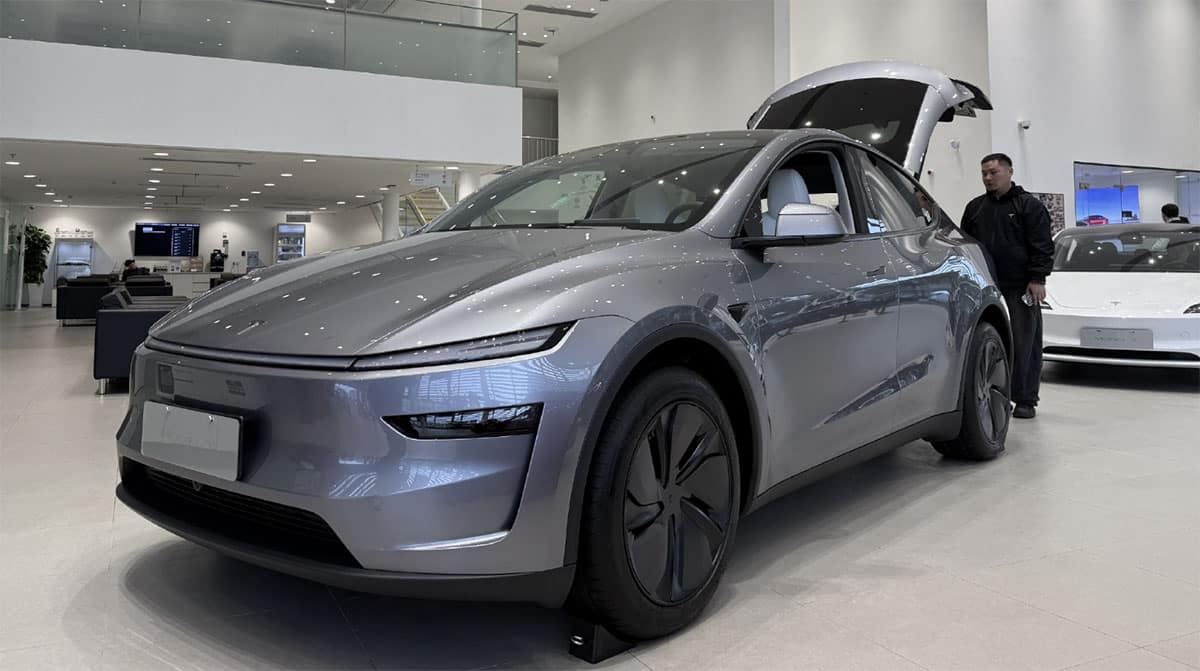
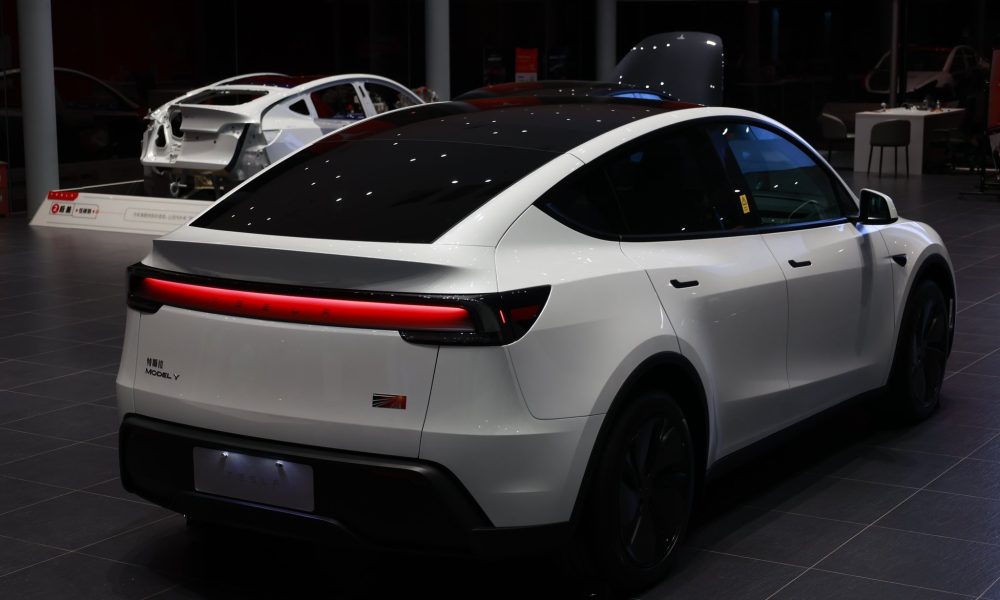
[Autohome Industry] On February 26, Tesla officially announced the delivery of the first batch of the refreshed Model Y, reiterating the stance they took when the car was first unveiled: "Bring on the comparisons!"
At this point, people finally realized why Tesla dared to be so "bold" in the Chinese market—it had something to rely on. The day before, Tesla had pushed the 2024.45.32.12 software update to owners who had spent 64,000 yuan on the Full Self-Driving (FSD) package, quietly changing the official definition of FSD from "Full Self-Driving" to "Autopilot Assisted Driving."
Although not all features of the U.S. version of FSD have been implemented in China, its arrival has still caused a significant stir in China's smart electric vehicle market. After all, the long-awaited "FSD coming to China" has finally become a reality.
So, how does Tesla's China version of FSD perform? Can it catch up to the top-tier Chinese autonomous driving companies? Will it bring new challenges to China's smart electric vehicle industry?
12 Points Aren’t Enough for FSD to Lose?
When news of FSD's arrival in China broke, the automotive industry immediately fell into a frenzy of "hard-to-get cars." Due to the limited number of Tesla vehicles equipped with FSD and high market demand, some owners found themselves with an unexpected windfall.
It is reported that a Model 3 with FSD can now rent for 4,000-5,000 yuan per day, several times the daily rental price of a regular Model 3. Seeing this rental boom, some industry insiders joked that if you had a wide enough network, you could earn back the 64,000 yuan cost of FSD just by renting out your car these days.
However, despite the high demand, FSD's performance on Chinese roads has left many disappointed. "12 points aren’t enough for FSD to lose," lamented a Tesla owner in a video posted on February 25.
As one of the first to experience Tesla's FSD in China, he reported that within a few hours of activating the feature, the vehicle repeatedly committed traffic violations such as running red lights, crossing solid lines, and making illegal left turns.
This owner isn’t alone. During a three-hour nighttime test of Tesla's FSD in Beijing conducted by Autohome, the system required 17 interventions, with instances of traffic violations and wrong turns.
A colleague from Autohome who participated in the test noted that the primary reason for interventions was the system's inability to recognize the road, such as choosing the wrong lane, ignoring dedicated vehicle lanes, or misunderstanding right-turn/U-turn traffic light rules.
However, he also acknowledged Tesla FSD's capabilities. In his view, the need for interventions was
mainly due to insufficient data. In most cases, Tesla FSD performed well, with impressive object recognition range, distance, accuracy, scene understanding, and response speed, giving the impression that the vehicle was confident in its abilities.
Notably, during the three-hour test, there were
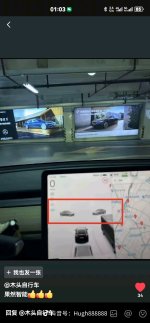
no dangerous interventions. While there were some flaws—such as the system being unable to distinguish whether it was on the ground or in an underground parking lot, and parking functionality lagging behind competitors like Xpeng and Huawei—FSD's handling of complex scenarios was surprisingly nuanced.
Regarding Tesla's sudden rollout of FSD in China, Chen Yuhang, founder and chairman of YiHang Intelligence, told Autohome, "This is likely related to Tesla hitting a sales bottleneck. In 2024, Tesla delivered 1.789 million new vehicles, a year-on-year decrease of 1.1%, marking the first decline in Tesla's sales in a decade. In the critical Chinese market, the Model 3 and Model Y, Tesla's volume sellers, have shown signs of sales fatigue. Meanwhile, domestic automakers have made rapid advancements in autonomous driving, with sales continuously rising. Tesla urgently needs FSD to enhance its product competitiveness."
In Chen's view, the rollout of FSD in China feels somewhat rushed. While Tesla's FSD has strong foundational capabilities, its lack of localization in China means that despite its high profile, launching an immature version could harm Tesla's reputation and market confidence.
FSD Dancing in Shackles
For now, domestic automakers may not need to fear FSD, primarily because it is "dancing in shackles." The Chinese version of FSD is more basic and simpler than the V13 version Tesla promoted in the U.S., as it is not trained on vast amounts of Chinese road data.
In fact, Tesla's path to bringing FSD to China has not been smooth. In January, Elon Musk stated, "Tesla still faces difficulties deploying FSD in China.
China currently does not allow Tesla to transmit video data outside the country, and the U.S. does not permit Tesla to conduct testing and training in China."
This means that despite China's rich local scenario data, Tesla's computing power can only be deployed overseas. To accelerate FSD's rollout, Musk has resorted to a "neutered" approach, using publicly available video data from Chinese streets combined with simulators for training, hoping to gradually iterate toward a "full-blooded" version.
Industry insiders reveal that in early February, Tesla dispatched some U.S. autonomous driving engineers to China to work on localizing and optimizing the mature version of FSD. This approach allows FSD to improve its performance in China without exporting data.
However, FSD still requires a significant amount of localized Chinese data to adapt to Chinese traffic, and full localization will take time.
"Chinese road conditions differ significantly from those in the U.S., and FSD's entry into China will face challenges," Zhou Guang, CEO of Yuanrong Qixing, told Autohome. "Static scenarios like overpasses, tunnels, and dedicated lanes, which are unique to China, require specialized adaptation. Additionally, China's high traffic density means the difficulty of promoting autonomous driving lies not in navigation or static scenarios, but in dynamic scenarios involving interactions between pedestrians, non-motorized vehicles, and cars, as well as cut-in situations. Foreign autonomous driving companies need to optimize their systems for these 'Chinese scenarios,' which will take time."
Moreover, Tesla faces computational bottlenecks in training FSD in China. Tesla has built the Cortex supercomputing cluster overseas for FSD training, equipped with approximately 100,000 NVIDIA H100 and H200 chips, making it the automaker with the largest computing power. However, this cannot be used for training on Chinese data.
There are rumors that Tesla may lease or build a computing center in China to train FSD. Even with significant investment, it will be difficult for Tesla to match the scale of its overseas cluster in the short term. Whether the computing power of this center can meet China's massive data training needs remains unknown, potentially constraining FSD's iteration speed.
In terms of safety, there is ongoing debate about whether Tesla's vision-based approach is suitable for the Chinese market.
Li Xiang, CEO of Li Auto, has pointed out that Musk, due to his lack of firsthand experience with Chinese road conditions, underestimates the value of LiDAR. Domestic autonomous driving professionals generally agree that LiDAR provides a redundant safety net, especially for higher-level autonomous driving (L3 and above).
"For at least a long time, we believe this conclusion remains unchanged," Zhang Ning, vice president of Pony.ai and head of its Beijing R&D center, told Autohome. "Today, LiDAR still serves as an active light source, providing a safety net that pure vision systems cannot under many conditions."
In fact, in the advanced driver-assistance systems (ADAS) space (L2+), players like Huawei, NIO, Xpeng, and Li Auto have adopted
LiDAR in their high-end models. "We can thank the intense competition in the L2+ space for driving up LiDAR shipments and lowering costs, which is a natural trend in manufacturing," Zhang noted.
If FSD can adapt to China's complex urban road conditions in the near future, it may provide a temporary answer to the LiDAR debate.
Domestic Automakers' Counter-Siege Battle
Tesla's FSD has long been seen as a benchmark in autonomous driving, and its entry into China is bound to spark a new round of competition in smart driving.
Previously, major Chinese smart driving companies like Huawei and Xpeng have expressed welcome for Tesla's FSD. Li Xiang recently stated, "I hear many media outlets and KOLs are testing Tesla's FSD. We welcome everyone to compare Li Auto's systems with FSD anywhere in China." He added that Li Auto's latest AD training model will be fully rolled out soon, saying, "Li AD Max V13 vs. Tesla FSD V13—I'm confident!"
Most domestic autonomous driving companies also look forward to FSD's arrival in China. "FSD's entry will create a 'catfish effect,' pushing automakers to strengthen their focus on cutting-edge AI technologies and making the market more receptive to smart driving systems, especially high-level autonomous driving. This is a positive development for Yuanrong Qixing," Zhou Guang said.
From various tests, it appears that FSD still struggles to fully understand Chinese traffic rules and complex road conditions. In contrast, domestic smart driving systems perform better in adapting to local traffic laws and driver habits, with higher efficiency and fewer interventions.
The next challenge is whether FSD can achieve the same smooth experience in China as it does in North America. According to Tesla insiders, "Currently, FSD in China is still in the adaptation phase. Once this phase is over, its technical advantages may fully emerge, and it may not be as weak as some domestic reports suggest."
As for how long this adaptation phase will take, opinions vary. Some believe it will take one to two quarters, while more conservative estimates suggest 1-2 years.
In the meantime, Tesla will need to rethink its FSD business model. Compared to most vehicles on the market equipped with advanced ADAS, Tesla's mainstay Model Y is relatively affordable, but the one-time purchase price of FSD far exceeds that of competitors.
In contrast, Li Auto offers its smart driving features for free, Huawei's ADS advanced package has been reduced to 199 yuan per month, and BYD has made high-level smart driving accessible to 70,000-yuan models, promoting "smart driving for all." He Xiaopeng recently stated, "If high-level smart driving is to be promoted globally, it must offer standard basic hardware, free software, and frequent OTA updates."
This has led netizens to joke that Tesla's 64,000-yuan FSD is like the "ChatGPT" of smart driving, while domestic smart driving systems are the free and user-friendly "DeepSeek." Tesla's high-premium strategy may not work in China, where "smart driving equality" is reshaping industry norms. Tesla may have to reconsider its pricing model.
"Domestic users' willingness to pay for software is not yet fully mature, and high subscription fees could hinder adoption, prolonging the return on investment for technology development. If free smart driving systems quickly catch up to or surpass paid features, the rationale for paid models will be challenged," Chen Yuhang told Autohome.
Ouyang Minggao, an academician at the Chinese Academy of Sciences and vice chairman of the China EV100 Association, recently admitted that he was initially concerned about Tesla's FSD entering China, fearing it could disrupt the domestic autonomous driving market. However, with the emergence of DeepSeek, his concerns have significantly diminished. DeepSeek's innovations will bring technological equality, eliminate monopolies, and refocus competition on application-driven scenarios.
FSD's China Debut: A Cautionary Tale and an Inspiration
For Chinese automakers, rather than viewing FSD as a "wolf at the door," they should treat it as a whetstone. When Tesla begins to seriously address the unique characteristics of the Chinese market, the ultimate showdown in smart driving will truly enter an exciting chapter. After all, in the marathon of smart mobility, temporary leads are never the endgame. (By Autohome's Zhang Yuzhe and Peng Fei)