Southeast Asia quarterly economic review: Holding up strongly, September 3, 2024 | Full Report by McKinsey

Trade Surplus in 2024 (Only ASEAN 6 countries and those who release the data) - I will add more countries as data comes up, some countries havent release their full year trade data including Malaysia

1. Indonesia trade surplus in 2024 : 31 billion USD
2. Malaysia trade surplus in 2024 : 30 billion USD
3. Vietnam trade surplus in 2024 : 24.77 billion USD
4. Thailand trade deficit in 2024 : 6.3 billion USD ( trade balance : - 6.3 billion USD )
 
Last edited:
To view this content we will need your consent to set third party cookies.
For more detailed information, see our cookies page.


New! ASEAN GDP and GDP per Capita 1980-2029 / IMF (Oct. 2024 Data)​

 
To view this content we will need your consent to set third party cookies.
For more detailed information, see our cookies page.


Vietnamese businesses brace for Trump's tariffs​

 
Trade Surplus in 2024 (Only ASEAN 6 countries and those who release the data) - I will add more countries as data comes up, some countries havent release their full year trade data including Malaysia

1. Indonesia trade surplus in 2024 : 31 billion USD
2. Malaysia trade surplus in 2024 : 30 billion USD
3. Vietnam trade surplus in 2024 : 24.77 billion USD
4. Thailand trade deficit in 2024 : 6.3 billion USD ( trade balance : - 6.3 billion USD )

Singapore's trade surplus in 2024 is around SGD257bil. Current account surplus is SGD128bil.


I think looking at current account balance rather than trade balance is more meaningful.

A large portion of Southeast Asia's (including Singapore's) exports are contributed by foreign MNCs because we do not have many strong indigenous companies competing in the global market. The profits from export earnings are thus accrued to foreign companies.

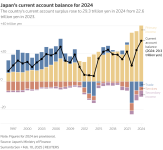
Japan is the opposite of us. They have a trade deficit but one of the largest current account surpluses in the world, because they have a lot of companies manufacturing overseas which earns primary income for Japan.

https://www.reuters.com/markets/asi...s-2024-foreign-investment-returns-2025-02-10/

1739529250819.png

@Yellow is Okay
 
Singapore's trade surplus in 2024 is around SGD257bil. Current account surplus is SGD128bil.


I think looking at current account balance rather than trade balance is more meaningful.

A large portion of Southeast Asia's (including Singapore's) exports are contributed by foreign MNCs because we do not have many strong indigenous companies competing in the global market. The profits from export earnings are thus accrued to foreign companies.

Japan is the opposite of us. They have a trade deficit but one of the largest current account surpluses in the world, because they have a lot of companies manufacturing overseas which earns primary income for Japan.

https://www.reuters.com/markets/asi...s-2024-foreign-investment-returns-2025-02-10/

View attachment 100822

@Yellow is Okay

Thanks for the data, I will update later
 
Singapore's trade surplus in 2024 is around SGD257bil. Current account surplus is SGD128bil.


I think looking at current account balance rather than trade balance is more meaningful.

A large portion of Southeast Asia's (including Singapore's) exports are contributed by foreign MNCs because we do not have many strong indigenous companies competing in the global market. The profits from export earnings are thus accrued to foreign companies.

Japan is the opposite of us. They have a trade deficit but one of the largest current account surpluses in the world, because they have a lot of companies manufacturing overseas which earns primary income for Japan.

https://www.reuters.com/markets/asi...s-2024-foreign-investment-returns-2025-02-10/

View attachment 100822

@Yellow is Okay
I've always said Vietnam has been running on the illusion of trade surpluses and booming exports for way too long. But when you break it down, it's not Vietnam that's truly winning. It's the Koreans, the Chinese, and other foreign players who are raking in the real profits. Now, with Trump pushing to cut the US trade deficit, Vietnam might take the hit, but the ones actually benefiting the most from those surpluses aren't even us.
 
Singapore defense budget for 2025 is 23 billion USD, 12 % increase from last year, this basically three times larger than Indonesian defense budget for 2025 where the figure is lower than in 2024 at 8 billion USD.

To view this content we will need your consent to set third party cookies.
For more detailed information, see our cookies page.
 
Singapore defense budget for 2025 is 23 billion USD, 12 % increase from last year, this basically three times larger than Indonesian defense budget for 2025 where the figure is lower than in 2024 at 8 billion USD.

To view this content we will need your consent to set third party cookies.
For more detailed information, see our cookies page.


It's SGD23bil, or around USD17bil. But yeah, weapons and ammunitions are expensive. Even a large country like Russia has difficulty sustaining firepower for a prolonged period of time.
 
To view this content we will need your consent to set third party cookies.
For more detailed information, see our cookies page.


Vivian Balakrishnan on global uncertainty and implications for Singapore | Part 1​

 
Updated ASEAN 6 Trade Balance (Merchandise/Goods)

Trade Surplus in 2024 (Only ASEAN 6 countries and those who release the data) - I will add more countries as data comes up, some countries havent release their full year trade data including Malaysia

1. Singapore trade surplus in 2024 : 148 billion USD
2. Indonesia trade surplus in 2024 : 31 billion USD
3. Malaysia trade surplus in 2024 : 30 billion USD
4. Vietnam trade surplus in 2024 : 24.77 billion USD
5. Thailand trade deficit in 2024 : 6.3 billion USD ( trade balance : - 6.3 billion USD )
6. Philippine trade deficit in 2024 : 54.2 billion USD
 
To view this content we will need your consent to set third party cookies.
For more detailed information, see our cookies page.
 
To view this content we will need your consent to set third party cookies.
For more detailed information, see our cookies page.


Johor's Rise as ASEAN’s Data Center Capital (2025) - Data Centers Development Update​


To view this content we will need your consent to set third party cookies.
For more detailed information, see our cookies page.


Johor Bahru 2025: Latest Urban Megaprojects & What’s Coming Next!​

 
IMF cuts real GDP growth forecast for Malaysia to 4.1% in 2025


By Bernama / Bernama

To view this content we will need your consent to set third party cookies.
For more detailed information, see our cookies page.


KUALA LUMPUR (April 23): The International Monetary Fund (IMF) has downgraded its real gross domestic product (GDP) growth forecast for Malaysia to 4.1% this year, from its January estimate of 4.7%, in line with a broader reduction in regional projections.

In its April 2025 World Economic Outlook, titled "A Critical Juncture amid Policy Shifts", the IMF also forecast Malaysia’s real GDP to expand by 3.8% in 2026.

The IMF trimmed its global growth projection for 2025 to 2.8%, down 0.5 percentage point from the January forecast.

Among Malaysia’s regional peers, the IMF cut Indonesia’s 2025 growth outlook to 4.7% from 5.1%. The Philippines is now expected to grow by 5.5%, compared with 6.1% earlier, while Thailand’s growth forecast was revised down to 1.8% from 2.9%.

The fund said major policy shifts are reshaping the global trade landscape and reigniting uncertainty, once again testing the global economy’s resilience.

“Since February, the US has announced multiple waves of tariffs against trading partners, some of which have invoked countermeasures.

“Markets initially took the announcements mostly in stride, until the US’ near-universal application of tariffs on April 2, which triggered historic drops in major equity indices and spikes in bond yields, followed by a partial recovery after the pause and additional carve-outs announced on and after April 9,” it said.

The IMF reiterated that the global economy is at a critical juncture, with signs of stabilisation emerging through much of 2024, after a prolonged and challenging period of unprecedented shocks.

“Inflation, down from multi-decade highs, followed a gradual though bumpy decline towards central bank targets. Labour markets normalised, with unemployment and vacancy rates returning to pre-pandemic levels,” it added.

On productivity, the IMF noted widening discrepancies, as manufacturing activity continues shifting from advanced economies to emerging markets.

Industrial production plunged in all countries at the onset of the pandemic. The recovery paths, however, have been decisively different.

Production has soared in China, and has also expanded in smaller European Union (EU) economies and the Asean-5 (Indonesia, Malaysia, the Philippines, Singapore, Thailand), whereas it has struggled to return to pre-pandemic levels in Japan and the largest EU countries, the IMF added.

Meanwhile, the IMF said industrial production in the US had rebounded more strongly than in other advanced economies.

On commodities, the IMF projected fuel prices to fall by 7.9% in 2025, led by a 15.5% drop in oil prices, and a 15.8% fall in coal prices. These declines are expected to be partially offset by a 22.8% rise in natural gas prices, driven by colder-than-expected weather, and the cessation of Russian gas flows to Europe via Ukraine since January.

Non-fuel commodity prices are forecast to increase by 4.4% in 2025.


Japan Pushes Back: A Turning Point in US Trade Relations​


The Jakarta Globe

April 24, 2025 | 11:55 am

1745473041170.webp
This photo shows vehicles bound for foreign countries at a logistics center in Kawasaki near Tokyo, Thursday, March 27, 2025. (Michi Ono/Kyodo News via AP)

Japan found itself at the target of President Donald Trump’s aggressive trade offensive, facing a 25% tariff on imported vehicles, a 24% levy on a range of other goods, and a sweeping 10% universal baseline tariff on all imports. In a notable shift in tone, however, Trump simultaneously declared a 90-day moratorium on new tariffs for around 70 countries, signaling the start of a high-stakes period of tariff negotiations.


The Japanese government expressed its discontent with these measures, with Prime Minister Shigeru Ishiba describing them as "extremely disappointing and regrettable". In a striking and impassioned speech to Japan’s House of Representatives, opposition lawmaker Shinji Oguma criticized Trump’s tariff aggression, labeling it “extortionist”. The speech, which has gone viral globally, reflects growing anxiety in Tokyo over the future of US-Japan economic relations. Oguma’s central charge: Trump’s approach to tariffs and bilateral trade was not just transactional, but coercive, and Japan, he warned, must not fall victim to what he termed “US extortion.”


Oguma’s recent remarks strike at the heart of that discomfort. He accused the US of threatening Japan’s economic autonomy by forcing one-sided negotiations and failing to treat its longstanding ally as an equal partner. Using fiery rhetoric, he warned that Trump's trade ideology -- “America First” at all costs -- risked unraveling decades of trust and interdependence.


The US-Japan economic partnership is one of the most prevailing and strategically significant in the postwar world. But it has never been without friction. Oguma’s speech is not a sudden outburst; it is the culmination of decades of US economic and political pressures on Japan, and policy divergence, a boiling-over of Japanese frustration, catalyzed by the Trump administration’s unjustified use of tariffs.

The data clearly illustrate the long-standing economic relationship and how Trump has threatened it in an instant.


In trade in goods, Japan has long maintained a trade surplus with the US, a trend that dates back to the late 1960s. In 2024, Japan exported $148.2 billion in goods to the US, with automobiles, vehicle parts, machinery, electronics, and agricultural products accounting for a significant portion. In contrast, US exports to Japan amounted to only $80.2 billion, driven by key products such as aircraft, machinery, semiconductors, pharmaceuticals, automotive parts, and agricultural goods. This disparity results in a bilateral trade deficit of $60 billion for the United States in goods, a persistent figure that continues to attract scrutiny from American policymakers.


Yet this headline figure ignores the full picture.


In trade in services, the United States holds a clear advantage. Since the 1980s, the US has maintained a trade surplus in services with Japan, as Japan’s economy evolved and services trade expanded. In 2024, the US exported $47.1 billion in services to Japan, including finance, insurance, professional services, intellectual property, and business services, resulting in a trade surplus of $15.9 billion. These figures surpassed Japan’s $31.2 billion in services exports to the US in the same year, with Japan’s exports primarily consisting of shipping, logistics, finance, and intellectual property licensing. Travel, education, and transportation services also heavily favor the US.


Investment has long been a pillar of Japan and the US economic engagement. In 2023, the United States received approximately $783.3 billion in foreign direct investment (FDI) from Japan, making it the largest foreign investor in the US. The manufacturing sector was the primary recipient of this investment, totaling $375.7 billion, with Japanese companies significantly contributing to US employment, particularly in manufacturing. Japanese companies like Toyota, Honda, Subaru, and Daikin operate dozens of plants across the US and have spent decades investing in American communities. Moreover, Japanese investors also invested in infrastructure in the US, including high-speed rail and renewable energy projects. Japan has also become a vital partner in the US tech ecosystem. Lately, SoftBank has committed to invest in US artificial intelligence infrastructure. Likewise, in 2024, Microsoft announced a $2.9 billion investment in Japanese AI infrastructure, with plans to open two new data centers and launch major talent exchange programs between Seattle and Tokyo.


Oguma’s speech channels this broader strategic pivot. His appeal for Japan -- and by extension, other countries -- to stand up against American “extortionists” is a call for Tokyo to craft a more independent, balanced, and sovereign economic strategy, one that builds resilience not by retreating from globalization, but by diversifying its partnerships.


To move forward, Japan must double down on regional integration. In addition to strengthening its commitment to the Regional Comprehensive Economic Partnership (RCEP), the world’s largest free trade agreement, Japan should continue to deepen its ties with ASEAN and other East Asian nations. The bilateral Japan-ASEAN Comprehensive Economic Partnership (CEPA) offers a platform for Japan to optimize its economic engagement with Southeast Asia, particularly Indonesia, one of the region’s fastest-growing economies. By leveraging both RCEP and CEPA, along with its strategic partnership with Indonesia, Japan can not only bolster its trade relations within the region but also buffer itself from the volatility of US policy shifts, thereby recalibrating toward growing regional demand.


Japan and its East Asian neighbors should strengthen intra-regional trade and investment flows. In 2000, intra–East Asian trade accounted for roughly 45% of the region’s total trade; by 2023, this figure had inched up to around 53%, still far below the level of intra-EU trade that is around 67%. There is enormous room for growth, particularly through supply chain integration, digital connectivity, and green infrastructure financing. Investments in ASEAN, Korea, and China can generate spillovers that benefit Japan’s industrial base and innovation ecosystem.


Shinji Oguma’s speech should not be interpreted as anti-Americanism, but rather as a strong reminder that even the closest allies deserve fair treatment. Oguma's stance reflects a broader concern, not only for Japan but for the global economy, regarding the implications of Trump’s short-sighted unilateral trade policies. It underscores the importance of upholding the multilateral trading system and maintaining equitable international trade relations.


The relationship between the US and Japan, as well as with the broader international community and the global economy, is far too vital to be reduced to the narrow focus of tariffs and trade deficits.


It must be anchored in a long-term vision of shared prosperity, mutual respect, and collective dignity.


----


The views expressed in this article are those of the editorial board of The Jakarta Globe.
 

Users who are viewing this thread

Pakistan Defence Latest

Latest Posts

Back
Top