APKWS And Pantsir-S1s: Saudi Arabia Acquiring More Cost-Effective Defenses Against Drones
By
Paul Iddon,
Senior Contributor.
Paul Iddon is a freelance journalist focused on Middle East affairs.
Apr 01, 2025, 04:40pm EDT
A Pantsir self-propelled surface-to-air and anti-aircraft missile system during the 'Peace Mission ... More
China News Service via Getty Images
Saudi Arabia’s recent military acquisitions suggest that the kingdom is building more cost-effective air defenses against drones and other relatively cheap munitions, a completely understandable move given Riyadh’s experiences against the Houthis in Yemen during the 2015-22 war.
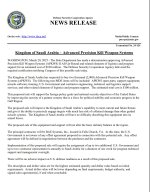
A March 20, 2025, State Department Defense Security Cooperation Agency
press release revealed that Saudi Arabia has requested 2,000 Advanced Precision Kill Weapon Systems II for an estimated $100 million.
The DSCA release came a mere day after the official X account of U.S. Central Command, CENTCOM,
published a video showing a U.S. fighter aircraft shooting down a Houthi drone with an APKWS. Given Saudi Arabia’s recent experience fending off drones from the same group using far more expensive systems, its interest in the comparably inexpensive APKWS is hardly surprising.
After launching its Decisive Storm air campaign against the Houthis in March 2015, Riyadh became embroiled in a conflict that would last until a ceasefire in March 2022. Later in that war, the Houthis repeatedly fired ballistic missiles and drones into the kingdom. Saudi Arabia relied heavily on its MIM-104 Patriot air defenses against the missiles and F-15 fighter jets firing expensive AIM-120 air-to-air missiles at incoming drones.
As a result, Riyadh found itself expending air-to-air missiles worth millions, carried by high-performance jets that cost
thousands per hour to fly, to shoot down drones that cost tens of thousands at most to build.
Saudi Arabia moved to replenish these expensive missiles,
requesting 280 AIM-120C-7/C-8 Advanced Medium Range Air-to-Air Missiles for $650 million in late 2021 and
300 MIM-104E GEM-T missiles for $3.05 billion in mid-2022.
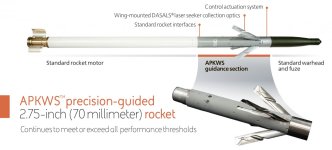
With a laser guidance kit, the APKWS converts low-tech 70mm unguided rockets,
primarily Hydra Mk 66s, into precision-guided munitions. The APKWS can hit targets in the air and on the ground and is compatible with everything from fighter jets and helicopters to
Humvees and pickup trucks. The Ukrainians have used the ground-launched APKWS against incoming Russian drones.
The CENTCOM video confirms the system is combat-tested against the exact type of drones that Saudi Arabia had no cost-effective way of intercepting a mere few years ago. That now looks set to change. And at $100 million for 2,000, Riyadh can well afford to expend laser-guided APKWS rockets at a much higher rate than its AIM-120 AMRAAMs should it face similar asymmetrical threats in the future.
It appears the APKWS isn’t the only more cost-effective system Saudi Arabia has sought to bolster its defenses against drone threats.
According to reports by
the Kyiv Independent and the
Organized Crime and Corruption Reporting Project published in January 2025, Riyadh has also reached a deal to acquire the Pantsir-S1 medium-range air defense system from Moscow. Evidence of that hitherto undisclosed deal was discovered in leaked internal emails from Ruselectronics, a subsidiary of Russia’s state-owned defense conglomerate Rostec, that the investigative journalists examined.
According to these reports, Saudi Arabia ordered 39 Pantsir-S1s in April 2021 when it was still enduring Houthi drone and missile attacks. The February 2022 Russian invasion of Ukraine doesn’t appear to have canceled the contract, which was expected to last from its signing in 2021 until some time in 2026.
The Stockholm International Peace Research Institute’s enormous arms transfer database lists the 39 Pantsir systems and 900 57-E6 surface-to-air missiles. Incidentally, the only other transfer from Russia to Saudi Arabia on that exhaustive database is 10 TOS-1 multiple rocket launchers ordered in 2017. That’s not because Russia was disinterested in selling the oil-rich kingdom its military hardware. On the contrary, Moscow had previously
sought to sell Riyadh T-90 main battle tanks and BMP-3s in 2008 and also
pushed it to buy its strategic S-400 Triumf air defense system in the late 2010s.
Riyadh’s reported interest in the Pantsir-S1 was likely due to its capabilities as a point defense system against threats such as drones. Its 57-E6 missiles and anti-aircraft artillery are arguably ideal for threats like Houthi drones and cruise missiles. During the long war with the Houthis, Saudi oil infrastructure was targeted, most notably in the September 14, 2019, Abqaiq-Khurais drone attack, which briefly cut Saudi oil production by half and undoubtedly unnerved the kingdom’s leadership. Pantsir-S1s deployed at such sensitive sites could provide Riyadh with an additional defensive layer against future attacks of that kind. And with 39 systems reportedly being delivered, they could cover a significant number of critical infrastructure and strategic sites throughout the country.
As with the APKWS, the Pantsir-S1 is a much more cost-effective solution for asymmetrical threats such as militia drone strikes than other high-end air defense systems in Riyadh’s arsenal. According to those leaked emails reviewed by the Kyiv Post and OCCRP, Saudi Arabia had agreed to pay over 2 billion euros, $2.158 billion, for the systems and related services. That’s a lower overall price tag than those 300 Patriot interceptors it ordered to replenish its dwindling stocks in 2022, an experience the kingdom doubtlessly wants to avoid repeating.
As
with its neighbor, the United Arab Emirates, which acquired the Pantsir-S1 over a decade ago, Saudi Arabia is gradually
building a diverse, multi-layered air defense. In addition to its Patriots, it has the even more advanced Terminal High Altitude Area Defense anti-ballistic missile systems on order, expecting completed delivery and deployment by 2028. Riyadh has also ordered medium-range KM-SAM Block II systems from South Korea.
These are among the best air defense missile systems available on the market today. And with Pantsir-S1s covering the lower tier of Saudi air defense against drone threats, potential gaps or blindspots that could make another asymmetrical attack like Abqaiq-Khurais possible should at least be partially plugged or covered. The Russian-made systems may even end up serving as the last line of defense for certain strategic sites and infrastructure across the vast desert kingdom.
With systems like the Pantsir-S1 and APKWS at its disposal, Saudi Arabia will be better positioned to counter aerial asymmetrical threats while preserving its more advanced interceptors and systems for other more dangerous threats it might one day face.
Follow me on
Twitter.
As with the APKWS, the Pantsir-S1 is a much more cost-effective solution for asymmetrical threats than other high-end air defense systems in Riyadh’s arsenal.

www.forbes.com
In other words, by every measure, KSA has now one of the best, most effective, most proven and cheapest air defenses in the world. Add the other purchases (not mentioned by this informative article) and the ongoing and future local developments and solutions.
No air defenses, let alone combined ones, are completely fool-proof, let alone when talking about one of the largest countries on earth and the largest in the region by far (KSA) but I would not make any trades with anyone in the region in this regard.


en.wikipedia.org