Stunning photos reveal China’s futuristic J-XDS fighter jet
On
Apr 5, 2025
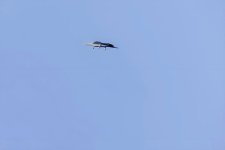
On April 5, 2025, a series of striking images surfaced online, igniting widespread curiosity and debate across the United States and beyond. These photographs, circulating on social media platforms like X, showcased a sleek, futuristic Chinese aircraft labeled the J-XDS, which some claim to be a sixth-generation fighter jet.
Photo credit: X
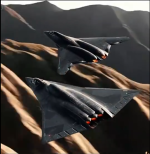
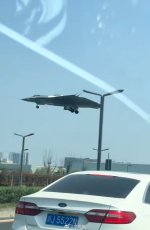
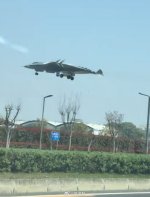
The images, revealing a tailless design with a distinctive lambda wing, movable wingtips, and advanced aerodynamic features, emerged from China, a nation typically shrouded in secrecy regarding its military advancements. For Americans keeping an eye on global military developments, the question quickly arose: what does this mean?
The timing of these leaks, the aircraft’s bold design, and the potential implications for U.S. air superiority have turned this into more than just another aviation story—it’s a window into China’s ambitions and a challenge to the world’s understanding of the next frontier in aerial warfare.
The photographs didn’t appear out of nowhere. They surfaced on platforms frequented by military enthusiasts and analysts, offering a rare glimpse into a program China has kept under wraps.
Unlike previous instances where blurry or distant shots left much to the imagination, these images were crisp, highlighting details like the aircraft’s diverters’ supersonic inlets [DSI] and a ventral groove running along its centerline.
The J-XDS, if the designation holds, appears to be a product of China’s relentless push to close the technological gap with the United States, which has long dominated the skies with fifth-generation fighters like the F-22 Raptor and F-35 Lightning II.
But why now? China’s military isn’t known for accidental leaks. The People’s Liberation Army Air Force [PLAAF] operates with a level of opacity that makes such clear visuals unusual, prompting speculation that this could be a deliberate move by Beijing to signal its growing prowess to the world.
The strategic context behind this apparent leak offers a compelling angle. China’s military modernization has accelerated in recent years, driven by a desire to assert dominance in the Indo-Pacific region and counter U.S. influence.
The timing aligns with heightened tensions in the South China Sea, where American naval and air forces frequently conduct freedom-of-navigation operations, and where allies like Japan and Australia have bolstered their own defenses.
By allowing these images to surface, China might be sending a message—not just to Washington, but to its regional neighbors and even its own citizens—that it’s ready to compete at the cutting edge of military technology. Analysts have noted that such displays can serve multiple purposes: projecting confidence to domestic audiences, deterring adversaries, or even distracting from other, less visible projects.
To understand the J-XDS itself, it’s worth diving into what the images reveal about its design. The aircraft features a tailless configuration, a departure from traditional fighter jet layouts that rely on vertical stabilizers for control. Instead, it sports a lambda-shaped wing—a broad, swept-back design that tapers sharply at the tips.
These wingtips appear articulated, and capable of moving independently, which could enhance maneuverability or stability at high speeds. The twin DSI inlets, positioned on either side of the fuselage, are a modern touch, eliminating the need for mechanical diverters to manage airflow into the engines, a feature seen on China’s J-20 stealth fighter.
The long, pointed nose and the ventral groove suggest a focus on reducing radar cross-section, a hallmark of stealth technology. While exact specifications like speed, range, or armament remain unknown, the design hints at a platform built for agility, stealth, and possibly integration with advanced systems beyond what current fifth-generation jets can offer.
What sets the J-XDS apart isn’t just its looks—it’s the questions it raises about China’s technological leap forward. Most discussions of sixth-generation fighters center on capabilities like artificial intelligence, directed-energy weapons, or seamless coordination with unmanned drones.
The movable wingtips and ventral groove could point to something more than aerodynamic flair. Some experts speculate these features might tie into real-time flight control adjustments driven by AI, allowing the aircraft to adapt instantly to combat conditions. Others wonder if the J-XDS is designed to operate as a command node in a networked battlefield, directing swarms of drones or sharing data with other assets.
While these ideas remain unconfirmed, they align with trends in next-generation aviation, where the U.S. Air Force’s Next Generation Air Dominance [NGAD] program is exploring similar concepts. The difference is that China has now put a tangible image to the idea, while NGAD remains largely conceptual in the public eye.
Looking back at China’s track record offers valuable perspective. The J-20, introduced in 2017, marked China’s entry into the stealth fighter club, but it took years of refinement before it became fully operational. Early prototypes dazzled onlookers at airshows, yet analysts like those at The National Interest pointed out that its engines lagged behind Western counterparts, limiting its performance.
The J-31, another stealth project, followed a similar path—impressive unveilings followed by a slow march to deployment. This pattern suggests the J-XDS might be in its infancy, a prototype meant to showcase potential rather than a jet ready for combat.
Historically, China has used such reveals to test reactions, refine designs, and build momentum for production. The J-20, for instance, evolved from a demonstrator in 2011 to a mainstay of the PLAAF by the early 2020s, a timeline that could hint at the J-XDS’s future if it follows suit.
Comparisons to U.S. and global counterparts provide further context. The F-22, operational since 2005, redefined air superiority with its stealth and supercruise capabilities, boasting a top speed exceeding Mach 2 and a combat radius of about 600 miles.
The F-35, with over 1,000 units delivered worldwide, excels in versatility and sensor fusion, though its stealth comes at the cost of agility compared to the Raptor. Russia’s Su-57, a fifth-generation contender, entered service in 2020 but has faced production delays and lacks the F-22’s stealth refinement. China’s J-20, meanwhile, blends stealth with a larger airframe, potentially prioritizing range and payload over dogfighting prowess.
The J-XDS, with its tailless design and advanced features, seems poised to leap beyond these, possibly rivaling the U.S.’s NGAD or Europe’s Future Combat Air System [FCAS], both of which aim to integrate manned jets with drones and AI by the 2030s. Without hard data, it’s impossible to say how it stacks up, but the visual alone suggests China isn’t content to play catch-up.
The global reaction to these images extends far beyond the Pentagon’s walls. Japan, with its own F-X sixth-generation program underway in collaboration with the UK and Italy, likely sees the J-XDS as a direct challenge.
Tokyo’s proximity to China and its reliance on U.S. security guarantees make any PLAAF advancement a pressing concern. South Korea, developing the KF-21 Boramae, might accelerate its efforts to counterbalance China’s growing air power. India, locked in border disputes with China, could view this as another reason to bolster its indigenous Tejas program or deepen ties with Western suppliers.
Australia, a key U.S. ally in the Pacific, has already committed to acquiring F-35s and loyal wingman drones, but the J-XDS might prompt a reassessment of its long-term strategy. Each nation’s response will hinge on how seriously it takes China’s latest move—and whether it believes the J-XDS is more than a flashy prototype.
Back in the U.S., the Pentagon has remained tight-lipped, though it’s hard to imagine this hasn’t sparked internal discussions. Just weeks ago, on March 21, 2025, President Donald Trump announced Boeing’s selection to build the F-47, the manned centerpiece of the NGAD program, touting it as a jet that “our enemies will never see coming”.
The timing of China’s leak, coming so soon after, feels like a riposte—a reminder that the race for air dominance is far from won. The F-47, like the J-XDS, remains shrouded in secrecy, but its development reflects America’s push to maintain an edge, integrating drones and advanced sensors into a
“family of systems.” China’s reveal could pressure U.S. lawmakers and defense planners to expedite NGAD, especially as budget debates loom over its estimated $300 million-per-unit cost.
Yet, a healthy dose of skepticism is warranted. High-quality images don’t guarantee a functional aircraft. The clarity of these photos raises the possibility of manipulation—could they be digitally enhanced or staged to exaggerate China’s progress? Past leaks, like those of the J-36 in December 2024, sparked similar excitement only to reveal early-stage prototypes still years from deployment.
The J-XDS might follow suit, a testbed meant to impress rather than fight. Alternatively, China could be playing a longer game, showcasing this design to mask advancements in another, less visible program. Without flight footage or official confirmation, the line between reality and propaganda blurs, leaving observers to wonder how much of this is theater.
The broader implications of the J-XDS extend beyond its wings. If it represents a genuine step toward sixth-generation capability, it could reshape power dynamics in the Indo-Pacific, where air superiority remains a cornerstone of U.S. strategy.
China’s ability to field such a jet by the 2030s would challenge American dominance, forcing allies to rethink their reliance on U.S. protection. At home, it might fuel debates over defense spending, with critics like Elon Musk arguing that manned fighters are obsolete compared to drones.
For the average American, the stakes might feel distant, but the ripple effects—higher military budgets, shifting alliances, or even future conflicts—could hit closer to home than expected.
In the end, the J-XDS is more than a plane—it’s a puzzle. China’s decision to let these images slip, whether intentional or not, has pulled back the curtain just enough to spark intrigue without revealing the full picture. The design suggests ambition, the timing implies intent, and the reactions hint at unease. Yet, until more evidence emerges, it’s a story of potential rather than certainty.
For now, the U.S. and its allies must weigh what they’ve seen against what they don’t know, balancing vigilance with the possibility that this is just another chapter in China’s long game. Is the J-XDS a game-changer, or a mirage meant to keep the world guessing? Only time—and perhaps Beijing—will tell.