r3alist
Elite Member


who's to say ..
we'll cross that bridge when we get to it, I suppose.
I mean I am wondering basically the Christians of India today went through that process at some point?from a few generations
Follow along with the video below to see how to install our site as a web app on your home screen.
Note: This feature may not be available in some browsers.
who's to say ..
we'll cross that bridge when we get to it, I suppose.

Very big country, this one.I mean I am wondering basically the Christians of India today went through that process at some point?from a few generations
These guys are normally so nice and polite and good peopleThere's the OGs, 100+ year type, mostly down south, Goans, Keralites etc
This was surprising when I found outThen there's the new recruits, Punjabis/Sikh ones.. missionaries ka newest target.. crazy what's going on in Punjab, bro.. big topic, maybe a bit too spicy for these boards, but something is going on there.

Indian parliament's lower house passes controversial bill on Muslim properties
3 hours ago
Share
Save
Neyaz Farooquee
BBC News, Delhi
Getty Images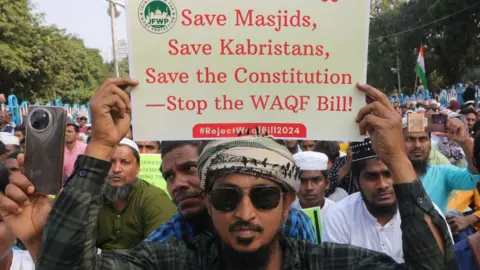
The government claims the bill brings transparency but critics see it as an infringement on the rights of Muslims
The lower house of India's parliament has passed a controversial bill that seeks to change how properties worth billions of dollars donated by Indian Muslims over centuries are governed.
The Waqf (Amendment) Bill, 2024 - which brings in dozens of amendments to an existing law - was passed late on Wednesday night after a heated debate that went on for over 12 hours.
The government says the bill will introduce transparency into the management of waqf, as the properties are called.
But opposition parties and Muslim groups have called it an attempt to weaken the constitutional rights of India's largest religious minority.
In the Lok Sabha, as the lower house is called, the bill was passed with 288 MPs voting in favour of it, and 232 against (the halfway mark is 272).
It has now been sent to the Rajya Sabha, or upper house, for discussion and passage.
If it is passed by the Rajya Sabha, it will be sent to President Droupadi Murmu for her assent before it becomes law.
The bill was first tabled in parliament in August last year but was sent to a joint parliamentary committee (JPC) after an outcry from opposition members. The version that has been passed incorporates several changes suggested by the sharply divided committee. Opposition members who were on the panel have alleged that the JPC accepted the changes suggested by the BJP and its allies while rejecting all amendments they proposed.
Mallikarjun Kharge, Congress MP and leader of the opposition in the Rajya Sabha, said the opposition was united and would work to defeat "the unconstitutional and divisive agenda of the Modi government on the Waqf Amendment Bill". But the numbers may not be in the opposition's favour.
Muslim groups have argued that the bill "aims to weaken the waqf laws and pave the way for the seizure and destruction of waqf properties".
Speaking in the Lok Sabha, Congress leader Gaurav Gogoi said the bill would "dilute the Constitution, defame minority communities, divide Indian society and disenfranchise minorities".
Federal Home Minister Amit Shah defended the bill, saying that the opposition was scaring minorities by creating "an illusion that this bill would interfere in the religious activities of Muslim brothers and in their donated property".
What is the bill about?
The waqf properties, which include mosques, madrassas, shelter homes and thousands of acres of land donated by Muslims, are managed by boards. Some of these properties are vacant while others have been encroached upon.
In Islamic tradition, a waqf is a charitable or religious donation made by Muslims for the benefit of the community. Such properties cannot be sold or used for any other purpose - which implies that waqf properties belong to God.
The government says that the waqf boards are among India's largest landholders. There are at least 872,351 waqf properties across India, spanning more than 940,000 acres, with an estimated value of 1.2 trillion rupees ($14.22bn; £11.26bn).
A major criticism from opponents of the bill is that it grants the government undue power to regulate the management of these endowments and determine whether a property qualifies as "waqf".
The bill also proposes the induction of two non-Muslim members on the waqf boards which oversee these properties. Critics have opposed this provision, arguing that most religious institutions run by non-Muslims do not permit followers of other faiths in their administration.
You'll get your share of not-so-nice ones there too.These guys are normally so nice and polite and good people
In punjab it's the sikh dalits converting. Nothing new about that, as the dalits have always been the main target of missionaries. It's just that punjab percentage wise has the largest share of Dalits of any state. 1/3 i think.Very big country, this one.
There's the OGs, 100+ year type, mostly down south, Goans, Keralites etc
Then there's the new recruits, Punjabis/Sikh ones.. missionaries ka newest target.. crazy what's going on in Punjab, bro.. big topic, maybe a bit too spicy for these boards, but something is going on there.
Dalits and jungle tribals ka bhi they been doing for a while.. Christies, Mulls, Commies.. sab lage huwe hain to bring em into their fold lol
India is the mother of all hot messes bhai.
If land was donated without proper paperwork does that count ?They own land donated by Muslims and manage it, the waqf is vital in that regard
It's vital Indian Muslims fight against the hindutva state to defend their history, their lands, their faith and culture against a enemy that tries to push a hindutva state
Indian Muslims must come together together to protect their history, land and culture

If land was donated without proper paperwork does that count ?
You should always follow a legal framework whatever it is, however it doesn't make it any less vital for the waqf to protect Muslim land and property if that property was left for the waqf to administer let's say pre partition when paperwork wasn't always completed
This isn't about the waqf,
What this is about is Hindus having a itch up their ass on why Indian Muslims have something
In this case the waqf and Muslim property is targeted
But at any moment they could jump on why urdu is being used in Bollywood as it's a Muslim language
Why Muslims are allowed to wear hijab
Or why can they have meat shops
It's ALWAYS SOMETHING, and Indian Muslims have to draw a line in the sand and stand their ground against a avowed enemy
The waqf has been very active of late and for good reason
The Indian muslims are on the move, they are moving from areas where they represent low percentage of populations and moving to areas where their are more Muslims
This is of course getting the sanghis bent out of shape again, because it's creating Muslim dominated areas
But Indian Muslims have. 250 million population, they need to make citadels and vast areas of Muslim domination where they can observe their faith, and culture and implement their way of life and if needs be have the numbers to protect their people
In this move Indian Muslims may lose 1 million people, to pressure especially in the villages where some are a very mixed up in their practices, but overall they will emerge with numbers in specific areas which will protect them
I'm beginning to seriously think that you might just be clinically insane, and suffering from proper pathological obsession.The Indian muslims are on the move, they are moving from areas where they represent low percentage of populations and moving to areas where their are more Muslims
This is of course getting the sanghis bent out of shape again, because it's creating Muslim dominated areas
But Indian Muslims have. 250 million population, they need to make citadels and vast areas of Muslim domination where they can observe their faith, and culture and implement their way of life and if needs be have the numbers to protect their people

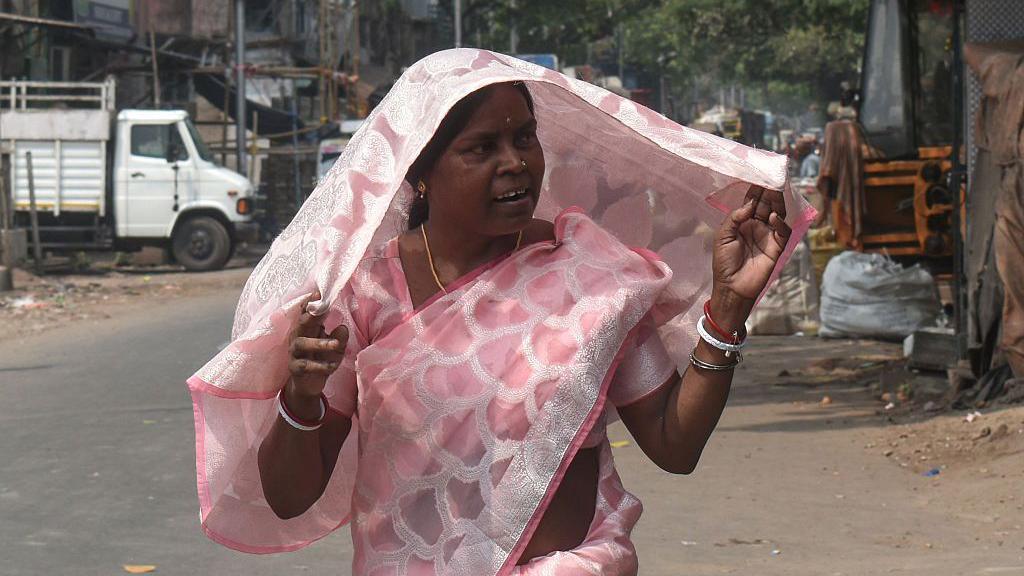
Not only in North India but in Mumbai also its very hot....Image source,Getty Images
Image caption,
The weather department has issued a heatwave alert until Wednesday
Nikita Yadav
BBC News, Delhi
India's weather department has warned of high temperatures in parts of northern India, including capital Delhi, for this week.
- Published
3 hours ago
The Indian Meteorological Department (IMD) has said northern and central states - including Haryana, Punjab, Rajasthan and Gujarat - can expect maximum temperatures to cross 40C.
It has issued a yellow alert which means that the heat is tolerable for the general public but can cause moderate health concerns for infants, the elderly and people with chronic diseases.
Northern India usually sees heatwaves between April and June, but in recent years, global warming and climate change have caused extreme temperatures to arrive earlier and last longer.
According to the IMD forecast, the highest temperature in Delhi is expected to hit 41C on Monday afternoon.
People have been advised to avoid heat exposure, wear lightweight and breathable cotton clothing and cover their heads with a cloth or umbrella outdoors.
The capital recorded a maximum temperature of 38.2C on Sunday.
Last week, IMD chief Mrutyunjay Mohapatra said most parts of India would experience an intense heatwave this summer, with above-normal temperatures expected across most of the country.
States like Uttar Pradesh, Jharkhand, Chhattisgarh and Odisha could see as many as 10 to 11 heatwave days, Mr Mohapatra said.
"From April to June, most parts of north and east India, central India and the plains of north-west are expected to experience two-to-four more heatwave days than normal," he added.
Heatwaves usually start occurring in northern India from the end of April, but we are seeing that their occurrence has recently been exacerbated by climate change, says Mahesh Palawat, vice president of meteorology and climate change at weather forecasting company Skymet.
"We go straight from winter to summer; the spring season in northern India is shrinking," he said.
"In the coming days, we will see wind speeds slowing down with clear skies. This naturally leads to a rise in temperature," Mr Palawat added.
Last year, India recorded its hottest day ever at 50.5C in Rajasthan state. More than 40,000 suspected cases of heatstroke were also reported.
One weather station in Delhi in May recorded a maximum temperature of 52.9C, although the government later said it was due to a sensor error and revised it down, external by 3C.
Nearly 150 people died due to the heatwave in 2024, according to official data but independent researchers said the toll was much higher.


