China hits back at Canada with fresh agriculture tariffs

I don't understand the securities industry and related economics. According to industry insiders:

Yesterday, Japanese hedge funds were the first to fail to withstand the pressure and were forced to sell a large number of US Treasury bonds, causing a huge change in US Treasury bond prices.

I just woke up today and saw the latest news about Trump...

If China also starts to sell a large number of US Treasury bonds, what can Trump do to save the United States?
the value of dollar is based on trust.
nothing else
people believe the dollar has a value.

if people don’t trust the dollar then the US is finished.
since Trump starts global tariffs war the US stocks lost more than 12 trillion USD.
but that loss was not enough to make Trump change his mind.

but yesterday when banks, investors in Europe, Asia began to sell off US gov bonds, Trump got heart attack. his neocons are panicking.

if China sells off US bonds, depending how the US central bank responds, the consequences could be severe for the dollar.
 
That's why after 70% esp like 100%, doesn't make sense anymore, two countries effectively will be decoupled.
It depends on how the Chinese top leaders want to play this game.

1. If they want to play slowly, they will retaliate in kind. China will raise its tariffs by the same amount as the US raises! The two numbers remain the same and rise synchronously.
2. If they want to further anger Trump, they can fight back with a very humiliating number. For example, China can raise its tariffs on the US to 99999999%. It has no practical significance, but it is very humiliating.
3. If they don't want to play child's games with Trump, they can directly announce a complete termination of China-US trade. Game Over !

I guess they will use the first way.
 

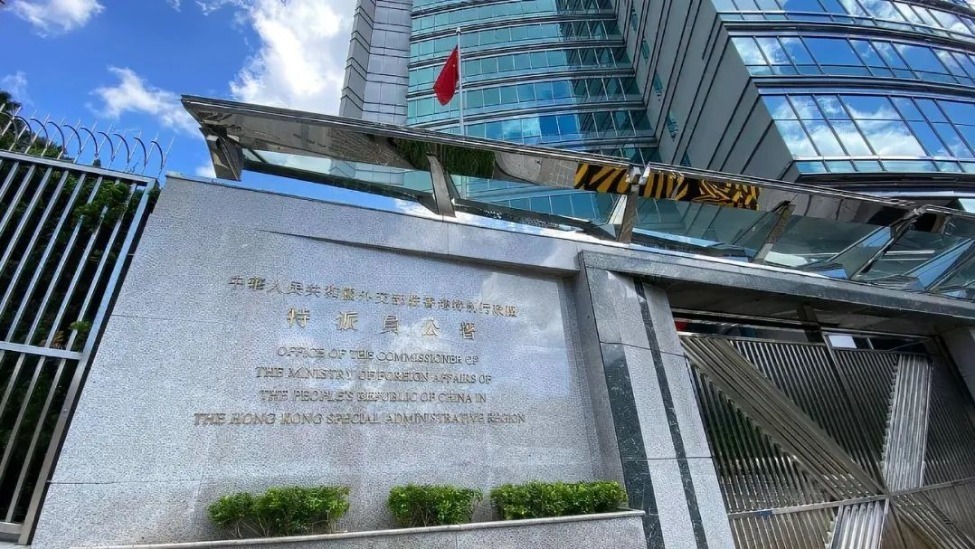
The Hong Kong Office of the Ministry of Foreign Affairs warns: Barbarians who force countries around the world to call and admit defeat should never expect to receive a call from China​

Commissioner's Office of the Ministry of Foreign Affairs in Hong Kong
April 10, 2025 12:39:46


On April 9, a spokesperson for the Commissioner's Office of the Ministry of Foreign Affairs in Hong Kong wrote to the South China Morning Post, clarifying China's solemn position on the US's imposition of serious and unreasonable tariffs on China. The letter was published in the South China Morning Post and on its website on April 10. The full text is as follows:

Facing economic bullying, China will fight to the end

In response to your newspaper's recent report that the United States has imposed tariffs of up to 104% on China, I would like to once again express the Chinese government's solemn position. The United States, in disregard of widespread opposition from the international community, has imposed so-called "reciprocal tariffs" on all its trading partners under ridiculous pretexts. This is a typical example of unilateralism, protectionism, and economic bullying. It seriously infringes upon the legitimate rights and interests of all countries, seriously damages the rules-based multilateral trading system, and has a serious impact on the global economic order. The US has even brazenly imposed tariffs of up to 104% on China. This is blatant intimidation and blackmail, and China will never accept it. This move by the US will not make America great again but will only turn America into a barbarian in the 21st century.

According to your newspaper, the US side claimed that "China wants to make a deal, but doesn't know how to start. We are waiting for their (China) call." The fact is that the US does not know how to start. It does not know how to get along with China, nor does it know the correct way to get along with other countries. Instead, it is obsessed with the "art" of bullying and blackmailing the whole world. We want to warn the US: The barbarians who are trying to use the tariff stick to force countries around the world to call and surrender should never expect to receive a call from China. In a phone call with US President-elect Trump in January this year, President Xi Jinping clearly pointed out that the essence of China-US economic and trade relations is mutual benefit and win-win results, and confrontation and conflict should not be our choice. The two sides should strengthen cooperation on the principles of mutual respect, peaceful coexistence and win-win cooperation. Unfortunately, the US did not listen to China's earnest advice. If the US is truly sincere in engaging in dialogue with China on the issue of tariffs, it should immediately correct its wrong practices and adopt an attitude of equality, respect and reciprocity. If the US insists on its own way, China will fight to the end!

We note that the unreasonable tariffs imposed by the United States also apply to Hong Kong. What I want to emphasize is that Hong Kong has the unique advantage of "backed by the motherland and connected to the world", and the sky will not fall. We firmly believe that with the firm support of the central government and the people of the motherland, Hong Kong is fully capable, confident and determined to respond properly. The Pearl of the Orient is not afraid of wind and rain and will shine even brighter!


Last edited:
Like minorities being mass murdered in some country that is going on everyday now.
mass reform camps is a better idea.. someday you should share learnings on how to run concentration camps ..
 
will be the case.
the world is not big enough for 2 elephants.
The problem with America is, white Americans want their own country or race to stay on top at the expense of the prosperity of all other countries, cultures and races... This is a zero-sum game they're playing, and it's not good for anyone. The Americans need to kindly move their 300 million warmongering populace to another habitable planet to leave the rest of us peaceful Earthlings alone... Right now, America under Trump is pursuing a very dark and divisive policy now that would end in catastrophic Global War.......
 
mass reform camps is a better idea.. someday you should share learnings on how to run concentration camps ..
Yeah, in some delusional and distorted minds.
 
they can protest because they are in America.. in some other countries, they would have been overun by Tanks
just pathetic to see indian still licking boots, stand on your own like a man, instead of doing ritual and praying inside:" He doesn't me, he doesn't see me", with this kind of mindset, you guys will never be a real power.
 
The problem with America is, white Americans want their own country or race to stay on top at the expense of the prosperity of all other countries, cultures and races... This is a zero-sum game they're playing, and it's not good for anyone. The Americans need to kindly move their 300 million warmongering populace to another habitable planet to leave the rest of us peaceful Earthlings alone... Right now, America under Trump is pursuing a very dark and divisive policy now that would end in catastrophic Global War.......
Much to do with human psyche. much to do with great powers Not particularly with certain races.

Americans are ok in general I lived and worked in Chicago for a while.

many americans however are religious. lots of them are religious fanatics. much like iran mullahs. they believe they are chosen people.
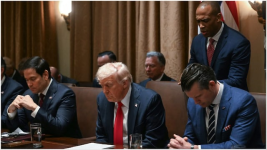
ever seen a Trump cabin meeting?
they begin with a prayer.
much like a club of nuts
they believe they are chosen to save the world from tyranny.

1744273886144.png
 
This new game is fun. I'm loving it.
 
just pathetic to see indian still licking boots, stand on your own like a man, instead of doing ritual and praying inside:" He doesn't me, he doesn't see me", with this kind of mindset, you guys will never be a real power.
please check grammar and composition before posting
 

National Film Bureau: Will moderately reduce the number of American film imports


CCTV News
2025-04-10 18:13:18 From Beijing

1385 people participated


In response to a recent reporter's inquiry as to whether the U.S. tariff increase on China would affect the import of American films, a spokesperson for the National Film Administration said that the U.S. government's wrong move of abusing tariffs on China would inevitably further reduce domestic audiences' favorability toward American films. We will follow market rules, respect audience choices, and moderately reduce the number of American films imported. China is the world's second largest film market. We always adhere to a high level of opening up to the outside world and will introduce excellent films from more countries in the world to meet market demand.


Faced with the uncertainty of the tariff storm, many foreign companies still choose to stay in mainland China


17:51 2025/04/10 China Times News
Lu Bohua


When faced with uncertainty such as high tariffs, people tend to choose to maintain the status quo, and in the manufacturing sector, China is the status quo. Pictured is a bearing factory in Shijiazhuang, Hebei, China. (Photo/Xinhua News Agency)

When faced with uncertainty such as high tariffs, people tend to choose to maintain the status quo, and in the manufacturing sector, "China is the status quo." Pictured is a bearing factory in Shijiazhuang, Hebei, China. (Photo/Xinhua News Agency)


Even as U.S. President Trump is imposing more tariffs on China, his approach of imposing tariffs on the vast majority of global businesses and the unpredictability of future actions have prompted many companies to decide to remain in China, which is exactly the opposite of what he expected. American businesses pointed out that when faced with the uncertainty of high US tariffs, people tend to choose to maintain the status quo, and in the manufacturing sector, "China is the status quo."


The New York Times reported that Trump's new tariffs on China have exceeded 100%, but unlike his first term, this time he also imposed high import tariffs on dozens of other countries, including some Asian countries. The move had the unintended effect of making China a more attractive place for production and sourcing. Because the widespread tariffs have eliminated the incentive for some companies to diversify their production and sourcing operations to Asian countries such as Vietnam and India.


The report pointed out that the chaos caused by Trump's tariff policy announcement last week has made many companies more cautious in adjusting their supply chains to avoid causing more turmoil. Faced with policy changes and uncertainties, the company chose to maintain the status quo: continue to maintain long-term cooperative relationships with suppliers or partners in mainland China.


"Right now, our strategy is to stay in China and protect our business there," said Travis, a bedding manufacturer. Luther said. He attended a conference of American entrepreneurs this week and said that like other business owners in attendance, he had not spent time looking for new partners or considering ways to move his business from China. Instead, he is working with business partners in China to find ways to reduce costs or develop new products. Cost advantage is only one of the reasons for choosing Chinese suppliers. Now cost is no longer the main reason. What attracts them is the sophisticated manufacturing process.


Although Trump wants to bring manufacturing back to the United States, this is a difficult goal to achieve. Even if tariffs weaken China's cost advantage, the manufacturing capabilities, production capacity and speed of most American factories cannot match those of China. When Trump launched the first phase of his trade war against China, many American companies and multinational corporations moved some of their production lines to other countries such as Southeast Asia. For most companies, moving production back to the United States is not a viable option because switching suppliers is a difficult, expensive, and time-consuming process. Unless companies are clear about where government policy is headed, they are reluctant to do so.


The report quoted an executive of an international foundry as saying that since the US decision seemed to be made arbitrarily, it was impossible to make any long-term decision to move business away from China based on it. American businesses investing in China said, "In order for the industry to respond, there must be policy certainty," and "the rules of the game seem to change every day, and we have no choice but to stay put."


The report said that a few years ago, many Chinese companies went to neighboring Asian countries or Mexico to open factories to alleviate tariff pressure. A research note from Japanese investment bank Nomura Securities noted that recent U.S. tariffs on about 60 countries have greatly weakened the incentive to move factories away from China. Therefore, while China still faces huge challenges from high tariffs, the United States' widespread imposition of tariffs has inadvertently maintained China's position in the global supply chain.


Sarah Massey of the U.S. Foreign Trade Consulting said that when countries face high tariffs, people tend to maintain the status quo, and in the manufacturing sector, "China is the status quo." "At least we knew what this supplier could offer us and we were happy with them before the tariffs hit, so there was no reason not to continue. Whether the original cost could be maintained, that's another matter."


The tariff war is tough against mainland China! CNN: Trump may not win


14:44 2025/04/10 China Times News
Xu Tingying


On the 9th, US President Trump announced a 90-day suspension of reciprocal tariffs on trading partners, except for increasing tariffs on mainland China to 125%. (Photo/Associated Press)

On the 9th, US President Trump announced a 90-day suspension of reciprocal tariffs on trading partners, except for increasing tariffs on mainland China to 125%. (Photo/Associated Press)

On the 9th, US President Trump announced a 90-day suspension of reciprocal tariffs on trading partners, except for increasing tariffs on mainland China to 125%. CNN analysis shows that the United States may not be able to win the trade war with Beijing.

As he retreats from a vast global tariff war, U.S. President Donald Trump is escalating the standoff with the only country that could potentially defeat the United States in a trade showdown. The standoff is an extension of years of U.S. efforts to address China’s trade abuses. It is also the culmination of a longer period of souring relations stemming from a radical nationalist turn by a Pacific competitor turned hostile power that now appears poised to challenge American power head-on.


China has sent a clear signal that it believes it can outlast Trump in this confrontation - after all, it has been preparing for years. It is unclear whether Trump and his top officials fully understand China's resilience or how deep the impact of China's trade war may be on American consumers.


If Trump mistakenly believes that the "good relationship with Xi Jinping" that he praises almost every day can make Beijing make quick concessions, he is wrong.


A U.S.-China trade deal similar to the one reached during Trump's first term but broken down during the pandemic now seems unlikely. Trade tensions are reaching a peak, with strong arrogance on display on both sides.


However, Trump's aggressive approach is unprecedented. He believes he has a unique and perhaps final opportunity to reshape the dynamic between the United States and China, with mainland China, as the U.S. Trade Representative's office puts it, "the world's largest trading nation." "We only have one chance," Trump told reporters in the Oval Office on Monday.


But his methods were impulsive and indiscriminate, lacking a clear strategy. Moreover, he lacks basic respect for the dignity and strength of mainland China, which has been a recurring theme in this administration's handling of international affairs.


The reason why Xi Jinping cannot back down is that major political, global and economic interests are involved. This iron-fisted Beijing leader has always portrayed himself as a historical promoter of the revival of Chinese civilization's "rightful place". Therefore, it was unimaginable for him to bow to a tough American president. Showing weakness to the United States will not only weaken mainland China's own national strength, but will also be seen as "shameful" - especially in Asia, where such concessions are even more unacceptable.


At the same time, Chinese rhetoric is permeated by the assumption that the United States is trying to destroy China's economic and political system. On Tuesday, Chinese Embassy spokesman Liu Pengyu condemned the U.S. tariffs as an "abuse" and said they violated mainland China's "legitimate rights and interests."


Beijing, like Washington, is piling up confrontational sentiment based on arrogance. Chinese official media strongly argues that the United States is a declining empire. Trump’s second term, and the political chaos he has unleashed, is more a sign of weakness than a display of strength.


Trump’s dramatic style and attacks on U.S. allies, including in Southeast Asia, have only served to bolster Beijing’s narrative: the United States is no longer a reliable partner and that mainland China’s “politically controlled capitalism” is a superior model.


The reason why mainland China is showing confidence in the face of this trade war that may last for a long time also comes from Xi Jinping's repositioning and modernization of the economic structure of mainland China.


“I think if you were Xi Jinping right now, you’d say, ‘By the metrics I care about — technological resilience and self-sufficiency — we’re doing OK, and these tariffs may not impact us in the short term,’ ” said Lily McElwee, an adjunct fellow at the Center for Strategic and International Studies and president and CEO of the Phoenix Council on Foreign Relations. She also noted that Xi may also believe that beyond Beijing’s core strengths, “mainland China has some tools to retaliate that would impose significant costs on the United States.”


As a truly authoritarian leader, Xi Jinping does not need to worry, as Trump does, about the impact of the trade war on upcoming elections (such as next year's congressional midterm elections). While public opinion in mainland China remains important, Xi may believe he can bear the economic pain that his people will endure better than Trump.


If inflation in the United States soars and further triggers an economic recession, the United States may eventually take the initiative to seek peace and end the trade war under conditions that are favorable to Beijing.


Trump: " I m the chosen one to fight China " in 2019

To view this content we will need your consent to set third party cookies.
For more detailed information, see our cookies page.
 

Users who are viewing this thread

Pakistan Defence Latest

Latest Posts

Back
Top