The tariff war is tough against mainland China! CNN: Trump may not win
14:44 2025/04/10 China Times News
Xu Tingying
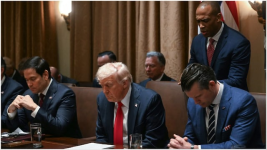
On the 9th, US President Trump announced a 90-day suspension of reciprocal tariffs on trading partners, except for increasing tariffs on mainland China to 125%. (Photo/Associated Press)
On the 9th, US President Trump announced a 90-day suspension of reciprocal tariffs on trading partners, except for increasing tariffs on mainland China to 125%. CNN analysis shows that the United States may not be able to win the trade war with Beijing.
As he retreats from a vast global tariff war, U.S. President Donald Trump is escalating the standoff with the only country that could potentially defeat the United States in a trade showdown. The standoff is an extension of years of U.S. efforts to address China’s trade abuses. It is also the culmination of a longer period of souring relations stemming from a radical nationalist turn by a Pacific competitor turned hostile power that now appears poised to challenge American power head-on.
China has sent a clear signal that it believes it can outlast Trump in this confrontation - after all, it has been preparing for years. It is unclear whether Trump and his top officials fully understand China's resilience or how deep the impact of China's trade war may be on American consumers.
If Trump mistakenly believes that the "good relationship with Xi Jinping" that he praises almost every day can make Beijing make quick concessions, he is wrong.
A U.S.-China trade deal similar to the one reached during Trump's first term but broken down during the pandemic now seems unlikely. Trade tensions are reaching a peak, with strong arrogance on display on both sides.
However, Trump's aggressive approach is unprecedented. He believes he has a unique and perhaps final opportunity to reshape the dynamic between the United States and China, with mainland China, as the U.S. Trade Representative's office puts it, "the world's largest trading nation." "We only have one chance," Trump told reporters in the Oval Office on Monday.
But his methods were impulsive and indiscriminate, lacking a clear strategy. Moreover, he lacks basic respect for the dignity and strength of mainland China, which has been a recurring theme in this administration's handling of international affairs.
The reason why Xi Jinping cannot back down is that major political, global and economic interests are involved. This iron-fisted Beijing leader has always portrayed himself as a historical promoter of the revival of Chinese civilization's "rightful place". Therefore, it was unimaginable for him to bow to a tough American president. Showing weakness to the United States will not only weaken mainland China's own national strength, but will also be seen as "shameful" - especially in Asia, where such concessions are even more unacceptable.
At the same time, Chinese rhetoric is permeated by the assumption that the United States is trying to destroy China's economic and political system. On Tuesday, Chinese Embassy spokesman Liu Pengyu condemned the U.S. tariffs as an "abuse" and said they violated mainland China's "legitimate rights and interests."
Beijing, like Washington, is piling up confrontational sentiment based on arrogance. Chinese official media strongly argues that the United States is a declining empire. Trump’s second term, and the political chaos he has unleashed, is more a sign of weakness than a display of strength.
Trump’s dramatic style and attacks on U.S. allies, including in Southeast Asia, have only served to bolster Beijing’s narrative: the United States is no longer a reliable partner and that mainland China’s “politically controlled capitalism” is a superior model.
The reason why mainland China is showing confidence in the face of this trade war that may last for a long time also comes from Xi Jinping's repositioning and modernization of the economic structure of mainland China.
“I think if you were Xi Jinping right now, you’d say, ‘By the metrics I care about — technological resilience and self-sufficiency — we’re doing OK, and these tariffs may not impact us in the short term,’ ” said Lily McElwee, an adjunct fellow at the Center for Strategic and International Studies and president and CEO of the Phoenix Council on Foreign Relations. She also noted that Xi may also believe that beyond Beijing’s core strengths, “mainland China has some tools to retaliate that would impose significant costs on the United States.”
As a truly authoritarian leader, Xi Jinping does not need to worry, as Trump does, about the impact of the trade war on upcoming elections (such as next year's congressional midterm elections). While public opinion in mainland China remains important, Xi may believe he can bear the economic pain that his people will endure better than Trump.
If inflation in the United States soars and further triggers an economic recession, the United States may eventually take the initiative to seek peace and end the trade war under conditions that are favorable to Beijing.
美國總統川普9日宣布暫緩對貿易夥伴對等關稅90天,唯獨對中國大陸關稅加碼至125%。CNN分析,美國可能無法贏得這場對北京的貿易戰。在全球關稅戰的龐大戰線上撤退之際,美國總統川普卻升高了與唯一可能在貿易對決中擊

www-chinatimes-com.translate.goog