
hydrabadi_arab
Trusted Member

Need to keep working on eliminating hundi/hawala, then watch remittances cross $50 billion in 2026-27.
Follow along with the video below to see how to install our site as a web app on your home screen.
Note: This feature may not be available in some browsers.


 www.thenews.com.pk

Remittances surge to all-time high of $4.1 billion in March
Historic inflow represents 37.3% year-on-year increase from March 2024
By Business Desk
|
April 14, 2025
A person shows US dollars at a currency exchange store in Manila, Philippines, October 21, 2022. — Reuters
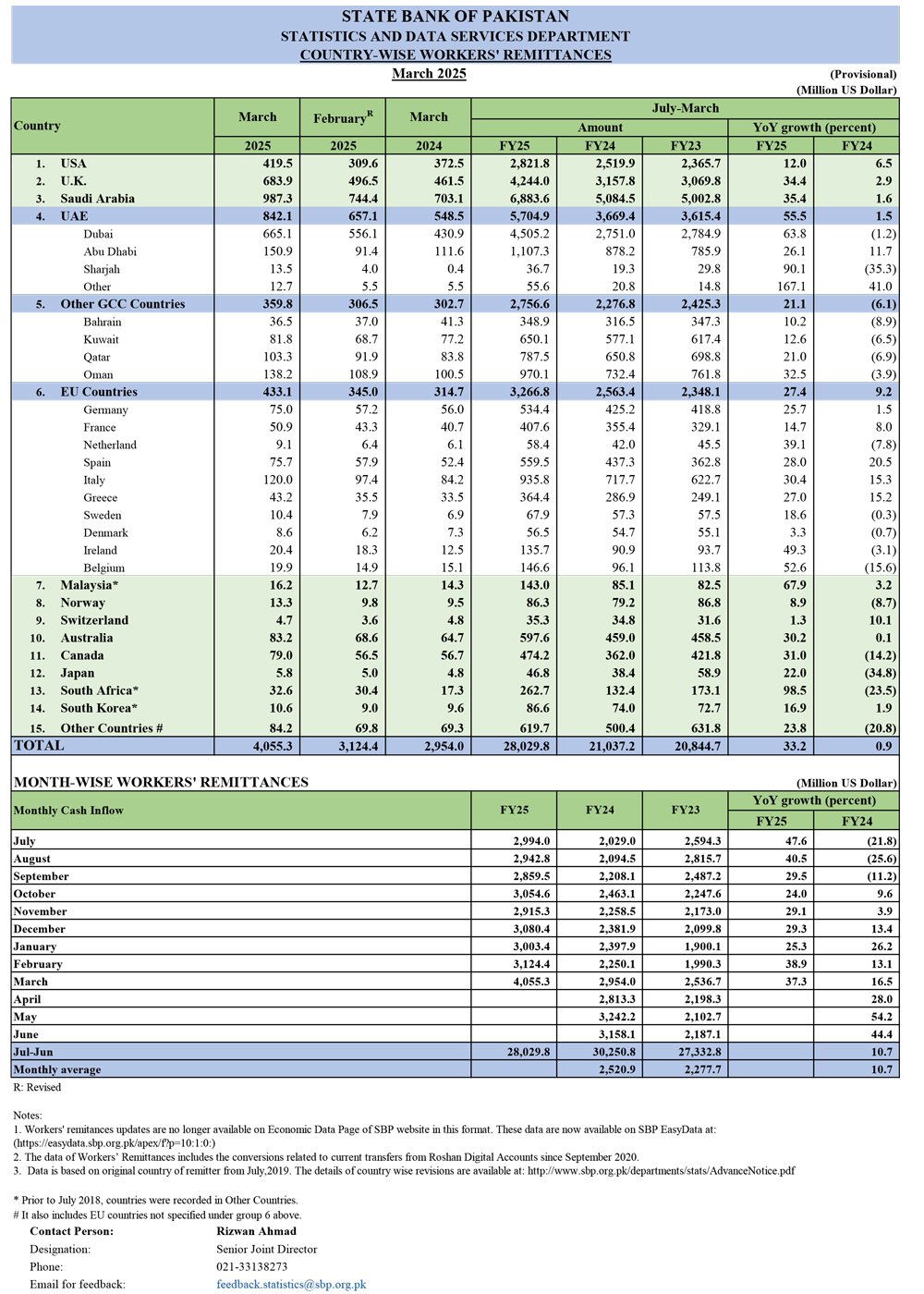
KARACHI: The State Bank of Pakistan (SBP) said on Monday that Pakistan's workers’ remittances surged to an all-time high of $4.1 billion in March 2025, marking the first time that monthly inflows have crossed the $4 billion milestone.
A 37.3% year-on-year increase from March 2024 and a 29.8% month-on-month rise compared to February 2025 have been represented by this historic inflow. It is the highest level of monthly remittances ever recorded in the country’s history.
According to Mustafa Mustansir, Director of Research and Business Development at Taurus Securities Limited, the surge was aided by seasonal inflows during Ramadan and Eid.
"Apart from that, remittances have also picked up due to the better economic health of the sending countries, amid falling domestic inflation and increase in real incomes. Also, the number of registered overseas workers may also be on the rise," he told Thenews.com.pk.
Cumulatively, workers sent home $28 billion during the first nine months of the current fiscal year (Jul-Mar FY25), reflecting a substantial 33.2% rise over the $21.0 billion received during the corresponding period of FY24.
The record inflows in March were primarily driven by remittances from Saudi Arabia ($987.3 million), the United Arab Emirates ($842.1 million), the United Kingdom ($683.9 million), and the United States ($419.5 million).
Pakistan records historic $4.1bn in March remittances
These four countries accounted for nearly 72% of the total inflows during the month.
Among GCC countries, the UAE showed exceptional growth, with remittances increasing by 54% year-on-year, largely supported by inflows from Dubai ($665.2 million) and Abu Dhabi ($151.1 million), up 54% and 35% respectively.
Saudi Arabia remained the single largest contributor, with a 35% year-on-year increase in March. Meanwhile, the UK posted a 48% rise, and the US saw a 12% gain compared to the same month last year.
Other notable contributions came from EU countries ($426.7 million, up 38% YoY), with Germany and Italy registering sharp increases of 34% and 30% respectively. Australia and Malaysia also posted solid year-on-year growth of 43% and 10%.
Remittances surge to all-time high of $4.1 billion in March
KARACHI: The State Bank of Pakistan said on Monday that Pakistan's workers’ remittances surged to an all-time high of $4.1 billion in March 2025, marking the first time that monthly...


They can be doubled and IT exports can be doubled.Need to keep working on eliminating hundi/hawala, then watch remittances cross $50 billion in 2026-27.
They can be doubled and IT exports can be doubled.
By end of next year Pakistan will have firmly stabilized.
Great work by current admin. No nonsense approach and getting things done.

 www.thenews.com.pk

Probably an increase due to extra money being send back, specifically Zakat payments. A lot of people in Pakistan say they are in need, so it’s probably more overseas Pakistanis directing their charity funds to their country of origin. Let’s see the number over the next three months and see if this is a trend or an anomaly.Remittances surge to all-time high of $4.1 billion in March
Historic inflow represents 37.3% year-on-year increase from March 2024
By Business Desk
|
April 14, 2025
A person shows US dollars at a currency exchange store in Manila, Philippines, October 21, 2022. — Reuters
KARACHI: The State Bank of Pakistan (SBP) said on Monday that Pakistan's workers’ remittances surged to an all-time high of $4.1 billion in March 2025, marking the first time that monthly inflows have crossed the $4 billion milestone.
A 37.3% year-on-year increase from March 2024 and a 29.8% month-on-month rise compared to February 2025 have been represented by this historic inflow. It is the highest level of monthly remittances ever recorded in the country’s history.
According to Mustafa Mustansir, Director of Research and Business Development at Taurus Securities Limited, the surge was aided by seasonal inflows during Ramadan and Eid.
"Apart from that, remittances have also picked up due to the better economic health of the sending countries, amid falling domestic inflation and increase in real incomes. Also, the number of registered overseas workers may also be on the rise," he told Thenews.com.pk.
Cumulatively, workers sent home $28 billion during the first nine months of the current fiscal year (Jul-Mar FY25), reflecting a substantial 33.2% rise over the $21.0 billion received during the corresponding period of FY24.
The record inflows in March were primarily driven by remittances from Saudi Arabia ($987.3 million), the United Arab Emirates ($842.1 million), the United Kingdom ($683.9 million), and the United States ($419.5 million).
Pakistan records historic $4.1bn in March remittances
These four countries accounted for nearly 72% of the total inflows during the month.
Among GCC countries, the UAE showed exceptional growth, with remittances increasing by 54% year-on-year, largely supported by inflows from Dubai ($665.2 million) and Abu Dhabi ($151.1 million), up 54% and 35% respectively.
Saudi Arabia remained the single largest contributor, with a 35% year-on-year increase in March. Meanwhile, the UK posted a 48% rise, and the US saw a 12% gain compared to the same month last year.
Other notable contributions came from EU countries ($426.7 million, up 38% YoY), with Germany and Italy registering sharp increases of 34% and 30% respectively. Australia and Malaysia also posted solid year-on-year growth of 43% and 10%.
Remittances surge to all-time high of $4.1 billion in March
KARACHI: The State Bank of Pakistan said on Monday that Pakistan's workers’ remittances surged to an all-time high of $4.1 billion in March 2025, marking the first time that monthly...
Most of your points do not have any direct or indirect affect on the increase in remittances. Such as devaluation of PKR. The increase in remittances is in USD and not in PKR. Also inflation has no relationship with increase in remittances.Remittance is increased due to rise of poverty level in Pakistan so more people are asking for help from people abroad
Let us keep things in perspective
1- Historic inflation , 250% devaluation of Rupee, in 2 years since government of Imran Khan was toppled, not 1% or 2% we are talking 250%
2- Historic rise in poverty, 30,000 rupee per month salary can't cut it, Utility bills are coming at 18,000 or 19,000 with additional taxes on it . Fabricated Tax on Oil when Oil was being sold at cheap rates in international markets
3- Historic debt , National Debt at highest
4- Historic Tariff 29% New Tariff
5- Historic closure of Textile companies, drop in Exports , this was before the Tariff
6- Rise in Crime, theft , violence
7- Rise in Violent Terrorism (Train Attack in Balochistan)
8- Historic fall in Human Rights Index and ability to attain Justice
9- Historic ban on Pakistani Visa in Saudi Arabia for Umrah claim that Pakistan is exporting beggars for pan handling , or asking for money on streets, unsure it if it is for 2 months or more
10- Historic rise in Missing person across Pakistan, stories prevented to be shown in Public TV but , circulating on Social Media
11- Historic rise in Electricity Tax , and secondary tax
12 - Historic demonstration in a Balochistan by People and Historic demonstrations by People in KPK and other parts of Pakistan
While on Other end
- 250,000 USD bonus for Judges who collaborate with rigged government and military , for retirement perk , A bonus for house building , even after their all housing expenses were paid by state all their life, this is issued as a Grant . They take bag full of money and move overseas because at airports. Claim is made that the judges could not construct a home because they lived in State home, so now it is duty of state to give them Bag full of money so they can build their own home
- Promotion for Police or people involved in kidnapping
- Salary increase of people sitting with Rigged government, now calling themselves Member of Parliament, every one gets $$ Money and Imported Cars
- Purchasing of selected few religious personalities who are nod driving in Imported vehicles , they were involve in laying abusive claims against marriage of Prime Minister Imran Khan, Brand new Luxury Vehicles (Sedans) uncommon in Pakistan because they are unaffordable by most salary workers
Remittances from Saudi Arabia led the pack at $987 million, followed by the UAE ($842 million), the UK ($684 million), and the US ($419 million). Year-on-year, inflows from the UAE soared 54 per cent, while those from the UK jumped 48 per cent.
Explainer: Why such a massive, sudden rise in remittances
Remittance inflows are critical source of foreign exchange for Pakistan
By Aimen Siddiqui
April 15, 2025
A foreign currency dealer counts US dollar notes at a currency market in Karachi on July 19, 2022. — AFP
KARACHI: Pakistan’s record monthly worker remittances in March is a result of both the government’s efforts to control flow of money through legal channels and a stable rupee, say experts.
The State Bank of Pakistan (SBP) on Monday released data on the country’s monthly inflows for the month of March, which reached $4.1 billion, up 30 per cent from February and 37 per cent higher year-on-year.
In his comments to The News, former adviser to the Ministry of Finance Khaqan Najeeb said that the surge could be attributed to four factors: Eid festivities and Ramazan, a rise in the number of Pakistanis seeking jobs abroad, macro stability here, and a crackdown against dubious money exchange offices.
He said that besides the Eid factor -- a season during which remittances typically rise -- a rise in remittances also point to people’s growing confidence in the formal banking channels. This, he said, is a result of a relatively stable exchange rate, which has rerouted the flow of money through legal channels instead of the previously popular informal methods of hawala and hundi.
Remittance inflows are a critical source of foreign exchange for Pakistan, helping bridge its current account gap and support the balance of payments amid ongoing IMF-backed reforms.
Remittances from Saudi Arabia led the pack at $987 million, followed by the UAE ($842 million), the UK ($684 million), and the US ($419 million). Year-on-year, inflows from the UAE soared 54 per cent, while those from the UK jumped 48 per cent.
Macroeconomist Ammar Habib Khan largely agreed with Najeeb. He said that an increase in remittances is largely seasonal in nature -- Ramazan and Eid during which time there is often a bump in remittances. Moreover, as the rupee remains fairly valued, remittances continue to come through formal channels.”
Khan added that “any divergence between real value and interbank value can potentially lead to remittances diverting away to informal channels.”
For the first nine months of the fiscal year (July to March), total remittances rose 33 per cent to $28.03 billion from $21.04 billion in the same period last year, according to note released by AKD Securities.
Strong growth was also noted from other key regions: the EU (up 38 per cent YoY in March), Canada (up 39 per cent), and Australia (up 29 per cent). Notably, Malaysia saw a 14 per cent YoY rise, while remittances from GCC countries other than Saudi Arabia and the UAE increased 19 per cent.
Head of Sustainable Development Policy Institute (SDPI) Dr Abid Suleri explained that steps taken by Pakistan to meet its Financial Action Task Force’s (FATF) commitment has made it difficult for people abroad to use informal channels. The rise in remittances can be seen as an official declaration of the money that used to enter the country through hawala and hundi, he said.
He added that a stable rupee has played a big role in increasing people’s confidence. “Those who send remittances are always mindful currency rates and try not to get their amounts stuck in foreign currency accounts because of fluctuations. Rupee stability observed during the last one and a half year has played a big role in a surge in remittances.”
Suleri also pointed to change in investment habits of overseas Pakistanis. He said that people who used to invest in real estate here are now moving away from this sector because of high taxation and other regulations. This money is now being parked in dollar accounts, leading to a rise in remittances.
He said that economic improvement in Gulf countries also improved overseas Pakistanis’ ability to send more money back home. Suleri predicted that the year would end with record remittances.
Per Khaqan Najeeb, this surge also reflects the dent created in the purchasing power of Pakistanis. He said that uncontrollable inflation over the last three years has had destructive effects on people’s buying capacity. This necessitated earners’ abroad to send higher amounts back home for their families to meet their expenses.
Najeeb said that the real test will come in the months ahead. “It is important to analyse the coming months and look at the remittance trend without the Eid factor. Any increase then would help stabilise Pakistan’s external account”, he said.
Explainer: Why such a massive, sudden rise in remittances
KARACHI: Pakistan’s record monthly worker remittances in March is a result of both the government’s efforts to control flow of money through legal channels and a stable rupee, say...

Simplest Explanation
- Every thing cost more in Pakistan , Food , rent , medicine
- When people can't afford it they ask for oversea Pakistani for Help
- People send money to help
- Inflation continues to rise because Pakistan keeps taking in more "Debt" and pays more interest back , Debt was only reduced under Musharraf once in history of Pakistan
Rupee Devaluation gives you illusion of more Remittance
Example:
2018
A man used to send $100 rupee per month in 2018 it meant 15,000 rupee were deposited in Pakistan
2025
A man still send $100 rupee per month in 2025 , it meant family gets 20,208.66 @202 rupee for 1 Dollar rate
From accounting perspective , same money will appear more in Rupee conversion
Company is Judged based on
- Industrial Power
- Exports , Industrial
- Exports , Agricultural Goods
- Exports , Services (IT , Bank loans if international Bank, Telecom)


