Remittances from Overseas Pakistanis - Updates

An interesting thing to look at from this amount of remittances is the ratio of remittances to the overall dollar earnings Pakistan generates internally, through exports and services. Is the diaspora becoming more valuable relative to the internal economy? Especially if the internal economy looks like it is stagnating (not my conclusion, but based on yesterday’s interview of the prominent economist Kaiser Bengali the Pakistan experience podcast).
 
The economy is collapsing internally key industries

Remittance make only a small % of internal revenue generated by Agriculture and other exports

The textile sector is close to collapse, the 29% Tariff will impact this sector exponentially on top

Farming is not providing enough food for locals , as most is being shipped out , for less money collected from foreign buyers (due to falling values of currency of Pakistan)
 
An interesting thing to look at from this amount of remittances is the ratio of remittances to the overall dollar earnings Pakistan generates internally, through exports and services. Is the diaspora becoming more valuable relative to the internal economy? Especially if the internal economy looks like it is stagnating (not my conclusion, but based on yesterday’s interview of the prominent economist Kaiser Bengali the Pakistan experience podcast).

Yes that's should be the real point of discussion.
Remittances are not any govt. achievement or failure. But Export is.
 
The economy is collapsing internally key industries

Remittance make only a small % of internal revenue generated by Agriculture and other exports

The textile sector is close to collapse, the 29% Tariff will impact this sector exponentially on top

Farming is not providing enough food for locals , as most is being shipped out , for less money collected from foreign buyers (due to falling values of currency of Pakistan)
This is why the desire to shift to mining, especially as it can be done with fewer people and it translates well to how Trump wants countries to market themselves to doing business with America.

Farming isn’t as much about exports as it is internal stability and reducing imports of goods stuffs, as Mr. Kaiser Bengali pointed out in yesterday’s interview.

IMHO, Pakistan can improve yields and/or at least lower input costs and expand arable land in a carefully managed way, but it will take some years and significant investment, on a federal, provincial, and personal level of each farmer. But this is crucial for a growing middle class, that fuels a stable internal economy, and makes the country attractive to FDI for services to serve the local economy as well as train the work force to compete in the global economy.
 
Last edited:

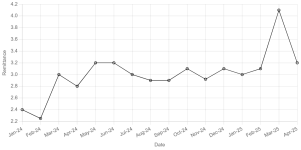
Pakistan’s remittances hit $3.2bn in April, fall 22% MoM


Saudi Arabia remains Pakistan's top source of remittance inflows

BR Web Desk
May 9, 2025

Remittance inflow since Jan 2024​

Figures in USD Billion

1746804237302.png

The inflow of overseas workers’ remittances into Pakistan stood at $3.2 billion in April 2025, the State Bank of Pakistan (SBP) data showed on Friday.

Remittances increased by 13.1% year over year, compared to $2.81 billion recorded in the same month last year. On a monthly basis, remittances were down 22%, compared to $4.1 billion in March.

Cumulatively, with an inflow of $31.2 billion, workers’ remittances increased by 31% during Jul-Apr, FY25, compared to $23.9 billion received during Jul-Apr, FY24.


Home remittances play a significant role in supporting the country’s external account, stimulating Pakistan’s economic activity as well as supplementing the disposable incomes of remittance-dependent households.

Last month, SBP Governor Jameel Ahmad said that given the strong level of remittances, the current account would remain in surplus throughout this fiscal year.

“There will be a substantial surplus, and this is the best performance on the external account during the last two decades,” he said, back then.

Breakdown of remittances

Overseas Pakistanis in Saudi Arabia remitted the largest amount in April 2025 as they sent $725.4 million during the month. The amount was down 26% on a monthly basis, and 2% higher than the $712.2 million sent by the expatriates in the same month of the previous year.

Inflows from the United Arab Emirates (UAE) declined by 22% on a monthly basis, from $841.9 million in March to $657.6 million in April. On a yearly basis, remittances jumped nearly 21%, as compared to $542.5 million reported in the same month last year.

Remittances from the United Kingdom amounted to $535.3 million during the month, down by 22% compared to $683.8 million in March 2025. YoY inflows from the UK improved by 33%.

Overseas Pakistanis in the US sent $302.4 million in April 2025, a MoM decrease of 28%.

PM rejoices over remittance growth

Prime Minister Shehbaz Sharif expresses satisfaction over a 31% increase in remittances during the first 10 months of FY2025, read a statement released by his office on Friday.

“The record increase in remittances reflects the patriotism of Overseas Pakistanis and their confidence in the country’s economic policies,” he said.

The prime minister highlighted that Overseas Pakistanis are playing a central role in economic development.
 

Remittances, money supply, and the ghost of inflation past


BR Research
May 14, 2025

In an unexpected twist, Pakistan is witnessing a sharp acceleration in money supply growth at precisely the time it should have been slowing.

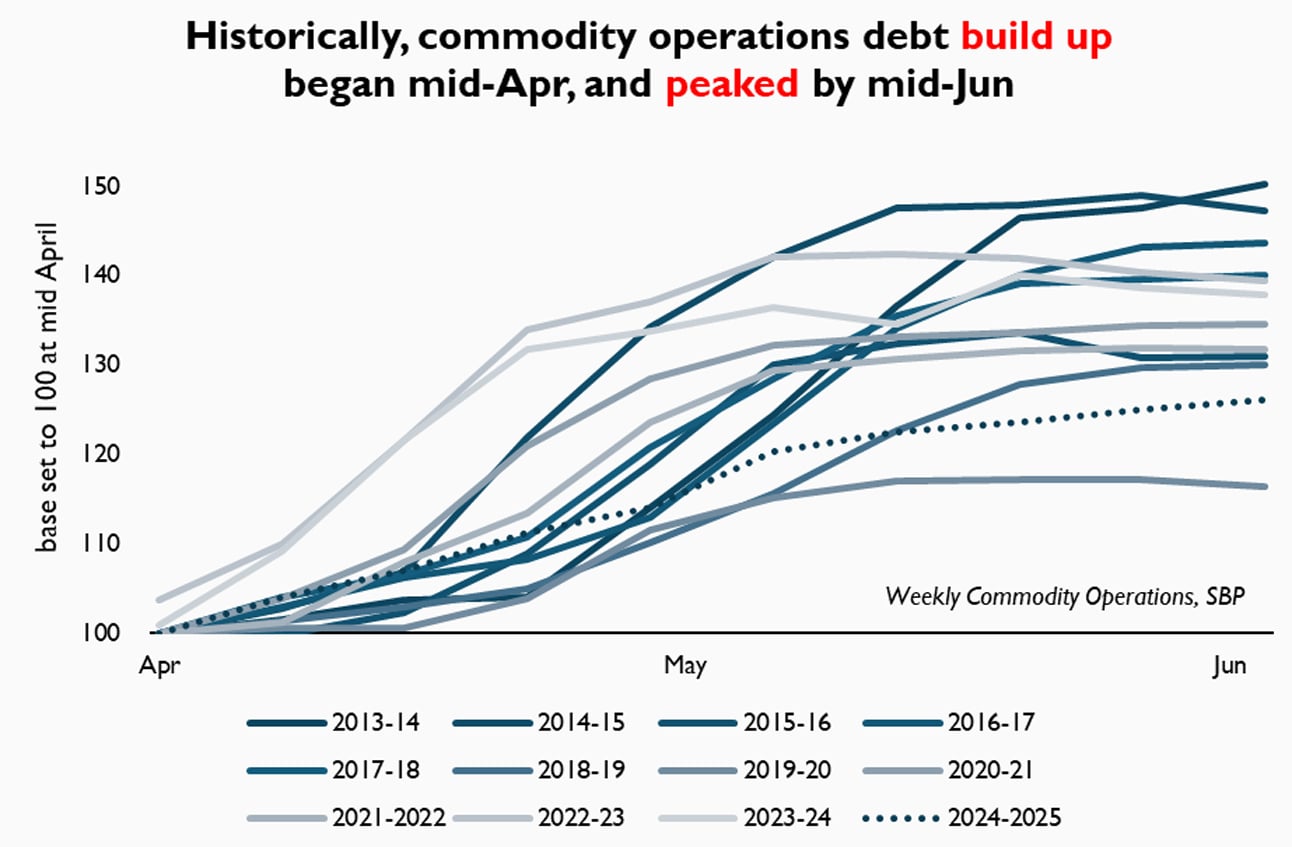
Despite the public sector’s long-awaited retreat from wheat procurement—and with it, the traditional seasonal build-up in commodity operations debt—money supply indicators are rising across the board. Currency in Circulation (CiC), Reserve money (M0), and Broad money (M2) are all clocking over 14 percent year-on-year growth since March 2025. The timing is not coincidental.

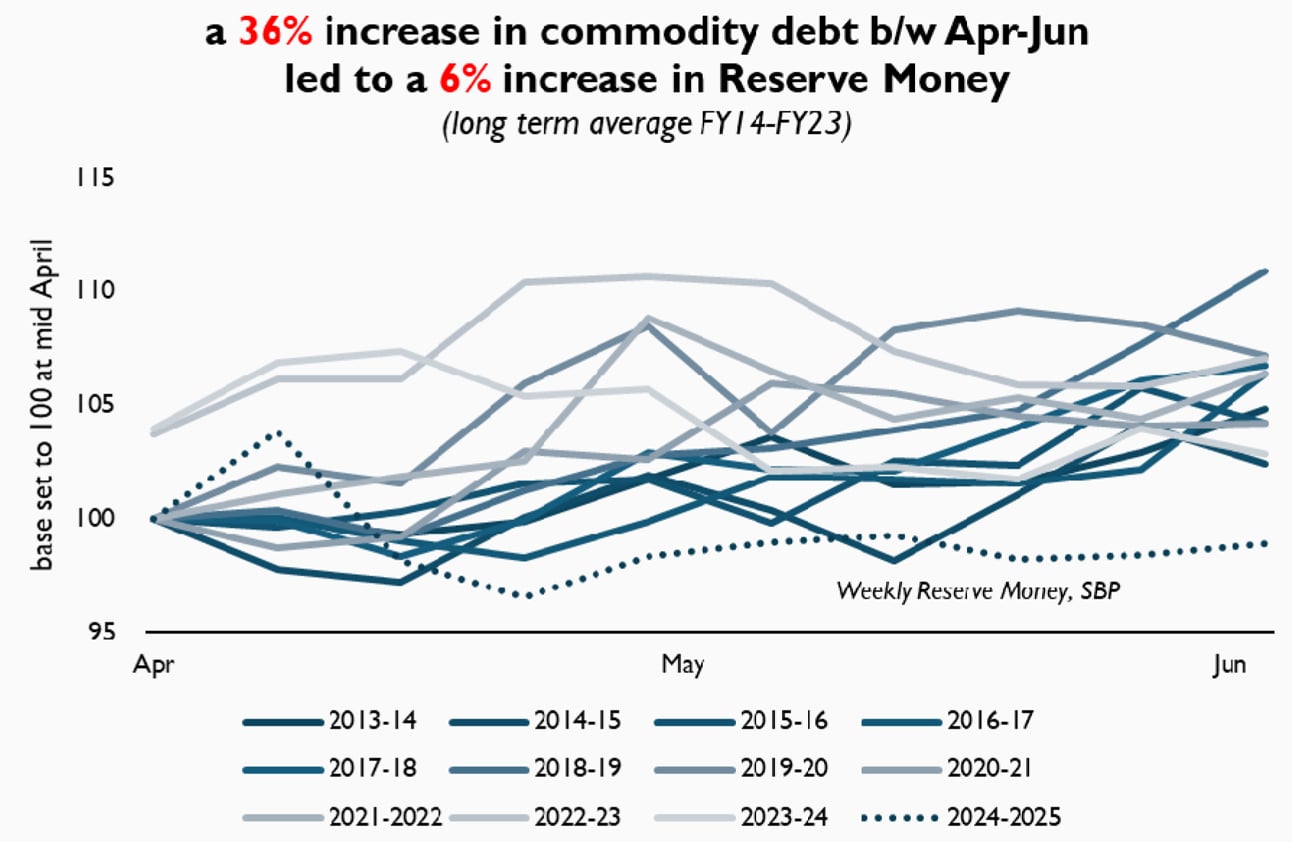
Historically, the fiscal machinery—via commodity operations—was the primary culprit behind post-harvest liquidity spikes. Between 2013 and 2023, commodity operations debt rose by an average 36 percent between April and June each year. While this debt was formally captured under M2, it consistently leaked into M0, causing Reserve money (M0) to grow by 6 percent during the same seasonal window.


68240a8528f84.jpg


Why? Because the government’s borrowing from banks to purchase wheat injected cash directly into rural markets, feeding cash demand and drawing on liquidity in the interbank to support vault cash and reserve requirements.

But not this year. Government borrowing for commodity operations is in net settlement mode. There is no surge in seasonal debt. There is no fresh fiscal injection into rural mandis. And yet—Reserve money is booming. The big question is: why?

The answer likely lies offshore. March 2025, coinciding with Ramzan and Eid-ul-Fitr, saw record growth in monthly inward remittances—up over 35 percent year-on-year. But here is the critical dynamic: SBP insists that it is not injecting dollars to defend the exchange rate.


68240a924b192.jpg


Instead, it is mopping up the excess FX from the interbank market to prevent the rupee from appreciating too quickly—and using those purchases to meet country’s external debt obligations. In doing so, it is injecting rupee liquidity into the system.

If those rupee injections are not being sterilized—if the counterpart Pak Rupee is left floating in the banking system—then we have a new, powerful monetary injection mechanism: remittance-driven reserve money expansion.

And this time, it is likely showing up not just in banks’ deposits with SBP, but also in currency in circulation (CiC), which had previously plateaued. Between Mar-Nov 2024, year-on-year increase in CiC had averaged below 5 percent. Over the past 12 weeks, it has averagedat nearly 15 percent. Reserve money (M0), appears to be following similar trends, averaging 13 percent, against 7 percent between Mar-Nov 2024.

If Reserve money is rising despite the absence of fiscal monetization—and due instead to remittance driven Pak Rupee injections—then SBP must come clean about its intervention and sterilization strategy. The question no longer is whether the exchange rate is being defended, but whether remittance absorption is being silently monetized.

If unsterilized remittance inflows are driving liquidity expansion, SBP risks fuelling demand-side inflation just as the economy begins to stabilize. In a low-velocity, high-liquidity environment, the lag may be deceptive—but the inflation impulse, when it comes, will be real.

The central bank must urgently clarify its sterilization strategy. If it chooses to absorb remittances without mopping up the resulting liquidity, it must do so with eyes wide open—and a credible inflation management plan in place. Failing that, it may find itself once again chasing inflationary shadows with a blunt rate hike months too late.
 
@Beijingwalker
@Persian Gulf
@Vi-va

We discussed a topic, how much 'indirect' tax our non resident pay in other countries as compared to locals there?
Are we slaves who eat inferior food, clothes, houses etc as compared to locals of those countries?

We found East Asians are outdated in Western countries by Indian-Chinese , including in gulf nations.
PG, we don't know why is this, but the Iranian match with those immigrants of Gulf who eat food from shops of main roads, wear clothes of brands and live in those areas where "indirect tax" collection is high . And the story is similar in Western countries 👍
 
Last edited:

Remittance boom fuelling recovery


BR Research
July 10, 2025

In fiscal year 2024–25, Pakistan witnessed a historic surge in remittance inflows, which climbed to an all-time high of $38.3 billion, marking a 26–27 percent increase compared to the $30.3 billion received in FY24.

This robust growth not only exceeded earlier projections but also provided a critical buffer for the country’s balance of payments.


On average, monthly remittances reached $3.19 billion, significantly up from $2.52 billion the previous year. These inflows played a vital role in stabilizing Pakistan’s external account, contributing to a current account surplus for the first time in over a decade. Moreover, they helped ease inflationary pressures and supported a relatively stable exchange rate.

June 2025 capped the fiscal year with inflows totalling $3.406 billion, a year-on-year rise of nearly 8 percent from June 2024. However, this figure represented a month-on-month decline of around 7.5–8 percent from the peak in May 2025.

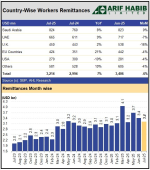
Country-level data shows that Saudi Arabia contributed $823 million, the UAE $717 million, and the UK $538 million in June. Notably, remittances from the United States declined 13 percent year-on-year, while inflows from the European Union rose sharply by 34 percent. While Gulf countries continued to dominate the remittance landscape, the notable rise from EU countries helped diversify the sources.

This shift reflects changing diaspora patterns and potentially more effective formal channelling of funds from Europe. The drop from the US may be attributed to softer economic conditions or seasonal variations.

Several structural factors underpinned this record-breaking year. The government’s Pakistan Remittance Initiative (PRI), coupled with the increased adoption of digital transfer systems like Raast, played a vital role in formalizing flows and reducing reliance on informal channels.

A relatively stable rupee, an improved macroeconomic environment, and a continued boom in Gulf labour markets all contributed to the uptick.

Additionally, remittance incentives and relaxed regulatory frameworks encouraged overseas Pakistanis to prefer formal routes. With increased demand for Pakistani labour in the Middle East and broader economic recovery, remittance flows remained resilient throughout the year.

In regional comparison, countries like Bangladesh, India, and the Philippines have adopted targeted strategies to attract and sustain remittance inflows. Bangladesh, for example, provides a cash incentive on remittances sent through formal banking channels, which has significantly shifted flows away from informal hundi/hawala systems. India leverages its vast, diversified diaspora with proactive consular engagement, digital transfer systems like Unified Payment Interface (UPI), and tax benefits for non resident Indians. The Philippines, through its Overseas Workers Welfare Administration (OWWA), offers structured reintegration programs and savings schemes that encourage Filipino workers abroad to invest back home. These countries also maintain stronger coordination between central banks, labour ministries, and overseas missions to ensure timely resolution of issues faced by their diaspora.

Pakistan, while making progress with initiatives like Raast and PRI, still lags in diaspora engagement strategies.

Expanding financial literacy among migrant workers, strengthening bilateral labour agreements, and offering more investment-linked remittance products could help address this.

For FY26, the target for remittances has been set at $39.4 billion, underscoring the government’s expectation to sustain this momentum. However, some risks include including potential slowdowns in Gulf economies, geopolitical shifts, and domestic policy inconsistency.

Maintaining remittance growth will require continued facilitation through policy incentives, improved digital infrastructure, and stronger diaspora engagement.

More importantly, the challenge lies in channelling these inflows toward long-term investment and development goals rather than mere consumption, thereby transforming remittances from a financial buffer into a catalyst for inclusive economic transformation.
 

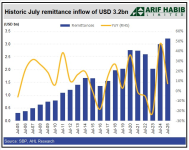
July workers’ remittances rise 7.4pc YoY

Rizwan Bhatti
Workers’ remittances maintained their growth momentum in the new fiscal year (FY26), rising 7.4 percent year-on-year in July, reflecting sustained inflows from overseas Pakistanis.

The State Bank of Pakistan (SBP) on Friday reported that Pakistan has received inflows of workers’ remittances amounted to $3.214 billion during July 2025 as against $2.994 billion in July 2024, showing an increase of $220 million.

However, home remittances in the first month of this fiscal year remain some 5.6 percent lower than June 2025, in which the country received inflows worth $3.406 billion.


During the last fiscal year, workers’ remittances remained instrumental as they more than offset the widening trade deficit. Workers’ remittances posted a robust growth of 27 percent in last fiscal year (FY25) over the previous fiscal year (FY24).

Overall, Pakistan received highest ever $38.3 billion home remittances during FY25 as against $30.25 billion in FY24. Workers’ remittances remained instrumental, as they more than offset the widening trade deficit.

Governor SBP, Jameel Ahmed, expressed confidence that home remittances will continue to grow in the current fiscal year. However, he noted that the pace of growth is expected to slow in the coming months due to the high base effect and the recent rationalization of home remittance incentive schemes.

According to the SBP Governor, the target for home remittances in the current fiscal year has been set at $40 billion, compared to $38.3 billion achieved in the previous fiscal year.

Remittance inflows in July 2025 were led by Saudi Arabia, which contributed $823.7 million, an increase of 8.4 percent. Inflows from the United Arab Emirates (UAE) rose 8.8 percent to $665.2 million in the first month of this fiscal year, compared to $611 million in the same month last fiscal year.

Remittances from the United Kingdom (UK) grew two percent to $450.4 million in July 2025 up from $443 million in July 2024. However, inflows from the United States of America (USA) fell 10 percent to $269.6 million in the first months of FY26.

Copyright Business Recorder, 2025
 
Remittance is earned through hard work by overseas Pakistanis for their families. The Pakistani elites spending even more luxurious imported goods. Food exports should be limited to keep domestic prices low.
 
Remittance is earned through hard work by overseas Pakistanis for their families. The Pakistani elites spending even more luxurious imported goods. Food exports should be limited to keep domestic prices low.
What are you talking about? Pakistan has been experiencing a current account surplus for some time now.

The remittances go into people's personal bank accounts, not into Pakistan's national treasury.

Whatever I send to my relatives, stays with my relatives. They spend it as they like. Or, whatever I send into my own personal account, stays in my personal bank account. However, the size of the bank's balance sheet increases creating an overall positive financial stability for the country.
 
@Pakistan Space Agency

PSA sb,

Well written. Just one disclaimer- PAK has experienced CA surplus because imports have been highly constrained, which is not good for fresh investments and has implications for future growth. PAK must gently relax restraints on imports and maybe allow PKR to depreciate a bit.

Regards
 
@Pakistan Space Agency

PSA sb,

Well written. Just one disclaimer- PAK has experienced CA surplus because imports have been highly constrained, which is not good for fresh investments and has implications for future growth. PAK must gently relax restraints on imports and maybe allow PKR to depreciate a bit.

Regards

imports have been highly constrained

It's becoming a thing of past now. Not as restricted as you thought.
 

Users who are viewing this thread

Latest Posts

Back
Top