Bangladesh Economy

So, you r an economics graduate. Good, very good. Someone with an economics background should form his opinion based on cold, hard statistics, not personal whims, right? Yet in your case, I often see the opposite.

For example, you falsely claim that law and order have improved under the Yunus administration. However, data published by the Bangladesh Police clearly shows that all types of crimes have increased disproportionately over the last 7/8 months.

Now, let’s examine how this abject failure of Yunus Govt to ensure stability has impacted foreign investment in our country. FDI dropped to a six-year low in the July Sept quarter of FY25, reaching only 104.33 million dollar, a 71% decline from the same quarter in FY24. In the October–December quarter, FDI fell even further, plummeting to around 70 million dollar. Net equity investment fell by 46% to $76.79 million, while reinvested earnings dropped by 73% to $72.9 million.
View attachment 112163
Furthermore, according to Bangladesh Bank, credit flow to private firms experienced its lowest growth since 2015. As a result, most private firms have halted their expansion plans, rendering thousands of young people unemployed.

Slowly but surely, this so called student regime is dragging the country back to the same gutter we had painfully climbed out of after 2006. Go and take a look at the Total GDP, GDP growth rate and per capita income of Bangladesh now and compare them with pre 2006 era. These figures r widely available on the internet.

Never forget it was Sheikh Hasina who transformed a nation with a per capita income of barely 600 dollar into one of the highest earning countries in Southeast Asia during her tenure.

I can confirm from friends in Bangladesh that the law and order situation has really deteriorated. Safety and social stability is a prerequisite to economic growth.

Quite a few posters here are partisan and see everything in binary terms, the situation is more nuanced. If you do anything but endorse their narrative they will start engaging in personal attacks and labelling you as supporter the party which they are opposed to. Whilst there was economic growth under Hasina there was also Awami League cadres brutalizing people up and down under the country, but on the other hand whilst Yunus has his advantages there are problems including the students and their very negative influence on the government, the breakdown of law and order and unnecessary antagonizing of India (the guardian of the seas comments by Yunus doesn't fall in that category by the way and is just the anti-Muslim Indian media trying to vilify and intimidate Bangladesh, the RAW connected Gaurav Arya basically threatened to invade our country).

Elections must be held soon whilst necessary reforms must be undertaken.

Yunus is doing a difficult job and I wish him the best. Most likely the next ruling party will be the BNP but hopefully a reformed BNP not engaged in massive corruption et la the early 2000s and not too close to radicals and extremists (including rabid India-haters) but more nationalistic and pro-Bangladesh.

@MNZGamerX
 
So, you r an economics graduate. Good, very good. Someone with an economics background should form his opinion based on cold, hard statistics, not personal whims, right? Yet in your case, I often see the opposite.
For example, you falsely claim that law and order have improved under the Yunus administration. However, data published by the Bangladesh Police clearly shows that all types of crimes have increased disproportionately over the last 7/8 months.
LOL, crimes committed and crimes reported these are totally two different thing. Awami era was a reign of terror, they ruled like nazis. Crimes were rampant in Bangladesh plus awami terrorism and killings but law enforcement agencies didn't registered crimes because it would tarnish the image of awami terror regime.

Now the picture is totally opposite with true defacto freedom of speech...
Now, let’s examine how this abject failure of Yunus Govt to ensure stability has impacted foreign investment in our country. FDI dropped to a six-year low in the July Sept quarter of FY25, reaching only 104.33 million dollar, a 71% decline from the same quarter in FY24. In the October–December quarter, FDI fell even further, plummeting to around 70 million dollar. Net equity investment fell by 46% to $76.79 million, while reinvested earnings dropped by 73% to $72.9 million.
Capture.PNG
LOL, we weren't talking about so called FDI failure of Yunus admin. You were claiming huge FDI inflow in awami era. I challenged you. Now for couple of posts you're beating around the bush instead of presenting proper proofs of your claims.
.
Since you joined this forum you're peddling awami leagues fake narratives and claims. When challenged you weren't able you present facts. For the last time present proofs of your claim about huge FDI inflow in Awami era...
Furthermore, according to Bangladesh Bank, credit flow to private firms experienced its lowest growth since 2015. As a result, most private firms have halted their expansion plans, rendering thousands of young people unemployed.
Blame awami league and its crony capitalists. Their rampant corruption, bank looting and money launderings are responsible for this situation. Awami league destroyed almost all private banks including giants like Islami Bank, Sonali Bank and others...

Now the Banks have every right to reclaim their money from awami loan defaulters. And as a consequence lots of awami crony conglomerates are closing down.

And who told you most of private firms have halted their expansion?
Slowly but surely, this so called student regime is dragging the country back to the same gutter we had painfully climbed out of after 2006. Go and take a look at the Total GDP, GDP growth rate and per capita income of Bangladesh now and compare them with pre 2006 era. These figures r widely available on the internet.

Never forget it was Sheikh Hasina who transformed a nation with a per capita income of barely 600 dollar into one of the highest earning countries in Southeast Asia during her tenure.
Just remember awami league is directly responsible for more than a million of killings in Bangladesh...
 
Last edited by a moderator:
@Prince_ You're yet to provide proof of your claims. Im waiting.

@LeonBlack08 You should start taking note of posters who are copy pasting fiction instead of facts. When challenged they're coming with more fiction.

In Bangladeshi context, being a fascist sympathizer is equivalent of being a Nazi sympathizer and denying fascists crimes against humanity is equivalent of holocaust denial...
 
@Prince_ You're yet to provide proof of your claims. Im waiting.

@LeonBlack08 You should start taking note of posters who are copy pasting fiction instead of facts. When challenged they're coming with more fiction.

In Bangladeshi context, being a fascist sympathizer is equivalent of being a Nazi sympathizer and denying fascists crimes against humanity is equivalent of holocaust denial...

If it is fiction in your opinion, you need to counter it with facts and present counter arguments in a civil manner without name-calling or labelling them. The other members are entitled to their opinion so long they don't condone criminal activities and/or violate forum rules.

If it is deliberate and repeated lying despite being debunked, please report those posts.
 
The realization period for such promised investments usually spans multiple years. The main success of Hasina's tenure, often referred to as the golden economic era in Bangladesh, was her ability to project a positive image of the country to investors through her vision, diplomacy, and leadership.

However, after the Hasina government was unjustly ousted just one year following the investment summit, it became the responsibility of the Yunus administration to maintain a peaceful, business friendly environment to ensure the realization of those promised investments.

But, as we've seen in the last 8 months, Mr. Yunus has failed miserably in this regard as Factory vandalism, arson, mob lynching, robbery have become a daily occurrence in his tenure, which I believe caused the investors to rethink their decision.

She was in power for 15 years. She had most stability compared to any other ruler in Bangladesh's history because she completely forced the opposition underground. Billions were committed by foreign investors over the years and was supposed to flow in, but majority didn't because of red tape and corruption of her regime. I already mentioned the case of Samsung.

The fact that you are blaming a transitional government who barely has been in power a few months amidst a volatile situation, for not getting enough investment commitment is ridiculous. You are comparing apples to oranges.

If you want to put Younus' ability to test, let him be in power 15 years and then we can compare the achievements.

Also - She was in power without fair election and killed thousands of civilians. If she had the best interest of the country in her heart, she would have resigned after the first day when the protests turned bloody by her own party thugs.

So please don't try to take us for fools that she was unjustly overthrown.
 
This Ashik dude hit all the hot spots in terms of attracting for investment. Prospecting for new is a continuous process. If anybody who knows something called drip marketing, then he/she would know that it is a continuous process.
Take feedback from prospect and take those feedback seriously to attract investment.
One summit won’t get too much.
 
This Ashik dude hit all the hot spots in terms of attracting for investment. Prospecting for new is a continuous process. If anybody who knows something called drip marketing, then he/she would know that it is a continuous process.
Take feedback from prospect and take those feedback seriously to attract investment.
One summit won’t get too much.

Exactly.

It's so ridiculous that people comparing a transitional government - whose job is to restore normalcy and hold elections - with an autocratic regime who were in power for 15 years and had the ability to do a lot more to bring in FDI with the level of political stability it enjoyed.

The fact that this summit raised this much positive buzz is a success in itself for a transitional government.
 
Well, if I want to compare two successive governments in Bangladesh, stats on FDI inflow will be the last indicator I would choose. FDI inflow has always been abysmally low, and whatever FDI we got in the last 15 years, it was mostly reinvestment by existing MNCs with next to zero greenfield investments, resulting in a lack of diversification of exports. This could have been improved, the way our peers like Vietnam did, but there has been no reforms at all in the last 15 years despite political stability. Instead, all the state institutions were destroyed serially.

There was high GDP growth during Hasina true but it was mostly due to exorbitant government spending on misplanned projects and that too with borrowed money and rising foreign debt.


^Just a few from thousands of such examples. Explains the jobless growth in Bangladesh where youth unemployment was peaking every year.

Anyone understanding ECON 101 would know that this economic growth is not just unsustainable but also pushing the country towards an inevitable default. One external shock and it's game over!

And the shock finally came with COVID and the Ukraine war. That's when all the banks started getting looted and money getting syphoned out of the country because those in power knew what was coming!

Trust on the financial system was at its lowest - people were recommending each other to withdraw their money from banks while expatriates were increasingly avoiding banking channels to send money. Foreign reserves, as expected, began depleting.

Now I don't expect Hasina to know and predict all this stuff, which is fine. What I expected, however, was that she would at least know who should be delegated what - this is a basic leadership quality which she lacked entirely. People with crooked background were installed everywhere, some say many of them were apppointed under India's direction. Bangladesh was effectively a kleptocracy with no future under Hasina.

Whatever benifits of doubts you could give to Hasina, in 2024 it was all clear that she was willing to stoop to the lowest to stay in power, be that by selling the country's sovereignty to India or by killing thousands of her own citizens.

Bangladesh under Yunus is surely not perfect but the way he has held the country together is almost like a miracle. I was honestly expecting a Libya-like situation given the massive disinformation campaign coming from India and Awami League's desperate efforts to destabilize the country. The thing I have found the most remarkable is that unlike before, people are now hopeful and confident about the country's future.
 
Exactly.

It's so ridiculous that people comparing a transitional government - whose job is to restore normalcy and hold elections - with an autocratic regime who were in power for 15 years and had the ability to do a lot more to bring in FDI with the level of political stability it enjoyed.

The fact that this summit raised this much positive buzz is a success in itself for a transitional government.
He did a marvelous job on this summit. He spent like $130,000 but got $150,000,00 worth of investments.
He was with HSBC in his previous position.

HSBC
Full-time · 5 yrs 4 mosFull-time · 5 yrs 4 mos
Associate Director, Infrastructure Finance Investment Banking

I am an inactive real estate agent. Real estate business needs a lot of marketing whether it is phone call, direct mail, email, and door knocking (as last resort!). This needs some folks smart as him to follow up on the attendee investors.

And it is not too early to start working on the next summit!!
 
@Prince_ You're yet to provide proof of your claims. Im waiting.

@LeonBlack08 You should start taking note of posters who are copy pasting fiction instead of facts. When challenged they're coming with more fiction.

In Bangladeshi context, being a fascist sympathizer is equivalent of being a Nazi sympathizer and denying fascists crimes against humanity is equivalent of holocaust denial...
I don't see the point in presenting any data in front of. U refuse to accept proven facts if they don't align with your misguided belief. Anyway,

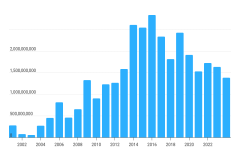
Bangladesh-Foreign-Direct-Investment-Inflows-US-2025-04-16-11-31.png
This is the revised version of total FDI inflow, where Bangladesh Bank, following IMF guidelines, has deducted the losses incurred by foreign investors from 2019 onwards.

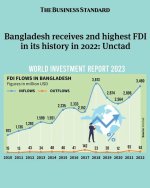
But, if we take the face value of the total FDI inflow, without the accounting revision then FDI inflow would be this
490020595_122153926478456192_116120576698323950_n.jpg
Now, go and compare the foreign investments made during the BNP-Jamaat period with the investment inflows during Sheikh Hasina's tenure. There is a reason why Bangladesh has progressed leaps and bounds under her leadership.
 
I don't see the point in presenting any data in front of
Good. Then don't spread fake news and propaganda. If you get challenged because of your claims, you must come up with proper data and facts to back them up...
U refuse to accept proven facts if they don't align with your misguided belief.
LOL, I will believe in facts not fictions. And till now you failed to present facts in every threads I challenged you.
Anyway,

Bangladesh-Foreign-Direct-Investment-Inflows-US-2025-04-16-11-31.png

This is the revised version of total FDI inflow, where Bangladesh Bank, following IMF guidelines, has deducted the losses incurred by foreign investors from 2019 onwards.

But, if we take the face value of the total FDI inflow, without the accounting revision then FDI inflow would be this
490020595_122153926478456192_116120576698323950_n.jpg
You're changing the goalpost here...

In this thread you were criticizing Yunus administrations investment summit as it only attracted 150+110 millions FDI. While claiming awami league era investment summit in 2023 attracted 3.48 billions.

I challenged you to provide verifiable proof of your claim about awami era 2023 investment summits 3.48 billions FDI sources and where they have invested. Just like Yunus administration did, 150 from Handa group and 110 FDI in shopUp. Simple...

Please don't expect us to believe any awami era data without proper proofs...
Now, go and compare the foreign investments made during the BNP-Jamaat period with the investment inflows during Sheikh Hasina's tenure.
Earlier you were comparing 8 months old post revolution interim Yunus administration. Now you want to compare BNP-Jamayat era which was in power almost 2 decades ago?

Awami league failed to attract FDI and companies like Samsung and Aramco who really wanted to invest huge amount didn't because of awami leagues corruption and lawlessness...
There is a reason why Bangladesh has progressed leaps and bounds under her leadership.
So called awami era growth was unsustainable growth, fuelled by public spending with bad foreign loans. This is why Bangladesh is yet to recover from Covid times economic shock and Russia-Ukraine war just made it worse. Awami league hated everything Pakistani except Pakistani economic model. LOL...
 
Last edited:
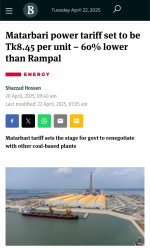
In a major breakthrough in bulk power tariff restructuring, the Bangladesh Power Development Board (BPDB) has managed to bring down the per-unit cost of electricity from the 1,200MW Matarbari Ultra Super Critical Coal-Fired Power Plant by around 60.60% compared to that of the 1,320MW Rampal Power Plant.
.
This is how real "unnoyon" (progress) happens...
.
Source
 
In a major breakthrough in bulk power tariff restructuring, the Bangladesh Power Development Board (BPDB) has managed to bring down the per-unit cost of electricity from the 1,200MW Matarbari Ultra Super Critical Coal-Fired Power Plant by around 60.60% compared to that of the 1,320MW Rampal Power Plant.
.
This is how real "unnoyon" (progress) happens...
.
Source

Good news! Time to renegotiate on other deals now.

1000006774.png
 
Bangladesh draws growing attention of foreign investors
Says Uber official in an interview with The Daily Star

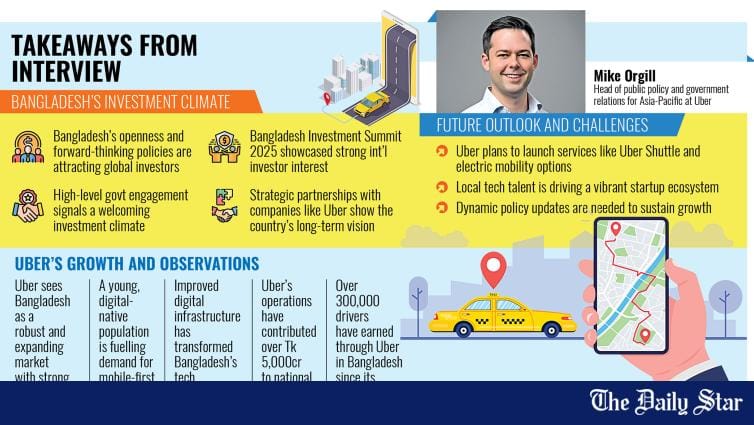
Bangladesh is increasingly attracting foreign investors, especially in the fields of technology and digital services, according to Mike Orgill, head of public policy and government relations for Asia-Pacific at Uber.


This rising interest reflects the openness of the government, its willingness to engage and efforts to maintain a policy dialogue with investors, strategic partners and global companies, said the top executive of the American multinational transportation company that provides ride-hailing services.

"These developments are helping boost investor confidence and opening up broader opportunities for innovation, growth, and long-term development," he said during an interview with The Daily Star.

On the sidelines of the recently concluded Bangladesh Investment Summit in Dhaka, Orgill said, "The government's active engagement with the international business community reflects a positive signal."


"It shows that Bangladesh is keen to welcome investment," he added.

According to the Bangladesh Investment Development Authority (Bida), the four-day summit, jointly organised by Bida and the Bangladesh Economic Zones Authority, received initial investment proposals worth Tk 3,100 crore.

The Uber executive pointed to recent meetings with the interim government as evidence of a policy direction aimed at building meaningful partnerships, especially with companies that have maintained a sustained presence in Bangladesh.


Such engagement is timely, he noted, as countries around the world are vying for foreign direct investment and striving to position themselves as centres for innovation.

He said that the government's attention to platforms like Uber was not merely symbolic but strategic. "These interactions show a willingness to embrace global best practices, consider policy reforms, and unlock new avenues for growth."

Orgill also welcomed the tone of recent public statements from government officials, noting that their focus on digitisation, inclusive growth, and youth employment closely aligns with Uber's mission and broader goals for a digital economy.

"It's very exciting to see how the government is focused on attracting international investment," he said after a meeting of US delegation with Commerce Adviser Sk Bashir Uddin.

"It's also very encouraging to see them spend time with companies like Uber that have been in the market for some time and continue to develop that partnership."

"I think it is a really important signal to investors like us. It was also exciting to hear -- I am not sure if you saw some of the speeches -- the forward-looking ideas the interim government presented. So yes, I was very happy to be here."

Beyond government relations, Uber's experience on the ground points to strong market fundamentals. Despite the evolving nature of urban mobility, demand for Uber's services in Bangladesh continues to rise, backed by an engaged and growing customer base.

"This momentum shows that the Bangladesh market is not only emerging, it is expanding," Orgill said.

He credited much of this growth to the country's youthful and tech-savvy population.

With a median age under 30, the country offers fertile ground for mobile-first services. There is a rising demand for digital platforms that improve daily convenience and connectivity -- ideal conditions for companies like Uber that depend on flexible workforces and digitally fluent users.

At the same time, key macroeconomic trends are also moving in the right direction. Urbanisation is accelerating, fuelling demand for accessible, reliable, and cost-effective transport.

From Uber's perspective, these are not future possibilities but present realities shaping operations and expanding the user base.

"We continue to have a strong business here," Orgill said. "Consumers are increasingly using the app. So, I see it as a robust market for us. And I think the macroeconomic conditions here are pretty inspiring."

"Look at the population growth, the age of the population. There is a really young, talented workforce. Digital penetration is growing. All these factors make Bangladesh a growing market for any industry. From Uber's perspective, there is a lot to be excited about."

He said another key enabler has been the improvement of digital infrastructure.

Read more

Bangladesh has significant investment potential: experts

A decade ago, limited smartphone use and patchy internet access made the adoption of digital services difficult. Today, widespread 4G coverage, affordable mobile data, and the growing use of digital wallets and apps have made it easier for Uber to connect with riders and drivers alike, according to the executive.

Orgill said Bangladesh is no longer just a consumer of global tech solutions; it is now cultivating a vibrant innovation ecosystem of its own.

He praised the growth of local tech talent, which is driving a new wave of start-ups and digital platforms tailored to local needs. "It is growing so fast, right? Everybody is on their phones. Internet connectivity is superfast these days."

"I have been coming to Bangladesh for over 10 years. Back then, internet penetration was very low. You could not get devices. And now, everyone has 4G smartphones. It is just a completely different ecosystem."

"And what is inspiring is the remarkable local tech talent. It is not just large foreign players anymore -- there is a robust, growing native ecosystem driven by Bangladeshi talent solving local problems."

Since launching in Bangladesh eight years ago, Uber says more than 300,000 drivers have earned income through its platform. In the past year alone, it estimates its economic contribution to be over Tk 5,000 crore, largely from driver earnings and related activities.

"That's a significant contribution to Bangladesh's economy, and it's growing. I am proud of that impact. Proud to be a part of it. And this is a market we are very committed to."

In the future, Uber plans to introduce new services such as Uber Shuttle and electric mobility options, aimed at further adapting to local needs and environmental priorities.


"The government's active engagement with the international business community reflects a positive signal," the Uber official said.
However, Orgill acknowledged that challenges remain, particularly regarding policy frameworks. Chief among them is the issue of fare caps, which have not been revised in over a decade.

Uber argues that this limits its ability to adjust pricing based on supply and demand, making it difficult to ensure consistent service and fair earnings for drivers.

Despite such hurdles and challenges, Orgill remains optimistic.

"This is a market with enormous potential," he said. "The signs are encouraging, and our commitment to Bangladesh is deep."


To view this content we will need your consent to set third party cookies.
For more detailed information, see our cookies page.
 
1000006999.png


Users who are viewing this thread

Pakistan Defence Latest

Back
Top