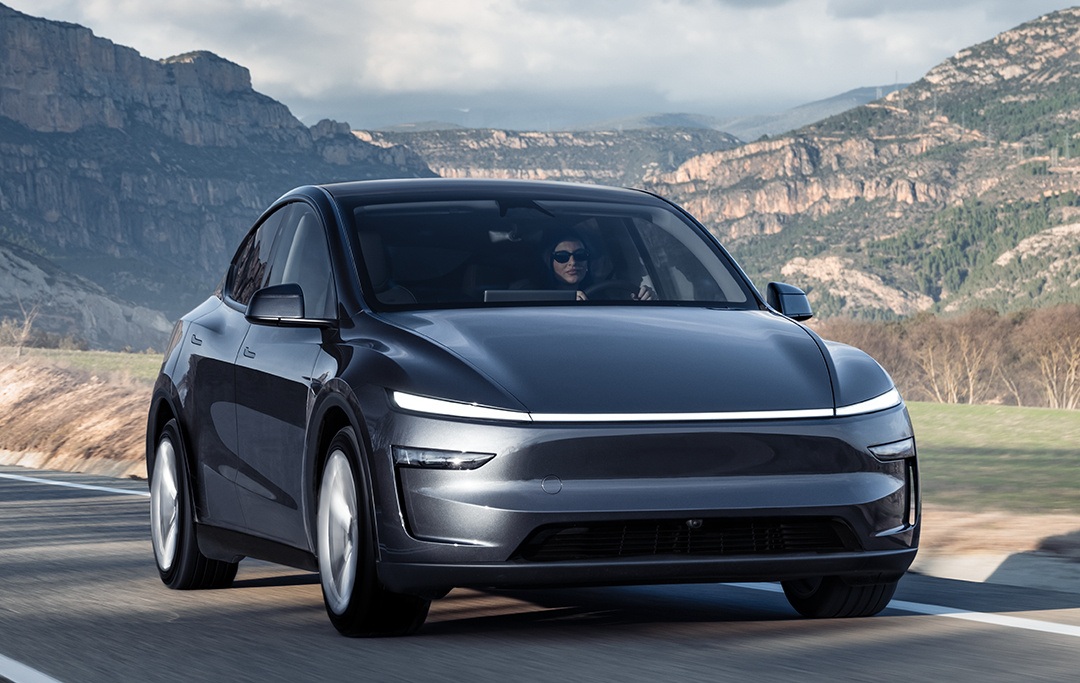
Elon Musk hints Tesla FSD for China may be possible very soon

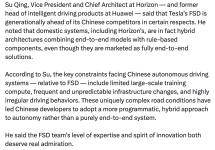
The North American version of Tesla FSD (ie not a Chinese trained one) AI + computer vision challenges its Chinese LiDAR competitors in their own backyards which it has never seen.

To view this content we will need your consent to set third party cookies.
For more detailed information, see our cookies page.

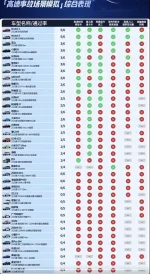
Comparison of Tesla FSD with 7 Chinese ADAS Systems.​


There was/is/will be no safety without multisensor fusion. Lidar and 4D Millimeter-Wave Radar are must have.

In China, Tesla FSD and many other similar solution are called Se version of autopilot, which means it's designed for those who go cheap.
 
There was/is/will be no safety without multisensor fusion. Lidar and 4D Millimeter-Wave Radar are must have.

In China, Tesla FSD and many other similar solution are called Se version of autopilot, which means it's designed for those who go cheap.

There's certainly nothing stopping the Chinese government from suddenly requiring secondary systems on all cars.

However as of now the North American version of Tesla FSD is doing very well compared to its China specific trained competitors. (y)
 
There's certainly nothing stopping the Chinese government from suddenly requiring secondary systems on all cars.

However as of now the North American version of Tesla FSD is doing very well compared to its China specific trained competitors. (y)
Good. But FSD is not doing well in China market.

In China, almost all consumers believe that vision only solution is inferior compared with those with Lidar & 4D Millimeter-Wave Radar.

Only 10k - 20k dollar vehicles use vision only solution.
 
Good. But FSD is not doing well in China market.

In China, almost all consumers believe that vision only solution is inferior compared with those with Lidar & 4D Millimeter-Wave Radar.

Only 10k - 20k dollar vehicles use vision only solution.

Certainly having multiple systems should easily do better than just vision only.

However currently they aren't doing better....in fact most are doing much worse.
 
Certainly having multiple systems should easily do better than just vision only.

However currently they aren't doing better....in fact most are doing much worse.
I disagree.

Even if FSD can use all the Chinese data, and give FSD enough time to mature on China road, I don't think FSD can beat the best Chinese autopilot solution providers.

There are lots of companies investing on autopilot in China, much more than the rest of the world. China autopilot market is much bigger than the rest of the world combined.

Tesla is good, but Elon should have spent more time on his car company, he lost focus I think.

Elon is damn smart, but he is a human after all, he can't win all the time. Those Chinese companies spent more time, more money and much more human resources on autopilot in a much bigger market.
 

Tesla’s (TSLA) Full Self-Driving Could Expand in China Due to New Data Export Rules​


China has released draft guidelines that could help EV maker Tesla TSLA +1.94% ▲ expand its advanced driver-assistance features in the country, according to a Bloomberg report on Friday. For the first time, Beijing has provided clear rules on how data generated in China, including from driver-assistance systems and product development, can be accessed, used, and exported. This is an important step for companies like Tesla, which need to send data abroad in order to improve their systems.


The proposed guidelines were published by China’s Ministry of Industry and Information Technology, along with seven other government agencies, and are now open for public comment. The framework covers key types of information, such as autonomous driving algorithms, training images, operational data, and vehicle-to-road perception data. These are all critical for developing and improving advanced driver-assistance technologies like Tesla’s Full Self-Driving (FSD) system.

Being able to export this data is especially valuable for Tesla because the core team working on FSD is based in the U.S., and having access to real-world data from Chinese roads would help optimize the system’s performance in China, the world’s largest car market. It’s worth noting that, until now, strict data controls have been a barrier for foreign automakers. However, the new guidelines could provide Tesla with a clearer path to making its most advanced driver-assistance features more competitive in China.

What Is the Prediction for Tesla Stock?


Overall, analysts have a Hold consensus rating on TSLA stock based on 14 Buys, 12 Holds, and nine Sells assigned in the past three months, as indicated by the graphic below. Furthermore, the average TSLA price target of $285.97 per share implies 12.1% downside risk.


US trained FSD driving on China's streets by Chinese Tesla owners
To view this content we will need your consent to set third party cookies.
For more detailed information, see our cookies page.

Tesla FSD China Daily Drive With Some Interesting Situations​


Tesla Model Y reclaims the best-selling SUV crown in China for May​

 
Last edited:
I disagree.

Even if FSD can use all the Chinese data, and give FSD enough time to mature on China road, I don't think FSD can beat the best Chinese autopilot solution providers.

Tesla Autopilot just did that on an ADAS test...even when they suspiciously used 2023 model year cars with older microchips while almost everybody else were 2025.


chinas-massive-adas-test-36-cars-15-hazard-scenarios-216-v0-689p7s2uqref1.webp

To view this content we will need your consent to set third party cookies.
For more detailed information, see our cookies page.


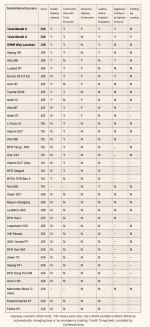
China’s massive ADAS test: 36 cars, 15 hazard scenarios, 216 crashes​


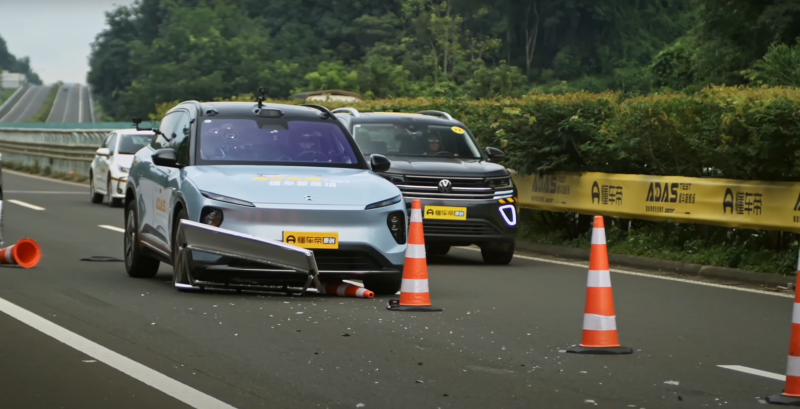
Chinese media outlet Dongchedi conducted a large ADAS test of 36 cars in 15 obstacle scenarios. Six of them were travelling at high speeds on the expressway, and nine of them were in urban scenarios.

Let’s look at the ranking of the highway advanced driver-assistance system (ADAS) tests. A total of 36 cars were tested in six different scenarios, ranging from a sudden highway stop to avoiding a construction site and a collision with a wild pig. Yes (Y) means that the car passed the test by successfully changing the line or by activating autonomous emergency braking (AEB). No (N) means the car crashed.

Highway driving ADAS test ranking​

The Tesla Model 3 sedan and Model X SUV took the first and second positions, respectively, receiving 5/6 points and passing nearly all the test scenarios. The Model X was also the only car that successfully avoided the encounter with the wild pig. Unlike most of the other cars, Tesla vehicles were not equipped with lidar. The third spot went surprisingly to Great Wall Motor’s Wey Lanshan (also known as Wey 07) with its Coffee Pilot Ultra ADAS.

Nio ES6 (EL6 in Europe) is trying to avoid a construction zone on the highway.

The last positions went to cars such as Zeekr 7X, Xpeng P7+, Onvo L60, Firefly EV, or Mercedes-Benz C-Class, which didn’t avoid any of the scenarios.
Interestingly, cars from the same brands, equipped with the same ADAS, sometimes solved different situations differently. This can be caused by a slightly different software version, different sensor positions that send inputs to the ADAS software, or different ADAS chips with varying computing power, which can influence reaction time or other variables occurring in real-life testing.

chart1.png

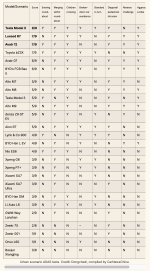
Urban driving ADAS test ranking​

26 cars were tested in nine different urban driving scenarios, including entering a roundabout, making a U-turn, encountering pedestrians crossing, or interacting with an aggressive e-bike.
Tesla got the first spot again with Model X, passing 8 out of 9 scenarios successfully. It was followed by Luxeed R7, equipped with Huawei’s ADS, and Avatr 12, also equipped with Huawei’s ADS ADAS.

Zeekr 7X and Onvo L60 were again among the losers, joined by Baojun Xiangjing and Wey Lanshan, which performed well in highway scenarios.
chart2.png


To view this content we will need your consent to set third party cookies.
For more detailed information, see our cookies page.
 
Last edited:

Tesla changes meaning of ‘Full Self-Driving’, gives up on promise of autonomy​

Sep 5 2025 - 2:47 pm PT

Tesla has changed the meaning of “Full Self-Driving”, also known as “FSD”, to give up on its original promise of delivering unsupervised autonomy.

Since 2016, Tesla has claimed that all its vehicles in production would be capable of achieving unsupervised self-driving capability.

CEO Elon Musk has claimed that it would happen by the end of every year since 2018.

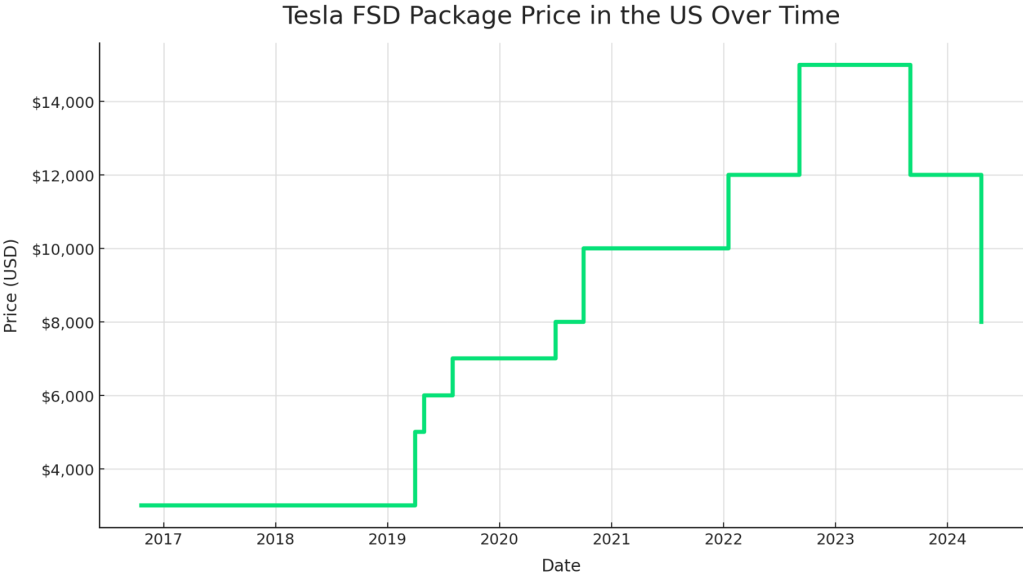
Tesla has even sold a software package, known as “Full Self-Driving Capability” (FSD), for up to $15,000 to customers, promising that the advanced driver-assist system would become fully autonomous through over-the-air software updates.


Almost a decade later, the promise has yet to be fulfilled, and Tesla has already confirmed that all vehicles produced between 2016 and 2023 don’t have the proper hardware to deliver unsupervised self-driving as promised.

Musk has been discussing the upgrade of the computers in these vehicles to appease owners, but there’s no concrete plan to implement it.

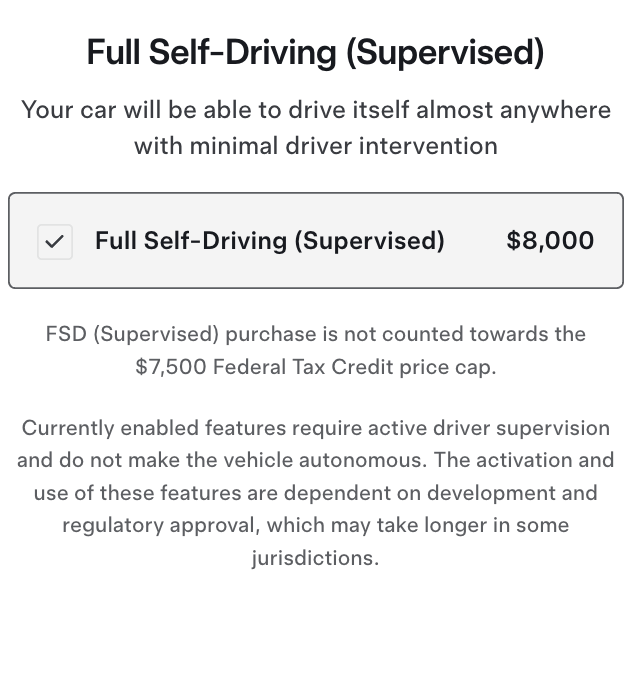
While there’s no doubt that Tesla has promised unsupervised self-driving capabilities to FSD buyers between 2016 and 2023, the automaker has since updated its language and now only sells “Full Self-Driving (Supervised)” to customers:

Screenshot-2025-09-05-at-2.07.54-PM.png

The fine print mentions that it doesn’t make the vehicle “autonomous” and doesn’t promise it as a feature.

In other words, people buying FSD today are not really buying the capability of unsupervised self-driving as prior buyers did.

Furthermore, Tesla’s board has just submitted a new, unprecedented CEO compensation package for shareholders’ approval, which could give Musk up to $1 trillion in stock options pending the achievement of certain milestones.

One of these milestones is Tesla having “10 Million Active FSD Subscriptions.”

At first glance, this would be hopeful for FSD buyers since part of Musk’s compensation would be dependent on delivering on the FSD promises.

However, Tesla has changed the definition of FSD in the compensation package with an extremely vague one”

“FSD” means an advanced driving system, regardless of the marketing name used, that is capable of performing transportation tasks that provide autonomous or similar functionality under specified driving conditions.
Tesla now considers FSD only an “advanced driving system” that should be “capable of performing transportation tasks that prove autonomous or similar functionality”.

The current version of FSD, which requires constant supervising by the driver, could easily fit that description.

Therefore, FSD now doesn’t come with the inital promise of Tesla owners being able to go to sleep in their vehicles and wake up at their destination – a promise that Musk has used to sell Tesla vehicles for years.

Electrek’s Take​

The way Tesla discusses autonomy with customers and investors versus how it presents it in its court filings and legally binding documents is strikingly different.

It should be worrying to anyone with an interest in this.

With this very vague description in the new CEO compensation package, Tesla could literally lower the price of FSD and even remove base Autopilot to push customers toward FSD and give Musk hundreds of billions of dollars in shares in the process.

Top comment by CRisner


Whoop. There it is.

Just like the comment years ago that Tesla would “open their network to non-Tesla’s by the end of the year” caused folks to think that suddenly non-Tesla vehicles worldwide would be able to use their Supercharger network, by year end, it turns out that a few charging stations in Norway opened up their CSS Tesla chargers to non-Tesla cars.

So technically correct, and accurate, but nothing like everyone thought would happen, especially in the USA.

I swear, anymore I feel its more interesting to wait for he “gotcha” from Tesla than it is to hear the intial announcement.

So today, Tesla puts a metric in place for Musk to be paid that includes a specific number of FSD cars on the road, then they change the definition of FSD to basically mean the same thing as their current Autopilot system. Suddenly every single Tesla meets the “FSD” definition.

Brilliant move. Check. Wonder what the next move will be.
View all comments

There’s precedent for Tesla decreasing pricing on FSD. Initially, Musk said that Tesla would gradually increase the price of the FSD package as the features improved and approached unsupervised autonomy.

That was true for a while, but then Tesla started slashing FSD prices, which are now down $7,000 from their high in 2023:

Screenshot-2025-09-05-at-2.33.55-PM.png

The trend is quite apparent and coincidentally began when Tesla’s sales started to decline.

FSD is now a simple ADAS system without any promise of unsupervised self-driving. This might quite honestly be one of the biggest cases of false advertising or bait-and-switch ever.

327 Comments
 
To view this content we will need your consent to set third party cookies.
For more detailed information, see our cookies page.

China's Car Safety Test Went SO Wrong!​


FSD is now a simple ADAS system without any promise of unsupervised self-driving. This might quite honestly be one of the biggest cases of false advertising or bait-and-switch ever.

How can you have unsupervised FSD when no country on the planet allows it on all of its streets.

Even Waymo which has had no drivers for like 7 years can't get nationwide approval.
 
Last edited:
To view this content we will need your consent to set third party cookies.
For more detailed information, see our cookies page.


translation:

XP-He Xiaopeng​

2025-12-11 15:04 Posted from the United States

An Interesting Bet​

Our VLA 2.0 will be released next quarter. As it's the first version, we must proceed steadily and surely, yet we also aim for a stunning debut, so the pressure is immense. Therefore, after test-driving FSD in Silicon Valley in mid-2024, I recently returned to Silicon Valley. Yesterday, I test-drove and compared the latest FSD V14.2 version and a Robotaxi.

The overall feeling is that FSD, which over a year ago provided a smooth L2+ advanced driver-assistance experience, has now entered a (software) quasi-L4 reassurance phase. During about 5 hours of test-driving in Silicon Valley and San Francisco, both the standard vehicle and the Robotaxi performed consistently using the same model—reassuringly stable. Although there were minor flaws, the level has significantly surpassed last year's standard. Our colleagues will share related videos with everyone at a later stage. This test drive has further strengthened my belief that the future will be an era of one self-driving system and one hardware architecture, divided into private Robo cars and shared Robotaxis. Everyone can skip L3 and directly enjoy a car with L4 capability.

Due to time constraints, our first version cannot yet achieve all the capabilities of the current FSD V14.2. However, while having dinner with the team today, I made a bet with the self-driving team. If by August 30, 2026, our VLA achieves the overall effect of FSD V14.2 in Silicon Valley within China, I will establish a very distinctive Chinese-flavored cafeteria in Silicon Valley, modeled after XPeng's current headquarters canteen. If we fail to achieve it, our Autonomous Driving Head, Xianming, has promised to run naked on the Golden Gate Bridge. Our entire team believes they will win a delicious cafeteria. Who do you think will win?


154119250-august-3-2020-mountain-view-ca-usa-xmotors-ai-headquarters-in-silicon-valley-xmotors-ai-is.avif

XPeng's self driving team is located in the US... :unsure:
 
Last edited:
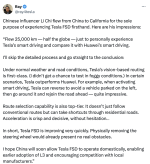
So Chinese Tesla owners have been using a modified US version of FSD…now they can build a custom one using video captured from Chinese cars.

Tesla now has AI training capability in China, a critical step for Full Self-Driving​


Tesla has launched an artificial intelligence training center in China, a critical development for the automaker’s Full Self-Driving (FSD) ambitions in the world’s largest electric vehicle market.

China’s AI training center now operational​

Tesla Vice President Grace Tao confirmed on Friday that the company has put an AI training center into operation in China, focusing on developing local assisted driving and AI capabilities.

Speaking to Shanghai-based financial news outlet Cailian, Tao said the center has “sufficient computing power to support development of assisted-driving features,” though she did not disclose details such as the center’s location, investment size, or specific computational capacity.

The announcement marks a significant milestone for Tesla’s FSD rollout in China. Due to the country’s strict data localization laws, Tesla has been prohibited from transferring driving data collected on Chinese roads to its US-based training infrastructure. This has been a major handicap for the company’s neural network-based self-driving system, which learns from real-world driving scenarios.

Why local training matters​

Tesla’s FSD relies on a neural network trained using video clips from real driving situations, enabling vehicles to make human-like decisions. The system has been trained on billions of miles of data from Tesla vehicles in the US and other markets.

However, in China, Tesla hasn’t been able to leverage this approach. When Tesla initially launched FSD in China in February 2025, CEO Elon Musk acknowledged the company “just used publicly available video on the Internet of roads and signs in China and used that to train in simulation.”

This workaround was far from ideal. Chinese roads present unique challenges, from different traffic patterns and signage to specific driving behaviors, that require localized training data to handle effectively.

With a local AI training center, Tesla can now:

  • Train its neural network on actual Chinese driving data collected from local Tesla vehicles
  • Iterate and improve the system specifically for Chinese road conditions
  • Comply with data localization requirements while still advancing FSD capabilities


=======================


To view this content we will need your consent to set third party cookies.
For more detailed information, see our cookies page.
 
Last edited:
To view this content we will need your consent to set third party cookies.
For more detailed information, see our cookies page.


To view this content we will need your consent to set third party cookies.
For more detailed information, see our cookies page.


teslafsd.png
 
huawei.png

To view this content we will need your consent to set third party cookies.
For more detailed information, see our cookies page.
 

Tesla officially confirms FSD Supervised is available in China​

...
The most critical development came in February 2026, when Tesla Vice President Grace Tao confirmed to Cailian that the company had put an AI training center into operation in China, creating a closed-loop pipeline — data collection, local storage, domestic model training, vehicle deployment, and iterative improvement — without data leaving the country.


Tesla FSD Wows Chinese Drivers — What's Behind the Buzz​

Less than two weeks after Tesla officially launched its supervised self-driving system in China, early users are reacting with genuine surprise — and the videos are spreading fast. Whole Mars Catalog, one of the most closely watched Tesla commentators on X, shared footage this week showing Chinese drivers visibly stunned by what the system can do in real-world urban conditions.

To view this content we will need your consent to set third party cookies.
For more detailed information, see our cookies page.


To view this content we will need your consent to set third party cookies.
For more detailed information, see our cookies page.

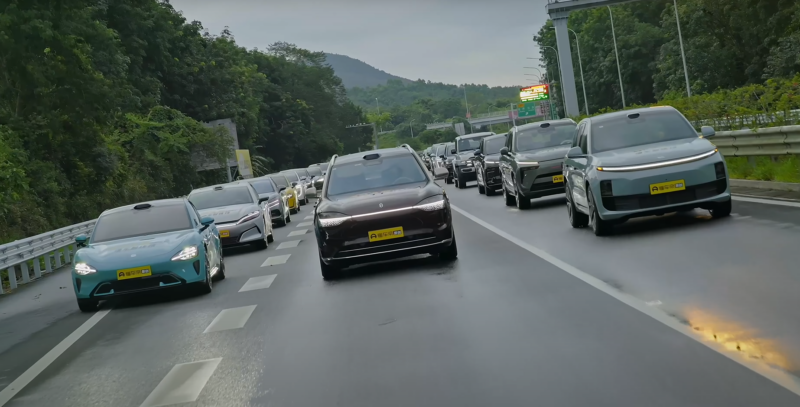
Li Auto L6, Huawei Stelato S9, Xiaomi Yu7, vs Tesla
 
Last edited:
I am not convinced of any kind of autonomous driving yet. I got to witness first hand lidar in action by sitting in the backseat of a human driven taxi. By the time the car on the side appeared on the display screen, it would have been too late to avoid a collision if it or you wanted to change lane. Seems to me old fashioned visual inspection of the side mirror could afford you a way faster reaction than relying on the lidar to scan the side of the car then display it on the cockpit display.

Technology sometimes works backward.
 

Users who are viewing this thread

Country Watch Latest

Back
Top