Hendarto
Registered Member


Amazing CM 401

 www.scmp.com

Zhang Tongin Beijing
Published: 5:58pm, 14 May 2025
Chinese state media has hailed what is believed to be the first combat use of the country’s hypersonic missiles, after Pakistan claimed they were used to destroy an Indian S-400 air defence system last week.
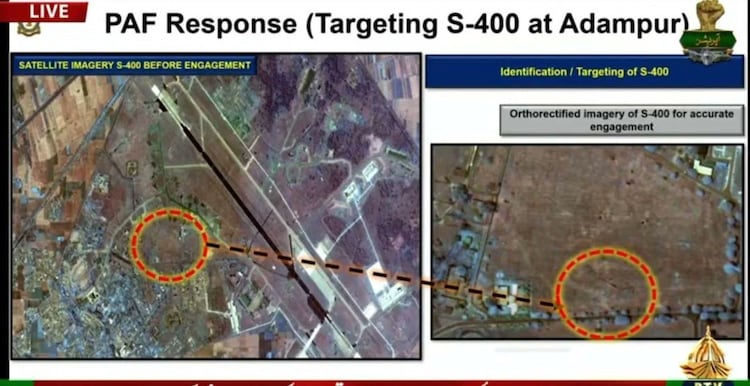
Describing it as the dawn of a new era in warfare, official news agency Xinhua reported on Saturday that Pakistan’s air strike had destroyed India’s Russian-built air defence system in Adampur, in the border state of Punjab.
Tensions escalated last week between India and Pakistan after New Delhi launched air strikes on Pakistan-administered Kashmir on Wednesday. India said it was responding to a militant attack on tourists in Indian-administered Kashmir last month – a deadly attack that Islamabad has denied being involved in.
https://archive.vn/o/70rKb/https://...g&embeds_referring_euri=https://www.scmp.com/
After India and Pakistan trade blows over Kashmir, will their ceasefire hold?
Following days of military exchanges, the two neighbours agreed to a ceasefire on Saturday that appears to be holding.
During the fighting, Pakistan carried out a strike that was “executed using hypersonic missiles launched from the JF-17”, a Chinese fighter jet, Xinhua reported, quoting a statement from Pakistan’s military.
“Precision-guided munitions were used to neutralise the advanced air defence asset,” the statement said.
Footage released by Pakistani authorities shows two CM-400AKG missiles, made by the China Aerospace Science and Industry Corporation, or CASIC, being used to carry out the mission.
Details of the technology behind the operation were revealed days later by China Space News, a state-controlled publication co-sponsored by CASIC and China Aerospace Science and Technology Corporation.
The China Space News report on Tuesday highlighted the speed and manoeuvrability of the missiles, but also what it called a breakthrough in their guidance technology.
It said precision guidance was the key to “stand-off strikes” – attacks launched from beyond the reach of enemy defences such as the one that destroyed India’s air defence system.
The Chinese hypersonic missiles use a guidance system that combines technologies such as inertial navigation and satellite positioning that makes them more accurate, gives them a longer range and makes them harder to jam, according to the report. As a result, it said strikes could now target specific high-value threats rather than relying on broad area attacks.
“This breakthrough in precision guidance technology lays the foundation for beyond-visual-range strikes,” the report said.
It also highlighted the use of “man-in-the-loop” technology, where operators can adjust targets in real time as the missile nears impact – useful for hitting moving or suddenly detected targets.
It said faster engines also helped the missiles break through enemy defences quicker, leaving less time for interception.

The Russian S-400 Triumf is one of the world’s most advanced air defence systems. Photo: AFP
Modern stand-off strikes no longer depend on a single weapon or platform, instead using a coordinated network of launchers, early warning aircraft, drones and satellites. The aircraft and satellites provide real-time target data, while drones handle scouting and damage checks.
That means launch platforms can fire from hidden locations and retreat quickly, while other parts of the system take over guidance, making the operation safer and more effective.
These advanced strike methods are also used by other lower cost weapons like upgraded rocket launchers and drones, which are now part of wider, coordinated attack networks. Rocket artillery, once used mainly for area bombardment, has become more precise thanks to modular designs and satellite-guided targeting, allowing it to strike both frontline and deep targets in real time.
Drones and loitering munitions are also playing a growing role. They can fly at low altitudes to avoid detection and offer a cheaper, more flexible way to carry out stand-off strikes with support from artificial intelligence.
The Indian air defence system destroyed last week – the S-400 Triumf – is one of the world’s most advanced, made by Almaz-Antey, Russia’s largest arms maker. It costs around US$1.5 billion and can hit targets up to 400km (250 miles) away and at an altitude of 30km (98,000 feet), including fighter jets, drones, cruise missiles and ballistic missiles.
Xinhua in its report cited military analysts as saying that the destruction of the S-400 could have far-reaching implications for India’s aerial defence and regional deterrence.
China reveals tech ‘breakthrough’ behind Pakistan’s hypersonic strike on India
Chinese missiles were used by Pakistan to destroy an Indian air defence system last week in what is believed to be their first combat use.
www.scmp.com
China reveals tech ‘breakthrough’ behind Pakistan’s hypersonic strike on India
Chinese missiles were used by Pakistan to destroy an Indian air defence system last week in what is believed to be their first combat use
Zhang Tongin Beijing
Published: 5:58pm, 14 May 2025
Chinese state media has hailed what is believed to be the first combat use of the country’s hypersonic missiles, after Pakistan claimed they were used to destroy an Indian S-400 air defence system last week.
Describing it as the dawn of a new era in warfare, official news agency Xinhua reported on Saturday that Pakistan’s air strike had destroyed India’s Russian-built air defence system in Adampur, in the border state of Punjab.
Tensions escalated last week between India and Pakistan after New Delhi launched air strikes on Pakistan-administered Kashmir on Wednesday. India said it was responding to a militant attack on tourists in Indian-administered Kashmir last month – a deadly attack that Islamabad has denied being involved in.
https://archive.vn/o/70rKb/https://...g&embeds_referring_euri=https://www.scmp.com/
After India and Pakistan trade blows over Kashmir, will their ceasefire hold?
Following days of military exchanges, the two neighbours agreed to a ceasefire on Saturday that appears to be holding.
During the fighting, Pakistan carried out a strike that was “executed using hypersonic missiles launched from the JF-17”, a Chinese fighter jet, Xinhua reported, quoting a statement from Pakistan’s military.
“Precision-guided munitions were used to neutralise the advanced air defence asset,” the statement said.
Footage released by Pakistani authorities shows two CM-400AKG missiles, made by the China Aerospace Science and Industry Corporation, or CASIC, being used to carry out the mission.
Details of the technology behind the operation were revealed days later by China Space News, a state-controlled publication co-sponsored by CASIC and China Aerospace Science and Technology Corporation.
The China Space News report on Tuesday highlighted the speed and manoeuvrability of the missiles, but also what it called a breakthrough in their guidance technology.
It said precision guidance was the key to “stand-off strikes” – attacks launched from beyond the reach of enemy defences such as the one that destroyed India’s air defence system.
The Chinese hypersonic missiles use a guidance system that combines technologies such as inertial navigation and satellite positioning that makes them more accurate, gives them a longer range and makes them harder to jam, according to the report. As a result, it said strikes could now target specific high-value threats rather than relying on broad area attacks.
“This breakthrough in precision guidance technology lays the foundation for beyond-visual-range strikes,” the report said.
It also highlighted the use of “man-in-the-loop” technology, where operators can adjust targets in real time as the missile nears impact – useful for hitting moving or suddenly detected targets.
It said faster engines also helped the missiles break through enemy defences quicker, leaving less time for interception.
The Russian S-400 Triumf is one of the world’s most advanced air defence systems. Photo: AFP
Modern stand-off strikes no longer depend on a single weapon or platform, instead using a coordinated network of launchers, early warning aircraft, drones and satellites. The aircraft and satellites provide real-time target data, while drones handle scouting and damage checks.
That means launch platforms can fire from hidden locations and retreat quickly, while other parts of the system take over guidance, making the operation safer and more effective.
These advanced strike methods are also used by other lower cost weapons like upgraded rocket launchers and drones, which are now part of wider, coordinated attack networks. Rocket artillery, once used mainly for area bombardment, has become more precise thanks to modular designs and satellite-guided targeting, allowing it to strike both frontline and deep targets in real time.
Drones and loitering munitions are also playing a growing role. They can fly at low altitudes to avoid detection and offer a cheaper, more flexible way to carry out stand-off strikes with support from artificial intelligence.
The Indian air defence system destroyed last week – the S-400 Triumf – is one of the world’s most advanced, made by Almaz-Antey, Russia’s largest arms maker. It costs around US$1.5 billion and can hit targets up to 400km (250 miles) away and at an altitude of 30km (98,000 feet), including fighter jets, drones, cruise missiles and ballistic missiles.
Xinhua in its report cited military analysts as saying that the destruction of the S-400 could have far-reaching implications for India’s aerial defence and regional deterrence.