India-Pakistan battle of drones triggers new South Asia arms race
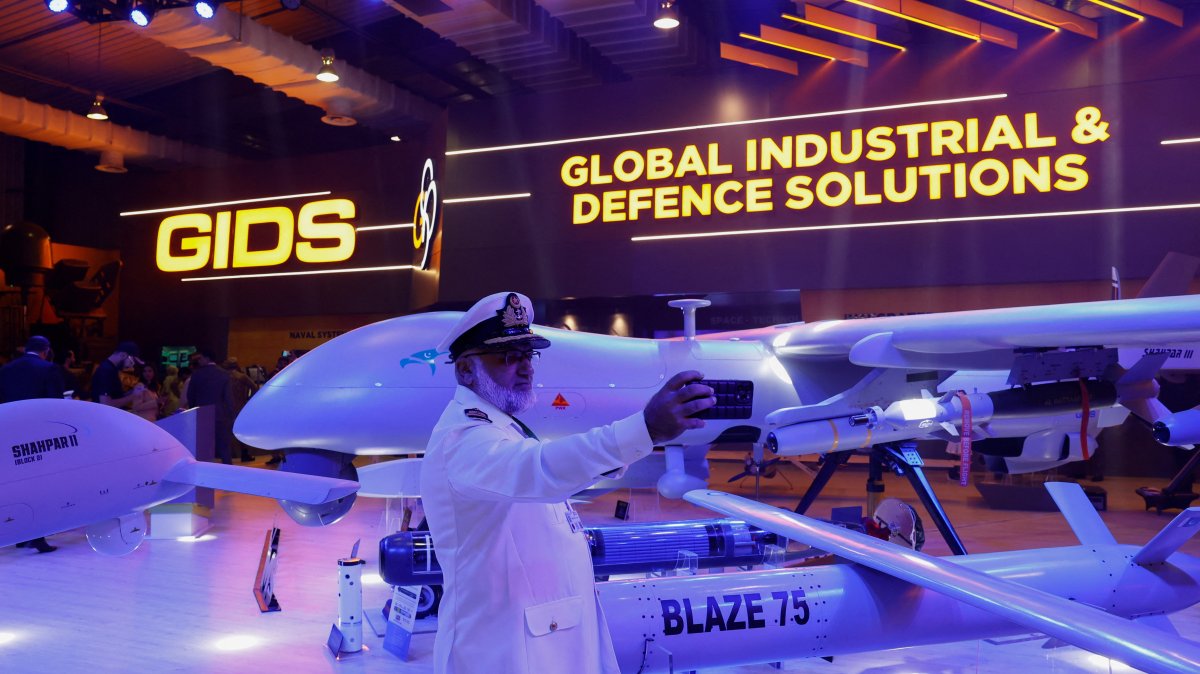
A member of the Pakistan armed forces takes a selfie with an unmanned combat aerial vehicle during IDEAS 2024 in Karachi, Pakistan, Nov. 21, 2024. (Reuters Photo)
by Reuters May 27, 2025 3:56 pm
Alittle after 8:00 p.m. on May 8, red flares streaked through the night sky over the northern Indian city of Jammu as its air-defense systems opened fire on drones from neighboring Pakistan.
The Indian and Pakistani militaries have deployed high-end fighter jets, conventional missiles and artillery during decades of clashes but the four days of fighting in May marked the first time New Delhi and Islamabad utilized unmanned aerial vehicles (UAVs) at scale against each other.
The fighting halted after the
U.S. announced it brokered a cease-fire but the South Asian powers, which spent over $96 billion on defense last year, are now locked in a drones arms race, according to Reuters' interviews with 15 people, including security officials, industry executives and analysts in the two countries.
Two of them said they expect increased use of UAVs by the nuclear-armed neighbors because small-scale drone attacks can strike targets without risking personnel or provoking uncontrollable escalation.
India plans to invest heavily in local industry and could spend as much as $470 million on UAVs over the next 12 to 24 months, roughly three times pre-conflict levels, said Smit Shah of Drone Federation India, which represents over 550 companies and regularly interacts with the government.
The previously unreported forecast, which came as India this month approved roughly $4.6 billion in emergency military procurement funds, was corroborated by two other industry executives.
The Indian military plans to use some of that additional funding on combat and surveillance drones, according to two Indian officials familiar with the matter.
Defense procurement in India tends to involve years of bureaucratic processes but officials are now calling drone makers in for trials and demonstrations at an unprecedented pace, said Vishal Saxena, a vice president at Indian UAV firm ideaForge Technology.
The Pakistan Air Force, meanwhile, is pushing to acquire more UAVs as it seeks to avoid risking its high-end aircraft, said a Pakistani source familiar with the matter.
Pakistan and India both deployed
cutting-edge generation 4.5 fighter jets during the latest clashes but cash-strapped Islamabad only has about 20 high-end Chinese-made J-10 fighters compared to the three dozen Rafales that Delhi can muster.
Pakistan is likely to build on existing relationships to intensify collaboration with China and Türkiye to advance domestic drone research and production capabilities, said Oishee Majumdar of defense intelligence firm Janes.
Islamabad is relying on a collaboration between Pakistan's National Aerospace Science and Technology Park and Turkish defense contractor Baykar that locally assembles the YIHA-III drone, the Pakistani source said, adding a unit could be produced domestically in two to three days.
Pakistan's military declined to respond to Reuters' questions. The Indian Defense Ministry and Baykar did not return requests for comment.
India and Pakistan "appear to view drone strikes as a way to apply military pressure without immediately provoking large-scale escalation," said King's College London political scientist Walter Ladwig III.
"UAVs allow leaders to demonstrate resolve, achieve visible effects, and manage domestic expectations – all without exposing expensive aircraft or pilots to danger," he added.
But such skirmishes are not entirely risk-free, and Ladwig noted that countries could also send UAVs to attack contested or densely populated areas where they might not previously have used manned platforms.
Drone swarms, vintage guns
The fighting in May, which was the fiercest in this century between the neighbours, came after an
April 22 attack in the disputed Himalayan region of Kashmir that killed 26 people.
Delhi blamed the killings on "terrorists" backed by Islamabad, which denied the charge. Indian Prime Minister Narendra Modi vowed revenge and Delhi on May 7 launched airstrikes on what it described as "terrorist infrastructure" in Pakistan.
The next night, Pakistan sent hordes of drones along a 1,700-kilometer (772-mile) front with India, with between 300 and 400 of them pushing in along 36 locations to probe Indian air defenses, Indian officials have said.
Pakistan depended on Turkish-origin YIHA-III and Asisguard Songar drones, as well as the Shahpar-II UAV produced domestically by the state-owned Global Industrial & Defense Solutions conglomerate, according to two Pakistani sources.
But much of this drone deployment was cut down by Cold War-era Indian anti-aircraft guns that were rigged to modern military radar and communication networks developed by state-run Bharat Electronics, according to two Indian officials.
A Pakistani source denied that large numbers of its drones were shot down on May 8, but India did not appear to sustain significant damage from that drone raid.
India's use of the anti-aircraft guns, which had not been designed for anti-drone warfare, turned out to be surprisingly effective, said retired Indian Brig. Anshuman Narang, now an UAV expert at Delhi's Centre for Joint Warfare Studies.
"Ten times better than what I'd expected," he said.
India also sent Israeli HAROP, Polish WARMATE and domestically-produced UAVs into Pakistani airspace, according to one Indian and two Pakistani sources. Some of them were also used for precision attacks on what two Indian officials described as military and militant infrastructure.
The two Pakistani security sources confirmed that India deployed a large number of the HAROPs – a long-range loitering munition drone manufactured by Israel Aerospace Industries.
Such UAVs, also known as suicide drones, stay over a target before crashing down and detonating on impact. Pakistan set up decoy radars in some areas to draw in the HAROPs, or waited for their flight time to come towards its end, so that they fell below 3,000 feet and could be shot down, a third Pakistani source said.
Both sides claim to have notched victories in their use of UAVs.
India successfully targeted infrastructure within Pakistan with minimal risk to personnel or major platforms, said KCL's Ladwig. For Pakistan's military, which claimed to have struck Indian defense facilities with UAVs, drone attacks allow it to signal action while drawing less international scrutiny than conventional methods, he noted.
Cheap but with Achilles heel
Despite the loss of many drones, both sides are doubling down.
"We're talking about relatively cheap technology," said Washington-based South Asia expert Michael Kugelman. "And while UAVs don't have the shock and awe effect of missiles and fighter jets, they can still convey a sense of power and purpose for those that launch them."
Indian defense planners are likely to expand domestic development of loitering munitions UAVs, according to an Indian security source and Sameer Joshi of Indian UAV maker NewSpace, which is deepening its research and development on such drones.
"Their ability to loiter, evade detection, and strike with precision marked a shift toward high-value, low-cost warfare with mass-produced drones," said Joshi, whose firm supplies the Indian military.
And firms like ideaForge, which has supplied over 2,000 UAVs to the Indian security forces, are also investing on enhancing the ability of its drones to be less vulnerable to electronic warfare, said Saxena.
Another vulnerability that is harder to address is the Indian drone program's reliance on hard-to-replace components from China, an established military partner of Pakistan, four Indian drone makers and officials said.
India continues to depend on China-made magnets and lithium for UAV batteries, said Drone Federation India's Shah.
"Weaponization of the supply chain is also an issue," said ideaForge's Saxena on the possibility of Beijing shutting the tap on components in certain situations.
For instance, Chinese restrictions on the sale of drones and components to Ukraine have weakened Kyiv's ability to produce critical combat drones, according to the Center for Strategic and International Studies think-tank.
A spokesperson for China's Foreign Ministry said in response to Reuters' questions that Beijing has always implemented export controls on dual-use items in accordance with domestic laws and regulations as well as its international obligations.
"Diversification of supply chain is a medium to long-term problem," said Shah. "You can't solve it in the short term."