PL-15E and HQ-16FE improvements needed?

The PFX need not be a twin engine behemoth, but a successor to the and-17 and J-10. A backbone single engine fighter, with the WS-10B engine (or perhaps even a WS-15 export approved version eventually) but with shaping that improved its chances at survival.

Look at the FS2020 design from SAAB, built around a planned 190 kn engine.

But instead of aiming for extreme maneuverability, it’s improved electrical power and ability to carry the most modern munitions, along with a focus on EW, it can hope to form a robust backbone. Perhaps even for under $50 million a copy?

So for decent aircraft purpose built to deal with the Russians, the likely supplier of India’s 5th Gen fighter, look to SAAB and what they are working on.

To view this content we will need your consent to set third party cookies.
For more detailed information, see our cookies page.


View attachment 121462
View attachment 121463

I really love your SAAB example but honestly maybe I'm wrong but I don't see the purpose of this until at least meets two very niche criteria:

1. Its procurement price is cheaper or at least equal to the J-10C [Pakistan's cheaper labour costs vs Chinese economies of scale]

2. Its capabilities/specs are decisively superior to the J-10C and can fit advanced armaments (including PL-15E, maybe future export PL-17E variants) — with wingtips and more hardpoints & payload.

This can justify both its development and procurement, rather than just stacking up on more imported Chinese J-10Cs.

Without this the cost-benefit analysis to me doesn't add up.
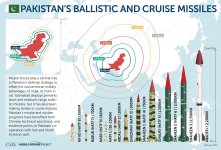
 
I am also a bit surprised about Pakistan's limitation in missile arsenal, Iran seems to be much ahead in this field compared with Pakistan.
Yeah, it only has subsonic cruise missiles going up to 600KM range. (Babur and Ra'ad 2).

It's ballistic missiles mostly seem orientated for the strategic nuclear role (Shaheen 1-2-3) and I question how survivable most are, Ababeel is a MIRV so some hope there but no HGV.

It was only until recently the Fatah series started development, which seem to be a tactical SSM program. The latest one Fatah 3 seems to have 450KM so far, and Fatah-4 is under development for 700KM.

An outdated infographic below:

1000020625.jpg
 
I am also a bit surprised about Pakistan's limitation in missile arsenal, Iran seems to be much ahead in this field compared with Pakistan.

To be fair, if your talking about the recent/current conflict Pakistan didn't use it's missile arsenal

It used the Fatah 1 and 2 system, drones and the CM400 from China

Pakistan has cruise missiles, air launched cruise missiles, various ballistic missiles of various ranges, MIRV capable missiles which would be used in a longer or more intense conflict

It does however need to continue pushing development to ensure parity with our enemies
 
What about the wide range of cruise and ballistic missile arsenal we already have. The so called tests they conduct every year.
All nuclear capable. Can be used but can trigger a nuclear reaction under misconception of being a nuclear strike from Pakistan. So, need something which is declared non-nuclear like Indian Brahmos. Furthermore, Babur and Raad are very slow missiles for current standard. We need something in high-supersonic (Mach 2.5.-3) or Hypersonic (> Mach 5) cruise missile. Indian Brahmos is Mach 2.8-3.
 
If fired ballistically, wouldn’t the PL-15s flight profile match that of the Phoenix missile? Range out to 100 nautical miles (190 km) with the cruising phase at 24-30 km? Don’t missile fins start to lose their maneuverability above 20 km due to lower air density?
Yes, airfoils would start to lose their efficacy. But this isn’t a concern for two reasons

If the target is making minor course corrections, given the distance between the PL-15 and the target at this stage, deviations in the target’s trajectory would generate very minor needed adjustment in angular velocity. AIM-54 relied on comparatively large fins and control surfaces, modern long ranged missiles like PL-15, PL-17, and AIM-260 introduced advanced flight controls that allowed the missile body itself to be used as a control surface and maintain a low drag silhouette

If the target for some reason is alerted to the incoming missile during this stage and start to conduct evasive maneuvers, dropping altitude, violently crank or even turn cold, then the missile wouldn’t have been able to reach the target regardless of what trajectory it may have taken.
 
I really love your SAAB example but honestly maybe I'm wrong but I don't see the purpose of this until at least meets two very niche criteria:

1. Its procurement price is cheaper or at least equal to the J-10C [Pakistan's cheaper labour costs vs Chinese economies of scale]

2. Its capabilities/specs are decisively superior to the J-10C and can fit advanced armaments (including PL-15E, maybe future export PL-17E variants) — with wingtips and more hardpoints & payload.

This can justify both its development and procurement, rather than just stacking up on more imported Chinese J-10Cs.

Without this the cost-benefit analysis to me doesn't add up.
Your right that better performance in tangible metrics and cost will have to be meet to justify Such an expenditure. The J-10 at $40 million is a great platform.

Therefor it would probably be best for the PAF to make the “PFX” not a platform but a program to reduce the effective detectability of its platforms. A “Have glass” style of program to reduce the signature of JF-17s and J-10s would probably be best.

The PFX money could also be well spend building a J-10 rebuild factory and if not manufacturing parts, being very capable of maintaining them, as part of a strategy to buy dozens more J-10s.

Considering the financial and political cost of maintaining and operating, not to mention potentially upgrading the F-16s, the PAF may have to look at a strategy where it may have quietly phasing out the F-16 from frontline service, alongside the retirement of the F-7PGs and Mirages. In a 20 squadron fleet, with 2 squadrons of J-35As, and 10 squadrons of JF-17s, the PAF could start with a goal of 4 squadrons of J-10s (3 more than the current fleet) and eventually progress to 6-8 squadrons; go from 72 fighters and move up to 108-144. At those numbers and at $40 million an airframe, that would be $720 million per squadron and probably $1 billion all in if you count support and munitions.

Money intended for the PFX program could, for example, be used to develop jammer pods for an Electronic attack variant of the J-35 for protection over Pakistan and any units operating beyond the borders of Pakistan.

I would also hope the J-10s could get an improved engine so at least one oversized squadron (24 aircraft) could be an electronic attack variant, and able to carry a “PL-17E” in the HARM role.

 
Last edited:
Yes, airfoils would start to lose their efficacy. But this isn’t a concern for two reasons

If the target is making minor course corrections, given the distance between the PL-15 and the target at this stage, deviations in the target’s trajectory would generate very minor needed adjustment in angular velocity. AIM-54 relied on comparatively large fins and control surfaces, modern long ranged missiles like PL-15, PL-17, and AIM-260 introduced advanced flight controls that allowed the missile body itself to be used as a control surface and maintain a low drag silhouette

If the target for some reason is alerted to the incoming missile during this stage and start to conduct evasive maneuvers, dropping altitude, violently crank or even turn cold, then the missile wouldn’t have been able to reach the target regardless of what trajectory it may have taken.
And you don’t believe lateral thrusters could improve the ability of the missile to be able to efficiently engage a target alerted to the incoming missile and employing violent cranking or notching?
 
The title of this thread should be changed to a generic Pakistani missile discussion thread IMO.

Pakistani missile discussions | BM, CM, MLRS, ALCM, ALBM, PGB
 
The title of this thread should be changed to a generic Pakistani missile discussion thread IMO.

Pakistani missile discussions | BM, CM, MLRS, ALCM, ALBM, PGB
PL-15 currently being one of the best if not the best aam is more than enough to handle the situation in South Aisa for at least another five-ten years, even it's export version.
 
I really hope the Chinese satellites release the information about the Pakistan kills

it would be great for both nations
It is high time that the situation in South Asia cools down rather than continuing to fuel hostility between the two sides. Continuing tensions are not in the global interest, especially not in Pakistan's. India is indeed much more powerful than Pakistan. Let India earn its decency and then reap the real benefits in the ensuing water negotiations.

Waiting patiently and letting India's boasts and rumors continue to fester, and when it reaches its peak, China will then publish the evidence bit by bit, which will maximize humiliation and undermine the credibility of its adversary. Just as China did in the Galwan River case.

The air battle took place right near China's Western Military Region Command, and China must have intercepted all electronic signals and possessed sufficient evidence. The West understands this which is why they admit Rafale was shot down and are not willing to go along with India's lies. So we don't have to rush at all, let the Indians keep digging the hole and see who gets buried in it in the end.
 
Your right that better performance in tangible metrics and cost will have to be meet to justify Such an expenditure. The J-10 at $40 million is a great platform.

Therefor it would probably be best for the PAF to make the “PFX” not a platform but a program to reduce the effective detectability of its platforms. A “Have glass” style of program to reduce the signature of JF-17s and J-10s would probably be best.

The PFX money could also be well spend building a J-10 rebuild factory and if not manufacturing parts, being very capable of maintaining them, as part of a strategy to buy dozens more J-10s.

Considering the financial and political cost of maintaining and operating, not to mention potentially upgrading the F-16s, the PAF may have to look at a strategy where it may have quietly phasing out the F-16 from frontline service, alongside the retirement of the F-7PGs and Mirages. In a 20 squadron fleet, with 2 squadrons of J-35As, and 10 squadrons of JF-17s, the PAF could start with a goal of 4 squadrons of J-10s (3 more than the current fleet) and eventually progress to 6-8 squadrons; go from 72 fighters and move up to 108-144. At those numbers and at $40 million an airframe, that would be $720 million per squadron and probably $1 billion all in if you count support and munitions.

Money intended for the PFX program could, for example, be used to develop jammer pods for an Electronic attack variant of the J-35 for protection over Pakistan and any units operating beyond the borders of Pakistan.

I would also hope the J-10s could get an improved engine so at least one oversized squadron (24 aircraft) could be an electronic attack variant, and able to carry a “PL-17E” in the HARM role.

One of the reasons why I lean towards Pakistan diverting its R&D resources to a heavy stealth UCAV is because in the 5th generation domain we already have both the J-35 and KAAN lined up, with hopefully at least one getting local production line. These will likely fill the manned asset of our 5th generation ecosystem.

But a major gap may still be available for an unmanned 'loyal wingman' type asset for MUM-T (manned-unmanned teaming) — and hence it sets our local industry with a more realistically achievable goal that they can work towards and can also fit into PAFs inventory in a sizeable amount.

When it comes to 5th gens, or more 4.5th gens, it seems they are already filled, with infrastructure planned to be built around those specific platforms and easier to expand the numbers around that.
 
The title of this thread should be changed to a generic Pakistani missile discussion thread IMO.

Pakistani missile discussions | BM, CM, MLRS, ALCM, ALBM, PGB
I wanted a thread to focus on these economical A2A or SAM missiles, and what incremental upgrades could make them a whole lot more effective. Missiles focused on enemy fighters and their munitions. A focus on a solid defensive capability, which might get overlooked in the desire to focus on the offense.
 
One of the reasons why I lean towards Pakistan diverting its R&D resources to a heavy stealth UCAV is because in the 5th generation domain we already have both the J-35 and KAAN lined up, with hopefully at least one getting local production line. These will likely fill the manned asset of our 5th generation ecosystem.

But a major gap may still be available for an unmanned 'loyal wingman' type asset for MUM-T (manned-unmanned teaming) — and hence it sets our local industry with a more realistically achievable goal that they can work towards and can also fit into PAFs inventory in a sizeable amount.

When it comes to 5th gens, or more 4.5th gens, it seems they are already filled, with infrastructure planned to be built around those specific platforms and easier to expand the numbers around them.

One of the reasons why I lean towards Pakistan diverting its R&D resources to a heavy stealth UCAV is because in the 5th generation domain we already have both the J-35 and KAAN lined up, with hopefully at least one getting local production line. These will likely fill the manned asset of our 5th generation ecosystem.

But a major gap may still be available for an unmanned 'loyal wingman' type asset for MUM-T (manned-unmanned teaming) — and hence it sets our local industry with a more realistically achievable goal that they can work towards and can also fit into PAFs inventory in a sizeable amount.

When it comes to 5th gens, or more 4.5th gens, it seems they are already filled, with infrastructure planned to be built around those specific platforms and easier to expand the numbers around that.
The risk with a UCAV, especially an expensive and elaborate platform is that the command link could be severed easily. This is why many nations are working on cheaper UCAVs.
 
PL-15 currently being one of the best if not the best aam is more than enough to handle the situation in South Aisa for at least another five-ten years, even its export version.
Reflecting on potential shortcomings can help improve it, so it is more able to deal with emerging threats; aircraft that know it’s coming and stealth aircraft.

As in the game of Go, we need to move to be better placed anticipating their moves.
 
Pakistan needs to increase it missile range to at least 10k km. Hindu terrorists next door have military bases litter across the Indian ocean and not just in their sh*thole of a nation. From Mauritius Islands to Maldives would need to be hit or targeted. They can easily launch nukes from those areas and hit Pakistan.
 

Users who are viewing this thread

Pakistan Defence Latest

Latest Posts

Back
Top