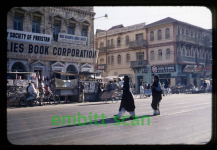
Zamzama Gun on display in Lahore, Circa 1950's.
The gun was used by Ahmed Shah in the battle of Panipat, in 1761. After the battle, on his way back to Kabul, he left it at Lahore with his governor, Khawaja Ubed, as the carriage that was supposed to take the gun to Kabul was not ready. The other gun he took with him but that one was lost in passage through the Chenab.
In 1762, Dhillon Jat Ruler Maharaja Hari Singh Bhangi went into battle with Khawaja Ubed. Bhangi attacked the then-village of Khawaja Said two miles from Lahore (now part of the city of Lahore), where the Mughal governor Khawaja Ubed had his arsenal, and seized his artillery, arms and ammunition. Amongst the guns captured was the Zamzama Gun itself. It was renamed by its Sikh captors Bhangi Toap.
For the next two years, it lay in the Shah Burj of the Lahore Fort. Thereafter, Raja Lehna Singh and Maharaja Gujjar Singh Bhangi got hold of it and they gave it to Sandhawalia Jat Ruler Charat Singh Shukerchakia as his share in the spoils. The Bhangi Sardars thought that Charat Singh would not be able to carry this gun with him and it would remain with them. Contrary to their expectations, Charat Singh successfully carried this gun to his fort at Gujranwala.
From Charat Singh, Zamzama was snatched by the Chathas who took it to Ahmadnagar where it became a bone of contention between the brothers Ahmad Khan chatha and Pir Muhammad chatha. In the fight that ensued, two sons of Ahmad Khan and one of Pir Muhammad were killed. In this fight, Gujjar Singh Bhangi sided with Pir Muhammad. After the victory, the gun was restored to Gujjar Singh. After two years, the gun was wrested by Charat Singh Shukerchakia from whom it was once again snatched by the Pashtuns.
Next year, Raja Jhanda Singh Bhangi defeated the Pashtuns of Chatha and brought the gun to Amritsar. In 1802, Ranjit Singh, after defeating the Bhangis, got hold of the gun. He used it in the battles of Daska, Kasur, Sujanpur, Wazirabad and Multan. In the siege of Multan, the gun was badly damaged.
Zamzama was severely damaged due to its use in the aforementioned wars and it had to be brought back to Lahore, unfit for any further use. It was placed outside Delhi Gate, Lahore, where it remained until 1860. When in 1864, Maulawi Nur Ahmad Chishti compiled the Tahqiqati Chishti, he found it standing in the Baradari of the garden of Wazir Khan, behind the Lahore Museum.
In 1870, it found a new asylum at the entrance of the Lahore Museum, then located in the Tollinton Market. It was placed in this position on the occasion of the Duke of Edinburgh’s visit to Lahore in 1870. When the present building of the museum was constructed it was removed further west and placed opposite the University Hall.
Repaired in 1977, the cannon now rests on Mall Road (Shahrah-e-Quaid-e-Azam) with Pharmacy Department, University of the Punjab on one side, and National College of Arts (NCA) and Lahore Museum on the other.