

This is all great, if you need a missile to go up against the US, you dont need an AESA seeker to go toe to toe with CM's. We can see that the missile is probably nowhere near as agile as CAMM based off of the OEM's datasheet and also its layout.I politely disagree. HQ-11’s primary design feature is not low costs-quite the contrary actually. Each individual interceptor, though having low diameters, comes with their own AESA ARH seekers, in stark contrast to other “low-cost” systems operated by PLA and PLAAF like HQ-22/FK-3 that maintained inexpensive SARH seekers despite larger missiles and improved kinematic performance.
From my understanding, HQ-11’s key descriptors should be independent, flexible, and resilient. One of the prominent feature that the HQ-11 have that is rarely seen in Chinese SAMs is this:
View attachment 125090
The system comes integrated with its own radar, a singular multi-purpose mechanically scanned AESA that can provide early warning and missile guidance, mounted on the TA450B chassis, which in PLA designation, is classified as a “special purpose vehicle” like chassis for truck howitzers and ballistic missile TELs, with stricter off-road and field mobility requirements compared to regular trucks.
To sum it up, the HQ-11 is a off-road capable vehicle; able to detect, acquire, and engage its own targets with minimal support units; with missiles capable of active homing to maximized firing channels (engaging as many targets simultaneously as possible); while carrying relatively numerous small-diameter missiles to ensure magazine depth, and able to operate in tandem with LD-3000 CIWS if that wasn’t enough.
A vehicle such as this is expected to be able to fulfill many roles, either as accompanying SAM coverage maneuvering with ground units, as supplementary reinforcements to other SAM batteries reacting to saturated attacks, or as a reactionary measure if other high value systems have been suppressed/damaged.
And no, there is currently no evidence that suggest that it wouldn’t be able to engage supersonic targets. We don’t know a lot about the kinematic performance of the missile actually.
Navigation
Install the app
How to install the app on iOS
Follow along with the video below to see how to install our site as a web app on your home screen.
Note: This feature may not be available in some browsers.
More options
Style variation
You are using an out of date browser. It may not display this or other websites correctly.
You should upgrade or use an alternative browser.
You should upgrade or use an alternative browser.
PAF SAM based Air Defense System - News, Discussion & Updates
- Thread starter CSAW
- Start date
More options
Who Replied?
hydrabadi_arab
Trusted Member
Suicidal considering you just have to look at the Russia/Ukraine war, where such standoff munitions are used on a daily basis yet capturing and holding land is done by troops, with Russia having the edge due to numbers.
Pakistan will not fight long war. That’s playing right in to Indian hand.
Pakistan need to deter India by maximum damage in minimum time. And if they want to escalate to nuclear war then so be it.

Ali_Baba
VIP Member

Suicidal considering you just have to look at the Russia/Ukraine war, where such standoff munitions are used on a daily basis yet capturing and holding land is done by troops, with Russia having the edge due to numbers.
Agree.
The answer is to grow the economy so that the defence expenditure Pakistan has, is not as much of an issue to support and maintain and in certain areas like the Airforce and Navy, to grow them.
Cesur
Registered Member
I have confidence in Pakistan’s radar, satellite, and electronic warfare capabilities, and I believe they will receive an even significant uplift from the Chinese in the coming days and months in this regard. The primary gap we face is our air defense system and our reaction time due to our narrow strategic depth and it may take over a year to match or exceed the performance of the S-400 and S-500. The Chinese have already outpaced the Russians in nearly every area, and certainly they’re working on this too. It’s only a matter of time. By contrast, India has few options and must rely solely on its own resources.You have to assume that India having seen PAFs soft kill capabilities will now work on trying to neutralise that capability, right? Make all CMs more resistant to soft-kills.
Waz
Administrator
Pakistan will not fight long war. That’s playing right in to Indian hand.
Pakistan need to deter India by maximum damage in minimum time. And if they want to escalate to nuclear war then so be it.
We have no guarantee of that. I agree with max damage in minimum time. But you can't hope to fight large troops formations with a smaller army.
Anyway, off-topic.

Harbyharb
Registered Member


Can you describe in more detail?This is all great, if you need a missile to go up against the US, you dont need an AESA seeker to go toe to toe with CM's. We can see that the missile is probably nowhere near as agile as CAMM based off of the OEM's datasheet and also its layout.
The FM-3000 does have an ARH seeker-
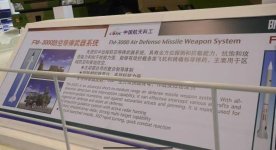
-the point I seek to make in the original post is that the FM-3000 is not designed to be the cheapest there is, but resilient against saturated strike, as the original FM-3000N billboard claim suggests, “Multi-target capability: Guiding 16 missiles to engage 16 targets” (simultaneously I presume).
Visually there’s little that suggest the missile have poor maneuverability, externally the missile employs a classic canard tail layout with gas rudder, a very common design for missiles designed for agility and maneuver authority during power phase. That, and, given in the PLA roster the HQ-11 replaced the HQ-7 SHORAD I see no reason why the missile would be not as agile as, say, CAMM.
Waz
Administrator
Agree.
The answer is to grow the economy so that the defence expenditure Pakistan has, is not as much of an issue to support and maintain and in certain areas like the Airforce and Navy, to grow them.
Yep, the economy should be the focus.
sutton9999
Registered Member

Brahmas is high flying, easy to detect when within range.
Brohmas can do low flying over sea with a less than 40% range (about 100km).
The reason some Brahmas escape AD:
1. Mainly counter it with EW.
2. saturation attack
3. outside the effective range of HQ9/HQ16
The likes of terrain-matching cruise missiles are far more difficult to counter.
Need an extensive radar network.
I assume the real damage was/will be done by the likes of Storm Shadow.
Brohmas can do low flying over sea with a less than 40% range (about 100km).
The reason some Brahmas escape AD:
1. Mainly counter it with EW.
2. saturation attack
3. outside the effective range of HQ9/HQ16
The likes of terrain-matching cruise missiles are far more difficult to counter.
Need an extensive radar network.
I assume the real damage was/will be done by the likes of Storm Shadow.

Khanivore
Trusted Member
Considering India’s recent strikes relied heavily on a mix of Israeli loitering drones (like Harop), air-launched stand-off weapons (SAWs), and BrahMos cruise missiles, Pakistan urgently needs a robust, sustainable last-layer defence system. China’s new “Metal Storm” system fits this role perfectly.
With its 16-barrel, 35mm configuration and firing rate of up to 400,000 rounds per minute, Metal Storm uses programmable AHEAD airburst ammo to destroy fast, low-flying threats like drones and cruise missiles within a 3–5 km radius. This makes it ideal for intercepting Harop drones, which have already proven effective in recent conflicts, as well as saturation missile attacks that could overwhelm traditional SAMs.
On land, Pakistan could deploy Metal Storm near vulnerable airbases, SAM sites, and radar stations -- precisely the kinds of targets India claims to have struck. It would act as a high-density firepower buffer after longer-range interceptors are spent or bypassed, giving commanders an affordable way to defend critical assets from swarm or precision attacks.
At sea, integrating this system into frontline warships -- especially the Type-054A/P frigates and e.g. Azmat-class fast attack craft -- would drastically boost close-in defence against BrahMos-class threats. It could also be a CIWS option for smaller patrol vessels operating in contested zones.
Strategically, this system is a cost-flipping tool. You don’t burn expensive SAMs on every drone or missile. Instead, you meet cheap loitering drones with cheap bullets -- preserving high-end interceptors for more dangerous threats. It also undermines the economic efficiency of India’s precision strike doctrine: when $1M munitions get defeated by dense bullet storms, that hurts confidence in future operations and procurement.
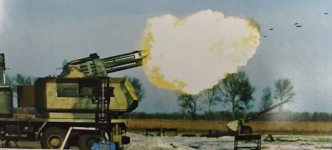
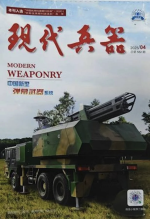
With its 16-barrel, 35mm configuration and firing rate of up to 400,000 rounds per minute, Metal Storm uses programmable AHEAD airburst ammo to destroy fast, low-flying threats like drones and cruise missiles within a 3–5 km radius. This makes it ideal for intercepting Harop drones, which have already proven effective in recent conflicts, as well as saturation missile attacks that could overwhelm traditional SAMs.
On land, Pakistan could deploy Metal Storm near vulnerable airbases, SAM sites, and radar stations -- precisely the kinds of targets India claims to have struck. It would act as a high-density firepower buffer after longer-range interceptors are spent or bypassed, giving commanders an affordable way to defend critical assets from swarm or precision attacks.
At sea, integrating this system into frontline warships -- especially the Type-054A/P frigates and e.g. Azmat-class fast attack craft -- would drastically boost close-in defence against BrahMos-class threats. It could also be a CIWS option for smaller patrol vessels operating in contested zones.
Strategically, this system is a cost-flipping tool. You don’t burn expensive SAMs on every drone or missile. Instead, you meet cheap loitering drones with cheap bullets -- preserving high-end interceptors for more dangerous threats. It also undermines the economic efficiency of India’s precision strike doctrine: when $1M munitions get defeated by dense bullet storms, that hurts confidence in future operations and procurement.
Last edited:
Ali_Baba
VIP Member
Integration i doubt will be a problem, all the assets are interlinked- tps77mrrs with hq-9s etc etc. Plus, if need be, CAMM can operate as a standalone sys paired to its other batteries or a network interface can be developed with the oem.
In terms of cost, in the bigger picture CAMM is the way forward IMO. Its a real shame and extremely infuriating the services did not adopt a common system. All 3 branches would have been extremely well served by camm, wed have probably been able to negotiate production facilities blah blah.
The reason why its important is really and truly, these Chinese systems are old. No matter how much lipstick you put on a pig, its still a pig. The missiles are derived from their soviet counterparts so suffer from the same limitations. The other aspect is, Chinas threat environment is SO different to ours. Their primary objective is the US, who does not deploy hypersonics extensively atm. But even more so, they have tons of depth so detection time is more reasonable. Even if China continued to modernise these missiles, they can free up a ton of space with new propellants electronics etc, but with their foe being the US, theyre probably packing in a ton of crazy advanced electronics, designed to face the US' EW might. Again, not an issue for us because the Indians havent really paid much heed to EW.
Beyond this, fundamentally, these missile systems are decades old. SAMs are a long term buy. At some point, the Chinese will lose interest in supporting these systems and then were buggered- we bought in so much, but did not setup any local supply chain to support these procurements, so if the Chinese lose interest, itll effectively be "deal with it".
In terms of cost, a $1m missile will be cheaper than losing a jet on the ground, or an aew etc. I also would be surprised if Chinese missiles are a ton cheaper. Im sure they are, but the disparity is probably not huge anyway considering they pull our pants down any chance they get.
When it comes to HQ-11, im opposed to us being beta testers for anyone. Particularly China. The reality is, we need to partner with those whos primary threat is the same one we face. So this narrows it down to Europe. We are effectively in the same position. Either them or Israel.
In terms of the actual missile, again, lets ignore ranges for a minute, just looking at the two missiles, you can see CAMM is alot more compact, likely alot more manuverable due to its TVC but also, post launch, its thrusters can position it perfectly for interception. The CAMM is an extremely, extremely capable missile and IMO is the perfect system for hypersonic interceptions. If we look at ranges, camm weighs 99kg and offers a 25km range, same as HQ-11, but CAMM is a far smaller, less draggy missile, designed likely to operate in lower parts of the atmosphere, unlike HQ-11 which is probably suited for flight in thinner air. What id actually propose is what the Euros did with Aster and what the Indians are doing with their domestic S400 variant.
Take camm, use it as the baseline for a family of missiles. CAMM for Shorad, CAMM-ER for MRSAM, CAMM with a booster for CAMM-LR. Either this, or buy into IRIS-T SL, of which the german have now developed SLM, SLX, another longer ranged variant and are even coming up with a HTK version for BMD... A full family of missile, bottom to the top.
Forget these Mix and Match Chinese systems, procured via closed bidding- its all very dodgy, i am heavily against any equipment procured without an evaluation process, no matter how well it fares, whether this is J-10c's or PL-15s.
I am not sure why you are dismissive of the HQ-11 but i will leave that with you. The HQ-9B was 'unproven' until it shot down the IAF plane recently. The capability was always there, so why wouldn't it be there for the HQ-11 or any other Chinese origin platform ?
Aside from that, Pakistan does not have the luxury of always purchasing the "best" system without considering the political aspects of any procurement in a conflict/wartime situation.
Will the manufacturers of the CAM "rush" to provide missile replenishment during a war? Will they rush to provide attrition replacements during a war? Looking at the manufacturers of the CAMM, the answer to both is no. China will, but not the suppliers of the CAMM platform.
It is fine balancing act between the capability of the platform, the cost of that capability, the capability of that platform in war and the politics of the platform. In the case of Pakistan, going for the absolute "best" for a platform that needs replenishment of "consumables like missiles" is a problem.
This is not like the Erieye procurement, where there are no consumables, so purchasing that platform makes a lot of sense(and proved to be pivotal to Pakistan).
Even with TOT and Licensing manufacturing, Pakistan would still be dependent on the "suppliers" to the manufacturers to still provide those same parts to Pakistan for local manufacturing, and that presents a choke point on Pakistan that should be avoided.
I do think when it comes to growing PAFs IADS, then home grown solutions and both Turkish and Chinese solutions are the way to go. They will come and support Pakistan in a war, no one else will and that has to go into decision making cycles for SAMs/IADS components with a dependency on need replenishments during wartime conditions.
Last edited:
SAMs are not a “flow” purchase. You buy huge stocks in batches. It is never in Pakistans plans to have a long sustained war where support and flow of arms will be needed. Week, two weeks, someone steps in and that’s it.I am not sure why you are dismissive of the HQ-11 but i will leave that with you. The HQ-9B was unproven until it shot down the IAF. The capability was always there, so why wouldn't it be there for the HQ-11?
Aside from that, Pakistan does not have the luxury of always purchasing the "best" system without considering the political aspects of any procurement.
Will the manufacturers of the CAM "rush" to provide replenishment during a war? Will they rush to provide attrition replacements during a war? Looking at the manufacturers of the CAMM, the answer to both is no.
It is fine balancing act between the capbility of the platform, the cost of that capability, the capability of that platform in war and the politics of the platform. In the case of Pakistan, going for the absolute "best" for a platform that needs replenishment of "consumables like missiles" is a problem.
This is not like the Erieye procurement, where there are no consumables, so purchasing that platform makes alot of sense.
I do think when it comes to growing PAFs IADS, then home grown solutions and both Turkish and Chinese solutions are the way to go. They will come and support Pakistan in a war, no one else will and that has to go into decision making cycles for SAMs/IADS components with a dependency on need replenishments during wartime conditions.
Clearly MBDA IT and Diehl are very willing to support Pakistani AD ambitions via their products. On top of that, a larger adoption of either system will give negotiating power for some form of local production/development like India got for ASRAAM.
I’m not sure why you think the Chinese will run to Pakistans support either, if sanctions are placed, nobody’s helping anyone.
I am dismissive of FM3000 because it is simply not capable of dealing with the threat we face to a satisfactory degree based off of what little is available out there. It’s a system that suffers with the same limitations as other Chinese missiles
Ali_Baba
VIP Member
Considering India’s recent strikes relied heavily on a mix of Israeli loitering drones (like Harop), air-launched stand-off weapons (SAWs), and BrahMos cruise missiles, Pakistan urgently needs a robust, sustainable last-layer defence system. China’s new “Metal Storm” system fits this role perfectly.
With its 16-barrel, 35mm configuration and firing rate of up to 400,000 rounds per minute, Metal Storm uses programmable AHEAD airburst ammo to destroy fast, low-flying threats like drones and cruise missiles within a 3–5 km radius. This makes it ideal for intercepting Harop drones, which have already proven effective in recent conflicts, as well as saturation missile attacks that could overwhelm traditional SAMs.
On land, Pakistan could deploy Metal Storm near vulnerable airbases, SAM sites, and radar stations -- precisely the kinds of targets India claims to have struck. It would act as a high-density firepower buffer after longer-range interceptors are spent or bypassed, giving commanders an affordable way to defend critical assets from swarm or precision attacks.
At sea, integrating this system into frontline warships -- especially the Type-054A/P frigates and e.g. Azmat-class fast attack craft -- would drastically boost close-in defence against BrahMos-class threats. It could also be a CIWS option for smaller patrol vessels operating in contested zones.
Strategically, this system is a cost-flipping tool. You don’t burn expensive SAMs on every drone or missile. Instead, you meet cheap loitering drones with cheap bullets -- preserving high-end interceptors for more dangerous threats. It also undermines the economic efficiency of India’s precision strike doctrine: when $1M munitions get defeated by dense bullet storms, that hurts confidence in future operations and procurement.
View attachment 125096
View attachment 125097
I do think that a CIWS based system like this(and other CIWS solutions) should form part of the solution for base/high value protection. As you say, consumables are a lot cheaper with this type of solution.
Cesur
Registered Member
Suicidal considering you just have to look at the Russia/Ukraine war, where such standoff munitions are used on a daily basis yet capturing and holding land is done by troops, with Russia having the edge due to numbers.
Whilst the Indian army has more numbers, it has some serious flaws as well.
It has roughly 700,000 troops in the Kashmir Valley one of the largest concentrations of soldiers anywhere in the world.
Points of vulnerability for India:
Supply‐line dependency: Most forward units in the Valley depend almost entirely on two land corridors—Jammu‐Srinagar Highway (NH44) and the Leh‐Manali Highway (NH1D). Block one, and you disrupt a huge portion of India’s ability to reinforce or sustain.
Logistical bottlenecks: High altitude, avalanche prone passes (e.g., Banihal and Zoji La) are seasonally difficult. Even minor landslides or ambushes can paralyze convoys for days.
Overstretched deployments: Units garrisoned deep in mountain valleys often rotate on short notices, leading to fatigue and lowered acclimatization when deployed at a different elevation
Two-Front War” leverage: The Pakistan Army’s conventional rivalry narrative hinges on “If India must guard the Chinese border in the northeast and Pakistan in the west, its attention and resources are split.” Even hinting at cross-LoC incursions can force India to divert central reserves (e.g., corps in Punjab) to northern commands. That redeployment cycle buys Pakistan extra time to shape battlefield conditions. If China escalates on the LAC, India will have to shift additional southern or eastern corps. But in practice, India’s strategic planners maintain contingency forces specifically earmarked for Kashmir operations, which they can’t divert easily without risking gaps.
Success we saw in this conflict: AF, SH-15 and Fatah series. The AF can provide cover to ground troops, use electronic warfare to disrupt key infrastructure and the SH-15 and Fatah series can mobilize quickly in all sorts of terrains to attack
If we have any sort of ambitions of taking back our water rights then it's tied with the issue of Kashmir. The solution to this is capture & secure water. Any large-scale military operation aimed at seizing and holding the Kashmir Valley to secure river headwaters would require controlling at least 80–90 percent of the basin’s catchment.
One thing which doesn't get talked about enough is how much damage our army inflicted on them in Jammu region. Akhnoor, Udhampur air bases and a bridge HQ was targeted and incursions in some parts of Poonch. Like I noted above, these are one of the key supply points for Indian army.
Last edited:
Bilal
THINK TANK: CONSULTANT

I am not too sure about Dhiel, the Germans are not the right partner. Last thing we want is to fall back into the same trap of sanctions and arm twisting that we faced in the 90s and early 2000s.SAMs are not a “flow” purchase. You buy huge stocks in batches. It is never in Pakistans plans to have a long sustained war where support and flow of arms will be needed. Week, two weeks, someone steps in and that’s it.
Clearly MBDA IT and Diehl are very willing to support Pakistani AD ambitions via their products. On top of that, a larger adoption of either system will give negotiating power for some form of local production/development like India got for ASRAAM.
I’m not sure why you think the Chinese will run to Pakistans support either, if sanctions are placed, nobody’s helping anyone.
I am dismissive of FM3000 because it is simply not capable of dealing with the threat we face to a satisfactory degree based off of what little is available out there. It’s a system that suffers with the same limitations as other Chinese missiles
Additionally, the Chinese would be more willing to provide tech transfers and local production.
On top, it would be even better to expedite the local LOMADS and a shorter ranged quick reaction, terminal defence system based in the tech learnt from it. On paper it’s seems quite capable. It’s testing has been going on for quite sometime now.
Last edited:

Bentley777
Registered Member
The HQ-19 is not a good use of our limited resources, iA better investment would be to improve our ballistic missiles arsenal and increase of the yields of our nuclear bombs to the 400-500 kiloton range to ensure MAD so that a ballistic missile strike is out of the question for them.

Even algeria got S400 but nuclear power pak cannot have HQ -19 and better AD with having huge population and being only muslim nuclear power

Users who are viewing this thread
Total: 1 (members: 0, guests: 1)


