

Muslim Women on a Mission: Condemning Hamas, Fighting Antisemitism
By Susan Crabtree
RCP Staff
February 07, 2024 Soraya M. Deen
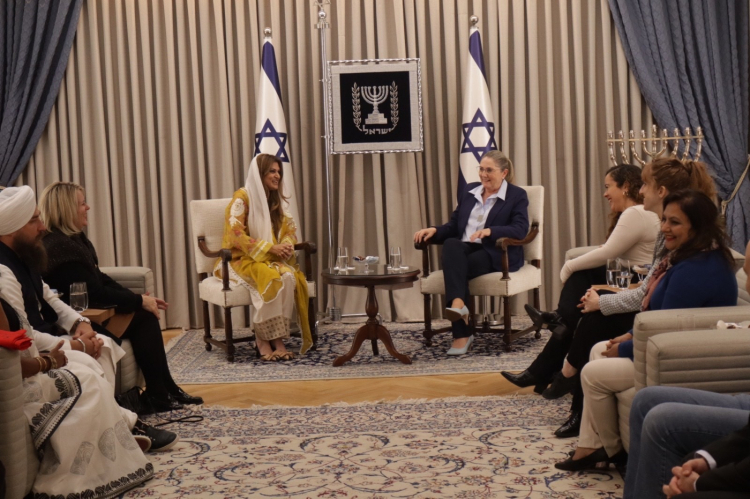
SPECIAL SERIES: Religious Liberty Around The World
They’re fearless even when threatened by powerful male leaders of their own faith. A group of resolute Muslim American women aren’t waiting around for someone else to bridge the gaping religious and ethnic divisions that Hamas’ Oct. 7 terrorist attacks and the ensuing Israel-Hamas war laid bare in the United States and around the world.
The group, American Muslim and Multi-Faith Women’s Empowerment Council, or AMMWEC, has been tackling the issue head-on since the first days after Hamas terrorists crossed into Israel, torturing and slaughtering more than 1,200 Israelis, including women, children, and the elderly.
While many Americans were shocked at the outpouring of antisemitism on college campuses, a courageous group of Muslim American women are vigorously trying to change the narrative.
Several AMMWEC members have spent the last several months condemning Hamas for its atrocities and speaking out against rising antisemitism. The group also has decried the global reticence to address the unthinkable sexual violence Hamas perpetrated against Israeli women. It took the United Nations Women until the end of November to explicitly condemn the rapes and brutal assaults against Israeli women and girls.
“We have to bring back humanity,” Anila Ali, a Pakistani American president of AMMWEC, told RealClearPolitics in an interview last week. “You’re not white, and I’m not brown. We’re women. But at the same time, there’s no sugarcoating Hamas anymore. On the Palestinian cause, if you want to stay safe, you’re going to have to say, ‘Hamas get out.’”
Just five days after the Oct. 7 attacks, the women organized a multi-faith peace vigil outside the White House to show solidarity with the victims of the atrocities in Israel. In November, Ali addressed a pro-Israel rally in D.C., declaring herself a “friend of the Jewish people” and condemning the Hamas attacks as a violation of Islam. She ended her remarks with the words, “Am Yisrael Chai,” an affirmation of the continuity of the Jewish people, which translates to “The Nation of Israel Lives.”
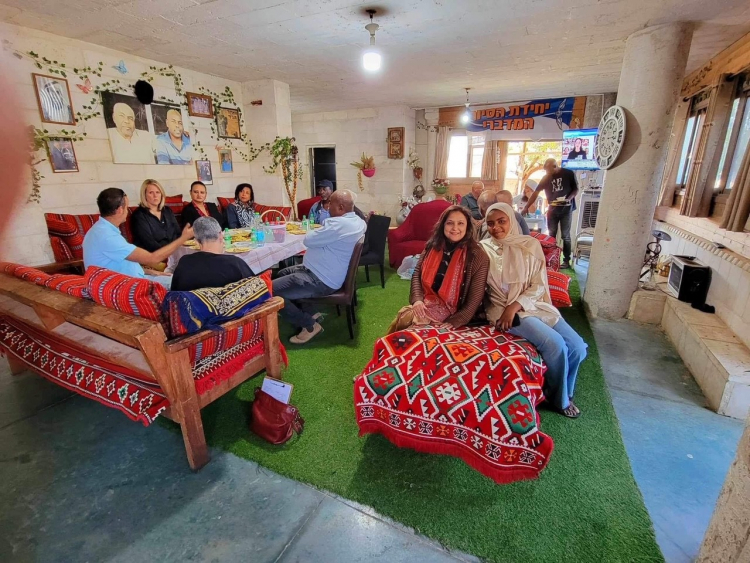
Sharing lunch with Muslim Bedouins in Rafat, near Ramallah on the West Bank. (Photo courtesy of Soraya M. Deen)
Afterward, she received death threats from California, where she previously lived, as well as from her native Pakistan. In early December, Ali and a delegation of Muslim women leaders traveled to Israel, braving Hamas rocket attacks amid a collapsing ceasefire to visit the damaged homes and meet with survivors in several of the country’s southern cities.
“The Muslim world was [mostly] silent about what happened on Oct. 7,” Bangladeshi-born Farhana Kohrshed, 51, who moved to Boston as a teenager, told an interfaith group of Muslims, Jews, Sikhs, and Yitzhak Danino, the mayor of Negev City, during the visit. “We are here to denounce what Hamas has done to you.”
Organized by the Combat Antisemitism Movement, the group had already visited the now-abandoned city of Sderot, which is less than a mile from the Gaza Strip. They also traveled to Ofakim, which lost 52 residents on Oct. 7, visiting the bullet-scarred home of survivors whose loved ones were gunned down in the attack.
Hearing about the horrific brutality was heartbreaking. But it was also enlightening to hear how Israelis near the border view their Palestinian neighbors even after the attacks, members of the delegation recalled. A woman they met had lost two sons, one who was shot immediately in the attacks, the other who died a month later as a hostage in Hamas captivity.
When a Jewish leader was blaming the Palestinians for the attacks, the Israeli woman quickly interjected, blaming Hamas, not the Palestinians, recalled Soraya M. Deen, a 60-year-old lawyer and interfaith activist who founded Muslim Women Speakers and is an AMMWEC member.
“She’s so intelligent, so kind,” said Deen, who immigrated to the U.S. from Sri Lanka as a young adult. “There was no hatred for the Palestinians despite her loss.”
Last week in Washington, D.C., several women leaders of AMMWEC were once again standing up for the Jewish victims of the Hamas attacks. The women were making their voices heard at the International Religious Freedom Summit, a bipartisan gathering of thousands of coalition leaders, nonprofits, and human rights advocates supporting the right of all people worldwide to worship in the faith of their choice or not to worship at all.
Afterward, several AMMWEC members also attended the National Prayer Breakfast, where President Biden called on all Americans to “stand against hate.”
“The challenges of our times remind us of our responsibilities as a nation,” Biden said. “To help each other [achieve] a just and lasting peace here and abroad. That’s why we’re fighting the rise of antisemitism and Islamophobia here in the United States.”
After the president’s speech, AMMWEC members fanned out on Capitol Hill, meeting with several members of Congress and staff, including aides in House Minority Leader Hakeem Jeffries’ office, and thanking them for listening to their calls to replace the outpouring of anger and hate with interfaith solidarity.
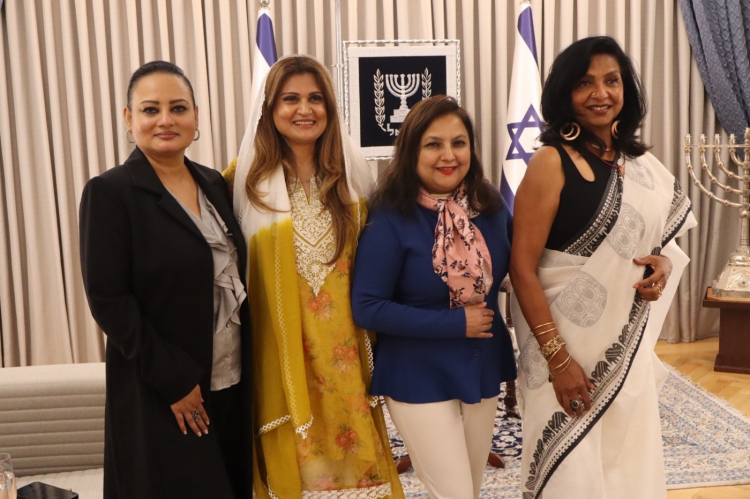
Left to right: Farhana Khorshed, Anila Ali, Zebunnesa Zubair, Soraya Deen. (Photo courtesy of Soraya M. Deen)
“AMMWEC envisions a world where Muslims fight # antisemitism, & Jews fight #Islamophobia, and together we fight hate just as our @POTUS stated in his speech at the National Prayer Breakfast,” the group stated in a post on X.
The Muslim American group also stopped by the office of Rep. Rashida Tlaib, a Michigan Democrat and one of the most vocal critics of Israel’s treatment of Palestinians. Tlaib and Rep. Cori Bush, a Missouri Democrat, were the only two members to vote against a bill barring participants in the Oct. 7 attack on Israel from entering the United States. Rep. Delia Ramirez, an Illinois Democrat, voted present, while 422 lawmakers voted in favor.
During the impromptu meetings, the groups called on Tlaib and her colleagues to condemn Hamas for the “rape, murder, torture, assault and all mutilations” Israeli women suffered and to engage in “robust political leadership to reject antisemitism.” The group pressed Tlaib to promote national unity and speak out against hate speech on college campuses while urging peace-loving Palestinians “to build a leadership that eschews violence and end the calls for the destruction of Israel.”
The fight is not new for many of these courageous Muslim women. In the days after the 9/11 attacks, Ali and several other like-minded Muslim women decided that, as mothers, they were in a unique position to serve as the first line of defense against extremism and to counter anti-Muslim sentiment around the country.
Ali, 56, was born in Pakistan and educated in London while her father served in the Pakistani embassy there. She later returned to Karachi for further study, then married and moved to Saudi Arabia before relocating to the United States in 1996.
“What we’re doing today is something we believe in. This country is a great country,” she said. “It’s given us this opportunity. It is our duty as Muslims to protect the country. It’s very clear in our religion that wherever you live, you have to serve.”
In many ways, the outpouring of hatred across the country after Oct. 7 feels like “déjà vu all over again,” more than two decades after New York’s Twin Towers fell. But for Ali, the anti-Jewish demonstrations on college campuses add yet another disturbing facet.
“We are very patriotic American and Muslim mothers, and we feel like what is happening right now is very problematic for us,” she said. “There are organizations that are being funded from the outside and they are taking our kids away and teaching them how to hate the Jews, taking the geopolitics of the Middle East and implanting it in on our campuses. That is what is causing the antisemitism of today.”
Zebunnesa Zubair, a member of AMMWEC’s executive board who was raised in Bangladesh before moving to the Los Angeles area as a young adult, said she studied at a California college several years ago but never witnessed such racial and religious divisions.
“I was never bothered before [about] who is Jewish, Christian, Hindu, but after Oct. 7, things have been very much about labeling,” she told RCP. “So, we have to be very careful – this is imported hate. Why are our U.S.-born children behaving like that?
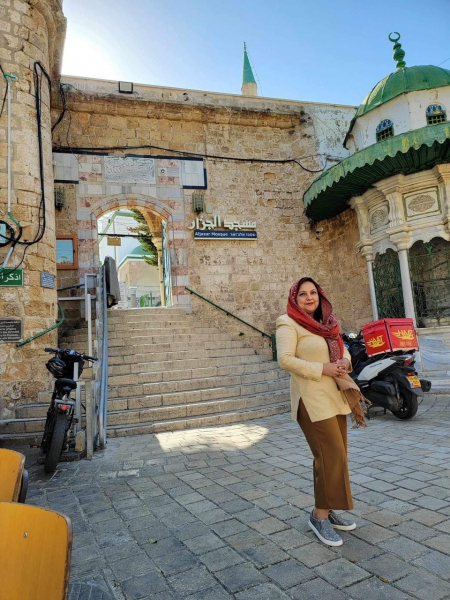
Zebunnesa Zubair outside the el-Jazzar Mosque in Acre, Israel. (Photo courtesy of Soraya M. Deen)
Zubair said she loves America and, as a Muslim woman, has enjoyed more freedom here to practice her faith than she did in her home country. “This country gave me the freedom, whether I’m going to the library, whether I’m going to the nightclub, whether I’m going to the mosque,” Zubair said. “Back in Southeast Asia, women do not go to the mosque – they go very little. They pray together in small groups. In California, I go almost every week. We have more freedom here to practice our religion than we do back home.”
It’s a perilous time in the Middle East, and also in the United States, where the Hamas-Israeli conflict threatens to tear at the fabric of American society – the fundamental values of pluralism and tolerance that allow for peaceful expression and religious freedom, these women believe.
“They’re poisoning our next generation on college campuses and a lot of Americans who have nothing to do with the conflict,” Ali said. “We’ve got to challenge this victimhood narrative. Our mission now is to change the way our communities think and to take them out of that poisonous cycle.”
Last month, John Ondrasik, the singer-songwriter who uses the stage name Five for Fighting, released his chilling ballad, “OK.” The song pairs probing lyrics asking why more people aren’t condemning the Hamas attacks, accompanied by a video montage of the Oct. 7 brutality. Ondrasik called the song a “moral” rather than political commentary and included images of a Muslim woman speaking out in solidarity with Israel and denouncing Hamas.
Responding to AMMWEC’s post last week about its peaceful visit but forceful message to Tlaib’s office, Ondrasik conveyed his support in one simple message. “This is how it’s done,” he said in a post on X applauding the group’s work.
Susan Crabtree is RealClearPolitics' national political correspondent.
By Susan Crabtree
RCP Staff
February 07, 2024 Soraya M. Deen
SPECIAL SERIES: Religious Liberty Around The World
They’re fearless even when threatened by powerful male leaders of their own faith. A group of resolute Muslim American women aren’t waiting around for someone else to bridge the gaping religious and ethnic divisions that Hamas’ Oct. 7 terrorist attacks and the ensuing Israel-Hamas war laid bare in the United States and around the world.
The group, American Muslim and Multi-Faith Women’s Empowerment Council, or AMMWEC, has been tackling the issue head-on since the first days after Hamas terrorists crossed into Israel, torturing and slaughtering more than 1,200 Israelis, including women, children, and the elderly.
While many Americans were shocked at the outpouring of antisemitism on college campuses, a courageous group of Muslim American women are vigorously trying to change the narrative.
Several AMMWEC members have spent the last several months condemning Hamas for its atrocities and speaking out against rising antisemitism. The group also has decried the global reticence to address the unthinkable sexual violence Hamas perpetrated against Israeli women. It took the United Nations Women until the end of November to explicitly condemn the rapes and brutal assaults against Israeli women and girls.
“We have to bring back humanity,” Anila Ali, a Pakistani American president of AMMWEC, told RealClearPolitics in an interview last week. “You’re not white, and I’m not brown. We’re women. But at the same time, there’s no sugarcoating Hamas anymore. On the Palestinian cause, if you want to stay safe, you’re going to have to say, ‘Hamas get out.’”
Just five days after the Oct. 7 attacks, the women organized a multi-faith peace vigil outside the White House to show solidarity with the victims of the atrocities in Israel. In November, Ali addressed a pro-Israel rally in D.C., declaring herself a “friend of the Jewish people” and condemning the Hamas attacks as a violation of Islam. She ended her remarks with the words, “Am Yisrael Chai,” an affirmation of the continuity of the Jewish people, which translates to “The Nation of Israel Lives.”
Sharing lunch with Muslim Bedouins in Rafat, near Ramallah on the West Bank. (Photo courtesy of Soraya M. Deen)
Afterward, she received death threats from California, where she previously lived, as well as from her native Pakistan. In early December, Ali and a delegation of Muslim women leaders traveled to Israel, braving Hamas rocket attacks amid a collapsing ceasefire to visit the damaged homes and meet with survivors in several of the country’s southern cities.
“The Muslim world was [mostly] silent about what happened on Oct. 7,” Bangladeshi-born Farhana Kohrshed, 51, who moved to Boston as a teenager, told an interfaith group of Muslims, Jews, Sikhs, and Yitzhak Danino, the mayor of Negev City, during the visit. “We are here to denounce what Hamas has done to you.”
Organized by the Combat Antisemitism Movement, the group had already visited the now-abandoned city of Sderot, which is less than a mile from the Gaza Strip. They also traveled to Ofakim, which lost 52 residents on Oct. 7, visiting the bullet-scarred home of survivors whose loved ones were gunned down in the attack.
Hearing about the horrific brutality was heartbreaking. But it was also enlightening to hear how Israelis near the border view their Palestinian neighbors even after the attacks, members of the delegation recalled. A woman they met had lost two sons, one who was shot immediately in the attacks, the other who died a month later as a hostage in Hamas captivity.
When a Jewish leader was blaming the Palestinians for the attacks, the Israeli woman quickly interjected, blaming Hamas, not the Palestinians, recalled Soraya M. Deen, a 60-year-old lawyer and interfaith activist who founded Muslim Women Speakers and is an AMMWEC member.
“She’s so intelligent, so kind,” said Deen, who immigrated to the U.S. from Sri Lanka as a young adult. “There was no hatred for the Palestinians despite her loss.”
Last week in Washington, D.C., several women leaders of AMMWEC were once again standing up for the Jewish victims of the Hamas attacks. The women were making their voices heard at the International Religious Freedom Summit, a bipartisan gathering of thousands of coalition leaders, nonprofits, and human rights advocates supporting the right of all people worldwide to worship in the faith of their choice or not to worship at all.
Afterward, several AMMWEC members also attended the National Prayer Breakfast, where President Biden called on all Americans to “stand against hate.”
“The challenges of our times remind us of our responsibilities as a nation,” Biden said. “To help each other [achieve] a just and lasting peace here and abroad. That’s why we’re fighting the rise of antisemitism and Islamophobia here in the United States.”
After the president’s speech, AMMWEC members fanned out on Capitol Hill, meeting with several members of Congress and staff, including aides in House Minority Leader Hakeem Jeffries’ office, and thanking them for listening to their calls to replace the outpouring of anger and hate with interfaith solidarity.
Left to right: Farhana Khorshed, Anila Ali, Zebunnesa Zubair, Soraya Deen. (Photo courtesy of Soraya M. Deen)
“AMMWEC envisions a world where Muslims fight # antisemitism, & Jews fight #Islamophobia, and together we fight hate just as our @POTUS stated in his speech at the National Prayer Breakfast,” the group stated in a post on X.
The Muslim American group also stopped by the office of Rep. Rashida Tlaib, a Michigan Democrat and one of the most vocal critics of Israel’s treatment of Palestinians. Tlaib and Rep. Cori Bush, a Missouri Democrat, were the only two members to vote against a bill barring participants in the Oct. 7 attack on Israel from entering the United States. Rep. Delia Ramirez, an Illinois Democrat, voted present, while 422 lawmakers voted in favor.
During the impromptu meetings, the groups called on Tlaib and her colleagues to condemn Hamas for the “rape, murder, torture, assault and all mutilations” Israeli women suffered and to engage in “robust political leadership to reject antisemitism.” The group pressed Tlaib to promote national unity and speak out against hate speech on college campuses while urging peace-loving Palestinians “to build a leadership that eschews violence and end the calls for the destruction of Israel.”
The fight is not new for many of these courageous Muslim women. In the days after the 9/11 attacks, Ali and several other like-minded Muslim women decided that, as mothers, they were in a unique position to serve as the first line of defense against extremism and to counter anti-Muslim sentiment around the country.
Ali, 56, was born in Pakistan and educated in London while her father served in the Pakistani embassy there. She later returned to Karachi for further study, then married and moved to Saudi Arabia before relocating to the United States in 1996.
“What we’re doing today is something we believe in. This country is a great country,” she said. “It’s given us this opportunity. It is our duty as Muslims to protect the country. It’s very clear in our religion that wherever you live, you have to serve.”
In many ways, the outpouring of hatred across the country after Oct. 7 feels like “déjà vu all over again,” more than two decades after New York’s Twin Towers fell. But for Ali, the anti-Jewish demonstrations on college campuses add yet another disturbing facet.
“We are very patriotic American and Muslim mothers, and we feel like what is happening right now is very problematic for us,” she said. “There are organizations that are being funded from the outside and they are taking our kids away and teaching them how to hate the Jews, taking the geopolitics of the Middle East and implanting it in on our campuses. That is what is causing the antisemitism of today.”
Zebunnesa Zubair, a member of AMMWEC’s executive board who was raised in Bangladesh before moving to the Los Angeles area as a young adult, said she studied at a California college several years ago but never witnessed such racial and religious divisions.
“I was never bothered before [about] who is Jewish, Christian, Hindu, but after Oct. 7, things have been very much about labeling,” she told RCP. “So, we have to be very careful – this is imported hate. Why are our U.S.-born children behaving like that?
Zebunnesa Zubair outside the el-Jazzar Mosque in Acre, Israel. (Photo courtesy of Soraya M. Deen)
Zubair said she loves America and, as a Muslim woman, has enjoyed more freedom here to practice her faith than she did in her home country. “This country gave me the freedom, whether I’m going to the library, whether I’m going to the nightclub, whether I’m going to the mosque,” Zubair said. “Back in Southeast Asia, women do not go to the mosque – they go very little. They pray together in small groups. In California, I go almost every week. We have more freedom here to practice our religion than we do back home.”
It’s a perilous time in the Middle East, and also in the United States, where the Hamas-Israeli conflict threatens to tear at the fabric of American society – the fundamental values of pluralism and tolerance that allow for peaceful expression and religious freedom, these women believe.
“They’re poisoning our next generation on college campuses and a lot of Americans who have nothing to do with the conflict,” Ali said. “We’ve got to challenge this victimhood narrative. Our mission now is to change the way our communities think and to take them out of that poisonous cycle.”
Last month, John Ondrasik, the singer-songwriter who uses the stage name Five for Fighting, released his chilling ballad, “OK.” The song pairs probing lyrics asking why more people aren’t condemning the Hamas attacks, accompanied by a video montage of the Oct. 7 brutality. Ondrasik called the song a “moral” rather than political commentary and included images of a Muslim woman speaking out in solidarity with Israel and denouncing Hamas.
Responding to AMMWEC’s post last week about its peaceful visit but forceful message to Tlaib’s office, Ondrasik conveyed his support in one simple message. “This is how it’s done,” he said in a post on X applauding the group’s work.
Susan Crabtree is RealClearPolitics' national political correspondent.


 Draft - Initial response/Hamas movement’s response to a general framework for a comprehensive agreement between the parties (between the Israeli occupation, Hamas, and the Palestinian factions)
 The first stage (45 days):
 The second stage (45 days):
 The third stage (45 days):


