Chinese Naval Platform & PLAN discussions

Many in the comment section blast this German DW documentary

微信图片_20250607003723.png
微信图片_20250607003845.png
微信图片_20250607003942.png
 
Western media is losing their own targetted English speaking audiences
 
US navy shield of the republic

The US Navy's five roads to ruin​

The establishment wants you to believe it's all about the number of ships but the rot runs much deeper, which can lead to delusional strategy​

Analysis | Military Industrial Complex
Michael Vlahos
Jun 03, 2025

“A Navy Second to None” has been the most enduring consensus in American national defense. For more than a century, the American people and their elected leaders — Restrainers and Warhawks alike — have agreed that the U.S. Navy is, and must remain, “The Shield of the Republic.”

Yet today the Navy is in trouble. The Navy and its boosters in Congress want us to believe the problem is all about too few ships and too few facilities.

In fact, the rot runs much deeper. Americans can see that something is wrong, especially when it is staring them in the face: Navy “bureaus” that cannot design ships, builders that cannot build, shipyards that cannot repair, depots running out of munitions, command failures and corruption, accidents at sea, and billion-dollar fires in port.

The disorder is in fact positioned in the heart of the Navy Ethos itself. The precise term-of-art — “Navy Ethos” — was first introduced in 1980, here. It signifies the core, or essence of the Navy’s sense of self: Its codification of meaning, belonging, and identity — as a society and culture.

Hence, the real story of the Navy’s roads to ruin lies in the unraveling of the Navy’s own Ethos.

Yet how to show this? The Navy's five big, and indeed, existential problems can be best showcased by highlighting the struggles of five other navies in history that were forced to confront all-or-nothing cultural crises in their own “Navy Ethos.”

The wrong war​

No matter what they say, armed forces prepare for the war they want to fight. Before Pearl Harbor, the United States and Imperial Japanese navies built mirrored fleets centered around lines of battleships that would someday meet in mortal combat, which in the space of a single event — a Pacific Clash of Titans — would decide the destiny of nations.

Yet when war came, the efforts of both fleets, try as they might, could not make this happen. Alfred Thayer Mahan’s prophecy of “Seapower” mesmerized the U.S. and Japanese navies with the mutual conviction that a Pacific War could be decided by a single event: Another Tsushima or Trafalgar. Yet even if there were no way to achieve such a choreographed final fantasy, theidée fixe of decisive battle had become a way of life for both USN and IJN. This obsession with almighty battleships locked in a last battle led to the destruction of America’s prewar fleet in the first year of war, and then eventually, Japan’s.

Today, the Navy still pines for a Pacific fleet showdown, this time with China. It is still obsessing over its capital ship idée fixe (with carriers in place of battleships) — when, like 1941, its fleet is simply too small, too old, and too out of shape.

The wrong stuff​

In World War II, the U.S. Navy was saved only by America’s titanic industrial power, which in 1941 was building two backup fleets: A "two ocean" armada, to be followed by and an even bigger one. That second force, 5000+ ships, was built de novo — as though out of nothing — in just four years. The Navy was saved, not by its adaptable resilience, but by American Captains of Industry.

In tragic contrast, the Imperial Japanese Navy — the most powerful fleet in the world in 1941 — had no backup. When faced with a U.S. shipbuilding monster, it was literally ground down by those 5,000 brand spanking new American hulls. In this sense, the Nihon Kaigun is very much like the U.S. Navy today. War came, and it simply could not replace ships lost.

Frankly, the Japanese actually built quite a few new ships during the war — just not enough. Likewise, there are no Captains of Industry to save the U.S. Navy today. China has 200 times the shipbuilding capacity of the United States, and fabulous repair and maintenance that serves the entire maritime world. If America cannot build, repair, and maintain even its current, “incredibly shrinking” Navy, then it is no “maritime nation.”

The wrong rule​

What happens to the Navy that reaches the acme of power and success, and comes to believe that it will command the seas forever? That would be Great Britain from 1815-1914. For the Royal Navy, it meant atrophy, that invisible sclerosis hardening into an ossified way of life.

As it celebrates its always-triumphant orthodoxies, it also forgets how to think, it takes itself way too seriously, and it believes without a flicker of doubt that, to stay on top, the Fleet simply must keep doing what it has always done, in sufficient quantity and quality, of course. The Royal Navy may have survived on the basis of quantity and quality of ships.

Yet what about quality and originality of thought? A Navy Ethos that punishes new thinking, that throttles innovation, that cashiers criticism — all by the time proclaiming how it celebrates these things — is an ethos chained to its own “Rules of the Game.”

In this sort of culture, only the right people, who say the right things, and put on the right, bright face to the public can expect to move up. This is the sclerosis of success, and it is, for any society of war, the most dangerous disorder: For it cannot be cured from within. Thus, the strategic reckoning of the Royal Navy in World War I will be as nothing to what awaits its American Cousin, very soon.

The wrong team​

To know the U.S. Navy’s rot at its deepest means pulling back the curtain on a seemingly unlikely historical antecedent: Namely, the ruinous inner-working of Medieval and Early Modern Muslim empires.

This is the dynamic of the "slave dynasties." Corps of "Mamluks" or "Ghilman" ("enslaved soldiers") came to rule both Arab kingdoms and Caliphate. This aggressive artifact, burrowing deep into the heart of Muslim empire, reached its peak at the Ottoman Empire’s very height, where the business of the Sultan and his Sublime Porte became the business of its Janissary Corps.

This is what happens when servants become masters. Today, the business of the Navy is the business of its prime defense contractors, which have effectively taken over their titular overlords — the old bureaus — in the Department of the Navy. Today, the ideal cursus honorum, or life passage, for a naval officer is no longer to “make flag” and command a carrier strike group, but rather to realize one’s true destiny after retirement, with a seven-figure berth at one of the Big Five.

Lockheed Martin, Northrop Grumman, General Dynamics, RTX (formerly Raytheon), Boeing, and a few others do good work (of course), yet it is they who now define the Navy's course. Their splashy ads proclaim their loyal service, everywhere, and which also — subtly yet undeniably — proclaim that it is they who truly rule.

The wrong fate​

In 1781, in the American War, the French Marine Royale was literally "Peak France" at sea. Arguably, the Bourbon Coalitions’ navies won the war. Never before or since would the French Fleet be the instrument of such historic transformation as it achieved with this “world-historical” event. Yet, however triumphant, the war had dire consequences for the victor. France quickly unraveled into bankruptcy and revolution. Political calamity cascaded into a downstream disaster for the French Navy.

The U.S. Navy — which clearly does not represent "Peak America" at sea — cannot begin to be compared to the fleet that sealed the fate of Britain’s American empire and ensured U.S. independence. Yet as surely as for the Ancien Régime of 1789, a crisis in the American constitutional order would hit the U.S. Navy hard. It would feel the savage bite of American domestic strife, as well as the crippling burden of national debt working its way into the heart of national defense. A diminished nation will also mean an even more diminished Navy.

The bottom line is clear: Crises faced by others in history pale in comparison to the multiple vectors of failure facing the U.S. Navy today. Yet there are still hopeful guidelines the Navy might follow to hold ruin at bay: 1) Stay out of war for at least a generation, 2) Do what you can to leverage the State to create a real merchant navy and shipbuilding base, 3) Throw off the Old Religion. Let the Prophet go, and for a few years, simply observe the world as it is, and 4) Immediately consult a physician who can diagnose your sclerosis and tell you hard truths.

https://www.facebook.com/sharer/sharer.php?u=https://responsiblestatecraft.org/us-navy-crisis/
 
I don't think selling the world tea, porcelain, and silk equated to being a superpower.

Selling tons of say "Pepsi" around the world doesn't mean anything. Are we going to call Saudi Arabia a superpower because of oil? Certainly they are wealthy...superpower...meh.
 

How China Went from 19th-Century Subjugation to Global Superpower​

To view this content we will need your consent to set third party cookies.
For more detailed information, see our cookies page.


May 11, 2025
China is one of the world's oldest civilizations. It has been a great power in the past and aspires to become a global superpower in the future. Today’s China it is still grappling with traumas that go back to the 19th century.

Back then China sold silk, tea and porcelain to the British Empire, but hardly bought any British goods. To balance its trade with China, the British smuggled Indian opium into Chinese ports, which immediately increased demand for the drug and brought detrimental effects to the Chinese economy and the population.

The Emperor's protests did not prevent the British Empire from forcing through the legalization of opium in China after waging two wars. Japan also surprised and devastated the country in what is known as the Century of Humiliation. From then until today, China has focused on steering its destiny and disarming its rivals.

Good on Chinese to have the resilience, foresight and sheer determination to step out of the shadows of subjugation and humiliations.

I hope my countrymen can find the fortitude to do something along similar lines, but I'm highly skeptical they ever will.
 
I don't think selling the world tea, porcelain, and silk equated to being a superpower.

Selling tons of say "Pepsi" around the world doesn't mean anything. Are we going to call Saudi Arabia a superpower because of oil? Certainly they are wealthy...superpower...meh.
There you go creating strawman, no one made the claim.
 
There you go creating strawman, no one made the claim.

oh okay they were just considered a "great power"...and for some reason they weren't considered "great" in the 19th Century.

Thanks for clarifying that.
 
Last edited:
I don't think selling the world tea, porcelain, and silk equated to being a superpower.

Selling tons of say "Pepsi" around the world doesn't mean anything. Are we going to call Saudi Arabia a superpower because of oil? Certainly they are wealthy...superpower...meh.
Depends on superpower in what sense, in size of economy, China was indeed a superpower before the Opium War.
 

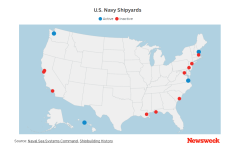
Map Shows America's Shipyards Disappear as China's Naval Empire Rises​

Mar 14, 2025

A map by Newsweek has outlined the extent of the decline of American shipbuilding, which President Donald Trump wants to rejuvenate.

Garnering fewer headlines than the rest of his address to Congress last week, Trump also announced in his speech a new maritime office in the National Security Council to revitalize both military and commercial shipbuilding.

It comes as a report published this week by the Center for Strategic and International Studies (CSIS) a Washington think tank, highlight's China position as the world's dominant player in shipbuilding, posing economic and security challenges for the United States.

The U.S. Navy has only four active public shipyards. Meanwhile, China has at least 35 sites with known ties to military or national security projects, according to CSIS researchers Matthew Funaiole, Brian Hart and Aidan Powers-Riggs, who analyzed 307 Chinese shipyards, all of which "operate under state directives."

Newsweek has contacted the White House for comment.

Why It Matters​

The U.S. Defense Department's year-end annual China military power report called the Chinese People's Liberation Army Navy the largest in the world, "with a battle
force of over 370 ships and submarines, including more than 140 major surface combatants."

The CSIS last year said the PLA Navy operated 234 warships, compared with the U.S. Navy's 219. The U.S. has an advantage in guided-missile cruisers and destroyers as well as overall tonnage thanks to its fleet of 11 aircraft carriers versus China's three.

This week, however, CSIS said China was on track to reach a 425-ship fleet by 2030—compared with the 300 vessels possessed by the U.S. Navy.

Waning American naval influence combined with the growing size of China's navy and its assertiveness on the seas will pose major challenges to U.S. and allied military readiness in the Indo-Pacific.

What To Know​

China's largest state-owned shipbuilder, the China State Shipbuilding Corporation (CSSC), built more commercial vessels by tonnage in 2024 than the entire U.S. shipbuilding industry had since WW2, the CSIS said.

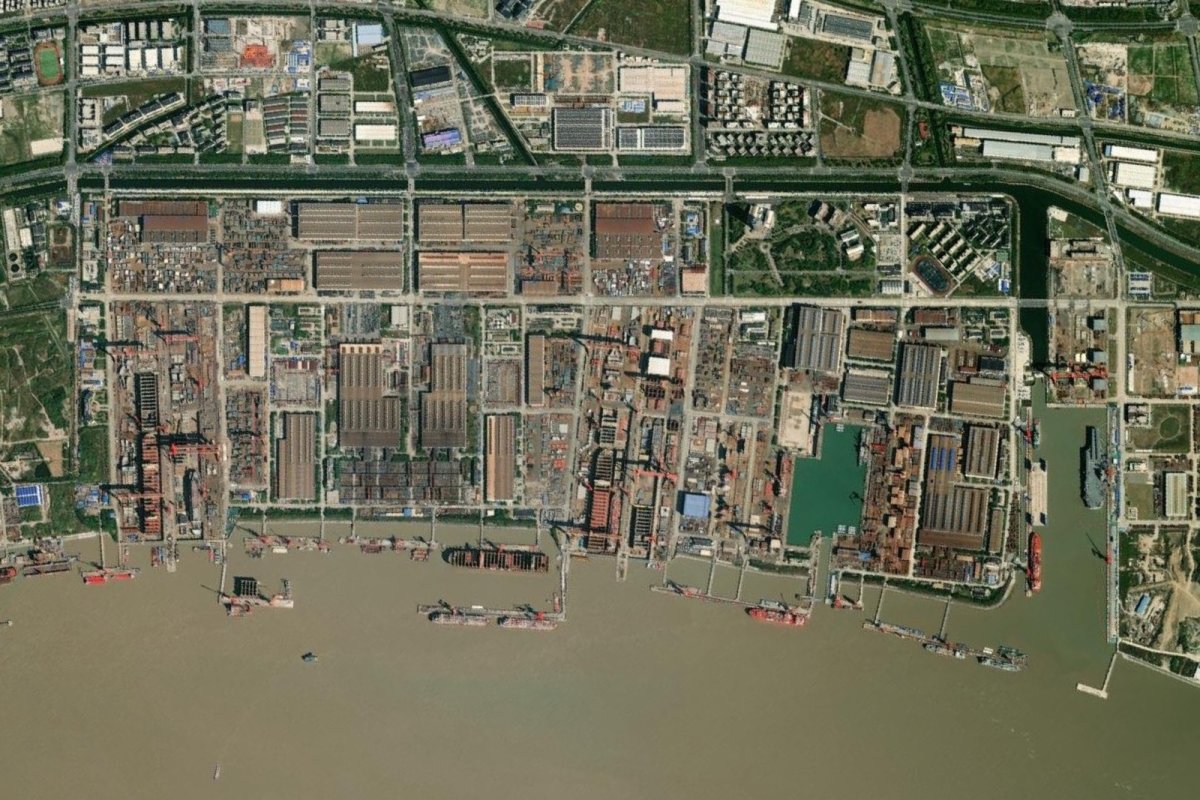
CSSC's Jiangnan Shipyard, in the eastern port city of Shanghai, built the Fujian, the country's third aircraft carrier, while the the Shandong, its Soviet-inspired second flattop, was constructed at a CSSC-owned shipyard in northeastern Dalian on the Yellow Sea.

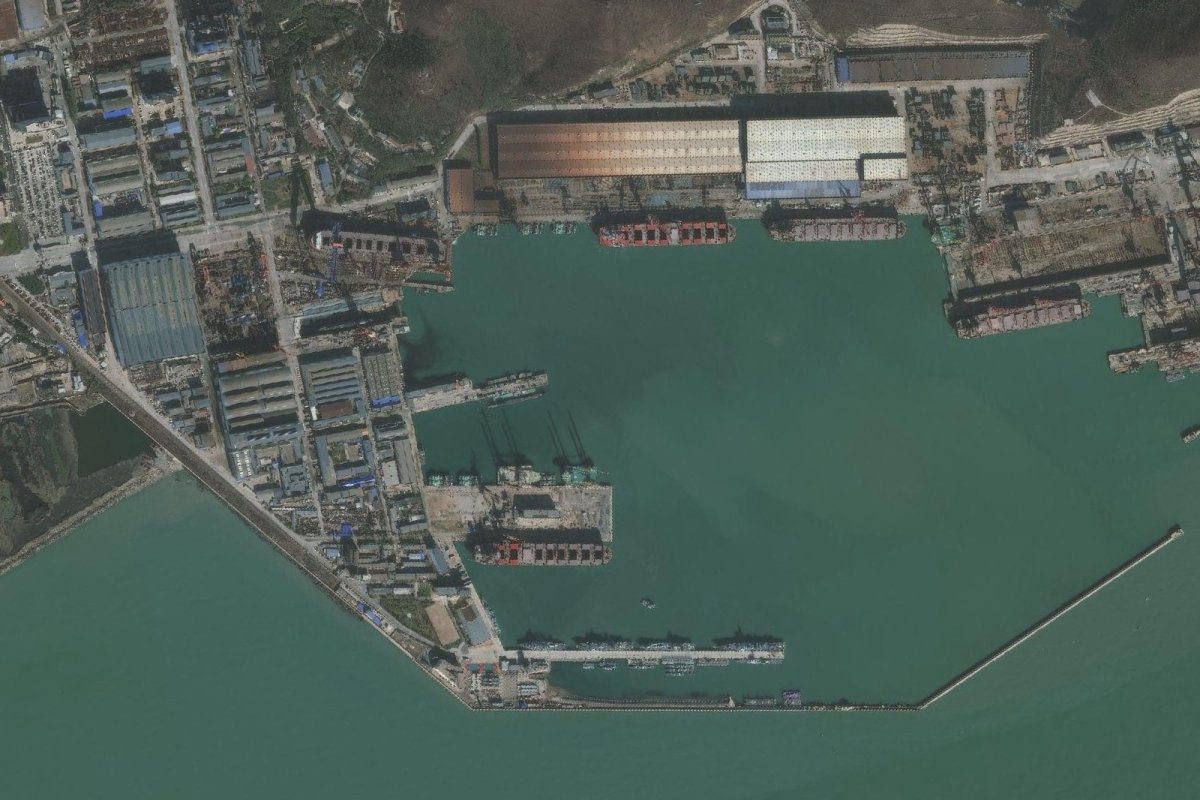
Work Underway At China's Jiangnan Shipyard

This image captured by Maxar on November 7, 2022, shows Jiangnan Shipyard in China's eastern port city of Shanghai, where the Chinese navy's third aircraft carrier, the Fujian, was launched. ESRI/MAXAR/EARTHSTAR GEOGRAPHICS

Through its "military-civil fusion" strategy, Beijing has integrated commercial and military production at many of its shipyards, giving the PLA Navy access to infrastructure, investment, and intellectual property from commercial contracts, CSIS said.

The think tank said foreign companies, including those from U.S.-allied nations, purchased 75 percent of ships built at China's dual-use shipyards, giving the country revenue and technological expertise.

By contrast, Newsweek's map shows that the U.S. Navy once commanded over a dozen public shipyards, many of which were vital to the American war effort in World War II. In the preceding decades, all but four have been closed.

The remaining active naval yards include Pearl Harbor and Puget Sound on the U.S.'s Pacific coast, as well as Norfolk and Portsmouth in the Atlantic. The sites are used for aircraft carrier and nuclear submarine maintenance.
微信图片_20250623112852.png
The U.S.'s dwindling shipbuilding capabilities were outlined in a 2023 U.S. congressional report which said in the 1970s, American shipyards were building about 5 percent of the world's tonnage—up to 25 new ships per year—but by the 1980s, this dropped to its current rate of around five ships per year.

Meanwhile, a leaked U.S. Navy briefing slide revealed that China's shipbuilding capacity was 232 times greater than that of the United States.

The U.S.'s dwindling shipbuilding capabilities were outlined in a 2023 U.S. congressional report which said in the 1970s, American shipyards were building about 5 percent of the world's tonnage—up to 25 new ships per year—but by the 1980s, this dropped to its current rate of around five ships per year.

Meanwhile, a leaked U.S. Navy briefing slide revealed that China's shipbuilding capacity was 232 times greater than that of the United States.

Brett Seidle, the U.S. Navy's acting acquisition chief, said in written testimony to lawmakers this week that the service fell short in shipbuilding, with costs too high and deliveries too slow.

He told the House Armed Services seapower panel that the challenges were shared across the nuclear and conventional shipbuilding communities, with both the Navy and the shipbuilding industry sharing responsibility.

Among the recommendations in this week's CSIS report are policies that encourage "friendshoring"—production outsourced to trusted partners, particularly existing shipbuilders Japan and South Korea.

By Brendan Cole and John Feng
Senior News Reporter
Trust Project IconNewsweek Is A Trust Project Member
FOLLOW
News Article


Translate

A map by Newsweek has outlined the extent of the decline of American shipbuilding, which President Donald Trump wants to rejuvenate.

Garnering fewer headlines than the rest of his address to Congress last week, Trump also announced in his speech a new maritime office in the National Security Council to revitalize both military and commercial shipbuilding.

China shipbuilding yard

This image taken on April 17, 2023 shows a new floating production storage and offloading vessel under construction at a shipyard in Nantong, in China's eastern Jiangsu province. GETTY IMAGES
It comes as a report published this week by the Center for Strategic and International Studies (CSIS) a Washington think tank, highlight's China position as the world's dominant player in shipbuilding, posing economic and security challenges for the United States.


The U.S. Navy has only four active public shipyards. Meanwhile, China has at least 35 sites with known ties to military or national security projects, according to CSIS researchers Matthew Funaiole, Brian Hart and Aidan Powers-Riggs, who analyzed 307 Chinese shipyards, all of which "operate under state directives."

Newsweek has contacted the White House for comment.

Why It Matters​

The U.S. Defense Department's year-end annual China military power report called the Chinese People's Liberation Army Navy the largest in the world, "with a battle
force of over 370 ships and submarines, including more than 140 major surface combatants."

The CSIS last year said the PLA Navy operated 234 warships, compared with the U.S. Navy's 219. The U.S. has an advantage in guided-missile cruisers and destroyers as well as overall tonnage thanks to its fleet of 11 aircraft carriers versus China's three.


This week, however, CSIS said China was on track to reach a 425-ship fleet by 2030—compared with the 300 vessels possessed by the U.S. Navy.

Waning American naval influence combined with the growing size of China's navy and its assertiveness on the seas will pose major challenges to U.S. and allied military readiness in the Indo-Pacific.

What To Know​

China's largest state-owned shipbuilder, the China State Shipbuilding Corporation (CSSC), built more commercial vessels by tonnage in 2024 than the entire U.S. shipbuilding industry had since WW2, the CSIS said.

CSSC's Jiangnan Shipyard, in the eastern port city of Shanghai, built the Fujian, the country's third aircraft carrier, while the the Shandong, its Soviet-inspired second flattop, was constructed at a CSSC-owned shipyard in northeastern Dalian on the Yellow Sea.


Work Underway At China's Jiangnan Shipyard

This image captured by Maxar on November 7, 2022, shows Jiangnan Shipyard in China's eastern port city of Shanghai, where the Chinese navy's third aircraft carrier, the Fujian, was launched. ESRI/MAXAR/EARTHSTAR GEOGRAPHICS
Through its "military-civil fusion" strategy, Beijing has integrated commercial and military production at many of its shipyards, giving the PLA Navy access to infrastructure, investment, and intellectual property from commercial contracts, CSIS said.

The think tank said foreign companies, including those from U.S.-allied nations, purchased 75 percent of ships built at China's dual-use shipyards, giving the country revenue and technological expertise.

By contrast, Newsweek's map shows that the U.S. Navy once commanded over a dozen public shipyards, many of which were vital to the American war effort in World War II. In the preceding decades, all but four have been closed.


The remaining active naval yards include Pearl Harbor and Puget Sound on the U.S.'s Pacific coast, as well as Norfolk and Portsmouth in the Atlantic. The sites are used for aircraft carrier and nuclear submarine maintenance.


The U.S.'s dwindling shipbuilding capabilities were outlined in a 2023 U.S. congressional report which said in the 1970s, American shipyards were building about 5 percent of the world's tonnage—up to 25 new ships per year—but by the 1980s, this dropped to its current rate of around five ships per year.

Meanwhile, a leaked U.S. Navy briefing slide revealed that China's shipbuilding capacity was 232 times greater than that of the United States.


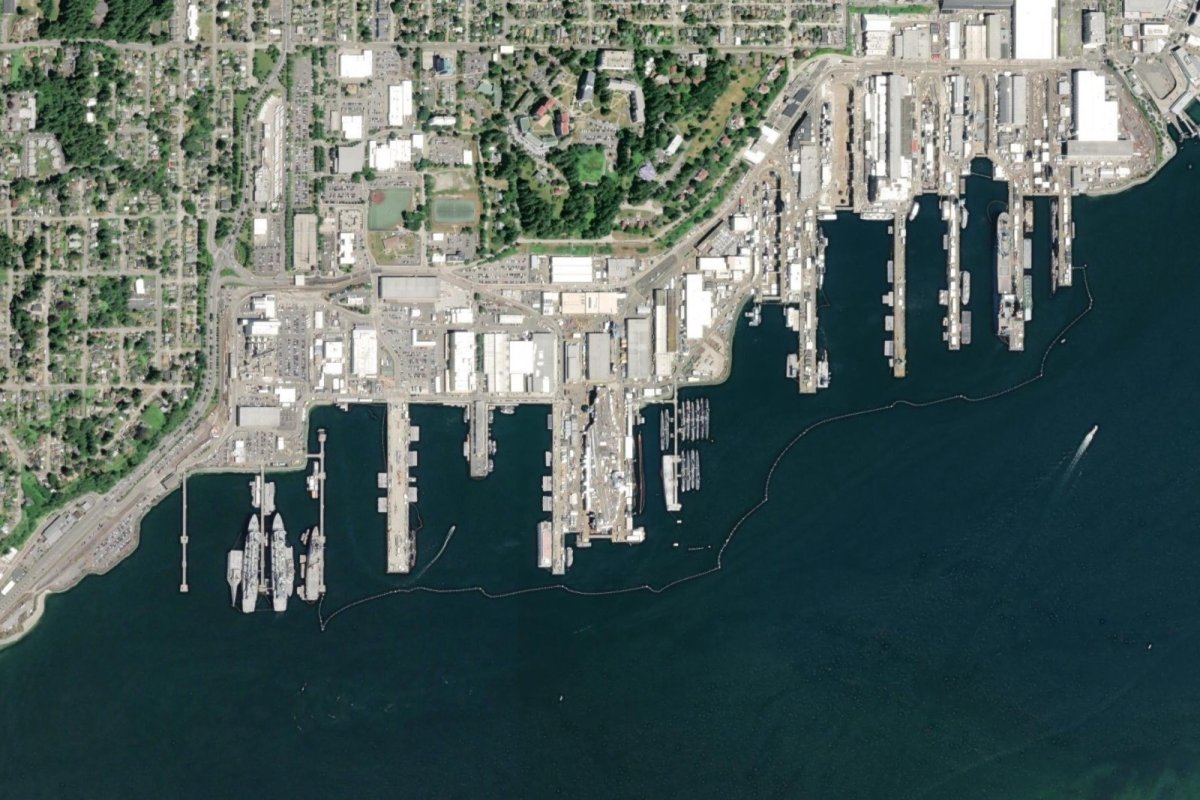
Maintenance Underway At U.S.'s Puget Sound Shipyard

This image captured by Maxar on June 24, 2022, shows Puget Sound Naval Shipyard, a U.S. Navy aircraft carrier maintenance facilities that forms part of Naval Base Kitsap in Bremerton, Washington. ESRI/MAXAR/EARTHSTAR GEOGRAPHICS
Brett Seidle, the U.S. Navy's acting acquisition chief, said in written testimony to lawmakers this week that the service fell short in shipbuilding, with costs too high and deliveries too slow.

He told the House Armed Services seapower panel that the challenges were shared across the nuclear and conventional shipbuilding communities, with both the Navy and the shipbuilding industry sharing responsibility.

Among the recommendations in this week's CSIS report are policies that encourage "friendshoring"—production outsourced to trusted partners, particularly existing shipbuilders Japan and South Korea.

"Washington should set realistic goals for enhancing its domestic shipbuilding capacity," the authors said. "Rather than striving to become a global shipbuilding power, the United States should prioritize developing a commercial shipbuilding industry that meets critical national security needs."

What People Are Saying​

Ship Wars, a report by the Center for Strategic and International Studies: "The United States needs to take decisive action to address the multifaceted security and economic challenges posed by China's shipbuilding industry. […] Past experiences in industries like solar panels and electric vehicle batteries, where U.S. and allied firms were nearly completely pushed out of the market by low-cost Chinese manufacturing, offer sober warnings of what can happen without intervention."

U.S. President Donald Trump: "We used to make so many ships. We don't make them anymore very much, but we're going to make them very fast, very soon."

Zev Faintuch, head of research and intelligence at Global Guardian told Newsweek: "U.S. security commitments are a question of both political will and capabilities—this is most true when it comes to shipbuilding. If the U.S. doesn't ramp up quickly—China's capacity is over 200 times greater—then the question comes down to will alone, a potential choice between war with China and upholding commitments."

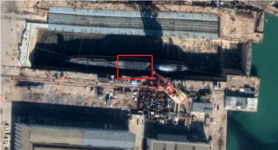
Work Underway At China's Bohai Shipyard

This image captured by Maxar on November 11, 2019, shows Bohai Shipyard in China's northeastern port city of Huludao, where the Chinese navy builds and maintains nuclear submarines. ESRI/MAXAR/EARTHSTAR GEOGRAPHICS

What Happens Next​

Trump's comments follow calls in February by four major labor unions for the U.S. to boost American shipbuilding and enforce tariffs and other "strong penalties" against China for its dominance in the sector.

Meanwhile, CSIS said Congress was focused on boosting naval capabilities through the bipartisan SHIPS for America Act, which is backed by the domestic industry groups and figures in the Trump administration, including China hawk national security adviser Mike Waltz.

GOP Senators Mike Lee and John Curtis want the option to build warships and major components overseas, in NATO countries and allies in the Indo-Pacific areas, such as Japan or South Korea, according to Axios.

 
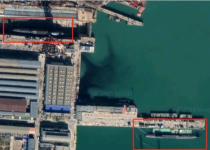
Two new Type 094B SSBNs have been spotted on Huludao shipyard; with one on the sea trial phase, another one near to be launched.


1.png

2.png
 
To view this content we will need your consent to set third party cookies.
For more detailed information, see our cookies page.


You need to understand their navy—the PLAN, or People's Liberation Army Navy. NOTE: If you want a copy or a copy of my slides whether you are a paid substack member or not and have a .mil email address, please let me know and I will make a copy available to you.In this video, I break down everything you need to know:
  • The PLAN’s history and strategic doctrine
  • Order of Battle (ORBAT) and theater command structure
  • Ship types, submarine force, carrier groups, and marine brigades
  • Political commissars and the role of ideology at sea
This isn’t an academic briefing. This is for soldiers, sailors, airmen, marines, and guardians who might find themselves on the front lines in 2027 or 2028. If you wear a uniform, this is for you.
 
This guy made a PLAGF/PLAA video and got some aspects of the Chinese ground service wrong. I don't see him as a good source of information about anything related to the PLA. He's very knowledgeable about Western combat systems, but partially ignorant about the PLA.
 
To view this content we will need your consent to set third party cookies.
For more detailed information, see our cookies page.
 

Users who are viewing this thread

Back
Top